16 Best AI Ad Generators in 2026, by Workflow
Compare 16 AI ad generators for static creative, video, UGC, scoring, product imagery, editing, localization, publishing, and campaign iteration.
 Anvisha Pai, Co-founder & CEO, Moda
The best AI ad generator is not necessarily the tool that produces the prettiest first draft. It is the one that removes the bottleneck between a campaign idea and a useful batch of ads.
That bottleneck varies. One team needs product images for 500 SKUs. Another needs 30 creator-style videos without coordinating shoots. A third already has winning concepts but cannot resize, localize, and revise them fast enough. Performance teams may care most about connecting real campaign results to the next creative brief.
This guide organizes 16 tools by those jobs. It includes vertical ad products such as Arcads and AdCreative.ai, plus horizontal creative systems such as Moda and Higgsfield that are not defined only by advertising but are widely used to make it.
The best AI ad generators at a glance
| Tool | Best for | Primary layer | Product shape | Main limitation |
|---|---|---|---|---|
| Moda | Editable, on-brand campaign creative across static, motion, and video | Composition and editing | Horizontal creative system | No ad buying, performance analytics, or predictive scoring |
| Canva Grow | Creating, publishing, and learning from paid-social ads in Canva | Full loop | Vertical ad workflow inside a broad suite | Deeper insights require higher-tier plans and connected ad accounts |
| AdCreative.ai | Rapid static variants plus preflight creative scoring | Generation and scoring | Vertical ad platform | A predicted score is not measured campaign performance |
| Photoroom | Product-led static ads and catalog-scale image variation | Asset production | Ecommerce visual system | Less suited to narrative ads or detailed motion editing |
| Google Product Studio | Free product images and simple videos tied to Merchant Center | Asset production and activation | Platform-native tool | Narrower creative control and product/category restrictions |
| Higgsfield | Social-first product videos, UGC concepts, and cinematic source footage | Asset and ad generation | Horizontal model platform with ad workflows | Generated footage still needs careful brand and product review |
| InVideo AI | Prompt-to-video ads using models, stock, voice, and scene editing | Video generation | Horizontal video system | Less control than a full timeline or compositor for exact finishing |
| Arcads | High-volume synthetic UGC and actor-led ads | UGC production | Vertical ad platform | Optimized for direct-response formats more than broad design systems |
| Creatify | Product-URL-to-ad workflows, batches, avatars, and launch tooling | UGC and full-loop production | Vertical ad platform | Automation can make the first drafts feel structurally similar without strong direction |
| HeyGen | Avatar-led ads and multilingual localization | UGC and localization | Horizontal avatar-video platform | Not a complete static-ad or campaign-design workspace |
| Pencil | Generating and scoring creative from connected performance evidence | Scoring and iteration | Vertical performance-creative platform | Most valuable when the team has clean creative-level data |
| Icon | Direct-response research, generation, editing, and creative analytics | Full loop | Vertical ad platform | Broad automation increases the need for human review and brand judgment |
| Omneky | Omnichannel creative, launch, and performance workflows | Full loop | Vertical advertising platform | More platform than a team needs if the only problem is making a few assets |
| The Brief | Multi-format production, localization, ad serving, and live updates | Production and activation | Enterprise creative-automation platform | Heavier workflow than a solo creator usually needs |
| FLORA | Reusable node-based generative workflows for campaign systems | Asset and workflow orchestration | Horizontal creative system | Not an ad manager or a conventional final-cut editor |
| CapCut | Finishing short-form video ads with captions, pacing, templates, and effects | Editing | Horizontal video editor | Creative intelligence and cross-channel campaign learning live elsewhere |
First, identify which part of the ad loop is broken
The phrase “AI ad generator” now covers four different product categories:
- Strategy and evidence. Tools study competitor ads, connected account data, or a product page to propose angles and hooks.
- Asset generation. Tools make product photography, avatars, voiceovers, B-roll, and synthetic footage.
- Composition and revision. Tools assemble the actual ad, preserve brand rules, fix typography, adjust pacing, and produce placement variants.
- Activation and learning. Tools publish to ad networks, read campaign results, and turn measured performance into the next brief.
A product can cover several layers, but very few are equally strong at all four. That is why a single overall ranking is misleading.
There is a second distinction: vertical versus horizontal software. A vertical ad platform knows about products, hooks, UGC structures, ad accounts, and creative testing. A horizontal creative system gives you more control across ads, launch graphics, social content, presentations, and video, but may not know anything about ROAS or campaign setup.
Do not confuse that distinction with aspect ratio. Horizontal systems such as Moda and Higgsfield can produce vertical 9:16 creative. Vertical ad products can also export landscape assets for YouTube and other placements.
Best for editable static, motion, and video campaigns: Moda
Moda is the strongest fit here when the team wants an agent to create campaign assets and humans to keep editing them on a real canvas. It can support static ads, motion graphics, generated video, and campaign variations without turning every revision into another one-shot generation.
The practical advantage is the handoff after the first draft. Text, layouts, scenes, timing, media, and visual elements remain editable. A marketer can ask for a campaign direction, then refine the headline, crop, product treatment, animation, or format in the same workspace. This is useful when one brief must become an Instagram feed ad, a story, a reel, a launch graphic, and adjacent sales or social material.
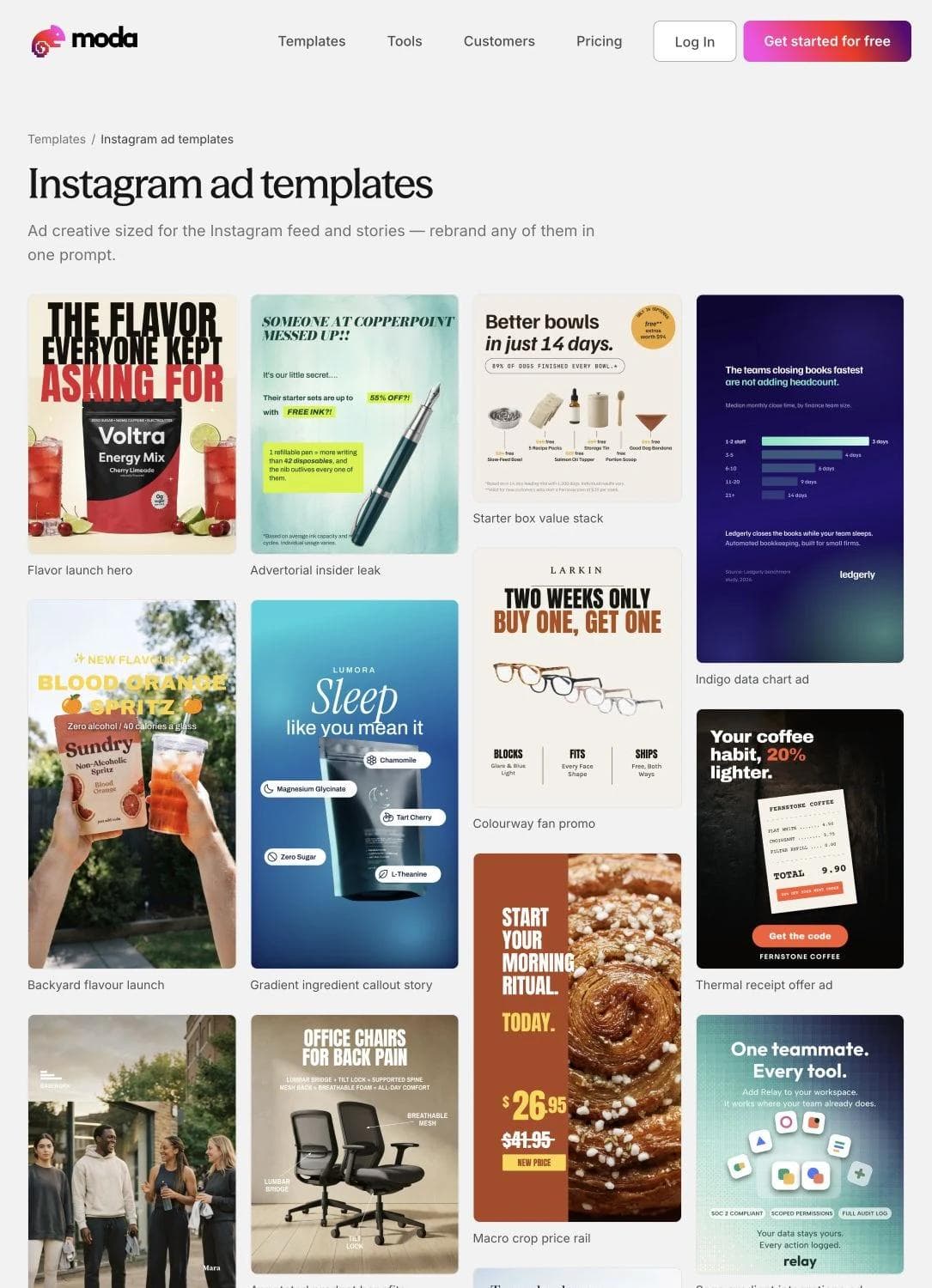
Moda’s growing Instagram ad template library includes real editable canvases for 1:1 and 4:5 feed placements and 9:16 stories and reels. The templates cover formats such as product benefits, offers, testimonials, feature callouts, launches, and editorial ads. They can be rebranded and revised rather than treated as flattened inspiration.
The limitation is equally important. Moda is not an ad manager, media buyer, attribution system, competitor-intelligence database, or predictive scoring product. Choose a vertical platform when the primary need is URL-to-UGC automation, campaign activation, or performance analytics. Choose Moda when the primary need is producing distinctive, editable creative across a campaign.
Best end-to-end paid-social loop: Canva Grow
Canva Grow has changed the Canva comparison in 2026. It is no longer accurate to describe Canva only as a template editor in an AI ad roundup. Grow can generate editable static and video ads from a website and brand context, publish to Meta, TikTok, and LinkedIn, and bring connected performance data back into an insights dashboard.
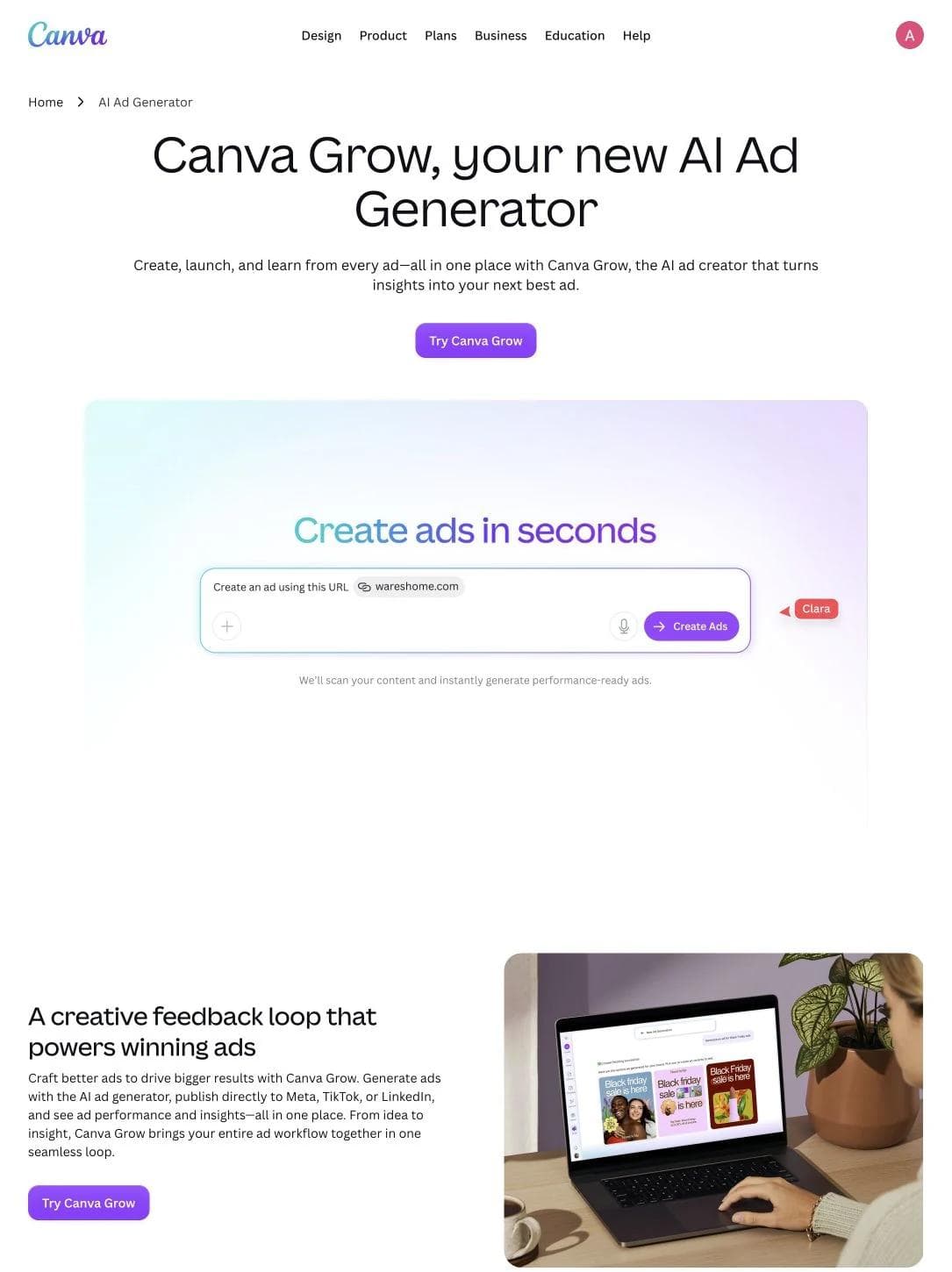
The 2.0 release adds a genuine feedback loop. Canva says it can tag creative elements, identify patterns in connected campaigns, generate refresh concepts from what is already performing, and move generated ads into the normal Canva editor through Magic Layers. That combination is useful for a small or midsize team that already works in Canva and wants fewer handoffs between design, activation, and reporting.
The tradeoff is depth and access. Some insight features require Business or Enterprise plans, and useful recommendations depend on connected account data. Teams with specialized media-buying, experimentation, or creative-analytics needs may still prefer a dedicated system.
Best for fast static variants and directional scoring: AdCreative.ai
AdCreative.ai is one of the most direct answers to the literal search query. It generates banners, copy, product images, videos, and UGC-style assets, with brand import, custom templates, competitor insights, and a Creative Scoring feature.
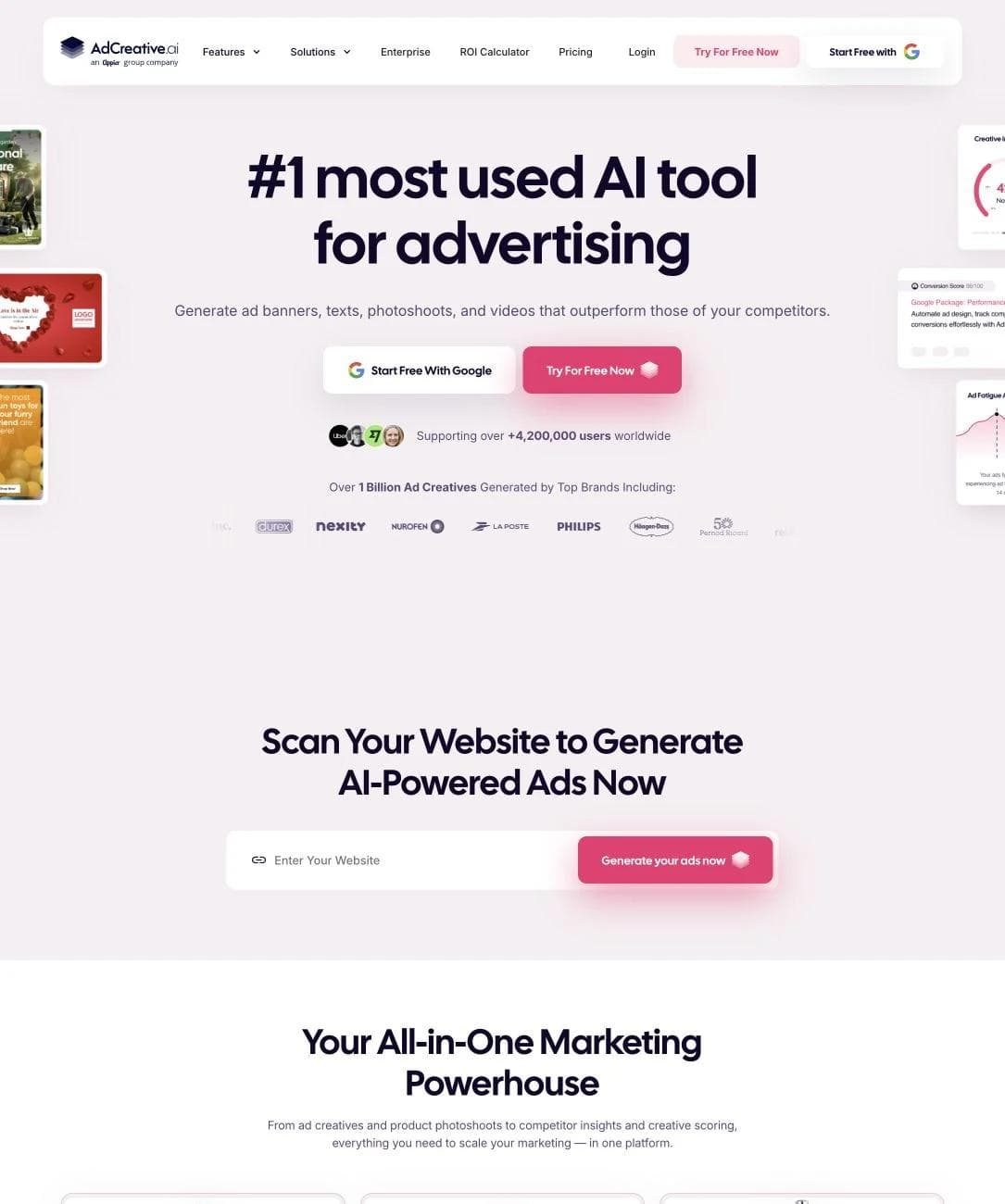
It is a good shortlist candidate when the problem is volume: many conventional ad layouts, sizes, and variations without building each one manually. The scoring layer can also help teams prioritize what to review or test first.
Treat that score as a preflight signal, not a result. A model cannot fully account for the audience, bid strategy, offer, landing page, placement, season, or measurement setup that affects a live campaign. Use scoring to narrow a batch and identify possible weaknesses. Use real experiments to decide what performs.
Best for product-led static ads at catalog scale: Photoroom
Photoroom is strongest when the product image is the center of the ad. It combines background removal and generation, product staging, brand kits, batch editing, video, and multi-format resizing for Meta, TikTok, Google, marketplaces, and ecommerce channels.
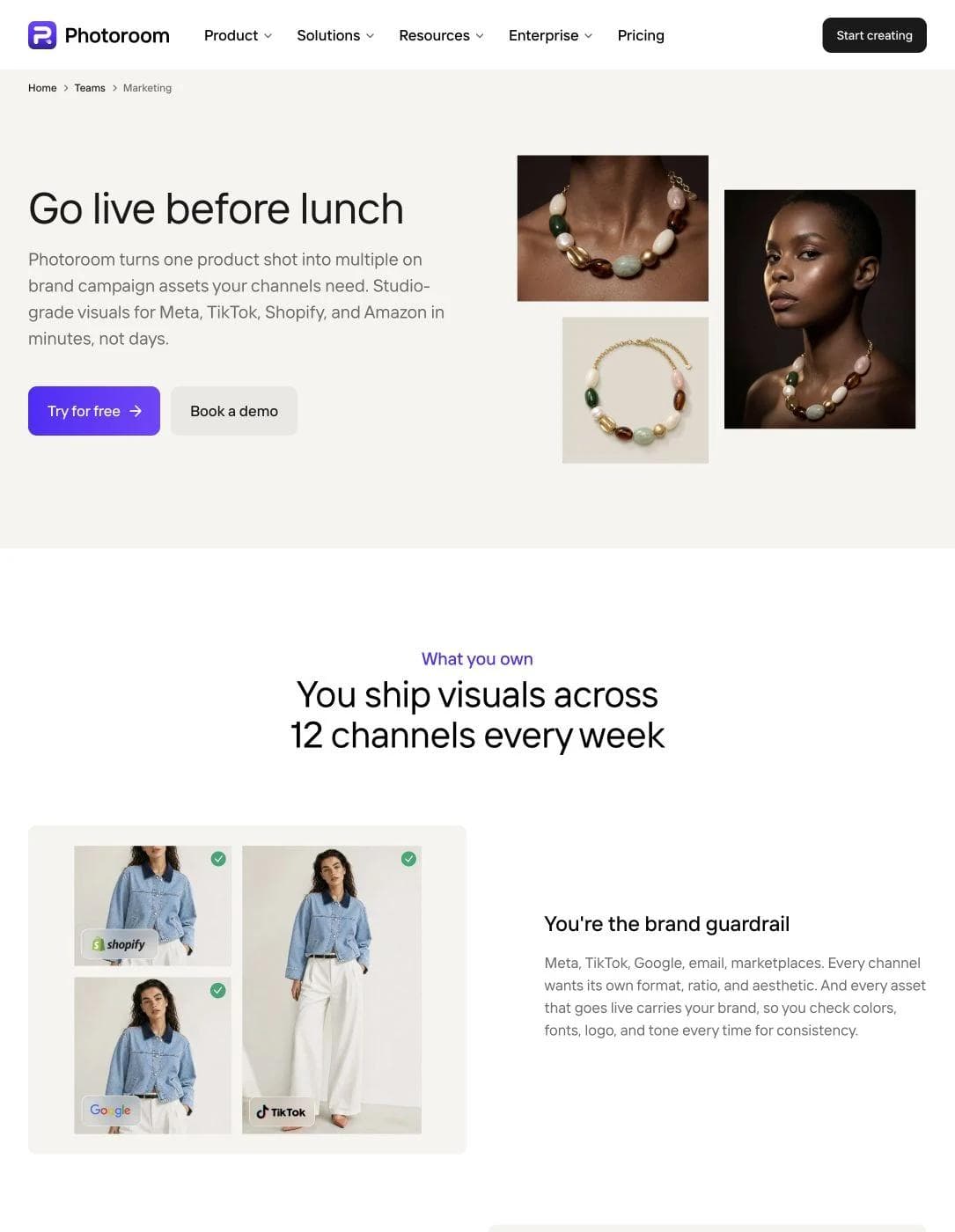
This is different from asking a general image model to redraw a product. Photoroom is built around product cutouts, edges, shadows, framing, and repeated treatment across many SKUs. A marketing team can create lifestyle or studio contexts, then apply the same visual rules across a catalog and export placement-specific variants.
Choose it for ecommerce product imagery, catalog refreshes, and large batches of consistent statics. Choose another tool when the ad depends on a narrative, a synthetic presenter, detailed typography, or a multiscene edit.
Best free option inside a Google Shopping workflow: Google Product Studio
Google Product Studio is easy to overlook because it lives inside Merchant Center rather than presenting itself as a standalone creative startup. It can generate and edit product images, remove or replace backgrounds, increase resolution, animate images, and create templated product videos.
Its biggest advantage is proximity to the product feed. Saved imagery can flow into Merchant Center surfaces, Shopping ads, and Performance Max campaigns. The video workflow supports horizontal, vertical, and square orientations and can use product images, brand colors, logos, text, and audio.
The boundaries are narrower than a general editor. Google documents category and image restrictions, and some video features remain limited by country. Product Studio is best for merchants who want a low-friction way to improve feed assets, not teams seeking broad creative direction or fine compositing control.
Best for generated product video and cinematic concepts: Higgsfield
Higgsfield is a horizontal generative-media platform that increasingly includes explicit ad workflows. Its Marketing Studio can import a product from a URL, then generate formats such as UGC, product reviews, tutorials, unboxings, virtual try-ons, CGI showcases, and cinematic spots.
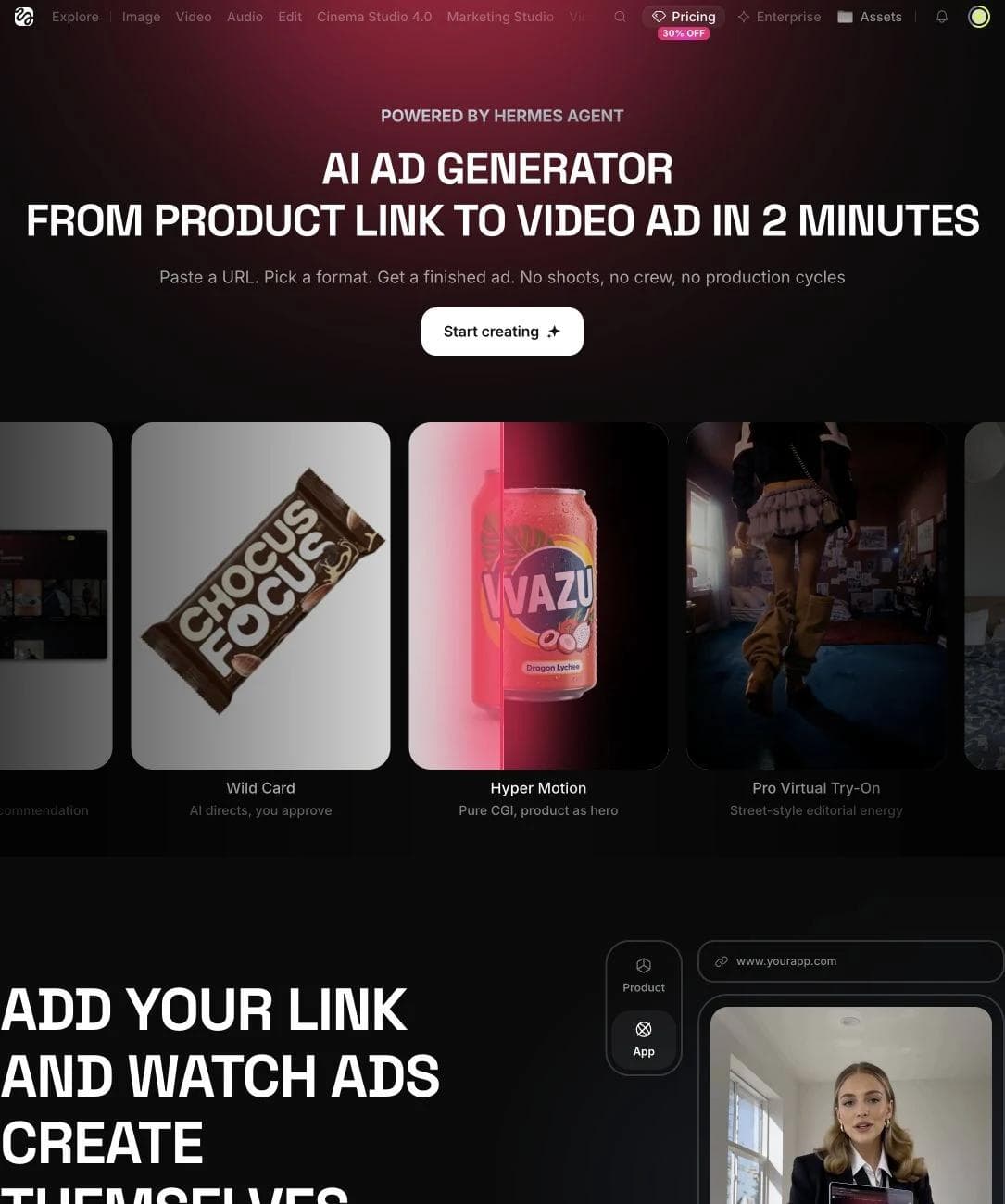
Higgsfield is especially useful when the missing ingredient is footage. Teams use it to generate social-first shots, product motion, visual hooks, and more cinematic material before assembling or revising the complete campaign elsewhere. Its broader model platform also makes it useful beyond advertising.
This distinction matters because many “AI ad generators” are wrappers around overlapping image, video, audio, and inference models. The meaningful differences are often product import, prompt enhancement, camera and character controls, ad structures, editing, and revision workflow. Our Higgsfield alternatives guide explains that market in more detail.
Review product fidelity carefully. Packaging, logos, text, hands, demonstrations, and physical interactions can change during generation. A visually exciting shot is not automatically a legally or commercially usable product claim.
Best prompt-to-video workspace with a broad media stack: InVideo AI
InVideo AI turns a prompt into a script, scenes, voiceover, music, stock or generated media, and a complete video draft. Its current ad workflow also includes product cloning, avatars, model access, scene-level prompt editing, and workflows for UGC, product films, Reels, Stories, posts, and YouTube ads.
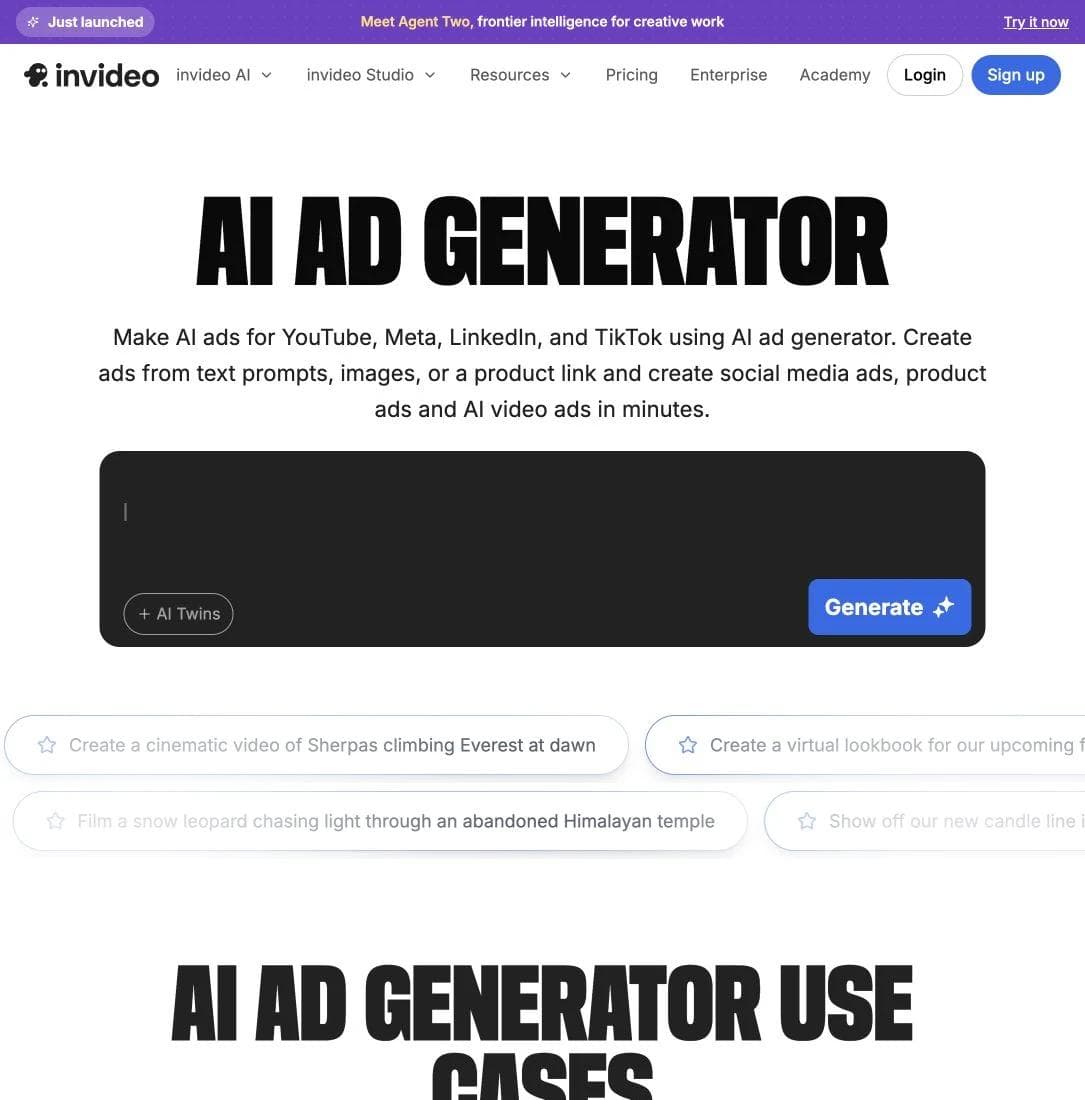
It fits marketers who want to move from an idea to a narrated ad without assembling every asset separately. The combination of generative models and licensed stock is useful when fully synthetic footage is unnecessary or too unpredictable.
The tradeoff is exact finishing. Prompt-based scene edits are convenient, but a team with detailed compositing, typography, and timing requirements may still want a more conventional timeline or canvas for the final pass.
Best for high-volume synthetic UGC: Arcads
Arcads remains one of the clearest vertical AI ad products. Its platform centers on synthetic actors, UGC-style ads, product placement, scripts, hooks, languages, variations, and repeatable workflows. Its newer Mark agent adds product and competitor research, brand memory, creative angles, static concepts, and fully assembled ads.
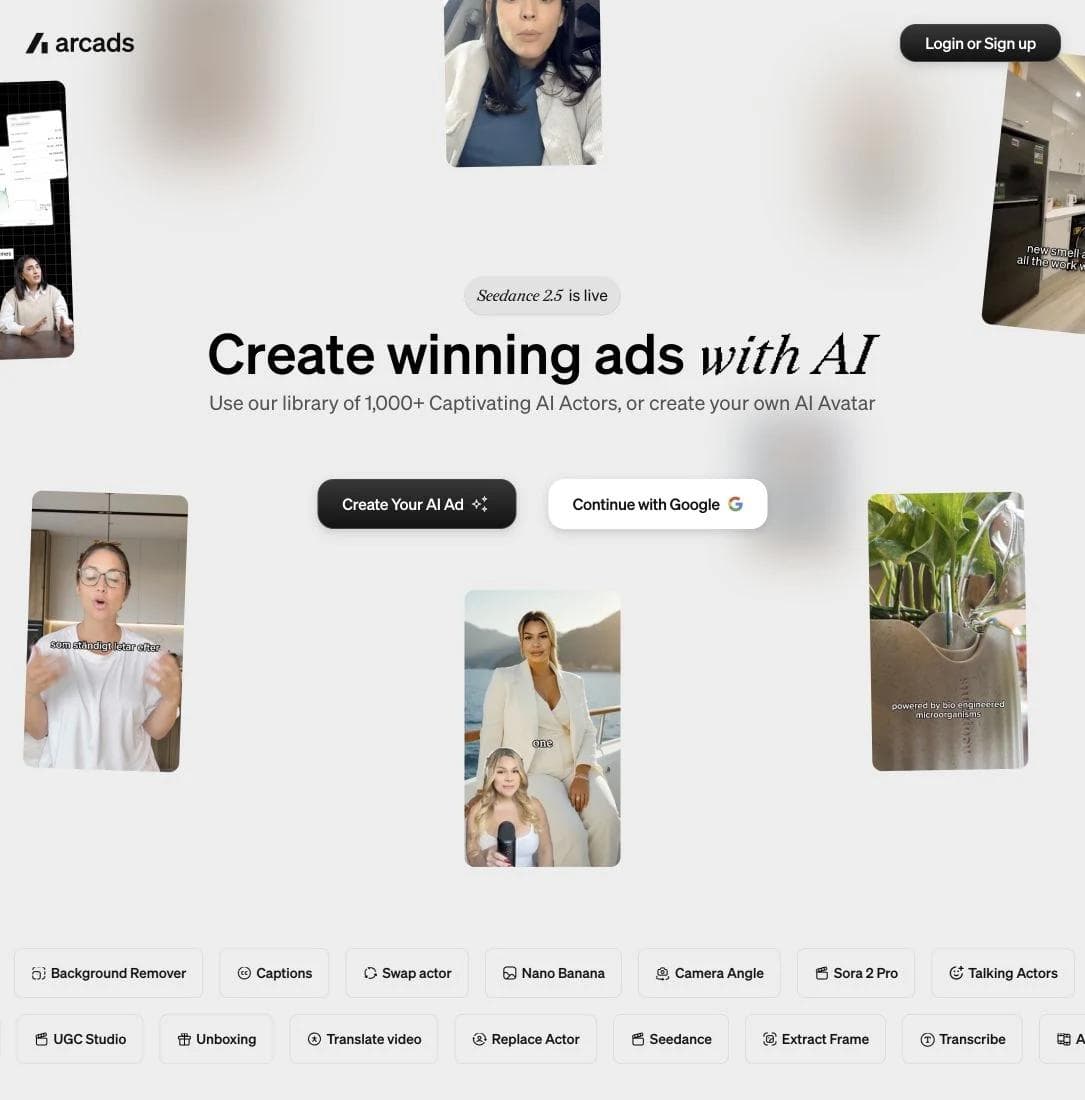
Choose Arcads when the production plan calls for many direct-to-camera concepts without recruiting and coordinating creators for every test. Its large actor library and detailed control over delivery, scene, and product presentation are more ad-specific than a general avatar platform.
The limitation is the format’s center of gravity. Arcads is optimized for direct-response and creator-style production. A brand campaign that needs a broader design language, intricate motion graphics, or many non-UGC formats may need another system alongside it.
Best for turning product URLs into ad batches: Creatify
Creatify has expanded beyond a simple URL-to-video tool. It can turn a product page, image, or brief into scripts, avatars, voiceover, B-roll, music, captions, static ads, and product animations. Batch workflows can produce many variants, while its current platform also includes a node-based Ad Flow, model playground, competitor tracking, campaign launch, and performance views.
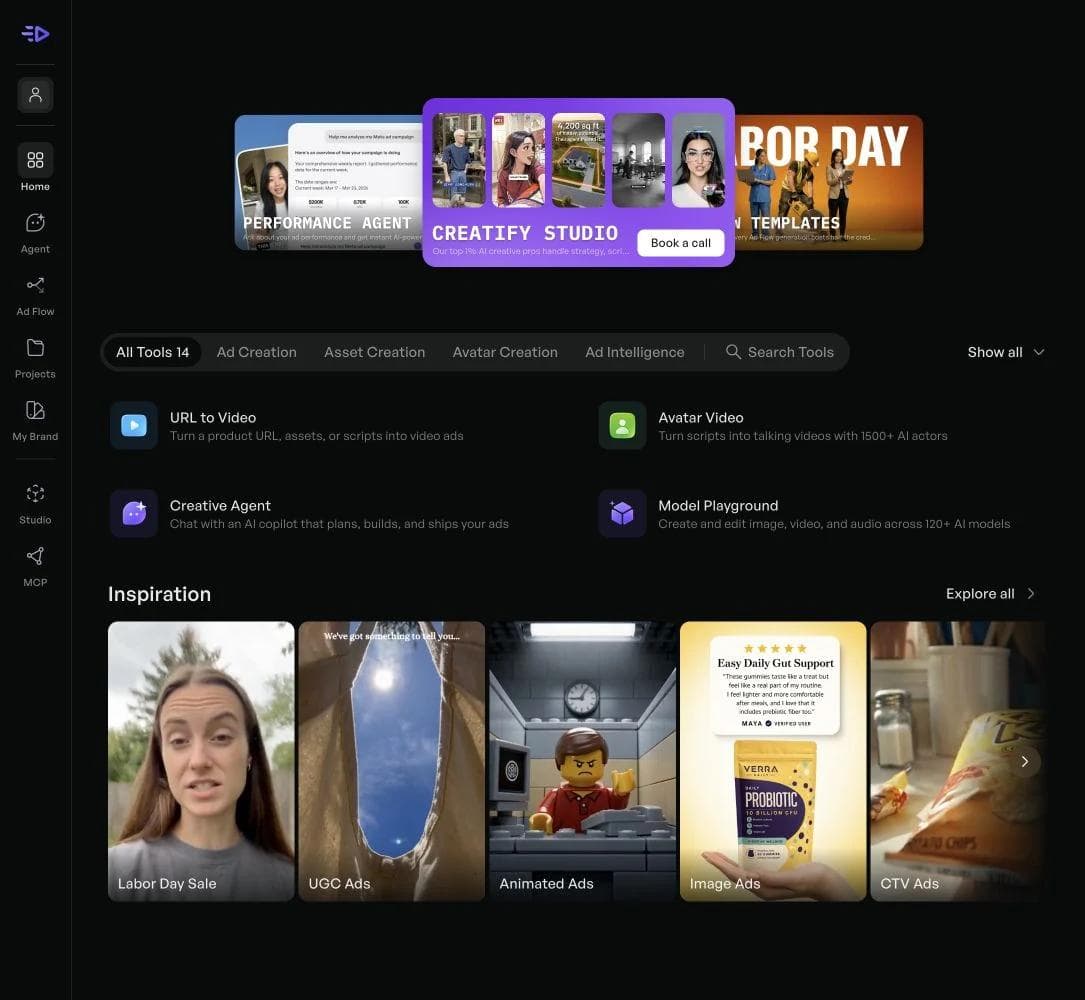
Creatify is a strong fit for ecommerce and app marketers who want a structured route from product context to multiple social ads. It supports vertical, square, and landscape output, so the same concept can be adapted for TikTok, Meta, YouTube, and other placements.
The automation is also the risk. URL extraction and ad formulas can create competent drafts quickly, but weak angles remain weak at scale. Supply strong product evidence, audience context, scripts, and references. Do not let a polished avatar substitute for a real creative premise.
Best for multilingual avatar-led campaigns: HeyGen
HeyGen is a horizontal avatar-video platform with increasingly specific advertising workflows. It can turn a URL, product photo, prompt, or script into presenter-led ads, then generate variations with different hooks, voices, creators, and calls to action.
Localization is the main reason to shortlist it. HeyGen supports many languages, voice and lip-sync workflows, captions, and vertical, square, and landscape exports. That makes it useful when a campaign needs the same presenter-led structure across regions without recording each version from scratch.
It is not a complete static campaign design system, and synthetic testimonials require ethical and legal care. Do not present an AI actor as a real customer or imply an experience that did not occur. Disclosure rules vary by platform and jurisdiction.
Best for performance-informed creative iteration: Pencil
Pencil is most useful after a team has accumulated creative and performance data. Its agents can help with strategy, generation, scripting, and analysis, while its Creative Insights agent works from uploaded or connected creative-level metrics to identify patterns by hook, format, message, and other tags.
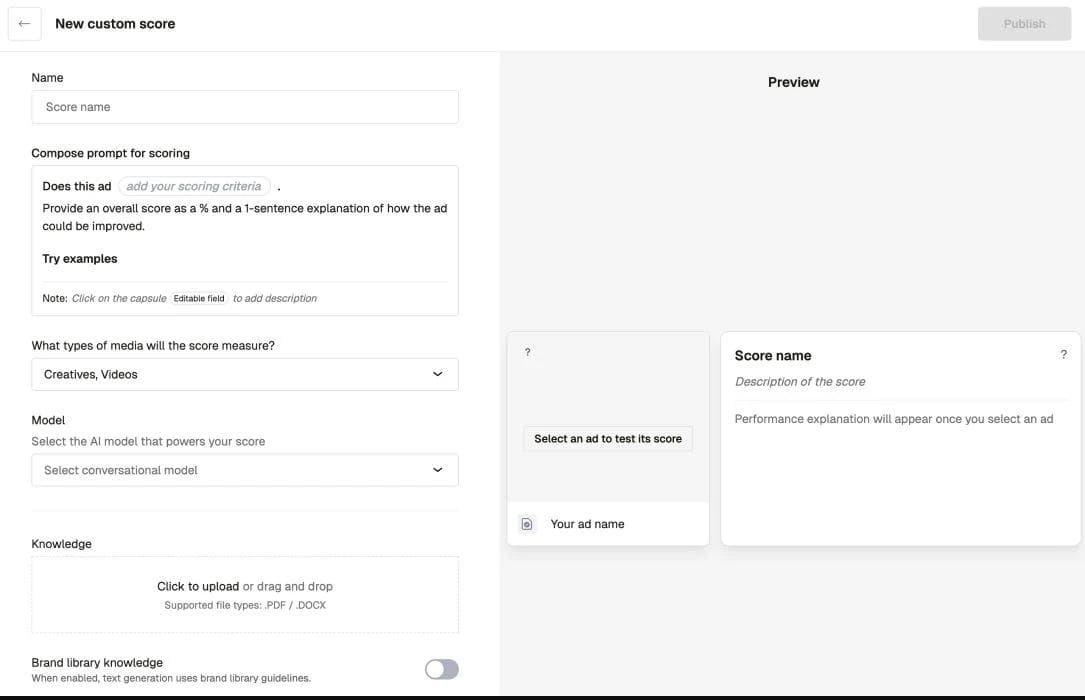
Pencil’s scoring framework can combine media-performance signals, brand relevance, third-party providers, and custom criteria. This is more useful than a universal black-box score when the team has specific compliance, brand, or category requirements.
Data quality is the constraint. Creative-level results can be distorted by different audiences, budgets, placements, offers, and flight dates. A pattern is more credible when it repeats across enough comparable spend. Pencil can organize evidence and propose the next test, but it cannot repair a confounded experiment.
Best direct-response all-in-one: Icon
Icon combines ad research, competitor tracking, asset generation, synthetic UGC, editing, variations, creative analytics, and ad-manager upload. Its product is explicitly designed around finding an angle, producing the ad, revising it, and moving it into a campaign.
That breadth makes Icon attractive for direct-response teams that would otherwise stitch together an ad library, UGC vendor, video editor, static editor, analytics layer, and launch tool. It can work from prompts, public ads, product context, and connected performance information.
The risk is automation theater. A tool can scan many ads and still choose a weak or overused idea. Human reviewers should verify that a concept is original, accurate, on-brand, and appropriate for the audience before multiplying it into a large batch.
Best for autonomous omnichannel advertising workflows: Omneky
Omneky spans creative generation, brand rules, image and video, avatars, competitor inspiration, campaign launch, analytics, forecasting, and optimization across several ad networks. It is closer to an advertising operating system than a single-purpose generator.
Choose it when the objective is to connect creation and activation across channels from one platform, especially when the team wants centralized brand controls and performance views. The product can be a better fit for a growth organization than for an individual creator because it addresses campaign operations as well as asset production.
That scope is also the tradeoff. If the bottleneck is simply a handful of static ads or one edited social video, a focused creative tool will be easier to evaluate and adopt.
Best for enterprise creative automation and localization: The Brief
The Brief, formerly Creatopy, is built for teams that need to scale an approved campaign across formats, markets, and live placements. Its workflow includes an editor, brand controls, templates, feeds, resize, translation, animation, approvals, ad serving, analytics, and the ability to update live creative.
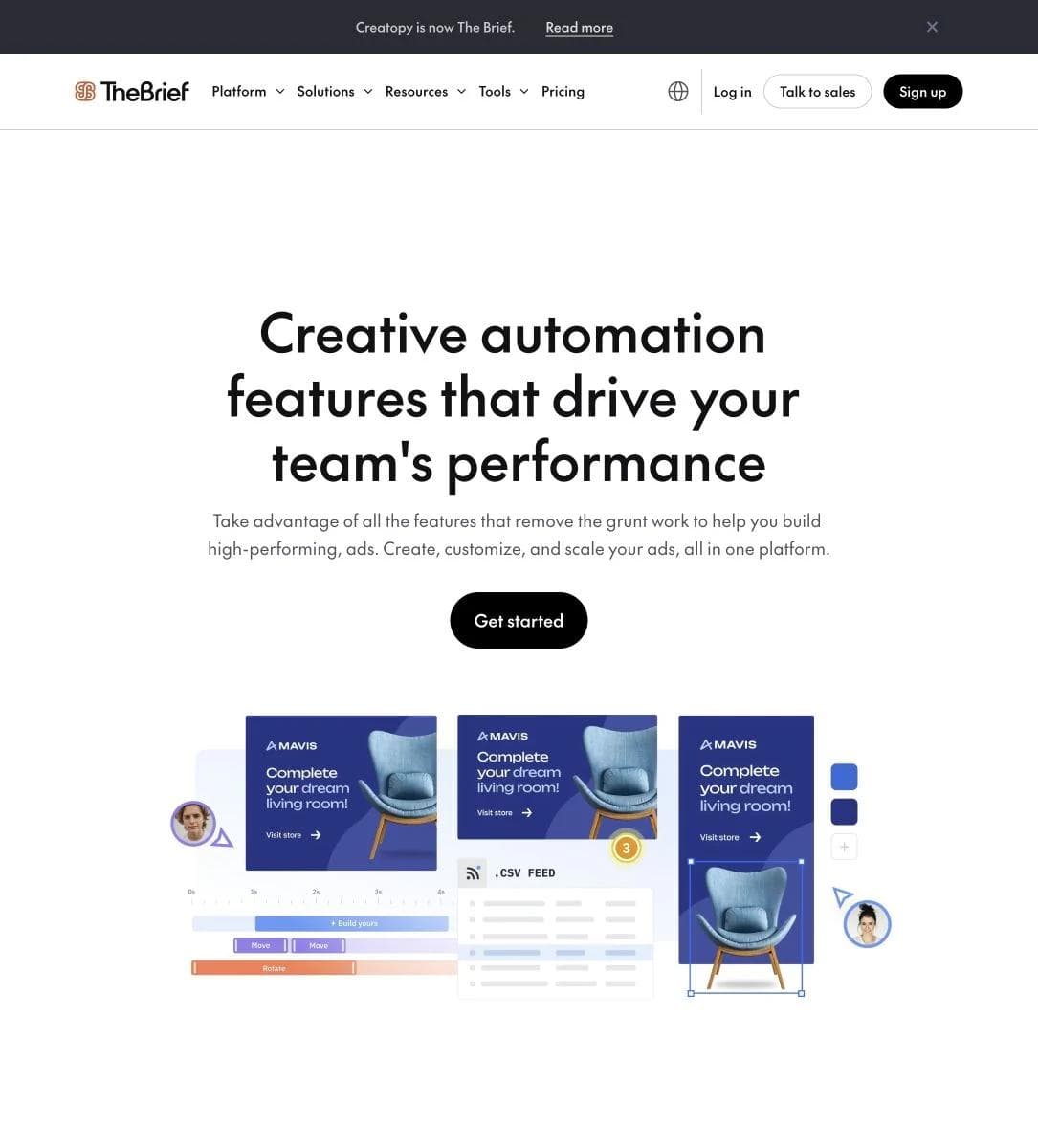
This is a different problem from generating one attractive ad. The Brief is strongest when the organization already has a hero concept and needs hundreds or thousands of governed variants, including static, animated, and video formats. Its AI features can generate copy and imagery, but the durable advantage is production automation.
Small teams may find that machinery excessive. Evaluate it when localization, feed-driven variants, approvals, and ad serving are real operating costs, not hypothetical future needs.
Best for reusable node-based generative ad workflows: FLORA
FLORA is a horizontal generative canvas rather than a conventional AI ad maker. Creative teams can connect models and assets in a node-based workflow, branch directions, batch campaign variations, collaborate, and save successful workflows as reusable Techniques.
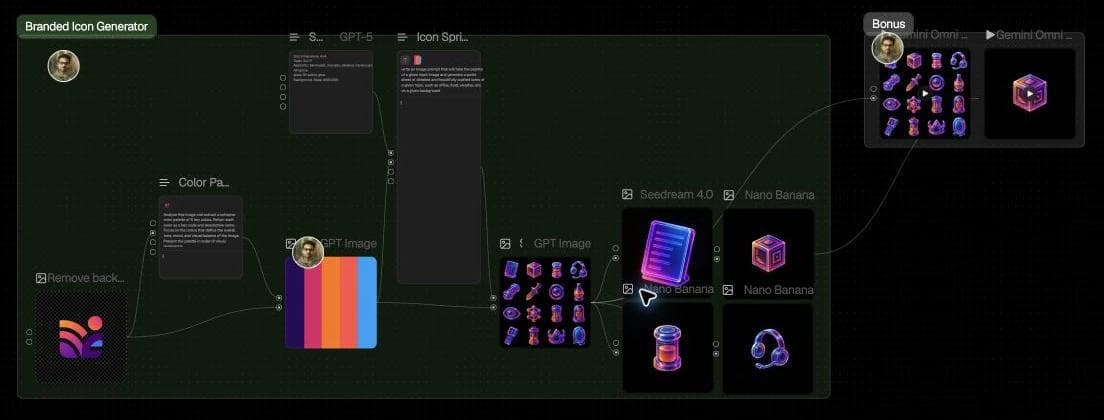
That makes FLORA interesting for teams that have outgrown isolated prompt boxes. A campaign system can retain the relationship between the brief, references, product inputs, intermediate generations, and final asset directions. The workflow itself becomes reusable.
FLORA does not replace an ad manager, media buyer, or full finishing suite. Its value is orchestration and exploration across generative models. The team still needs a deliberate approval, composition, and activation path.
Best for finishing short-form video ads: CapCut
CapCut is a horizontal video editor with ad-specific AI features. It can generate scripts, avatars, voiceovers, captions, images, and first-cut videos, then provides the timeline, effects, templates, music, overlays, and pacing controls needed to finish social creative.
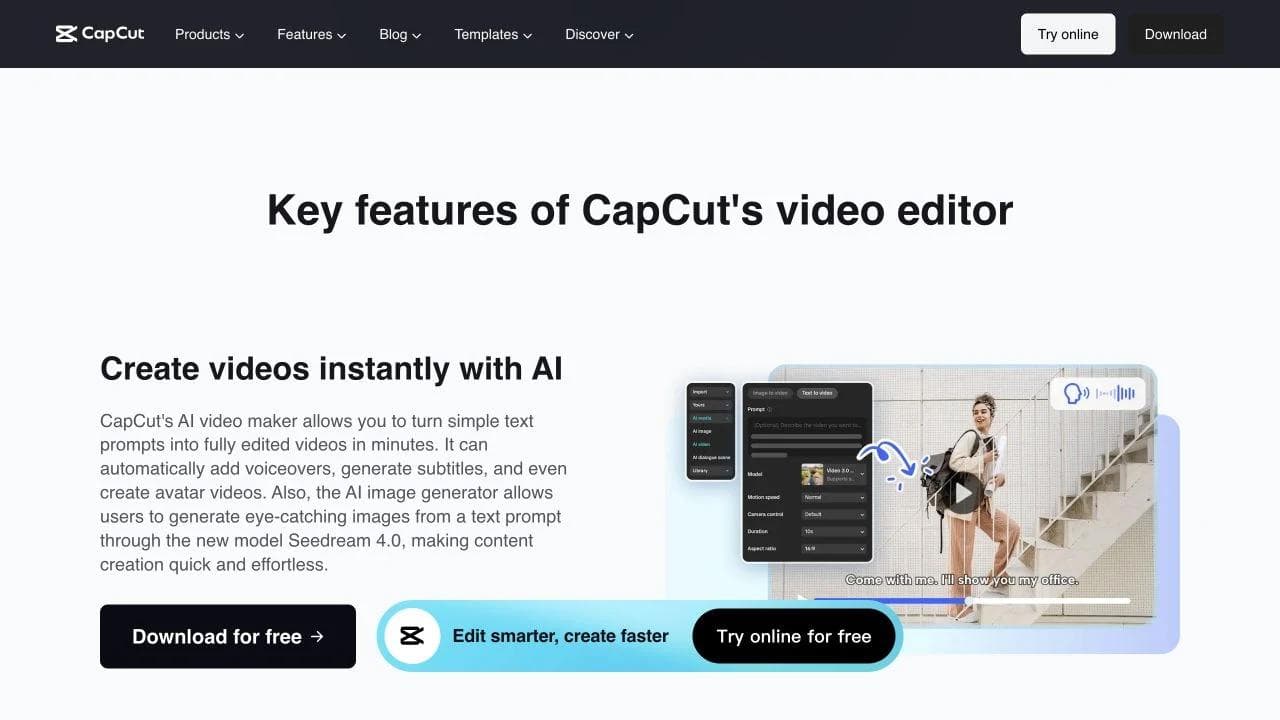
Choose CapCut when generation is only the beginning. It is especially useful for vertical TikTok, Reels, and Shorts ads where captions, hook timing, visual rhythm, and platform-native effects matter. It also supports broader formats and direct sharing to some social platforms.
CapCut does not provide the same campaign intelligence or cross-channel learning loop as Pencil, Canva Grow, Icon, or Omneky. It is the finishing room, not the performance strategy. Our CapCut alternatives guide covers editors and broader creative systems in more depth.
How to evaluate AI ad generators without wasting a month of credits
Do not ask every tool to make “an ad for our product.” That tests prompt defaults more than workflow fit. Use one evidence-rich brief and a short sequence of revisions:
- Provide the same product page, approved claims, audience, offer, brand assets, and two reference ads.
- Request three genuinely different concepts, not three cosmetic variations.
- Select one concept and ask for a static feed ad, a 9:16 story or reel, and a 16:9 video or display treatment where supported.
- Change the offer, headline, product image, and call to action after the first draft.
- Ask for five hook variations while keeping everything else constant.
- Inspect product fidelity, text accuracy, editability, brand control, captions, safe areas, export quality, and revision time.
- If the tool includes scoring, compare its prediction with a controlled live test. Do not compare scores produced by different vendors as if they share one scale.
The revision steps are more revealing than the initial render. Many systems can create a compelling demo. Fewer can preserve the approved product, make one precise change, and propagate it across a campaign without breaking something else.
A practical stack is often better than one platform
The strongest workflow may combine tools instead of forcing one product to do everything.
- Use Photoroom or Google Product Studio to create reliable product assets, then compose the final campaign in Moda or Canva.
- Use Higgsfield for generated footage, then finish pacing, captions, and claims in Moda or CapCut.
- Use Arcads, Creatify, or HeyGen for presenter-led footage, then add brand-specific graphics and alternate cuts in an editor.
- Use Pencil or another creative-intelligence layer to identify the next test, then produce it in the system your creative team can control best.
- Use The Brief when an approved concept must become a large localized or feed-driven campaign.
The goal is not maximum automation. It is a fast loop in which the team can understand the source, revise the claim, preserve the product, and learn from real results.
Which AI ad generator should you choose?
Choose Moda when you need editable static, motion, and video creative across an entire campaign. Choose Canva Grow when you want generation, paid-social publishing, and performance insights inside Canva. Choose AdCreative.ai for rapid conventional variants and directional preflight scoring.
Choose Photoroom or Google Product Studio when product imagery is the center of the workflow. Choose Higgsfield or InVideo when you need generated or assembled video. Choose Arcads for actor variety, Creatify for product-URL-to-ad batches, and HeyGen for multilingual presenter-led campaigns.
Choose Pencil when real creative-level performance data should inform the next brief. Choose Icon or Omneky for broader direct-response and campaign loops. Choose The Brief for enterprise production, localization, and serving. Choose FLORA for reusable generative workflows, and CapCut for short-form finishing.
Most importantly, choose based on the step you need to improve. An AI ad generator should make your testing system more precise, not merely produce more files.
Frequently asked questions
What is the best AI ad generator overall?
There is no universal winner because the category includes static design, product photography, generated footage, UGC avatars, editing, scoring, publishing, and analytics. Moda is strong for editable cross-format production, Canva Grow for a connected paid-social loop, Arcads for synthetic UGC, Photoroom for product imagery, and Pencil for performance-informed iteration.
What is the best AI ad generator for static ads?
Moda is a strong choice when the final layouts must remain editable and extend across a campaign. AdCreative.ai is useful for rapid conventional variants and scoring. Photoroom is strongest when accurate product imagery and batch processing are the main requirements. Canva Grow is compelling when the same team also wants direct publishing and connected insights.
What is the best AI ad generator for video ads?
Higgsfield is strong for generated product footage and social-first concepts. InVideo AI is useful for assembling a complete narrated video from prompts, models, and stock. Creatify provides a structured product-URL-to-ad workflow, while CapCut is better when the priority is detailed short-form editing after generation.
What is the best AI UGC ad generator?
Arcads is the most ad-specific choice for actor-led UGC volume and delivery control. Creatify is strong for ecommerce batches that begin with a product URL. HeyGen is a good fit for multilingual presenter-led campaigns. Test the same script and product interaction in each because avatar fit, product handling, and revision controls matter more than library size alone.
Can AI predict which ad will perform best?
AI scoring can prioritize a batch and identify common creative issues, but it cannot reproduce the full conditions of a live campaign. Audience, offer, budget, placement, landing page, auction dynamics, and measurement all affect results. Treat predictions as directional and validate them with controlled tests using real campaign data.

Real editable visuals. Real canvas. Full control.
Fly through design work