5 LlamaParse Alternatives, Tested on the Same Documents
We tested LlamaParse, Reducto, and Extend on the same PDFs, then compared Unstructured, Mistral OCR, and Docling for different migration paths.
 Anvisha Pai, Co-founder & CEO, Moda
If you want the closest hosted alternative to LlamaParse, test Reducto and Extend AI first. Reducto gives you unusually detailed control over parsing output and source grounding. Extend combines parsing with extraction evaluations, review, and workflow tooling.
The other credible choices replace a different layer. Unstructured is strongest when connected ingestion and delivery are part of the job. Mistral OCR 4 is a focused document-understanding component for teams building their own pipeline. Docling is the local, open-source route when infrastructure control matters more than managed convenience.
We reached that shortlist by separating product documentation from firsthand evidence. We ran LlamaParse, Reducto, and Extend as hosted APIs on the same four synthetic PDFs. We also ran pinned local versions of Unstructured and Docling on that corpus, reported separately because local initialization and hardware do not compare cleanly with hosted API timing. Mistral was not part of the test.
This is a switching guide for teams already considering LlamaParse. If you are starting with the broader question of which products to evaluate across PDF, Excel, and PowerPoint, read our comparison of seven AI document parsers.
The short answer: which alternative should you choose?
| Choice | Test it first when | What changes from LlamaParse |
|---|---|---|
| Reducto | You need a hosted parser with granular controls, block positions, confidence, citations, and adjacent extraction APIs | Its output schema, parsing modes, credit system, and integration details differ |
| Extend AI | You want parsing plus extraction evaluations, automated review, and human review workflows | You are potentially replacing more than the parsing endpoint, and each stage affects cost |
| Unstructured | Your larger problem is moving changing content from many sources through chunking, enrichment, embeddings, and destinations | It is an ingestion platform decision, not only a parser swap |
| Mistral OCR 4 | You want a lower-level OCR and document-understanding API with structured blocks and build the rest yourself | Your team owns chunking, evaluation, retries, and delivery unless it adds other services |
| Docling | Documents must stay in infrastructure you control, or you want a modifiable open-source stack | Your team owns deployment, scaling, model choice, monitoring, and upgrades |
There is also a good reason to stay with LlamaParse. Its current product spans Parse, Extract, Classify, Split, and Index, supports tier and version selection, and is designed around LLM and LlamaIndex workflows. A replacement should solve a real constraint, not merely produce similar Markdown in a demo.
What we tested
We built four synthetic PDFs containing eight pages in total:
- A two-page digital report with headings, a KPI table, a hyperlink, two-column reading order, a footnote, and a formula.
- A three-page table pack with wrapped labels, blanks, European number formatting, and a 46-row table crossing pages.
- Two raster-only invoice pages with light skew, line items, totals, address text, and a handwritten-style approval note.
- A mixed-layout page with checkboxes, comparison symbols, a formula, a horizontal bar chart, percentages, a caption, and a footer.
You can download the benchmark pack to inspect the fixtures, sanitized parser outputs, and evaluators used for these checks.
We used quality-oriented hosted configurations available on September 6, 2026: Reducto's r-1 preview through its V3 SDK, Extend's default parse_performance engine, and LlamaParse V2's agentic tier with the latest version and Markdown output.
Those are reasonable defaults, not equivalent quality or price tiers. Each file was uploaded and processed synchronously, one time, from the same machine and network.
For the local comparison, we pinned Docling 2.126.0 with DocumentConverter defaults and Unstructured OSS 0.27.5 with partition_pdf(strategy="auto", infer_table_structure=True). We did not tune OCR, tables, models, or accelerators. These runs establish what the named defaults did, not either library's performance ceiling.
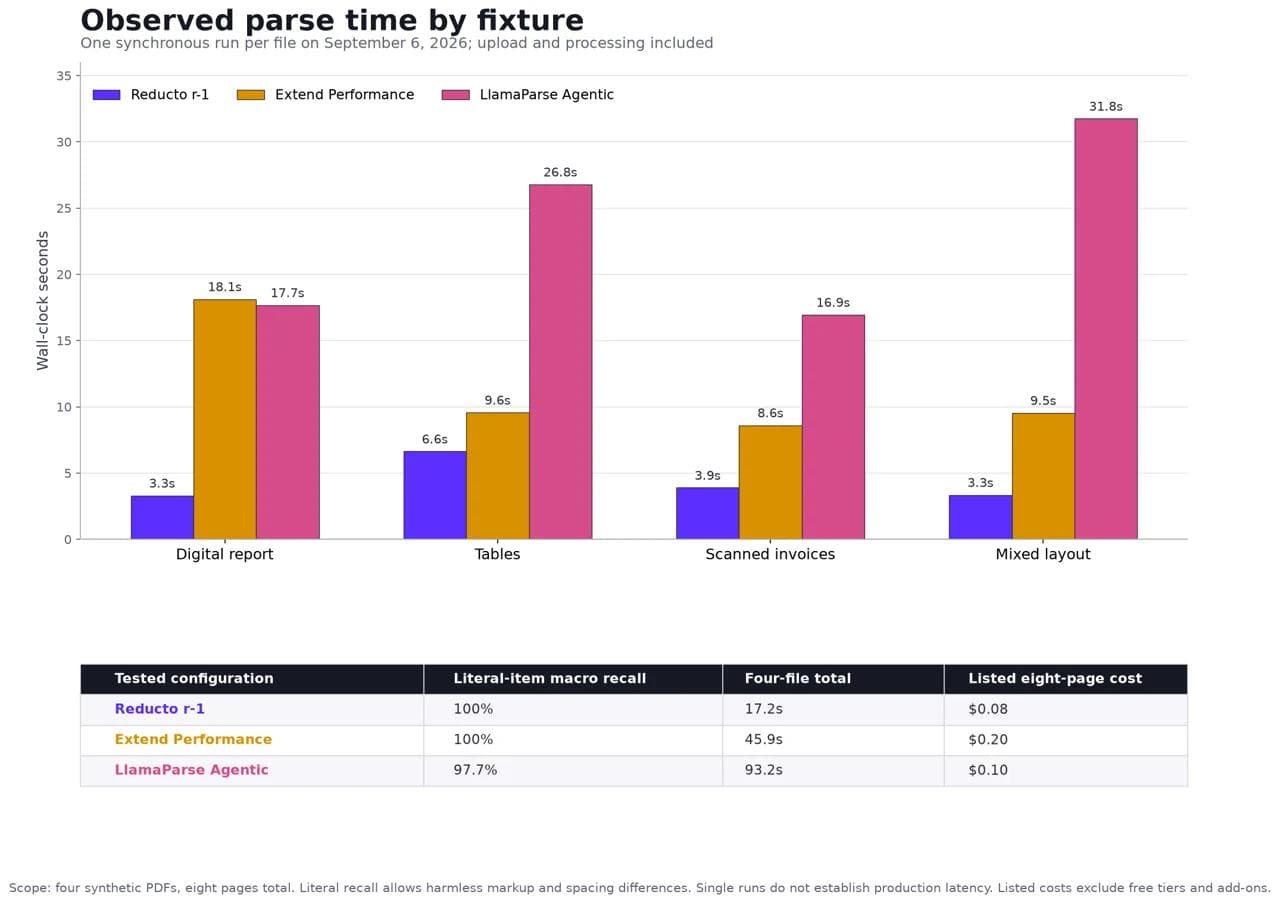
The recall check asked whether 175 expected strings survived after normalizing harmless Markdown, HTML, spacing, and mathematical-formatting differences. It did not score semantic field extraction, every coordinate, unsupported extra text, production reliability, or downstream RAG answer quality.
What the small test actually found
| Parser and configuration | Digital report | Tables | Scanned invoices | Mixed layout | Macro average |
|---|---|---|---|---|---|
| Reducto r-1 | 100% | 100% | 100% | 100% | 100% |
| Extend Performance | 100% | 100% | 100% | 100% | 100% |
| LlamaParse Agentic | 100% | 100% | 100% | 90.9% | 97.7% |
All three recovered every tested table cell, transaction ID, invoice field, and labeled reading-order statement. LlamaParse's lower score came from omitting the deliberately generic footer and page number on the mixed-layout page. That can be desirable boilerplate removal for RAG. It is an output-policy difference, not evidence that LlamaParse was less accurate on substantive content.
The clearest difference was how each parser represented the chart:
- Reducto wrote a concise prose description containing all five labels and values.
- Extend returned a typed figure block, label/value lines, and a generated caption.
- LlamaParse converted the plotted values into a two-column HTML table.
Any of those can be correct. Prose is compact for retrieval, a typed figure preserves the element's role, and a table is convenient for queries. Your downstream contract decides which is easiest to use.
The single-run wall-clock totals were 17.179 seconds for Reducto, 45.854 seconds for Extend, and 93.163 seconds for LlamaParse. These figures include upload and synchronous processing. They do not establish typical latency, throughput, or a categorical speed winner. Repeated runs, larger documents, concurrency, warm caches, and other tiers could change the order.
At the public rates used for these configurations, the eight pages worked out to approximately $0.08 for Reducto r-1, $0.20 for Extend Performance Parse, and $0.10 for LlamaParse Agentic. Extend also returned its 16-credit total in the API response. The other two figures came from public rate cards. Free allowances, negotiated terms, extraction, review, storage, and downstream processing are excluded.
This was a small acceptance test, not a universal leaderboard. It covered eight synthetic English-language pages and parsing output only. It did not test schema extraction, production uptime, long documents, multilingual scans, broad handwriting, or every table and chart type.
A 48-page public-document check
We also ran the three hosted configurations on NIST's public Artificial Intelligence Risk Management Framework 1.0. The 48-page PDF contains a table of contents, dense prose, repeated section structure, four multirow framework tables, and appendices. Our targeted check covered 40 strings spread across its metadata, headings, body, tables, and appendices.
Reducto, Extend, and LlamaParse each recovered all 40 checked items. Their single synchronous runs took 9.876, 34.775, and 140.146 seconds respectively. This larger file did not create a recall winner among the hosted parsers; it reinforced the need to compare output structure and downstream use instead. The timings remain one observation per tool, not latency estimates.
A small RAG-readiness test
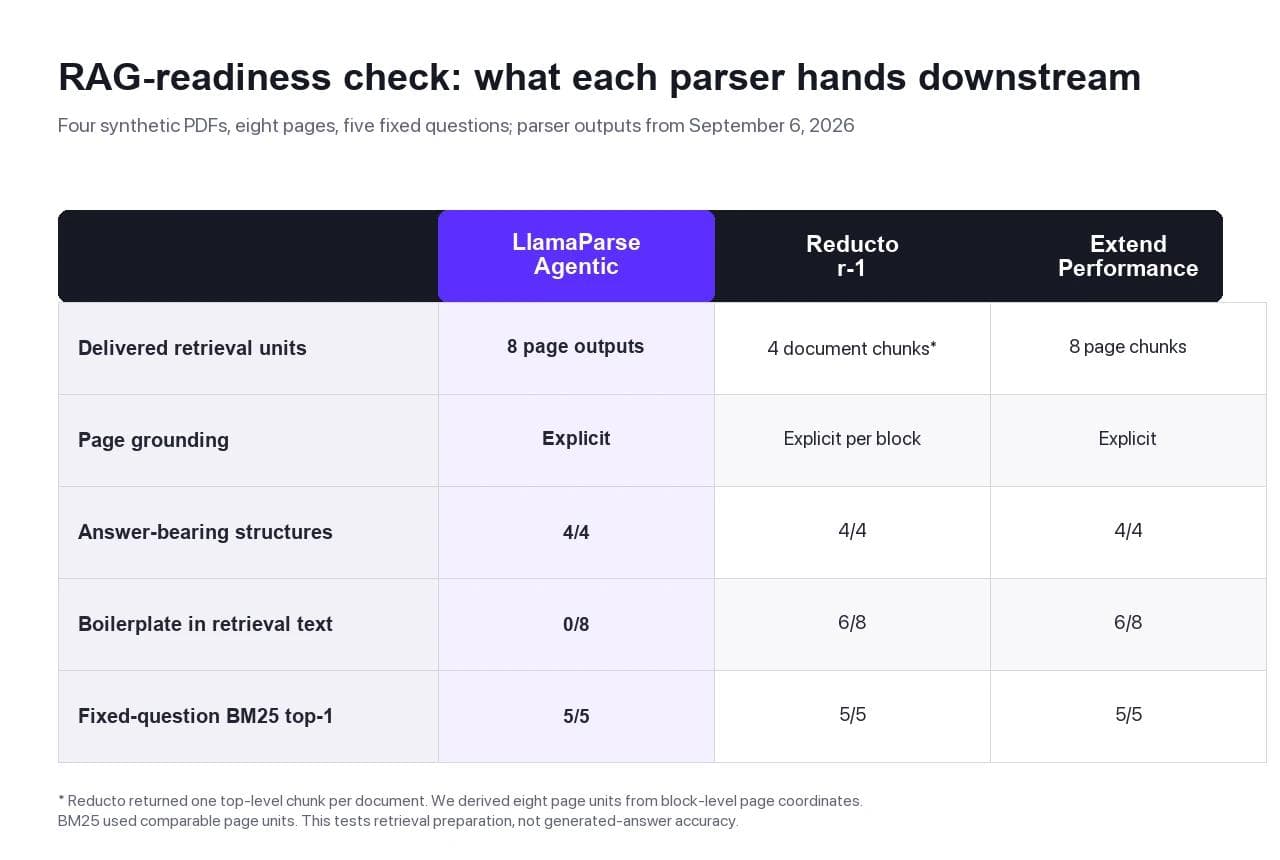
Because LlamaParse is often used upstream of retrieval, we also checked what the three hosted parsers actually handed to a simple retriever. We reused the saved outputs from the same run rather than calling the APIs again.
The test used five fixed questions whose answers lived on five known pages. We indexed page-level text with BM25, a traditional lexical retriever, and checked the rank of the correct page. We did not use embeddings, a reranker, or an answer-generating model. This isolates retrieval preparation from the many other choices that affect RAG quality.
| Check | LlamaParse Agentic | Reducto r-1 | Extend Performance |
|---|---|---|---|
| Top-level units returned | 8 page outputs | 4 document chunks | 8 page chunks |
| Page grounding | Explicit page number | Explicit on every block | Explicit page range |
| Answer-bearing structures kept together | 4 of 4 | 4 of 4 | 4 of 4 |
| Fixture boilerplate included in retrieval text | 0 of 8 pages | 6 of 8 pages | 6 of 8 pages |
| Correct page ranked first by BM25 | 5 of 5 questions | 5 of 5 questions | 5 of 5 questions |
The questions covered a regional service target, a numbered procedure, a transaction balance, an invoice total, and a chart value. In all five cases, all three parser outputs put the answer-bearing page first. The relevant answer text was present in every expected unit.
The more useful differences appeared before retrieval. LlamaParse delivered one Markdown object per source page and kept its detected footers outside that Markdown, so none of our repeated fixture footer text entered the retrieval documents. Extend also delivered page-sized chunks, but its page text retained the footer on six pages. Reducto returned one top-level chunk per document in this configuration. Its blocks carried page coordinates, so we derived eight comparable page units by grouping blocks on that field; six retained the footer text.
That does not make one representation universally better. LlamaParse and Extend were ready for page-level indexing with less adapter work. Reducto exposed more granular block structure for teams willing to define their own chunk assembly. LlamaParse's separation of footer metadata happened to produce cleaner retrieval text on this corpus, but a different application might deliberately retain headers and footers for provenance.
Five easy, lexically distinctive questions cannot establish end-to-end RAG accuracy. A production evaluation should add semantic paraphrases, ambiguous questions, cross-page answers, negative questions, embedding and reranking choices, and an answer model with citation scoring.
1. Reducto: the closest alternative for parsing controls
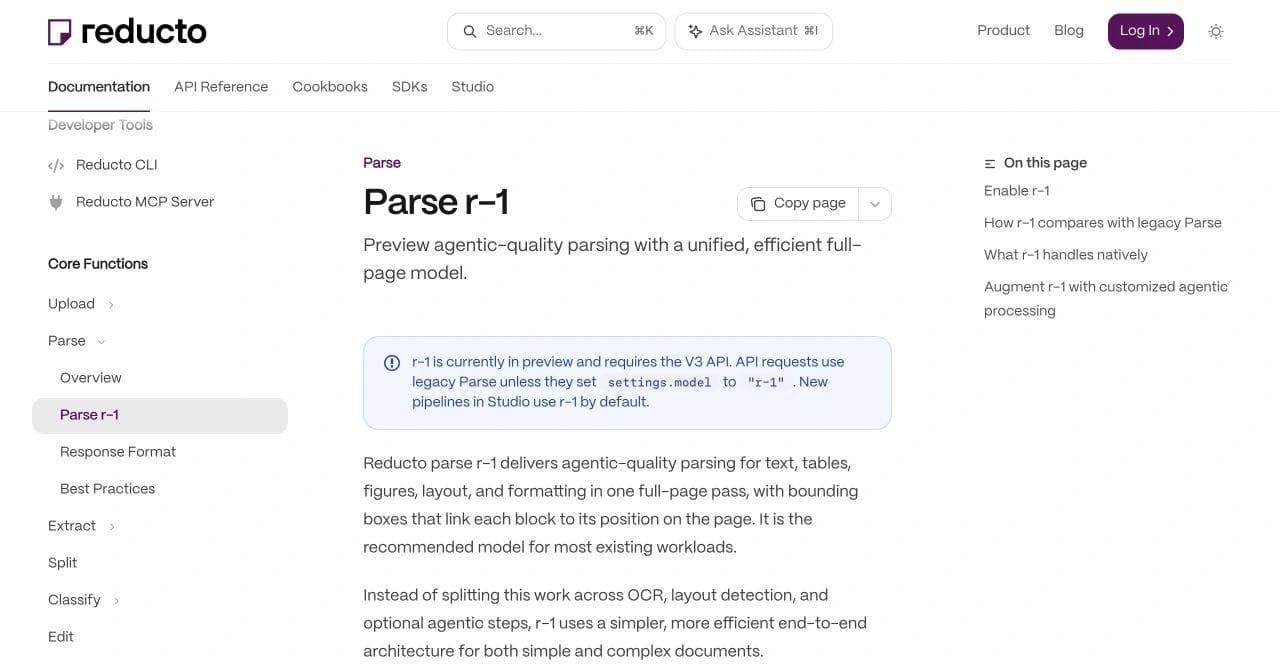
Reducto is the first LlamaParse alternative we would test when the central job is still hosted, API-first parsing. Its Parse documentation describes structured chunks and blocks for text, tables, figures, headers, and key-value regions, including page positions and confidence. Its separate Extract endpoint turns specified fields into JSON and can return source citations.
The configuration matters. Our run explicitly selected the r-1 preview with the V3 SDK. Reducto's documentation said that new Studio pipelines defaulted to r-1 while API calls without that model setting still used legacy Parse. A Studio proof of concept is therefore not a reproducible API comparison until its model and settings travel with the integration.
Reducto stood out in our fixture because it completed all four single runs in the least observed wall time while preserving every literal test item. That is a reason to run a larger trial, not a promise about production speed.
Choose Reducto over LlamaParse when its chunk and block representation, source evidence, and parsing controls fit your consumer more naturally. Before switching, compare both products on complex pages with the exact paid options you expect to use. Reducto charges different credit amounts for standard, complex, and agentic work, so the base rate alone is not a complete job estimate.
2. Extend AI: parsing plus an evaluation and review loop
Extend's Parse API returns layout-aware Markdown plus block-level text, tables, figures, and key-value information. It offers Performance, Light, and Auto engines, page or section chunking, HTML or Markdown tables, optional chart extraction, and agentic corrections for difficult OCR or tables.
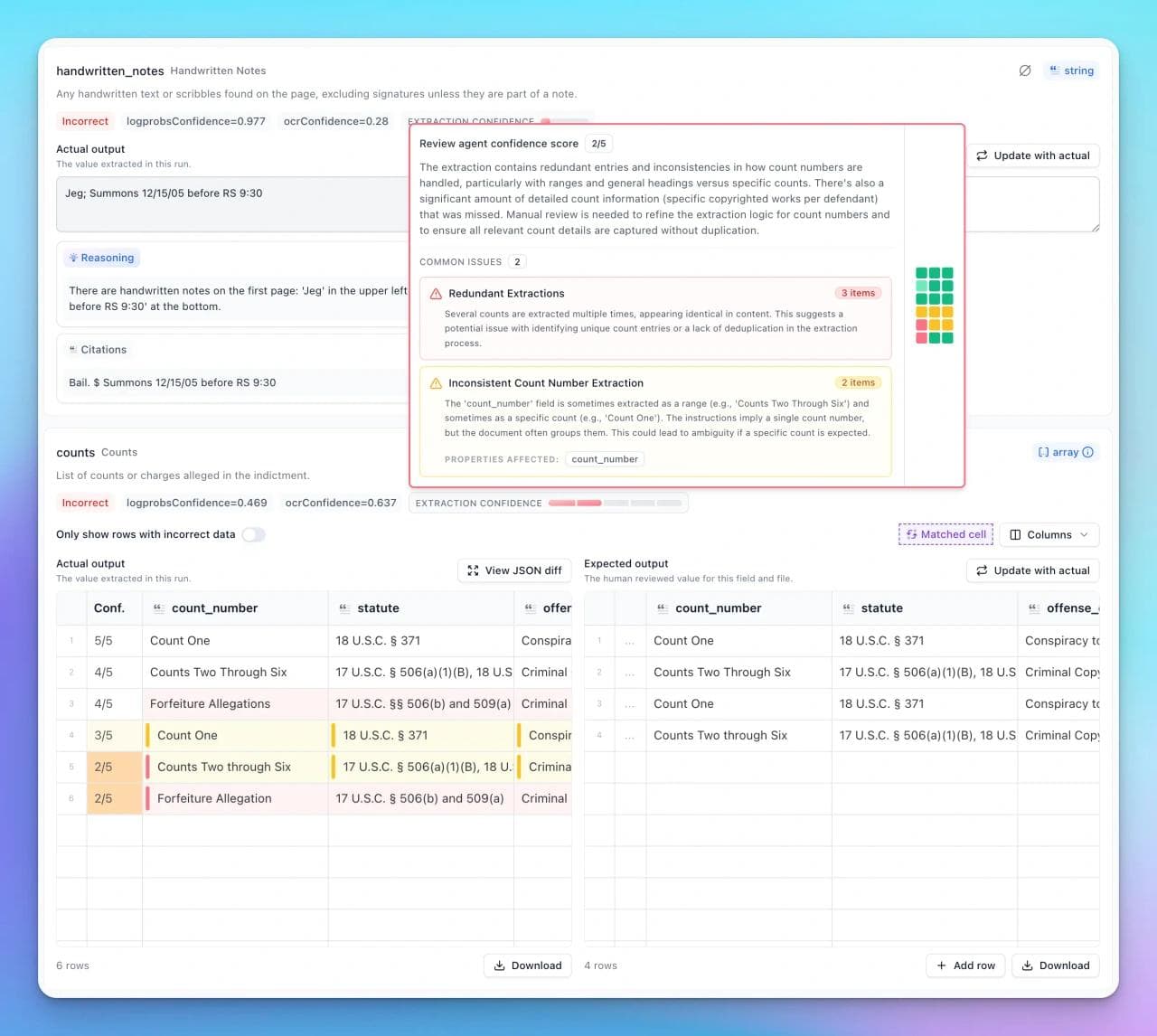
The more distinctive reason to consider Extend is the work surrounding extraction. Extend provides evaluation sets, a Review Agent, human-review steps, and workflows that connect parsing, extraction, classification, splitting, validation, and routing. That is useful when a parser result is only the first step in an operational queue.
In our parsing-only fixture, Extend Performance recovered every tested literal. Its four observed runs took longer and had a higher listed cost than the tested Reducto and LlamaParse configurations. Those comparisons do not include the value or cost of Extend's evaluations and review workflow, nor do they compare its lower-cost Light engine.
Choose Extend when the switching goal is to build a measurable document operation, not simply exchange one Markdown endpoint for another. Price the parse, extract, agentic correction, and review stages needed for an accepted result. Extend's own credit documentation makes those components visible separately.
3. Unstructured: when ingestion is the real problem
Unstructured belongs on the shortlist for teams whose pain starts before parsing or continues long after it. Its managed platform connects content sources, partitions documents, chunks and enriches them, creates embeddings, and writes to destination systems. That can replace a collection of ingestion jobs around LlamaParse rather than the parser alone.
Do not treat Unstructured's open-source library and managed API as the same product. Its open-source documentation describes the library as a prototyping starting point and lists material differences in models, extraction performance, chunking, enrichments, operations, and compliance. The managed platform advertised more than 40 connectors and multiple deployment routes when we checked it.
In our local test, Unstructured OSS 0.27.5 with the automatic PDF strategy recovered 100% of the digital-report items, 96.9% of the table items, 96.4% of the scanned-invoice items, and 100% of the mixed-layout items. All 46 transaction IDs appeared exactly once. It missed one invoice line total and three literal table labels after normalization. That 98.3% macro average describes one local default, not Unstructured's hosted VLM or High Res services.
As of September 6, 2026, Unstructured's public pricing page listed 10,000 free starting pages and $0.015 per page afterward for pay-as-you-go use. It also labeled structured data extraction as coming soon. Recheck that status if schema extraction is central, because LlamaParse, Reducto, and Extend already expose dedicated extraction surfaces.
Choose Unstructured when source synchronization, document transformation, embeddings, destination delivery, and workflow operation are one purchase. If you only need a parse call, its broader system may be more than the migration requires.
4. Mistral OCR 4: a lower-level component
Mistral OCR 4 is a credible alternative when the team wants a focused document-understanding model instead of another full parsing platform. The current OCR endpoint accepts document or image inputs and can return Markdown, typed blocks, bounding boxes, and confidence scores. Document AI options can add JSON-schema output, image annotations, and a custom document prompt.
Mistral's June 2026 OCR 4 release listed the API at $4 per 1,000 pages, with a 50% batch discount, and Document AI at $5 per 1,000 pages. Enterprise self-hosting was also available. The older 2025 Mistral OCR announcement is now marked deprecated, so comparisons should use OCR 4 rather than inherited claims about the original model.
We did not include Mistral in our authenticated test. Its low public page price is attractive, but it is not equivalent to a finished LlamaParse migration. A team may still need to define chunks, stable identifiers, evaluation, retries, schema extraction behavior, storage, and indexing.
Choose Mistral OCR 4 when those layers are already yours or when a smaller, composable API is the point. Choose a fuller platform when rebuilding operational plumbing would erase the apparent saving.
5. Docling: the self-hosted baseline
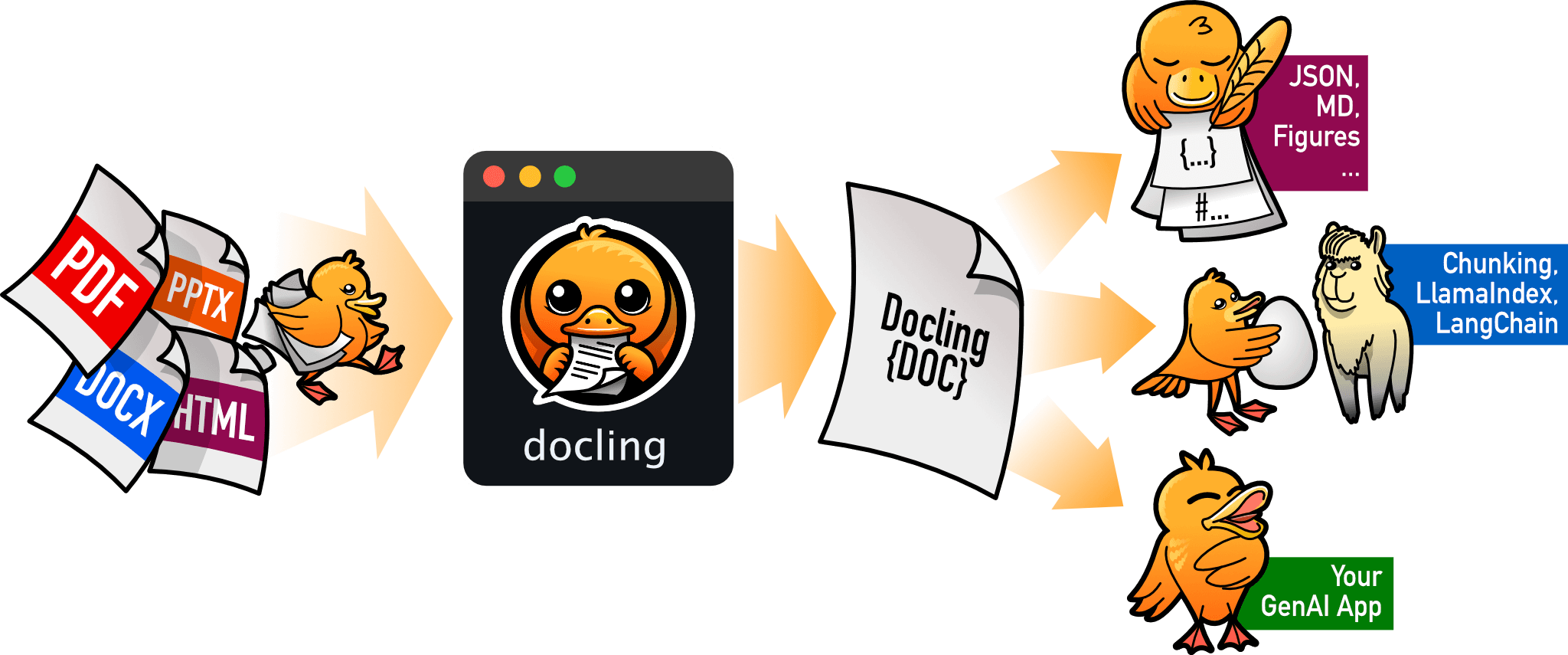
Docling is the clearest alternative when local execution is a hard requirement. It converts PDFs and native Office files into a structured DoclingDocument, then exports Markdown, HTML, JSON, text, or chunked JSONL. It supports OCR, layout analysis, tables, formulas, image understanding, several vision models, a CLI, and an API server through docling-serve.
The software is open source under the MIT license, but local does not mean costless. Your team owns inference hardware, dependency management, concurrency, upgrades, monitoring, and the gap between a notebook result and a production service. Benchmark the pinned version, models, and hardware you intend to run.
With Docling 2.126.0 and DocumentConverter defaults, our local run recovered 100% of the digital-report and table items, 64.3% of the scanned-invoice items, and 50% of the mixed-layout items. The missed mixed-layout items were mostly chart labels and values; the deliberately low-resolution invoices accounted for ten other misses. No OCR, table, model, or accelerator tuning was attempted, so the 78.6% macro average establishes the current default's behavior on this corpus, not Docling's ceiling.
Choose Docling when infrastructure ownership and data locality are more important than a managed control plane, and budget time to configure it for your difficult document classes. It is also useful as a local baseline: if a tuned deployment passes your acceptance pack, a hosted service needs to justify its added cost.
When should you stay with LlamaParse?
Stay when the current integration already works and the alternative does not fix a measured problem. LlamaParse remains especially coherent for teams that want parsing, extraction, classification, splitting, indexing, and agent tooling inside the LlamaIndex ecosystem.
Its current Parse documentation exposes four tiers, version pinning, custom prompts or schemas, page-level routing, and Markdown, text, or JSON outputs across more than 130 file types. Enterprise customers can also discuss a private-VPC deployment. Switching has real costs: output mappings, chunk identifiers, page numbering, retry behavior, caches, tests, and monitoring all need review.
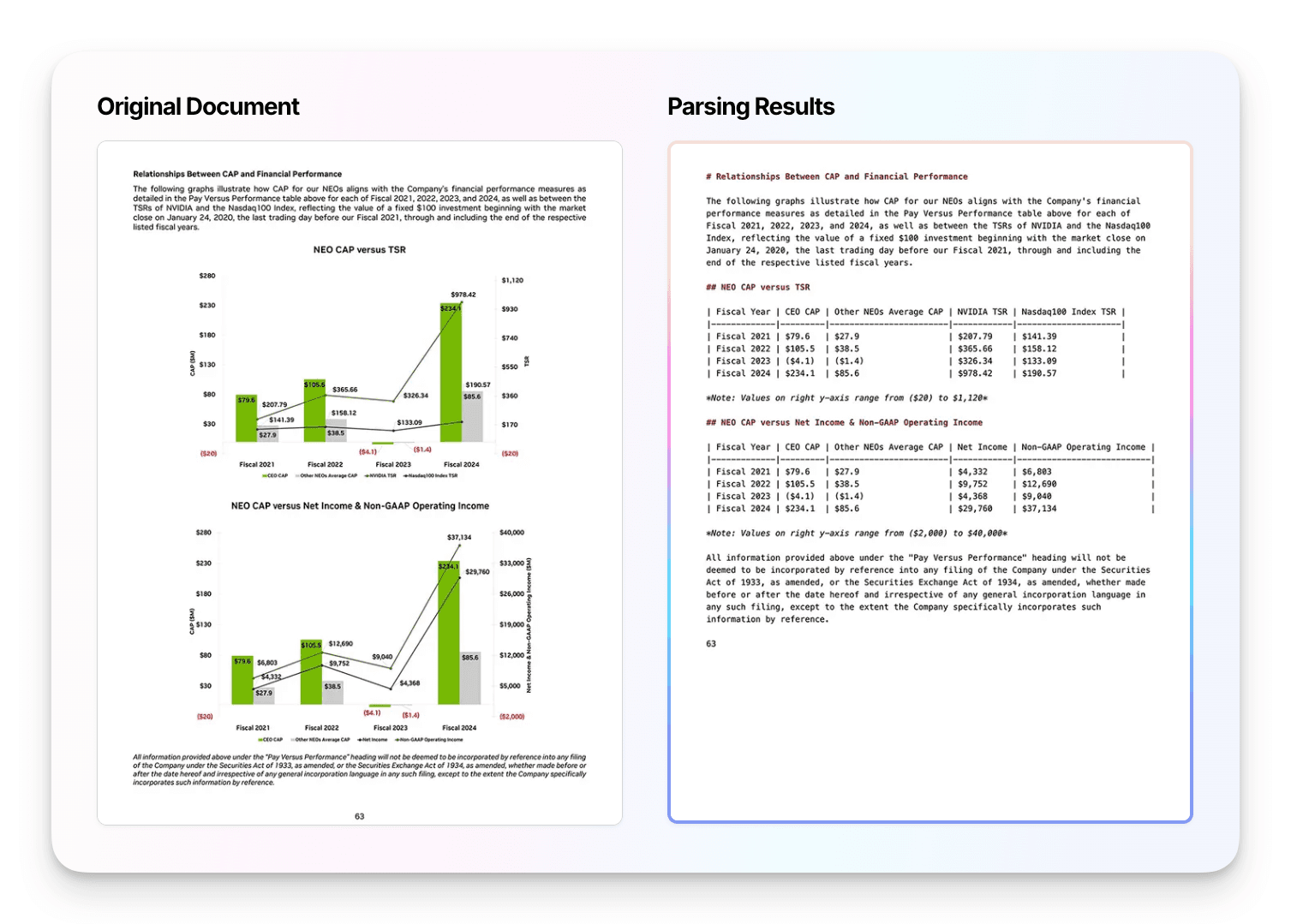
Our test does not show a substantive recall failure that would justify leaving LlamaParse. It shows that credible alternatives can preserve the tested content while returning materially different representations and operational surfaces.
A safer migration test
Before routing production documents to a replacement:
- Build a small acceptance pack from the document families that create real errors or cost. Remove or synthesize sensitive content before sharing files externally.
- Define expected content independently of every parser result. Include complete arrays, merged tables, boilerplate policy, figures, source locations, and failure handling.
- Run the incumbent and candidate with named tiers, versions, prompts, and options. Save raw responses and reported usage.
- Compare the output your application consumes, not only a vendor viewer. A field that exists in metadata is useless if your adapter drops it.
- Price the accepted workflow. Include parsing, extraction, retries, review, storage, and downstream model tokens.
- Change one schema or parser option and rerun. This tests whether the integration remains maintainable after its first successful demo.
- Shadow-run representative traffic before changing the production route.
The right alternative is the one that improves a constraint you can name: fidelity on a difficult document class, a better source-grounding contract, lower complete-workflow cost, stronger evaluation and review, connected ingestion, or infrastructure control.
Our recommendation
For a direct hosted replacement, run Reducto and Extend beside LlamaParse on your own acceptance pack. Start with Reducto when parsing controls and source-grounded output are the main need. Start with Extend when extraction evaluation and review are part of the system you want to buy.
Consider Unstructured when the larger challenge is keeping many sources synchronized into retrieval destinations. Consider Mistral OCR 4 when you want a lower-level document model and already own the rest of the pipeline. Consider Docling when local execution is non-negotiable and your team can operate it.
Our eight-page test found more agreement than disagreement. That is useful: it moves the buying decision away from vague claims of “better parsing” and toward the output contract, workflow, deployment model, and cost you will actually maintain.
LlamaParse alternatives FAQ
What is the closest alternative to LlamaParse?
Reducto and Extend AI are the closest hosted alternatives in this shortlist because both provide parsing plus adjacent structured-extraction capabilities. Test their exact output schemas and paid configurations against your LlamaParse integration.
Is there an open-source alternative to LlamaParse?
Docling is a strong open-source candidate for local document conversion and parsing. Unstructured also has an open-source library, but its own documentation distinguishes that library from its managed production platform.
Is Docling better than LlamaParse?
Not universally. Docling provides local control and avoids sending documents to a hosted parser, while LlamaParse provides managed infrastructure and a broader LlamaIndex-native platform. Accuracy and cost depend on your documents, Docling configuration, hardware, and LlamaParse tier.
Can Mistral OCR replace LlamaParse?
It can replace the document-understanding step for some teams. It does not automatically replace every chunking, evaluation, indexing, retry, and workflow capability a team may use around LlamaParse.
Which LlamaParse alternative is best for RAG?
For a direct RAG parser comparison, start with Reducto and Extend, then evaluate the chunk representation and source grounding your retriever needs. Use Unstructured when source and destination connectors are central, Mistral OCR when you build your own ingestion layer, or Docling for a local stack.

Real editable visuals. Real canvas. Full control.
Fly through design work