5 Reducto Alternatives for Document Parsing: A Hands-On Comparison
We tested Reducto, Extend, and LlamaParse on the same PDFs, then compared Mistral OCR, Unstructured, and Docling for different document workflows.
 Anvisha Pai, Co-founder & CEO, Moda
If you want the closest Reducto alternative, start with Extend or LlamaParse. Both now offer much more than PDF-to-Markdown conversion. Extend wraps parsing and extraction in an evaluation and review workflow. LlamaParse combines configurable parsing with extraction, classification, splitting, and indexing.
But those are not the only sensible answers. Mistral OCR is a focused document-understanding component for teams building their own application. Unstructured is strongest when connected ingestion and document ETL are the larger problem. Docling is the local, open-source option when files must stay in infrastructure you operate.
We ran Reducto, Extend, and LlamaParse on the same four synthetic PDFs. Across these eight pages, all three preserved every tested table cell, invoice value, transaction ID, and reading-order statement after harmless formatting differences were normalized. The useful differences were how each system represented charts, handled boilerplate, priced the run, and exposed the surrounding workflow.
This is a small acceptance test, not a universal leaderboard. For a broader map of seven tools across PDF, Excel, and PowerPoint, see our AI document parser comparison. This guide answers the narrower question: what should replace Reducto for your particular job?
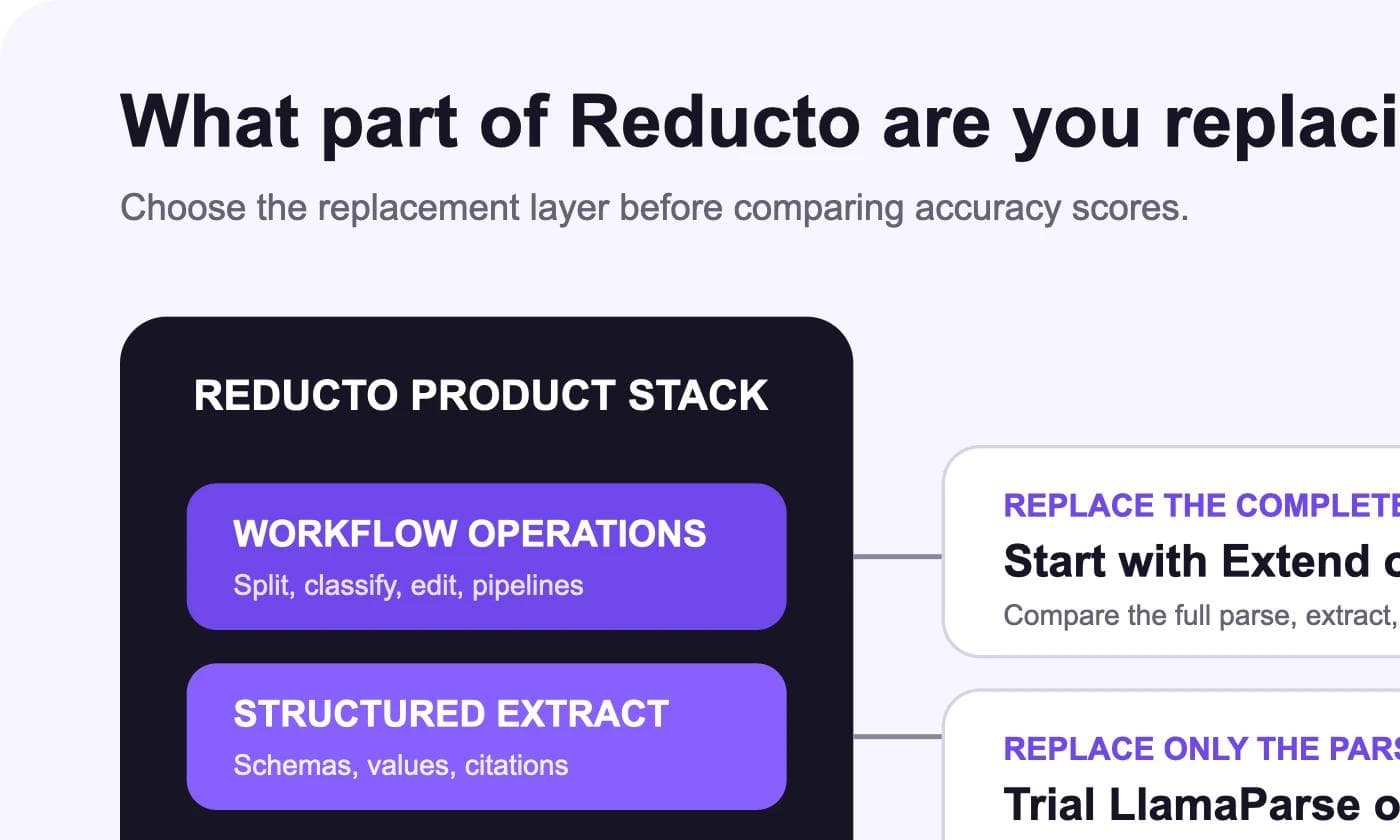
The five Reducto alternatives at a glance
| Alternative | Replacement layer | Start here when | Main purchase check |
|---|---|---|---|
| Extend | Managed parsing and extraction platform | You need evaluations, review, and maintained extraction processors | Price the complete parse, extract, and review path |
| LlamaParse | Managed parsing and LlamaCloud platform | You need configurable parsing, Office-file controls, or a wider RAG stack | Pin the exact tier and version you tested |
| Mistral OCR | Document AI component | Your team will build intake, validation, and routing around an OCR API | Confirm which surrounding workflow features you must supply |
| Unstructured | Document ETL platform or open-source partitioner | Sources, connectors, chunking, enrichment, and destinations are central | Separate the managed platform from the OSS library |
| Docling | Local document-conversion library | Data locality and infrastructure control outweigh managed convenience | Budget for models, hardware, upgrades, and operations |
Reducto remains a strong option when you want detailed parsing controls, source grounding, typed extraction, and several document operations behind one API. Looking for an alternative does not mean it failed. You may be changing costs, deployment requirements, developer workflow, or the kind of output your application consumes.
What are you actually replacing?
Reducto's current product surface includes Parse, Extract, Split, Classify, Edit, pipelines, Studio, and multiple deployment options. Its Parse documentation describes structured chunks containing text, tables, figures, layout, positions, and confidence. Extract adds schema-shaped fields and optional citations back to source locations.
That creates four different replacement decisions:
- Replace the complete managed platform. You need parsing, extraction, routing primitives, and tools for maintaining the workflow.
- Replace only the parser. You want reliable Markdown, JSON, tables, or layout blocks for an application you already operate.
- Replace the ingestion layer. Your real problem is moving documents from sources through transformation, chunking, enrichment, and storage.
- Replace the hosted service. Privacy, infrastructure control, or unit economics justify running models yourself.
An OCR endpoint can be excellent without replacing Reducto's extraction workflow. A document ETL system can solve more of the pipeline while offering a different parsing interface. A local library changes who owns capacity, updates, and failures. Compare products within the layer you need before comparing accuracy scores.
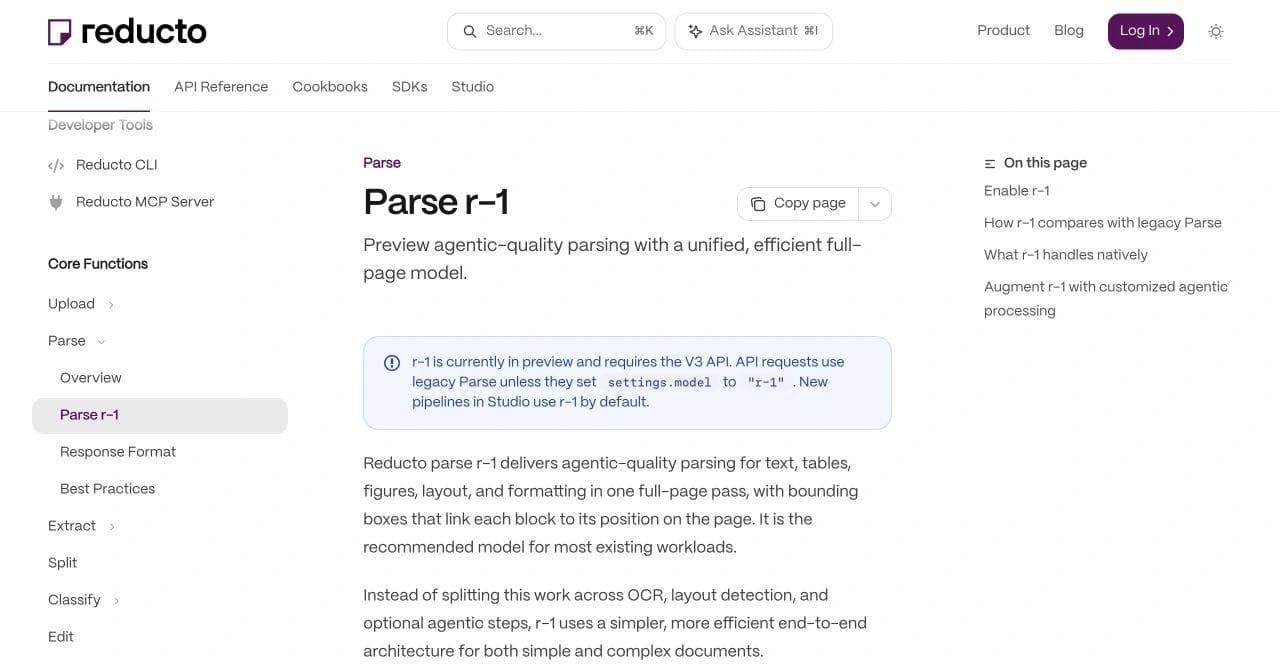
How we tested Reducto, Extend, and LlamaParse
We built four synthetic PDFs locally, then visually checked every rendered page before sending them to the three services:
- A two-page report with headings, two-column reading order, an ordered list, a footnote, a formula, and a KPI table.
- A three-page table pack with wrapped labels, blank cells, parentheses, European number formatting, and a 46-row table spanning pages.
- Two raster-only invoice pages with light skew, line items, totals, addresses, and a handwritten-style approval note.
- A mixed-layout page with checkboxes, comparison symbols, a formula, chart labels, percentages, a caption, and a footer.
The configurations were Reducto r-1 preview through its V3 SDK, Extend Performance Parse using the September 6 default, and LlamaParse V2 Agentic using the latest version with Markdown expanded. These are reasonable quality-oriented settings, not equivalent price or quality tiers.
We retained the raw JSON, exact configurations, timestamps, and fixture ground truth. Literal recall checked 175 expected strings across eight pages. It allowed harmless Markdown, HTML, spacing, and mathematical-formatting differences. It did not score every coordinate, penalize every extra word, or measure production reliability. We tested structured extraction separately below so a successful parse could not stand in for a successful schema-shaped result.
You can download the benchmark pack to inspect the fixtures, sanitized provider outputs, ground truth, and evaluators used for these comparisons.
What the eight-page test found
| Tested system | Literal recall by fixture | Four-file wall time | Listed cost for 8 pages |
|---|---|---|---|
| Reducto r-1 | 100%, 100%, 100%, 100% | 17.179 seconds | About $0.08 |
| Extend Performance | 100%, 100%, 100%, 100% | 45.854 seconds | About $0.20 |
| LlamaParse Agentic | 100%, 100%, 100%, 90.9% | 93.163 seconds | About $0.10 |
The four recall figures correspond to the digital report, tables, scanned invoices, and mixed-layout fixtures. LlamaParse's lower mixed-layout score came from omitting a generic footer and page number. It retained the substantive content. For a RAG index, that omission may be useful noise removal. For archival reconstruction, it may violate the output contract.
All three systems preserved the 46 transaction IDs exactly once, recovered the normalized invoice values, and kept the ten labeled reading-order statements in the intended left-column-then-right-column order. On this corpus, raw fact recovery did not separate the products.
Representation did. Reducto summarized the bar chart in concise prose with all five values. Extend returned a typed figure block containing label-value lines and a generated caption. LlamaParse turned the chart into a two-column HTML table. Prose is compact, a figure block preserves element type, and a table is straightforward to query. The right answer depends on the consumer.
The wall times are one synchronous run per file from one machine and network, including upload and processing. Reducto completed these particular calls sooner, but four sequential jobs cannot establish general latency, throughput, or uptime. The costs use public list rates checked September 6, 2026. Extend also returned 16 credits in its responses. Free allowances, storage, extraction, review, retries, and downstream processing are excluded.
A separate schema-extraction test
Parsing asks what is in a document. Extraction asks for specific values in a predictable shape. To test the second job directly, we sent the same two-page raster-only invoice PDF to Reducto Extract, Extend Extract, and LlamaExtract.
Every service received the same JSON Schema. It requested two invoices in page order, with invoice number, date, currency, bill-to address, purchase order, payment terms, subtotal, tax, total due, and six fields for every line item. We wrote the 60 expected scalar values before inspecting any response.
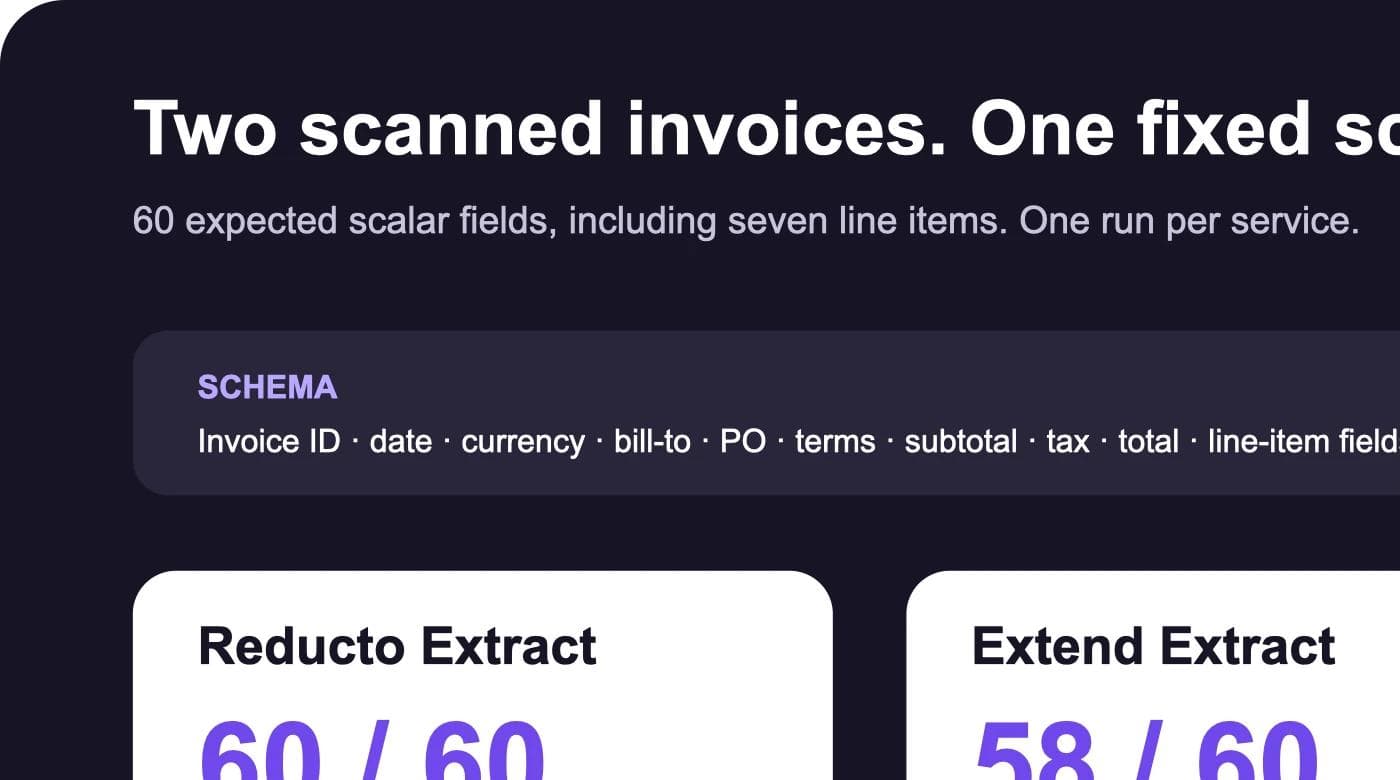
| Service | Expected values recovered | Observed wall time | What separated the response |
|---|---|---|---|
| Reducto Extract | 60 of 60 | 26.8 seconds | Wrapped values with source citations and extraction confidence |
| Extend Extract | 58 of 60 | 32.1 seconds | Returned both invoice objects and all seven line items, but shortened both bill-to fields to the company name |
| LlamaExtract | 60 of 60 | 27.0 seconds | Returned all expected values plus field-level grounding metadata |
The comparison normalized currency symbols, punctuation, and harmless spacing, such as Net30 versus Net 30. It did not forgive missing words. Extend returned Harbor Research LLC for both bill-to fields instead of the requested company and street address, producing the two misses. All three systems found the two invoices, their seven total line items, identifiers, dates, monetary values, quantities, and purchase-order numbers.
This result makes Reducto's grounding concrete rather than theoretical: each returned value included a citation to page content, and the response exposed extraction and parse confidence. LlamaExtract also returned grounding metadata, while Extend returned citations and OCR confidence in its response metadata. We did not score whether every citation polygon was perfectly tight, so this is evidence that grounding was returned, not a citation-accuracy ranking.
The times are one end-to-end run per service from one machine and network. They include upload and processing but do not establish production latency, throughput, or reliability. The fixture is synthetic and only two pages long. Treat 60 of 60 as passing this acceptance test, not as proof that either system is universally more accurate. The useful miss was semantic: if your schema says “bill-to,” decide whether the contract means a legal entity, a complete address block, or separate fields for each.
1. Extend: the closest alternative for maintained extraction workflows
Extend's documentation currently covers Parse, Extract, Classify, Split, Edit, saved processors, Studio, evaluations, review, and composed workflows. Its Parse response can include layout-aware Markdown, typed blocks, bounding boxes, and spatial metadata. Its Extract API accepts a schema and can return confidence data and source citations.
Extend is the strongest first evaluation when the difficult part is not the first successful parse, but keeping an extraction workflow correct as documents and schemas change. Evaluation sets store expected outputs. The Review Agent can flag extraction issues and score fields or array items. That creates a loop for correcting results, retaining examples, changing a processor, and checking regressions.
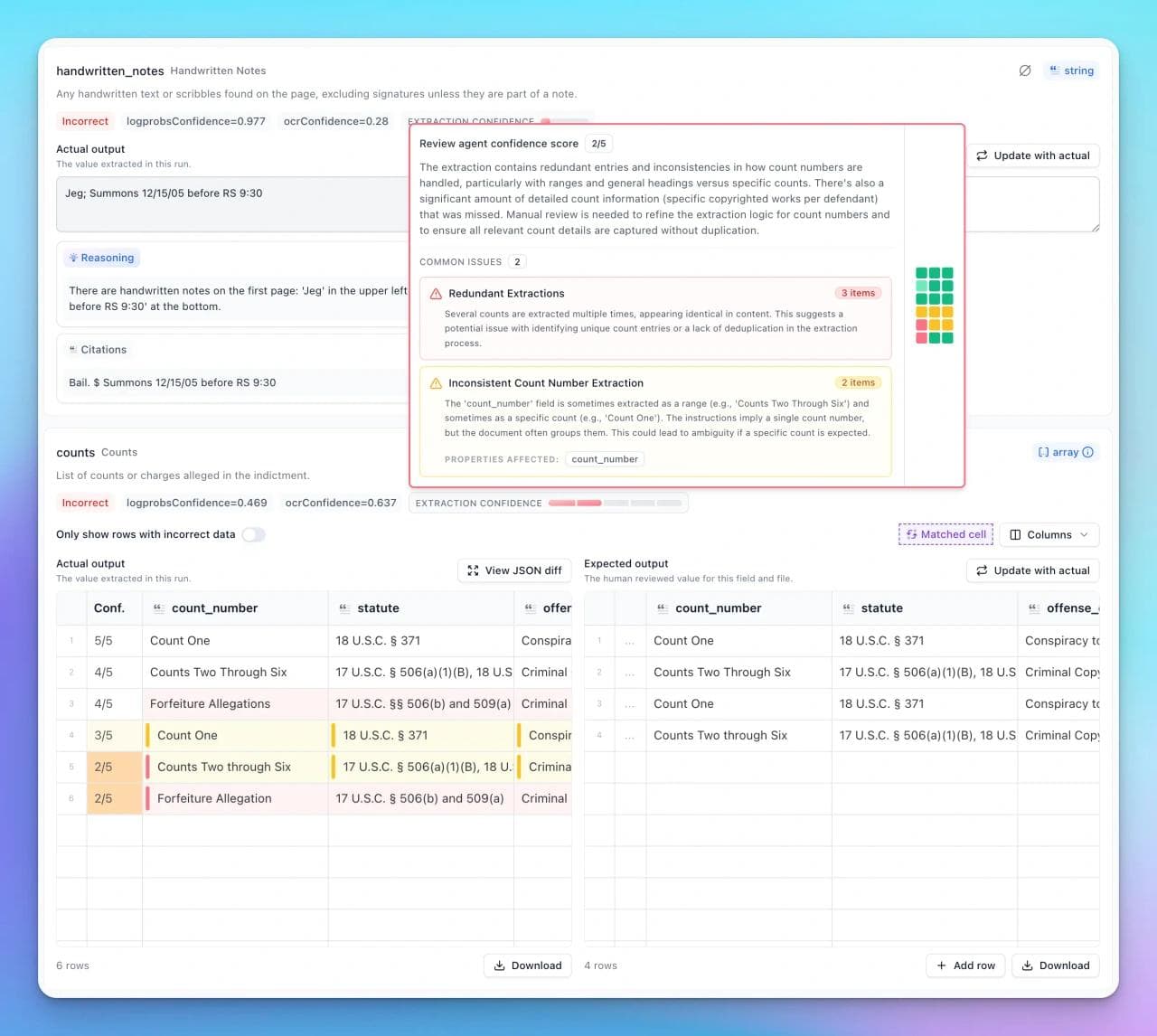
Our extraction test covered Extend Extract with a fixed schema, not its saved-processor evaluation loop or Review Agent. It recovered 58 of 60 expected values, with both misses caused by omitting the street address from a combined bill-to field. That supports a narrow claim about this run, not a general accuracy ranking or proof that review catches production errors.
At current Pay As You Go pricing, Performance Parse is listed at two credits per page and each credit costs $0.0125. Extraction, agentic corrections, and review can add credits. Build a complete job estimate from the workflow you will deploy rather than comparing only the initial parse.
Choose Extend first if: processor iteration, evaluation, and exception review are central to the purchase.
Stay with Reducto or keep it in the trial if: its r-1 output, detailed parsing controls, or deployment options already match the hard part of your workflow.
2. LlamaParse: the closest alternative for parsing and RAG flexibility
LlamaParse is now part of a broader LlamaCloud surface with Parse, Extract, Classify, Split, Index, batches, a web UI, SDKs, a CLI, and agent integrations. Its current Parse overview lists Fast, Cost Effective, Agentic, and Agentic Plus tiers, plus version pinning, prompts, schemas, table and chart handling, and more than 130 file types.
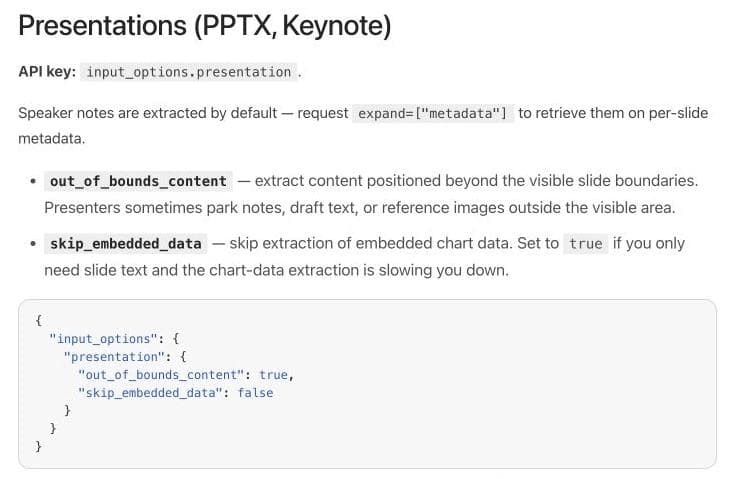
LlamaParse deserves particular attention when the source corpus includes native Office files. Its configuration documentation describes controls for presentation speaker notes, off-slide content, embedded chart data, spreadsheet tables, and formula computation. Do not flatten those decisions into a checkmark for PPTX or XLSX support.
In our PDF test, LlamaParse recovered all tested substantive values. It represented the chart as an HTML table and intentionally or incidentally omitted the mixed-layout page's generic footer and page number. That is a valuable reminder to define the output contract before scoring a parser. “Remove boilerplate” and “preserve the document” can produce different correct answers.
We tested the Agentic tier at the latest version. A Fast or Agentic Plus run is a different configuration with a different cost and output contract. Pin the tier and version that pass your acceptance set before relying on the result in production.
Choose LlamaParse first if: configurable parsing, Office-file semantics, or integration with the wider LlamaIndex and LlamaCloud stack matters.
Do not switch based only on: an attractive output from one tier without carrying the exact tier, version, expansions, and parsing options into the deployed request.
3. Mistral OCR: a focused component for a custom pipeline
Mistral's OCR processor returns page Markdown and can separately expose tables, images, hyperlinks, headers, footers, dimensions, typed blocks, bounding boxes, and confidence data. Document annotations add schema-shaped extraction.
The June 2026 OCR 4 announcement describes 170-language support, block classification, inline confidence, an API, and an enterprise self-hosting path. Its performance figures combine public benchmarks with Mistral-run evaluation, so treat them as vendor evidence until you reproduce the relevant task on your documents.
Mistral makes sense when you want a composable model/API layer and expect to own document intake, queues, validation, version changes, exception routing, and downstream storage. That can be a feature for a platform team. It can also turn a cheap OCR call into a larger engineering project.
Choose Mistral OCR first if: you need a focused multilingual document-understanding component and will build the surrounding product.
Do not treat it as a drop-in platform replacement until: you map every Reducto feature your application currently uses beyond Parse.
4. Unstructured: replace document ETL, not only OCR
Unstructured spans two products that should be evaluated separately. The managed platform builds workflows across document sources, partitioning, chunking, enrichment, embeddings, and destinations. The open-source unstructured library partitions many file types into typed elements and offers document-specific strategies.
Its managed partitioning documentation describes Fast, High Res, VLM, and automatic routing strategies. Its open-source partitioning documentation exposes local functions and a different installation and operations model. The legacy single-file Partition endpoint is not the complete current managed workflow product.
Unstructured is compelling when the recurring problem is keeping a corpus synchronized from storage systems into search or retrieval infrastructure. A common parser test is still useful, but it misses much of that purchase. Evaluate source metadata, updates, retries, chunking, enrichment, and destination behavior alongside page output.
We also ran Unstructured 0.27.5 locally with partition_pdf(strategy="auto", infer_table_structure=True). Literal recall was 100% on the digital report, 96.9% on the tables, 96.4% on the scanned invoices, and 100% on the mixed-layout page. It retained all 46 transaction IDs exactly once, but missed one invoice line total and three literal table labels after normalization.
That is evidence about one automatic open-source configuration, not Unstructured's hosted VLM or High Res services, which we did not test. The default local result also does not establish the library's ceiling. A tuned strategy, model, OCR setup, or workflow may behave differently.
We intentionally exclude local wall time from the hosted comparison. This run launched a fresh Python process for every file, and its first document initialized or downloaded dependencies. That measures setup and process-start cost, not steady-state service latency.
Choose Unstructured first if: connectors and document ETL are as important as parsing.
Avoid a false comparison: local library behavior does not establish the managed platform's models or operational experience, and the managed product does not make self-hosting effortless.
5. Docling: the local-control baseline
Docling converts files into a structured Docling Document and can export Markdown or Docling JSON. Its supported-format list includes PDF, DOCX, XLSX, PPTX, images, and many text and publication formats. The core repository uses the MIT license.
This is the most structurally different alternative on the shortlist. Files can stay in the environment you operate, the intermediate representation is inspectable, and you select the pipeline and optional OCR or vision components. In return, your team owns installation, model downloads, hardware, scaling, monitoring, upgrades, and failure recovery.
We ran Docling 2.126.0 locally using the default DocumentConverter PDF pipeline. Literal recall was 100% on the digital report, 100% on the tables, 64.3% on the deliberately low-resolution scanned invoices, and 50% on the mixed-layout page. The misses included ten tested strings in the scans and eleven mixed-layout items, mostly chart labels and values.
This establishes what Docling's current default did on our corpus, not what Docling can achieve after OCR, model, table, or accelerator tuning. We also exclude its local wall time from the hosted table. Each file launched in a fresh Python process, and the first run included dependency initialization or downloads. Comparing that cold local process with a remote synchronous API would produce a precise number for two different operating conditions, not a useful speed ranking.
Choose Docling first if: local processing and infrastructure control are requirements rather than nice-to-have features.
Keep a managed parser in the comparison if: operational simplicity and elastic throughput are worth paying for.
Reducto vs Extend vs LlamaParse
For the closest three-way decision, use the hardest required output as the tie-breaker:
- Start with Reducto when explicit parsing controls, grounding, current r-1 output, or its deployment options map closely to the requirement.
- Start with Extend when the team needs a maintained evaluation and review loop around schema extraction.
- Start with LlamaParse when parsing configuration, native Office semantics, or the wider LlamaIndex stack is important.
Then run all serious candidates on the same acceptance pack. Include a long table, a noisy scan, a layout whose reading order matters, and the native Office files you actually ingest. Write expected outputs before seeing any parser response. Count missing, duplicated, and invented rows separately. Verify that every citation points to evidence that supports the extracted value.
Finally, change one schema or parsing rule and rerun the pack. A parser's first demo matters less than whether your team can diagnose and safely maintain it six months later.
Our recommendation
For a direct hosted Reducto replacement, trial Extend and LlamaParse first. The eight-page test did not produce a general accuracy winner: all three hosted systems recovered the substantive tested content, while their output representation and boilerplate policies differed. Choose based on the output contract and workflow your application needs.
Add Mistral OCR when you want a lower-level component, Unstructured when ingestion and delivery are part of the purchase, and Docling when local control justifies owning the runtime. These are not consolation prizes. They are answers to different architecture decisions.
The best next step is not uploading one friendly invoice. Build a small, adversarial acceptance set from the document types that create real support tickets, define what must survive, and preserve every raw response. A parser should win because it meets that contract at an acceptable complete-job cost.
Frequently asked questions
What is the closest Reducto alternative?
Extend and LlamaParse are the closest general-purpose hosted alternatives in this shortlist. Both cover configurable parsing and broader document operations. Extend emphasizes processor evaluation and review, while LlamaParse connects parsing to the wider LlamaCloud and LlamaIndex stack.
Is Extend better than Reducto?
Not universally. In our small PDF test, both recovered every literal item we checked after normalization. Reducto completed these particular synchronous runs in less wall time and had a lower listed parse cost. Extend offers a documented evaluation and Review Agent workflow that may matter more for maintained extraction systems. Test the complete job you need.
Is LlamaParse better than Reducto?
It depends on the output contract and ecosystem. LlamaParse recovered all substantive tested values but omitted generic boilerplate on one fixture. That may improve a RAG index and harm an archival workflow. Its configurable tiers and Office-file controls make it a serious alternative, but the exact tier and version matter.
What is the best open-source Reducto alternative?
Docling is the clearest local document-conversion baseline in this shortlist. Unstructured also provides an open-source partitioning library. They have different representations, dependencies, and operating models, so test the exact package, pipeline, and models you intend to deploy.
Can Mistral OCR replace Reducto?
It can replace the parsing or document-understanding component for some applications. It does not automatically replace every workflow around Reducto, such as splitting, routing, evaluation, exception handling, or deployment operations. Map the used endpoints before switching.
Did you test all five alternatives?
We ran Reducto, Extend, and LlamaParse as hosted parsing services on four synthetic PDFs totaling eight pages. We also ran Reducto Extract, Extend Extract, and LlamaExtract against a fixed 60-value schema on the two scanned invoice pages. Pinned local versions of Unstructured and Docling ran on the parsing corpus, but are reported separately because local initialization and hardware do not compare cleanly with hosted APIs. Mistral OCR and Unstructured's hosted product were researched from current official documentation and were not tested.

Real editable visuals. Real canvas. Full control.
Fly through design work