Base44 vs Lovable: Which AI App Builder Fits in 2026?
Base44 vs Lovable compared for app building, backend, code ownership, Git sync, visual editing, testing, deployment, and long-term maintenance.
 Anvisha Pai, Co-founder & CEO, Moda
Base44 and Lovable are two of the most prominent vibe-coding platforms. The decision is no longer simply “easy no-code builder versus more flexible AI coder.” Both can now generate full-stack apps, manage a backend, edit code, sync with GitHub, test flows, and publish to a custom domain.
If you are still deciding whether either product is the right category, start with our guide to Lovable alternatives by project type. Developers weighing a broader coding environment should also compare Replit vs Lovable.
The better choice depends on the system you want to own after the first impressive demo. Base44 is strongest when you want an integrated app platform and prefer to keep the database, authentication, integrations, analytics, and operations inside one managed environment. Lovable is stronger when code and infrastructure portability are central requirements, or when developers expect to continue the project in a conventional Git workflow.
Base44 vs Lovable: the quick answer
- Choose Base44 when you want the shortest path from a prompt to a managed app and are comfortable building around Base44's data, authentication, integration, and hosting model.
- Choose Lovable when you want a prompt-first builder with a clearer route into a standard React and Git development workflow, including the option to move frontend or backend infrastructure later.
- Choose neither when your project has high-risk security, compliance, performance, or architecture requirements that need experienced engineers from the beginning.
- Consider Moda instead only when the deliverable is a polished static marketing site, campaign page, portfolio, or simple lead-capture site. Moda is not an app builder and does not replace Base44 or Lovable for authenticated products, complex backend logic, or SaaS development.
Research note: this comparison is based on current product documentation plus independent hands-on reports. Moda did not run a controlled Base44 versus Lovable build benchmark, and one-off generations are not treated as durable evidence of speed or code quality.
Base44 vs Lovable comparison
| Decision | Base44 | Lovable |
|---|---|---|
| Core model | Integrated AI app platform | AI development platform with managed and portable deployment paths |
| Best starting point | Founder or operator who wants the platform to supply most of the stack | Founder or product team that wants AI speed plus a conventional code path |
| Backend | Built-in entities, auth, functions, integrations, agents, and workflows | Lovable Cloud or an external Supabase-compatible backend |
| AI workflow | Build, Discuss, and visual Edit modes; model selection and comparison | Plan and Build modes, goal runs, subagents, drafts, and preview editing |
| Manual editing | Visual element editing, code tab, Tailwind classes | Preview editing and a project code editor |
| Git workflow | Two-way GitHub sync on qualifying plans | GitHub or GitLab sync, plus cloning and external development |
| Portability | GitHub sync for code; CLI eject duplicates frontend code, schemas, and backend resources into another Base44 project, but does not copy app data or remove Base44 runtime dependencies | Standard React projects; frontend and data can move to external infrastructure |
| Testing and recovery | Branches, version history, test data, testing agent, logs, security scans | Drafts, version history, browser testing, frontend tests, backend logs, security scans |
| Operational model | More platform-managed by default | Managed by default, with a more explicit hybrid or self-managed path |
| Static marketing site | Possible, but the app stack may be more than you need | Possible, but the app stack may be more than you need |
Feature access depends on plan and rollout. Check the current Base44 plans and Lovable pricing against your exact project before committing.
The decision framework most comparisons miss: choose your exit path first
AI app builders are usually evaluated at the moment of creation. That favors whichever tool turns one prompt into the most convincing first screen. A more consequential test is what happens after 20 revisions, real users, a schema change, a broken integration, and a developer joining the project.
Independent tests show why that caution matters. TechRadar's Base44 review reported two stalled attempts before producing a working app and found Lovable faster in its review sequence. A separate free-plan benchmark reached the opposite provisional result, with Base44 finishing faster, but explicitly noted that it was one run and that Lovable ran out of free credits before a fair follow-up revision. The useful conclusion is not that either tool is always faster. It is that you should test the full revision and handoff cycle on your own project.
Before choosing either platform, decide which of these outcomes you want:
- Remain fully managed. You want the platform to own hosting, backend services, authentication, deployment, and most operational decisions.
- Use a managed platform with developer escape hatches. You want to start with prompts, but keep code in Git and make local changes when needed.
- Treat the builder as scaffolding. You plan to move the product to infrastructure maintained by an engineering team.
Base44 is particularly compelling for the first outcome. Lovable is usually easier to justify for the third. Both can serve the middle, but the details of what moves and what remains platform-specific matter.
Where Base44 is stronger
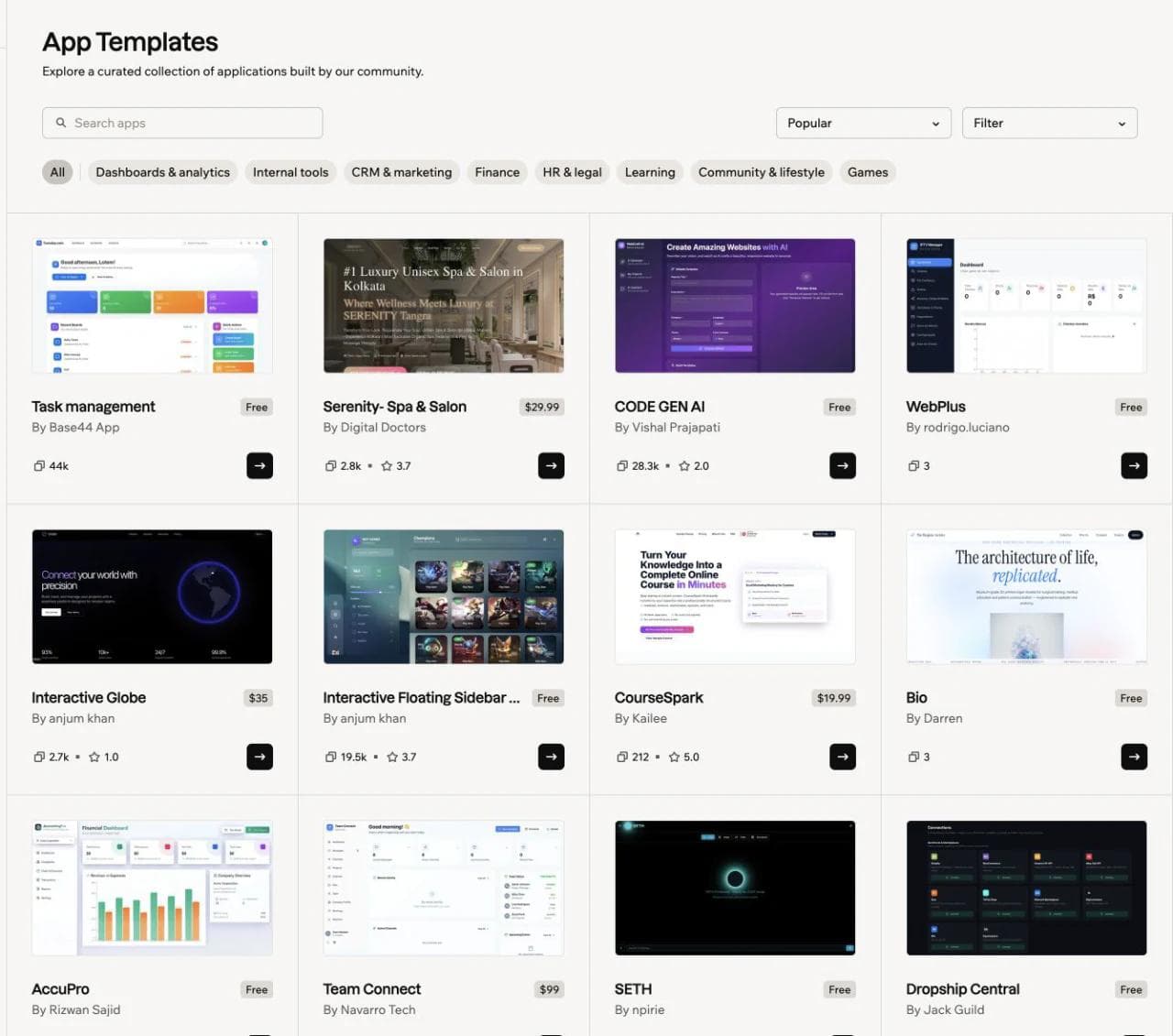
Base44 keeps more of the application stack in one mental model
Base44 describes itself as a platform for building apps, websites, and AI agents with built-in design, databases, user management, and hosting. Its documentation exposes entities, row and field permissions, authentication, serverless backend functions, automations, workflows, connectors, analytics, session recordings, and security scans as parts of the same system.
Wix acquired Base44 in 2025 and said it would continue operating as a distinct product. Base44 therefore has the backing of a larger website platform, while its long-term roadmap now sits inside Wix.
That breadth is useful for an operator who wants to build an internal portal, directory, lightweight CRM, workflow tool, or customer-facing MVP without selecting and connecting several vendors. Base44 can create and modify database records through chat, while its managed integrations can handle common actions such as sending email or calling external services.
The tradeoff is architectural commitment. The more your application relies on Base44 entities, agents, connectors, and integration credits, the more important it becomes to understand how those pieces would be reproduced elsewhere.
Its editing workflow now goes beyond repeated prompting
Some older Base44 comparisons describe a prompt box with little direct control. That is stale. Base44 currently documents three distinct modes:
- Build mode applies changes immediately.
- Discuss mode explores a change without modifying the application.
- Edit mode lets you select interface elements and change colors, spacing, text, and Tailwind classes manually or with AI.
The platform also supports custom project instructions, file freezing, version restoration, model selection, and side-by-side model comparisons. These controls help reduce a common AI-builder failure mode: spending prompts to reverse a change the agent should not have made. See Base44's current AI chat documentation.
Base44 provides a guided route into code
Base44 is not a sealed no-code box. Its Code tab supports direct source editing, and its current GitHub integration provides automatic two-way sync on eligible plans. A developer can clone the repository, run the app locally with the Base44 CLI, merge changes into main, and see them return to the Base44 project. Base44 documents that workflow here.
That makes Base44 more developer-friendly than many older reviews suggest. It still does not mean every part of a production application is independent of Base44.
Where Lovable is stronger
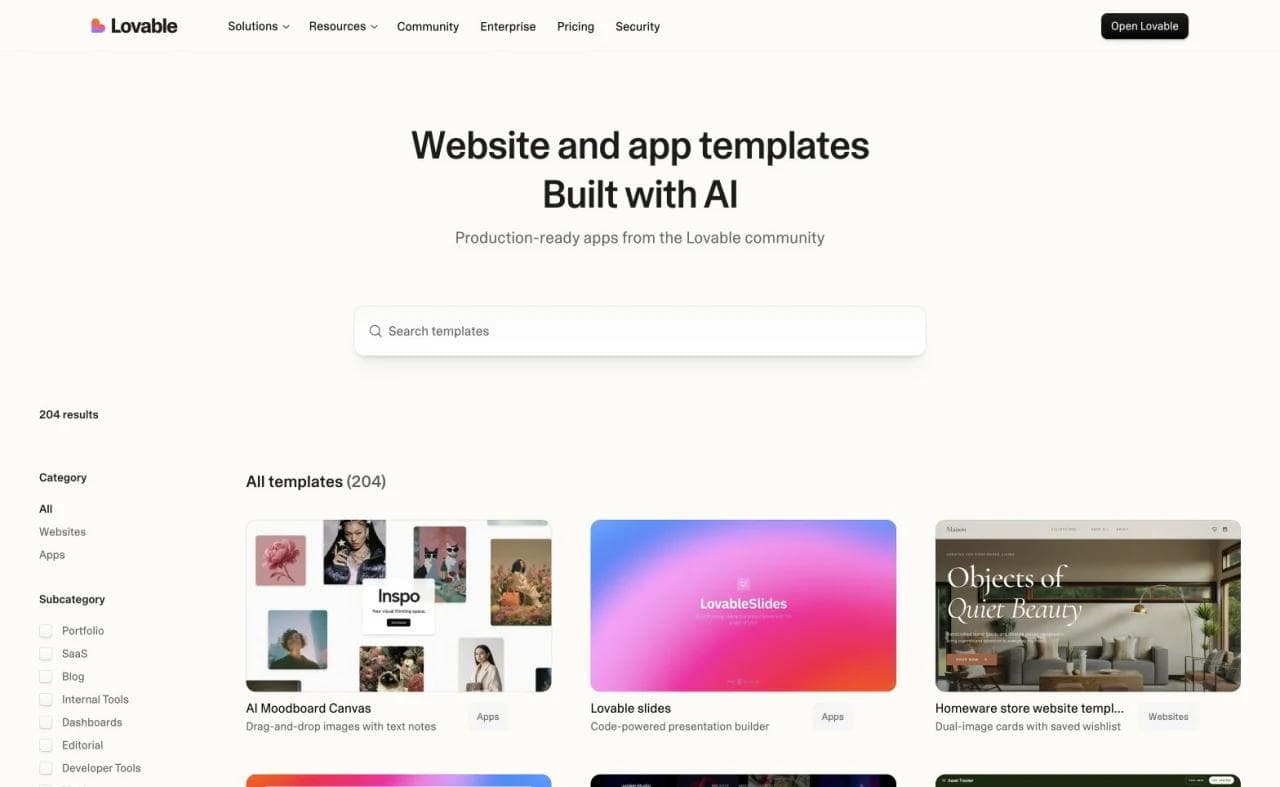
Lovable makes code and infrastructure ownership more explicit
Lovable projects use standard web technologies, and Lovable says projects can sync continuously with GitHub or GitLab. Teams can clone the repository, modify it outside Lovable, deploy the frontend elsewhere, or move toward self-managed infrastructure.
Lovable's own deployment guide separates an application into code, frontend hosting, and backend/data. You can keep everything on Lovable, host the frontend elsewhere while retaining a managed backend, or operate more of the stack yourself. That is a clearer migration model for a team that expects engineers to take over. Review the exact boundaries in Lovable's deployment, hosting, and ownership guide.
Portability still has a cost. If you leave Lovable's managed environment, your team becomes responsible for CI/CD, hosting, authentication, storage, backups, security, monitoring, and equivalent backend services. Owning the code is not the same as owning a production-ready operating system for free.
Lovable fits more naturally into a conventional product-development workflow
Lovable's current workflow includes Plan mode, Build mode, persistent project knowledge, reusable skills, goal runs, subagents, drafts, code editing, preview editing, version history, browser testing, and security checks. Plan mode is especially useful when a request could affect several parts of an application because it separates reasoning from implementation.
Developers can inspect source files, reference exact files in chat, download the codebase, or work through Git. Non-developers can continue making visual and prompt-based changes. That combination is attractive when a mixed product team wants the initial speed of vibecoding without treating the generated project as disposable.
Lovable's backend has a documented path toward standard infrastructure
Lovable Cloud includes a PostgreSQL-based database, authentication, storage, edge functions, secrets, logs, and managed deployment. Lovable also supports external Supabase projects. Its portability documentation explains how data and schemas can move, while noting that equivalent authentication, storage, realtime, and edge services must be supplied if you move away from the managed stack.
This does not make migration effortless. It does make the dependency boundary relatively visible before you build.
Code ownership: both improved, but the exports are not equivalent
The outdated shortcut is “Lovable gives you code, Base44 locks it away.” Base44 now supports two-way GitHub sync and local development, so that claim is no longer accurate.
The better question is what the code still expects at runtime.
Base44's CLI can also eject an app into a separate Base44 project. Its documentation says the command downloads frontend code, entity schemas, and backend resources, but not the application's data. It then creates a new Base44 backend project with a new app ID. That is useful for duplication and isolated development, but it is not the same as migrating the whole application to a vendor-neutral backend. See the Base44 eject command.
Lovable's standard frontend can be hosted outside Lovable. Moving a backend built on Lovable Cloud still requires a compatible backend and migration work. Lovable specifically notes dependencies on services such as auth, storage, realtime, and edge functions.
For either product, perform a portability rehearsal on a representative app before it becomes critical. Use something concrete, such as an internal request tracker with requester, approver, and admin roles, existing records, private attachments, an approval workflow, and one external notification:
- Connect the project to Git and make a reviewed change from a clean local clone.
- Run the frontend without the builder open and identify which backend calls still depend on the platform.
- Export representative records and attachments, then verify that relationships, identifiers, and timestamps survive.
- Inventory every platform SDK, secret, database, function, integration, authentication flow, and hosted service.
- Reproduce requester, approver, and admin permissions outside the original preview, including direct URL and API attempts.
- Estimate the code, data, identity, deployment, monitoring, and rollback work required to operate the app elsewhere.
Which is better for design and brand control?
Both products have moved beyond uneditable generated interfaces. Base44 has theme controls, a design system, Figma import, direct element editing, and code access. Lovable has design guidance, reusable design systems, Figma workflows, preview editing, React components, and access to component ecosystems.
Neither should be selected solely because a first prompt produced a fashionable landing page. Test a precise revision instead:
- Apply an existing type scale and color system.
- Match a supplied mobile layout, not just the desktop screenshot.
- Change one repeated component without altering neighboring sections.
- Add a new state to an existing component.
- Ask a marketer to update copy without touching application logic.
- Ask a developer to locate and review the resulting implementation.
The winner is the product whose working model your team can understand and maintain, not the one with the flashiest first generation.
Which is safer for a real production app?
Neither platform removes the need for security and product engineering judgment. Generated authentication, permissions, payment flows, data access rules, and API integrations deserve human review. A successful preview only proves that the happy path worked in that session.
At minimum, verify:
- Row-level and field-level permissions with multiple user roles
- Secrets kept out of browser code and repositories
- Authentication recovery and account deletion
- Payment webhook validation and duplicate-event handling
- Abuse prevention and rate limits
- Backups and data export
- Error monitoring and operational logs
- Browser tests for destructive and permission-sensitive actions
- A recovery path when an AI change breaks an existing flow
Both vendors now document testing and security tooling. Use those tools, but do not mistake an automated scan for a complete security review.
Access control differs before application logic begins
Base44's access documentation separates live-app users from editor collaborators and offers Private, Workspace, and Public app visibility. Private apps require a paid plan, and the current platform applies one visibility level to the app, so mixed public and private areas need role and data-permission design rather than a page-level visibility switch.
Lovable's publishing documentation separates project-editor access from published-site access. Free and Pro sites are externally reachable to anyone with the link, while workspace-only published access is available on Business and Enterprise plans. If the project is an internal tool, verify this plan boundary before comparing build credits or interface polish.
When Moda is the better choice
Base44 and Lovable are application builders. If you need accounts, private user data, database-driven workflows, background jobs, or complex backend logic, choose one of them or use a conventional development stack. Moda is not viable for that job.
Moda becomes relevant when the thing you are publishing is a static website rather than an application. Examples include:
- A launch or campaign landing page
- A branded company or product website
- A portfolio
- An event page
- A brochure-style site
- A lead-generation page with a simple form
Moda focuses on brand fidelity and visual quality, and it can create the surrounding launch assets such as slides, social graphics, ads, and video in the same creative workflow. That is useful for a marketing team, but it is a different category from vibe coding. Do not choose Moda for SaaS, authenticated portals, marketplaces, or application development.
Base44 vs Lovable: which should you choose?
Choose Base44 if:
- You want a broad managed stack with fewer infrastructure decisions.
- A non-technical operator will own most iteration.
- Built-in entities, workflows, connectors, analytics, and agents match the app you are creating.
- You are comfortable with Base44 remaining an important part of the runtime architecture.
Choose Lovable if:
- Git-based development and code review are first-class requirements.
- Developers are likely to take over or extend the project.
- You want an explicit path from fully managed hosting to a hybrid or self-managed stack.
- You expect to use standard React, PostgreSQL, or Supabase-oriented infrastructure.
Choose a conventional engineering stack from the start if:
- The product handles sensitive or regulated data.
- You need unusual infrastructure, networking, compliance, or performance characteristics.
- Complex authorization and backend correctness are central to the product.
- Your team already knows it will rewrite the generated application before launch.
The most useful Base44 vs Lovable test is not “Which one built my first screen faster?” It is “Which project's architecture, data, and revision workflow will I still understand six months from now?”
Frequently asked questions
Is Base44 better than Lovable?
Base44 is often the better fit when you want a highly integrated, managed app platform with built-in data, authentication, workflows, and integrations. Lovable is often better when code portability, Git-based development, and a path to external infrastructure matter more. Neither is universally better.
Can Base44 sync with GitHub?
Yes. Base44 documents automatic two-way GitHub sync on its Builder plan and above. Connected projects can be cloned and edited locally with the Base44 CLI. Older articles that describe Base44 as having no GitHub workflow are out of date.
Can I export a Lovable app and host it myself?
Lovable says you own the code and can sync it to GitHub or GitLab, host the frontend elsewhere, and migrate backend infrastructure. Self-hosting means your team must replace and operate any managed services the application depends on, including auth, storage, deployments, and monitoring.
Which is easier for a non-developer?
Base44's integrated platform can reduce the number of infrastructure choices a beginner must make. Lovable also supports non-developers, but its strongest long-term advantage appears when someone on the team can understand the generated code and infrastructure boundaries. The easier choice depends on the complexity of the application, not just the first prompt.
Should I use Base44 or Lovable for a landing page?
Both can create landing pages, but a full-stack app builder may be unnecessary for a static marketing page. A website-focused platform such as Framer, Webflow, Wix, Squarespace, or Moda can be a better fit when the page needs strong design, publishing, SEO controls, and a simple lead form rather than application logic.
---

Real editable visuals. Real canvas. Full control.
Fly through design work