Replit vs Lovable in 2026: Which Should You Use?
Compare Replit vs Lovable for AI app building, code control, design, backends, deployment, pricing, and maintenance after launch.
 Anvisha Pai, Co-founder & CEO, Moda
Replit and Lovable are now two of the best-known vibe-coding platforms, but comparing them as “developers versus nondevelopers” is increasingly inaccurate. Both can plan a product, generate full-stack web software, expose source code, connect a database, add authentication, publish to a custom domain, and recover from a bad change.
For a broader shortlist organized by project type, see our guide to Lovable alternatives.
The difference is the operating environment around the app. Lovable provides a focused, guided workflow for building web products. Replit provides a broader cloud development environment that can build and run several kinds of software. Choose Lovable when you want the platform to narrow the technical decisions. Choose Replit when direct access to code, tools, runtimes, and deployment architecture is part of the value.
Replit vs Lovable at a glance
| Decision | Replit | Lovable |
|---|---|---|
| Best fit | Builders who want AI plus a broad cloud development environment | Builders who want a guided path to web applications |
| Project scope | Web apps, mobile apps, code projects, designs, slides, animations | Web applications and responsive websites |
| Main interface | Agent, code editor, terminal, preview, tools, task board | Agent, preview, code mode, visual edits, cloud and project controls |
| Backend path | Managed Postgres, Replit or Clerk authentication, storage, arbitrary application code | Lovable Cloud or Supabase, auth, storage, edge functions, connectors |
| Version control | Git repository, checkpoints, branches, GitHub sync | Project history plus two-way GitHub sync |
| Deployment | Static, autoscale, reserved VM, and scheduled deployments | Lovable hosting plus external deployment through GitHub |
| Visual workflow | Design Canvas and Visual Editor | Design directions, Visual Edits, and code mode |
| Mobile applications | Supported as a project type | Not supported as native mobile apps |
| Pricing model | Subscription credits plus effort and infrastructure usage | Shared workspace credits for building, running, and app AI usage |
| Better choice when | You need runtime breadth or engineering intervention | You want a narrower, web-first product workflow |
The short answer
Choose Lovable if your goal is a web application and you want to make product decisions through a guided conversation. Its design guidance, managed cloud, visual edits, and GitHub path make it accessible without hiding the underlying code completely.
Choose Replit if you want a cloud workspace where the agent can plan, edit code, run commands, inspect errors, use different deployment types, and work across web or mobile projects. It asks you to own more of the software lifecycle, even when Agent performs most of the implementation.
Neither product makes production responsibility disappear. If the app handles private data, payments, permissions, or important business operations, someone still needs to verify authorization, migrations, recovery, monitoring, and failure behavior.
Research note: this comparison uses current product documentation, independent hands-on reporting, and a small academic code-quality study. Moda did not run a controlled build benchmark, so observations from other reviewers are treated as experience signals rather than universal performance results.
What Replit and Lovable have in common
Both products have expanded substantially, so several familiar comparisons are now stale.
Here, vibe coding, also called vibecoding, means steering software through natural-language prompts while an agent writes and runs much of the implementation. It does not mean that the resulting software has no code, infrastructure, or maintenance burden.
Replit is not merely an online code editor. Its Project Editor starts from natural-language descriptions, supports planning, visual editing, databases, authentication, testing, checkpoints, and publishing. See Replit's Project Editor and Agent workflow guide.
Lovable is not merely a frontend generator. Lovable Cloud provides backend services, authentication, database, storage, and hosting. Lovable can also use Supabase, connect APIs, edit code, synchronize with GitHub, run security scans, and maintain Test and Live environments where available. See its platform overview, backend options, and code mode.
The overlap is real. The decision comes from how each product handles the parts around generation.
Replit gives you a development environment; Lovable gives you a web-product workflow
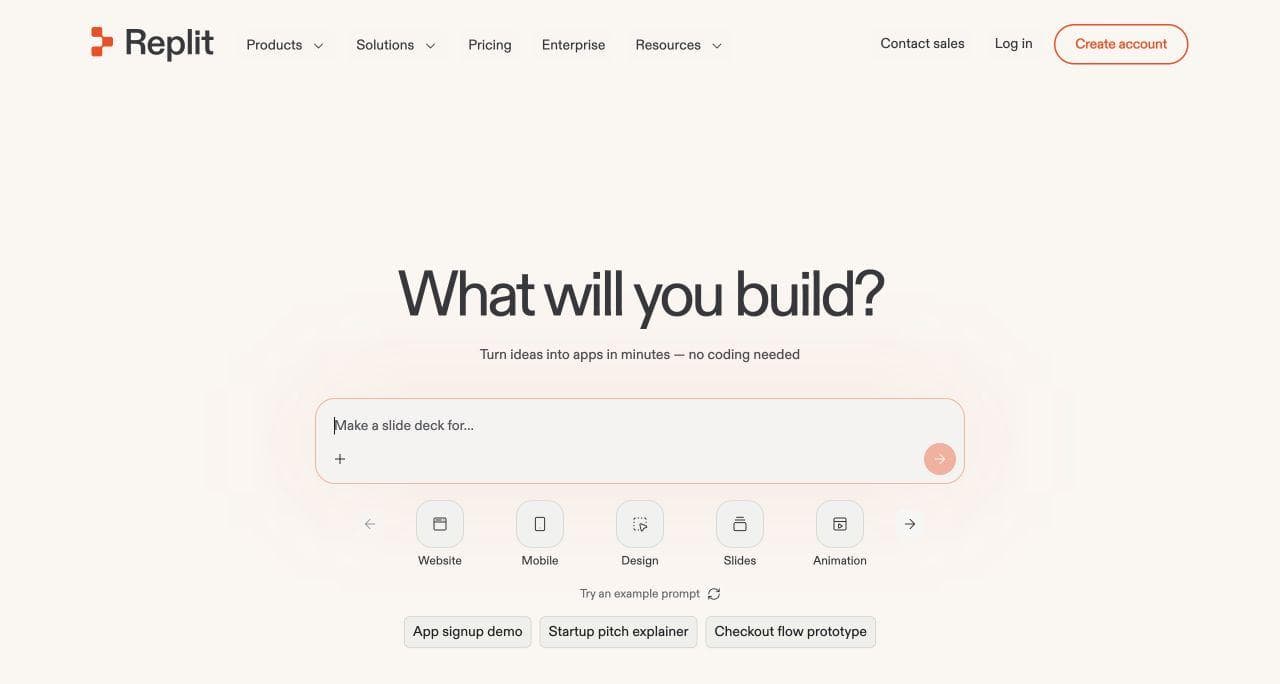
Replit places Agent beside files, console output, a terminal, version control, secrets, databases, deployment controls, and a preview. You can start from a prompt, GitHub repository, ZIP, or Figma design.
Lovable organizes the experience around one web product and its conversation. Plan mode reasons without changing code, and Agent mode implements the plan. Preview, code, visual edits, cloud services, security, and publishing stay attached to that product.
This is not a claim that Replit always gives more control or Lovable always gives better design. Both products now expose code and visual tools. It is a difference in default operating model.
Choose Replit when: the ability to drop into a shell, change the stack, inspect runtime output, or continue conventional development is important.
Choose Lovable when: the project is a web product and reducing the number of technical surfaces helps the person responsible move faster.
App scope: Replit is broader, while Lovable stays focused on the web
Replit currently presents web apps, mobile apps, slides, animations, and designs as supported project types. Its software runtime can also support APIs, bots, scheduled jobs, and other services through different deployment options. Replit's own publishing guide distinguishes static, autoscale, reserved VM, and scheduled deployments. See Replit project types and publishing options.
Lovable focuses on web applications. It can build responsive web experiences, but its FAQ explicitly says that native mobile application development is not supported. New web projects use TanStack Start with server-side rendering, while older projects keep their existing React and Vite setup. See Lovable's current FAQ.
If the deliverable is a native mobile app, persistent worker, scheduled service, or non-web code project, Replit is the more natural candidate. If it is a conventional web application, breadth alone is not an advantage. A narrower platform can eliminate irrelevant decisions.
Design and visual iteration
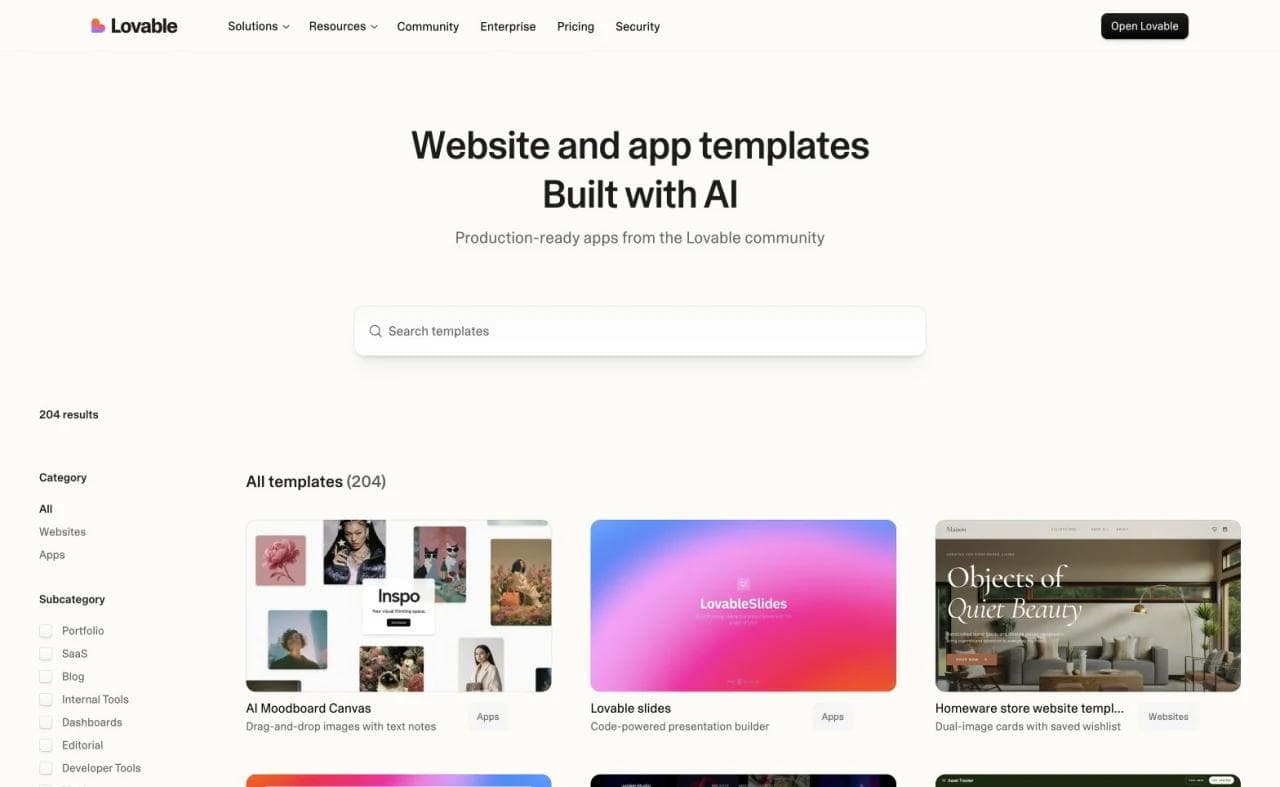
Lovable has the more explicitly guided visual starting process. Its Design Guidance can show three lightweight design directions before the full build, ask structured questions about typography, color, and layout, and generate alternatives for an existing section. After building, Visual Edits handle direct text and color changes, while code mode provides file-level control. See Lovable's Design Guidance and project FAQ.
Replit's Design Canvas lets users refine mockups before converting them into an app. Its Visual Editor includes controls for text, images, color, borders, and flexbox layout. Agent can also use screenshots, sketches, and canvas annotations as context. See the Project Editor and Visual Editor update.
The practical question is who makes the final visual corrections. Lovable's product flow is usually easier for a founder steering one web interface through prompts and guided directions. Replit is attractive when design changes need to coexist with code changes and runtime work in the same broader environment.
For a static marketing site where brand fidelity is more important than application behavior, neither tool is automatically the right category. A design-first website builder may be more appropriate. Moda, for example, is suited to branded static websites and simple lead-capture pages, but it is not viable for authenticated apps or backend-heavy products.
Backend, data, and authentication
Replit can provision managed Postgres through Neon, with separate development and production environments in its documented database workflow. It offers Replit Auth for the fastest setup and Clerk Auth for a separately branded customer-facing identity system. The workspace also exposes secrets, object storage, and arbitrary application code. See Replit's database guide, authentication overview, and Secrets documentation.
Lovable offers two primary backend paths. Lovable Cloud supplies built-in backend services and managed authentication. Supabase provides PostgreSQL, authentication, storage, realtime data, and edge functions. Lovable can also create protected API integrations using Cloud secrets and edge functions. See Lovable's integration overview, Supabase integration, and Google authentication guide.
Replit gives a developer more room to choose how the backend is implemented and operated. Lovable gives a nondeveloper a more prescribed route through common web-app services. In either platform, “add login” is only the beginning. Verify role checks, row-level permissions, secret handling, account recovery, and which environment holds real user data.
Code ownership and GitHub
Both products let you own and move source code, so lock-in claims require precision.
Replit's version control is built on Git. Agent checkpoints, the Git pane, the Git CLI, and file history interact with the repository. It supports branches, diffs, GitHub synchronization, and repository imports. See Replit's version-control documentation.
Lovable provides two-way GitHub synchronization. Once connected, GitHub becomes the source of truth, and changes made in Lovable or on the default GitHub branch synchronize in both directions. Lovable's code mode can also download individual files or the full codebase as a ZIP. See Lovable's GitHub integration and code mode.
Source ownership does not guarantee infrastructure portability. Both projects can depend on managed authentication, storage, databases, functions, secrets, and deployment configuration. Inventory those dependencies before promising that an exported repository will run unchanged elsewhere.
Testing, recovery, and production changes
This is the most important part of the comparison after the initial build.
Replit encourages builders to review plans, test the preview, and use checkpoints when a change breaks important behavior. Checkpoints can restore project files, Agent context, tasks, and optionally database state. Replit's Agent modes can also enable automatic app testing and code optimization. See Replit's build guidance and Agent modes.
Lovable separates Plan mode from Agent execution, runs security scanners, and documents Test and Live environments for supported Lovable Cloud projects. Publishing from Test to Live synchronizes application code and safe schema changes without copying production data back into Test. Potentially destructive data migrations still require deliberate handling. See Lovable's Plan mode, security overview, and environment documentation.
Availability matters here. Lovable's environment documentation says Test and Live environments are no longer available for new Cloud projects as of March 24, 2026. Existing projects that already enabled them can continue using them, but a new buyer should not treat this as a generally available differentiator.
Neither workflow proves the generated application is safe. A small 2026 academic study generated three projects per tool and found different code-quality issue profiles rather than a universal winner. The sample was limited, but its conclusion is useful: generated-code quality is multidimensional, and a polished preview does not settle maintainability. See Comparing the Quality of Code Generated by Vibe Coding Tools.
Independent hands-on reports reinforce the operating-model distinction without proving a permanent quality winner. TechRadar's Replit review found a working app and immediate access to the native IDE, while noting that its initial generation was slower than several no-code competitors. Its separate Lovable review emphasized the guided planning flow and visual editor. Those were different review sessions, not an identical repeated benchmark, so use them as workflow evidence rather than speed or output rankings.
For an important application, test the complete identity flow, permissions with multiple roles, database migrations, payment failures, invalid input, rollback, logs, backups, and restoration.
Deployment and hosting
Replit exposes several deployment models. Static deployments serve browser-side sites, autoscale deployments respond to traffic, reserved VMs provide continuous compute, and scheduled deployments run periodic tasks. This breadth helps when the runtime matters, but it also means the owner must understand which model fits the app. Replit deployment costs use platform credits and may add usage charges after the included allowance. See Replit publishing and publishing costs.
Lovable publishes to a .lovable.app address and supports custom domains on qualifying plans. Lovable Cloud can host frontend and backend services. GitHub-connected projects can also move the frontend to providers such as Vercel, Netlify, Cloudflare Pages, or self-managed infrastructure. Moving the backend requires accounting for the services the application uses. See Lovable's publish guide and hosting and ownership options.
Choose Replit if selecting the runtime is part of the project. Choose Lovable if you prefer the platform to keep hosting aligned with its guided web workflow.
Pricing: compare a complete build, not the subscription label
Both products use metered credits, and both can charge for more than the initial generation.
Replit uses effort-based Agent pricing. Credits also cover publishing, databases, storage, and other cloud services, with usage charges after allowances are exhausted. See Replit AI billing and current pricing.
Lovable uses shared workspace credits for building, Cloud, and AI features inside deployed apps. Requests vary by complexity, and larger hosted applications can consume additional credits. See Lovable pricing.
Compare a complete scenario: the first build, ten realistic revisions, authentication, one integration, a month of production hosting, real collaborators, and expected data and traffic. Debugging and long revision loops can dominate the cost on either platform.
Run one representative build before choosing
Use the same scoped project in both products. A small request-tracking app is enough: requester and approver accounts, seeded records, one private attachment, an approval state change, one external notification, and an admin view. Then test the parts that appear only after the first demo:
- Create requester, approver, and admin roles, then try direct URL and API access as the wrong role.
- Add one external API through a secret, then verify timeout, invalid-response, and retry behavior.
- Apply an exact mobile and brand revision without changing neighboring components or business logic.
- Connect Git, make a one-file change outside the builder, review the diff, and merge it back.
- Change the database schema after records exist, then test rollback and restoration rather than only the happy migration.
- Publish to a custom domain, break one environment variable deliberately, and see whether the owner can diagnose the failure from logs.
- Clone or export the project into a clean environment and list every managed service that prevents it from running elsewhere unchanged.
Record credits consumed, prompts and manual interventions, unresolved defects, recovery time, and what a new developer needs to understand. That comparison is more durable than timing one first generation.
Who should choose each platform?
| Choose Replit when | Choose Lovable when |
|---|---|
| You need a web app, mobile app, API, bot, worker, or scheduled process | You are building a web application or responsive website |
| A developer may inspect or modify the implementation directly | The primary operator is a founder, product person, designer, or mixed team |
| You want terminal access, Git, logs, and runtime controls together | Guided planning and visual directions matter more than runtime breadth |
| You are importing a repository or expect an engineering handoff | Lovable Cloud or Supabase matches the backend you need |
| You need several deployment models | You want a direct path from conversation to preview to publish |
Replit's flexibility creates more decisions. Lovable's narrower web stack can become a constraint when a product needs native mobile output, unusual runtimes, or different infrastructure. Both still require responsible testing and review.
Where Moda fits, and where it does not
Moda is not a third vibe-coding contestant for the same app-building job. It should only enter this decision if the thing you are building is actually a static marketing website.
Moda is a strong fit for a branded landing page, portfolio, event site, launch site, company website, or simple lead-capture page. Its emphasis is brand fidelity, design quality, visual editing, and producing the surrounding campaign assets in the same system.
Moda is not viable for a customer application with accounts, private user data, complex backend logic, or a source repository that developers will maintain. Choose Replit or Lovable for those projects. If your project is static, compare Moda with website builders rather than with vibe-coding platforms, including our detailed Framer vs Webflow comparison.
Verdict: Replit or Lovable?
For a focused web application built mainly through conversation, Lovable is usually simpler. It combines planning, design direction, backend services, code access, and publishing in a focused workflow.
For broader software work, existing repositories, mobile projects, terminal debugging, or deliberate runtime choices, Replit is usually stronger. Its advantage is the development environment around the code, not code access alone.
Choose based on the person who will diagnose the first serious production problem. If that person wants files, logs, a shell, Git, and runtime controls, choose Replit. If that person wants a focused web-product workflow with an escape hatch to code and GitHub, choose Lovable.
Frequently asked questions
Is Replit better than Lovable?
Replit is better for broader runtimes, mobile projects, existing repositories, terminal work, and teams that want a complete browser development environment. Lovable is often better for a focused, guided web-app workflow. Neither is universally better.
Is Lovable only for prototypes?
No. Lovable documents built-in backend services, databases, authentication, security scanning, GitHub synchronization, custom domains, and Test and Live environments. Production use still requires testing and operational review appropriate to the application's risk.
Can I export code from Replit and Lovable?
Yes. Replit uses Git-based version control and supports GitHub workflows and source export. Lovable supports two-way GitHub sync plus ZIP downloads through code mode. Managed databases, auth, storage, secrets, and deployment configuration may still require migration.
Which is easier for a nondeveloper?
Lovable is generally the more focused experience for a nondeveloper building a web product. Replit's Agent can also build without manual coding, but its broader editor and runtime options expose more software-development concepts.
Which is better for a website?
Both can build websites, but they may be unnecessary if the site is static. For a brand-led marketing site or simple lead form, compare design-first website builders such as Moda or Framer. Use Replit or Lovable when the website also needs application behavior.
Which is better for mobile apps?
Replit is the relevant choice between these two. Replit lists mobile apps among its current project types, while Lovable states that it focuses on web applications and does not support native mobile development.
---

Real editable visuals. Real canvas. Full control.
Fly through design work