Base44 vs Replit in 2026: Which Should You Use?
Compare Base44 vs Replit for AI app building, code, GitHub, backends, testing, deployment, migration, and long-term ownership.
 Anvisha Pai, Co-founder & CEO, Moda
Base44 and Replit can both turn a prompt into a working application, but they optimize for different ownership models. Choose Base44 when you want a managed app platform with built-in data, authentication, integrations, backend functions, and hosting. Choose Replit when you want a broader cloud development environment where code, Git, shell access, runtimes, and deployment choices remain central.
This is no longer a simple comparison between a no-code tool and a code editor. Base44 now includes code access, two-way GitHub synchronization on eligible plans, local development tools, backend functions, testing data, and observability. Replit now lets nondevelopers start from a prompt and have Agent plan, build, test, and publish an app. The practical difference is where each platform keeps complexity after the first build.
Base44 vs Replit: the quick answer
Choose Base44 if:
- A nontechnical founder or operator will drive most changes.
- You want data entities, authentication, permissions, integrations, backend functions, and hosting to share one managed model.
- The application fits Base44’s web app and backend-service architecture.
- Minimizing infrastructure decisions matters more than choosing every runtime component.
Choose Replit if:
- You need a general-purpose repository, shell, runtime, and debugging environment in the browser.
- You are importing existing code or expect developers to maintain the project directly.
- You need static, autoscaling, continuously running, or scheduled workloads.
- Mobile projects, bots, APIs, background tasks, or language flexibility are part of the requirement.
Choose neither without experienced engineering review if the application handles regulated data, high-risk permissions, critical payments, unusual infrastructure, or failure modes that the business cannot tolerate.
For adjacent matchups, see our Base44 vs Lovable and Replit vs Lovable comparisons.
Base44 vs Replit comparison
| Dimension | Base44 | Replit |
|---|---|---|
| Default workflow | Prompt-first managed app builder | Agent inside a general cloud development workspace |
| Best starting point | New web app, portal, workflow, or internal tool | New or existing software project |
| Source and code | In-product code view, ZIP export, GitHub sync, local CLI workflows | Git repository, visual Git pane, Git CLI, direct file and shell access |
| Backend | Base44 managed backend with entities, auth, functions, agents, and integrations | Application code plus managed or external databases, auth, secrets, and services |
| Data model | Managed NoSQL entities with row and field permissions | General application schemas, including managed PostgreSQL workflows |
| Frontend scope | App editor generates React web apps; backend SDK can support separately built clients | Web, mobile, and other project types inside a broader runtime environment |
| Deployment | Managed Base44 hosting or external frontend hosting with Base44 backend | Static, autoscale, reserved VM, and scheduled deployments |
| Recovery | Prompt reverts, version history, app cloning, separate test data | Agent checkpoints, Git history, file history, optional database rollback |
| Best owner | Nontechnical or mixed team comfortable with a managed platform | Technical builder or team that wants development surfaces exposed |
Feature availability can depend on plan and rollout. Verify the exact collaboration, GitHub, testing, domain, and usage limits you need before committing.
The difference most comparisons miss
Many Base44 vs Replit articles still describe Base44 as hiding the code or exporting only a frontend. That shortcut is stale. Base44’s current developer tools document direct code work, GitHub integration, custom backend functions, integrations, and a standalone backend service. Its GitHub workflow provides automatic two-way synchronization on eligible plans.
The more accurate distinction is:
Base44 gives developers increasing control within a Base44 application architecture. Replit gives builders a broader development environment in which Replit services are optional components of the application architecture.
That difference affects what you can build, how you debug it, and what must change if the project eventually moves.
How the same change lands in each platform
The products become easier to distinguish when you follow a change past the prompt.
| Requirement | Base44 default | Replit default | Decision implication |
|---|---|---|---|
| Restrict a record field by role | Configure entity permissions inside Base44’s data model | Implement and test authorization in the chosen application stack | Base44 provides a clearer managed path; Replit allows a custom one |
| Run a nightly synchronization | Use an automation or Base44 backend function | Use application code and a scheduled deployment | Replit exposes the workload as its own deployable runtime |
| Debug a failed API request | Inspect Base44’s activity monitor and function logs | Inspect application logs, terminal output, debugger, and service logs | Base44 narrows the surface; Replit exposes more of it |
| Add a mobile client | Build a separate client against the Base44 SDK | Start or maintain a mobile project in the Replit workspace | Replit provides the more direct prompt-led mobile route |
| Move the project | Export or sync source, then separately plan Base44 service and data migration | Move the Git repository, then migrate any Replit services and deployment configuration | Neither move is complete when source alone transfers |
First build and learning curve
Base44 starts from a managed product model. The editor centers on AI chat, preview, dashboard, code, testing, and publishing. A builder can define entities, roles, screens, and workflows without first choosing a framework, database, authentication vendor, or deployment topology. Its quick-start guide also documents role-based testing and code export.
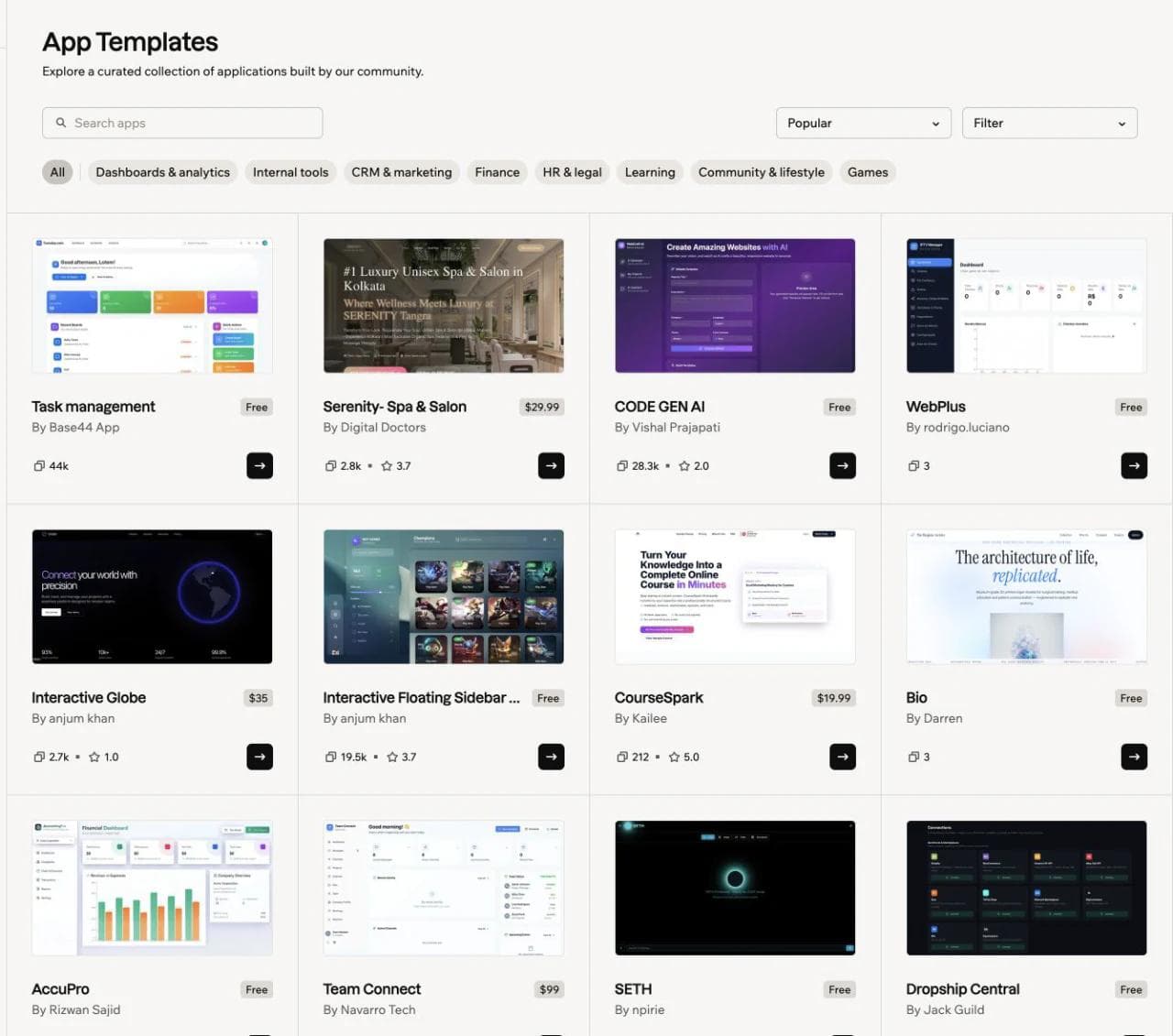
Replit’s Project Editor also starts from plain language, but exposes a broader workspace around Agent. Projects can begin from a prompt, GitHub repository, Figma design, or uploaded files. Files, console output, Git, secrets, database, and publishing remain accessible.
Base44 usually presents fewer architectural choices during the first build. Replit makes more of the underlying software environment available. That does not mean Base44 is only for beginners or Replit requires manual coding. It means the complexity appears in different places.
Choose Base44 when a nontechnical operator should be able to understand the app through entities, permissions, integrations, and workflows.
Choose Replit when the person responsible wants direct access to the repository, process output, shell, dependencies, and runtime configuration.
Application scope and runtime flexibility
Base44’s app editor is optimized for full-stack web applications. Its backend includes data, authentication, real-time updates, Deno-based functions, integrations, agents, and hosting. The Base44 backend service can also serve a custom frontend, including a developer-built mobile client.
Base44 site hosting supports static-export single-page applications. Server-side rendering and server components are not supported on that frontend hosting path, although Base44 backend functions can provide server behavior and a frontend can be hosted elsewhere. See the backend-service feature documentation.
Replit is broader. Its Project Editor lists web apps, mobile apps, designs, documents, and other project types. Its publishing model includes:
- Static deployments for browser-rendered sites
- Autoscale deployments for web apps, APIs, and variable traffic
- Reserved VM deployments for continuously running processes
- Scheduled deployments for periodic jobs and automation
Choose Base44 for web applications that fit its managed services. Choose Replit when the runtime itself is part of the product requirement, such as a bot, scheduled worker, nonstandard server, or broader language ecosystem.
Code access, GitHub, and local development
Both products now provide real code workflows.
Replit uses Git as the foundation of its version-control system. Agent checkpoints, the visual Git pane, Git CLI, and file history all operate around the repository. Teams can import from GitHub, work with branches, inspect diffs, resolve conflicts, and push changes back.
Base44 provides a code view, ZIP export, automatic two-way GitHub sync, and local development on qualifying plans. After GitHub is connected, changes to the main branch synchronize into Base44 and can be published from the app editor. Current documentation warns that the connection changes which earlier versions can be restored, so teams should understand that boundary before connecting.
Base44’s eject command downloads frontend code and backend resources into a separate local project. It creates a new Base44 backend and empty database. Entity schemas transfer, but live data does not. The result remains Base44-backed rather than a vendor-neutral copy of production.
This leads to a useful purchase question: Do you need access to the code, or independence from the platform architecture? Both products provide the first. Replit generally gives you more freedom on the second because its repository and runtime are less tied to one application SDK and data model.
Backend, data, and authentication
Base44’s backend service provides a managed NoSQL data layer based on entities. It supports row-level and field-level permissions, built-in authentication, real-time subscriptions, Deno-based TypeScript functions, OAuth connectors, secrets, file handling, and integrations proxied through Base44 infrastructure.
This reduces service selection, but it also means data access and backend logic use Base44 concepts and APIs.
Replit gives Agent a broader environment in which to assemble a backend. Replit documents managed PostgreSQL workflows with separate development and production environments, plus Replit Auth and Clerk Auth, encrypted secrets, object storage, and arbitrary application code. A developer can also choose external services and libraries.
Base44 reduces service selection. Replit increases architectural freedom. Neither removes the need to verify authorization. For any app with user accounts, test what two people with different roles can read, create, edit, and delete. A successful login is not proof that private data is protected correctly.
Testing, recovery, and debugging
Base44 provides several useful safety surfaces:
- Preview as a specific user or role
- A separate test-data environment on eligible plans
- Prompt-level reverts and version history
- Full app clones with empty data
- An activity monitor for requests, responses, status codes, and timing
- A security scan for permissions, credentials, login checks, dependencies, and headers
Its security documentation explicitly says the builder remains responsible for app security. That is the correct standard: a scan is an aid, not a production guarantee.
Replit combines Agent planning and testing with checkpoints and rollbacks. Checkpoints can preserve files, Agent context, tasks, and optionally database state. Because the project sits inside a general development environment, a builder can also inspect logs, run tests, use a debugger, query the database, and operate Git directly.
Base44 gives a nontechnical owner clearer app-specific test controls. Replit gives a technical owner more general debugging tools. Choose for the person who will investigate a failure the agent cannot repair.
Deployment and operations
Base44 keeps publishing aligned with its managed platform. Apps receive built-in hosting, visibility controls, share links, and custom domains on eligible plans. A custom frontend can use the Base44 SDK while hosted elsewhere.
Replit lets the owner select the deployment model. Static, autoscale, reserved VM, and scheduled deployments cover materially different workloads. That flexibility is useful, but the owner must understand whether the application should scale to zero, stay online continuously, or run on a schedule. Replit’s usage documentation also separates publishing, data transfer, compute, requests, and production database usage.
Do not compare only subscription labels. Price the first build, realistic revisions, databases, authentication, storage, background work, production compute, bandwidth, collaborators, test environments, and debugging. Both products meter parts of their service, so cost depends on the application and revision pattern.
Migration and long-term ownership
An exported repository is only one part of portability. Inventory five things:
- Source: Where is the authoritative code, and how are branches reviewed?
- Data: Can records, schemas, and files be exported without rebuilding relationships by hand?
- Identity: Who owns users, sessions, OAuth configuration, and password recovery?
- Runtime: Which backend functions, scheduled tasks, and integrations depend on platform APIs?
- Operations: How will domains, secrets, logs, monitoring, backups, and rollbacks move?
Base44’s GitHub and CLI support enable local development, but eject creates another Base44 backend and does not copy live data. Replit source is less coupled to one app model, but can still depend on Replit databases, auth, storage, and deployments. Neither product is lock-in free without inspecting the project.
A practical trial before committing
Do not evaluate Base44 and Replit only on the first generated screen. Build the smallest version of the real system, then perform these checks in both:
- Add two user roles and prove that each role is denied the other’s private data.
- Change a data model after records already exist.
- Connect one real external API using a protected secret.
- Make a deliberately bad revision, inspect what changed, and recover.
- Export or sync the source and run the documented local workflow.
- Estimate a month of building, testing, hosting, data, and integrations.
The winner is the platform whose project the responsible owner can still understand after those changes.
Verdict
Base44 is the better fit when you want an integrated, managed application model and a nontechnical or mixed team will own most iteration. Its current code, GitHub, CLI, testing, and backend capabilities make it more developer-friendly than older comparisons suggest.
Replit is the better fit when the development environment is part of what you are buying. It exposes a broader repository, runtime, terminal, version-control, and deployment surface, making it more suitable for existing codebases, unusual workloads, and technical teams that want to choose more of the architecture.
Choose based on how the responsible owner prefers to diagnose production problems. If that person wants entities, roles, integrated services, and managed operations, Base44 has the stronger default. If they want files, diffs, logs, a shell, and runtime choices, Replit does.
Frequently asked questions
Is Base44 better than Replit?
Base44 is often better for nontechnical teams building a web app around managed data, authentication, integrations, and workflows. Replit is often better for broader software projects, existing repositories, direct debugging, and flexible deployment. Neither is universally better.
Can Base44 sync with GitHub?
Yes. Base44 documents automatic two-way GitHub synchronization on eligible plans. Teams can edit locally, merge changes to the main branch, and publish through Base44. The connection has workflow constraints, so review the current documentation before enabling it.
Can you export a Base44 app?
Base44 supports ZIP export, GitHub synchronization, and a CLI eject workflow. The eject command creates a separate project backed by a new Base44 backend, copies frontend code and backend resources, and leaves the new database empty. It is not a complete vendor-neutral migration of production data and services.
Does Replit require coding knowledge?
No. Replit Agent can plan and build an application from natural language. Coding knowledge becomes more valuable when the project needs custom architecture, debugging, security review, or production maintenance because Replit exposes a broad development environment.
Which is better for mobile apps?
Replit provides a direct Agent workflow for mobile app projects. Base44’s app editor focuses on web applications, while its backend service can support a mobile frontend that a developer builds separately with the Base44 SDK. Replit is the more direct choice for a prompt-led mobile build.
Which is better for a static website?
Both can publish a website, but their application features may be unnecessary for a simple marketing site. If the deliverable is static content plus a basic form, compare website-focused builders on design control, responsive behavior, SEO, forms, CMS needs, and ongoing editing before choosing an app platform.

Real editable visuals. Real canvas. Full control.
Fly through design work