Creatopy vs Canva: Which Is Better for Ad Creative in 2026?
Compare Creatopy, now The Brief, with Canva for ad production, design, brand control, resizing, personalization, publishing, and team workflows.
 Anvisha Pai, Co-founder & CEO, Moda
Creatopy vs Canva is no longer just a comparison between two browser-based design editors. Creatopy has rebranded as The Brief and moved further into creative operations: multi-size ad production, data-driven variants, dynamic personalization, ad serving, and reporting. Canva remains the broader visual suite with a much larger template ecosystem and an easier path for general marketing work.
Choose Canva when the same team creates presentations, social posts, documents, videos, and occasional ads. Choose The Brief when paid-media operations are the center of the workflow and a design must become many sizes, audiences, languages, feeds, and live campaign variants. Choose neither based only on which editor feels nicer during one static banner.
Creatopy vs Canva at a glance
| Decision | Creatopy / The Brief | Canva |
|---|---|---|
| Core job | Ad creative production and operations | General visual communication across many formats |
| Best at scale | Multi-size sets, feeds, personalization, dynamic ads, serving, and measurement | Templates, Bulk Create, Resize, brand assets, and broad team adoption |
| Best for | Paid-media teams, agencies, and high-volume campaign operations | Marketers, small teams, educators, and mixed-use content production |
| AI posture | Agent and automation layer tied to ad workflows | Broad Magic Studio tools inside a large visual suite |
| Main tradeoff | Specialized system can be more than a casual designer needs | Breadth does not equal a dedicated creative-operations stack |
The framework: creation, multiplication, and activation
Most articles compare templates, stock libraries, and drag-and-drop editing. Those matter, but ad teams encounter the expensive work after the first design. A useful evaluation separates three stages:
- Creation: produce the visual concept, copy, animation, and brand treatment.
- Multiplication: adapt it across sizes, products, offers, languages, regions, and audiences.
- Activation: publish, serve, update, measure, and govern the live campaign.
Canva is strongest as a creation suite with increasingly capable multiplication tools. The Brief is designed to carry the creative farther into multiplication and activation.
Where Canva is stronger
One workspace for the rest of marketing
Canva is useful because ads rarely exist alone. The same marketer may need a pitch deck, organic social post, product sheet, event graphic, short video, and internal document. Canva’s breadth, familiar editor, template ecosystem, stock library, and team adoption reduce the cost of asking non-designers to make routine assets.
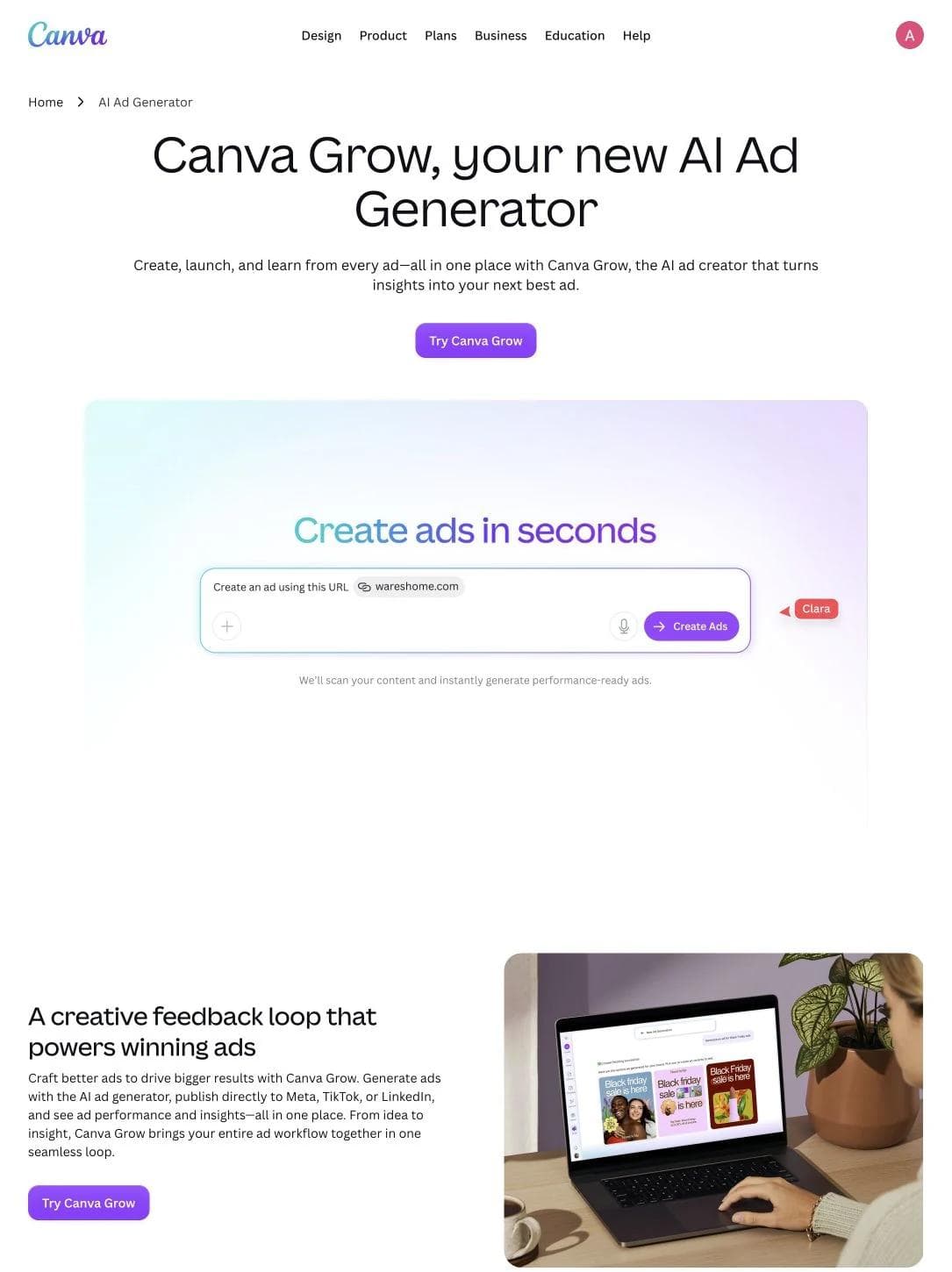
Canva also has serious scaling tools. Its Bulk Create and Resize documentation describes CSV or Excel-driven variations and repurposing designs into other formats. Its partner apps can connect parts of the workflow to Google, Meta, and Amazon advertising. A fair comparison should not dismiss Canva as a static template editor.
It is easier to justify for occasional advertisers
A small company making ten ads a month may get more value from a broad suite than from specialized ad infrastructure. The user can begin with templates, reuse brand assets, make a few sizes, and keep related content in a familiar environment. The Brief’s operational depth matters more as campaign complexity grows.
Where Creatopy, now The Brief, is stronger
The campaign system is the product
The Brief treats the design as a living campaign system. Its current ad-serving page documents responsive ad tags, network-specific exports, reporting, data-feed synchronization, and updates to deployed creative. Its personalization workflow supports CSV feeds, Shopify inventory, location variables, translated variants, dynamic text, and A/B testing.
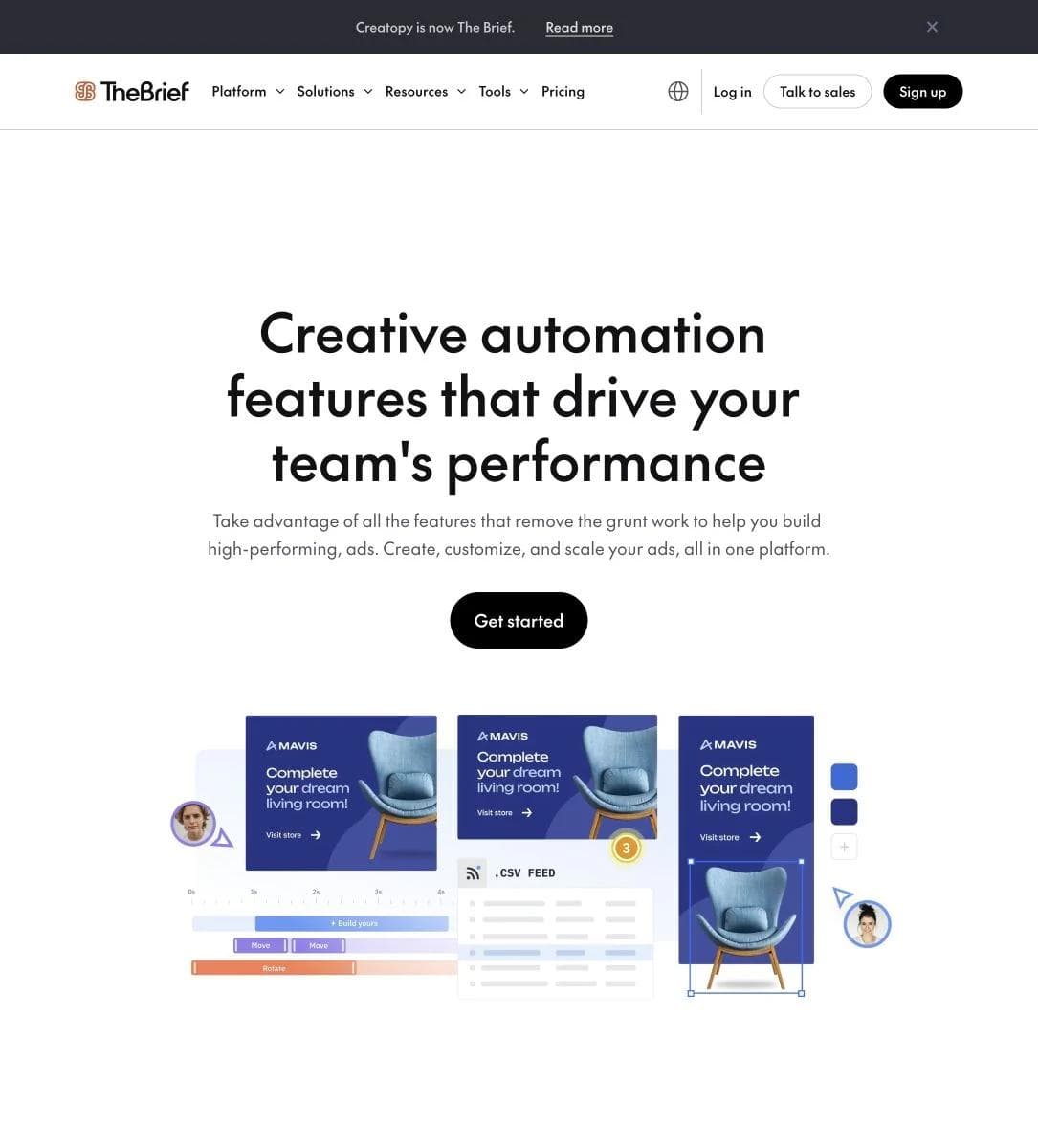
That means a catalog-price update or localized offer can flow through a system instead of requiring a designer to reopen and re-export every asset. For agencies, retail, travel, gaming, and other high-variation advertisers, that operational layer can be more important than the number of stock templates.
Multi-format production is designed into the editor
The product can edit and animate multiple sizes together, connect fields to data feeds, and generate high volumes of variants. Canva can also resize and bulk-populate designs, but The Brief’s surrounding serving and live-update system makes it a more coherent choice when those variants become an active media operation.
The questions to ask before buying either
- How many concepts become how many final assets each month? Count dimensions, languages, audiences, products, and offers.
- Does a feed drive prices, inventory, location, or copy? If so, test the complete update path rather than a demo template.
- Do you need files to upload manually, or live ad tags that can change after deployment?
- Who is allowed to edit a master, approve a campaign, and change brand-controlled elements?
- Does performance data merely report results, or feed the next creative decision in a workflow your team will actually use?
Also verify the current plan and brand name during procurement. Search demand still uses “Creatopy,” while the current product identifies itself as The Brief. Old reviews and screenshots may describe a materially earlier product.
Where Moda fits
Moda is a credible alternative for marketers who want an AI agent to create on-brand campaign concepts and leave them editable on a real canvas. It is especially useful when a brief should become ads, social posts, slides, one-pagers, images, or motion pieces without a designer manually assembling each first draft.
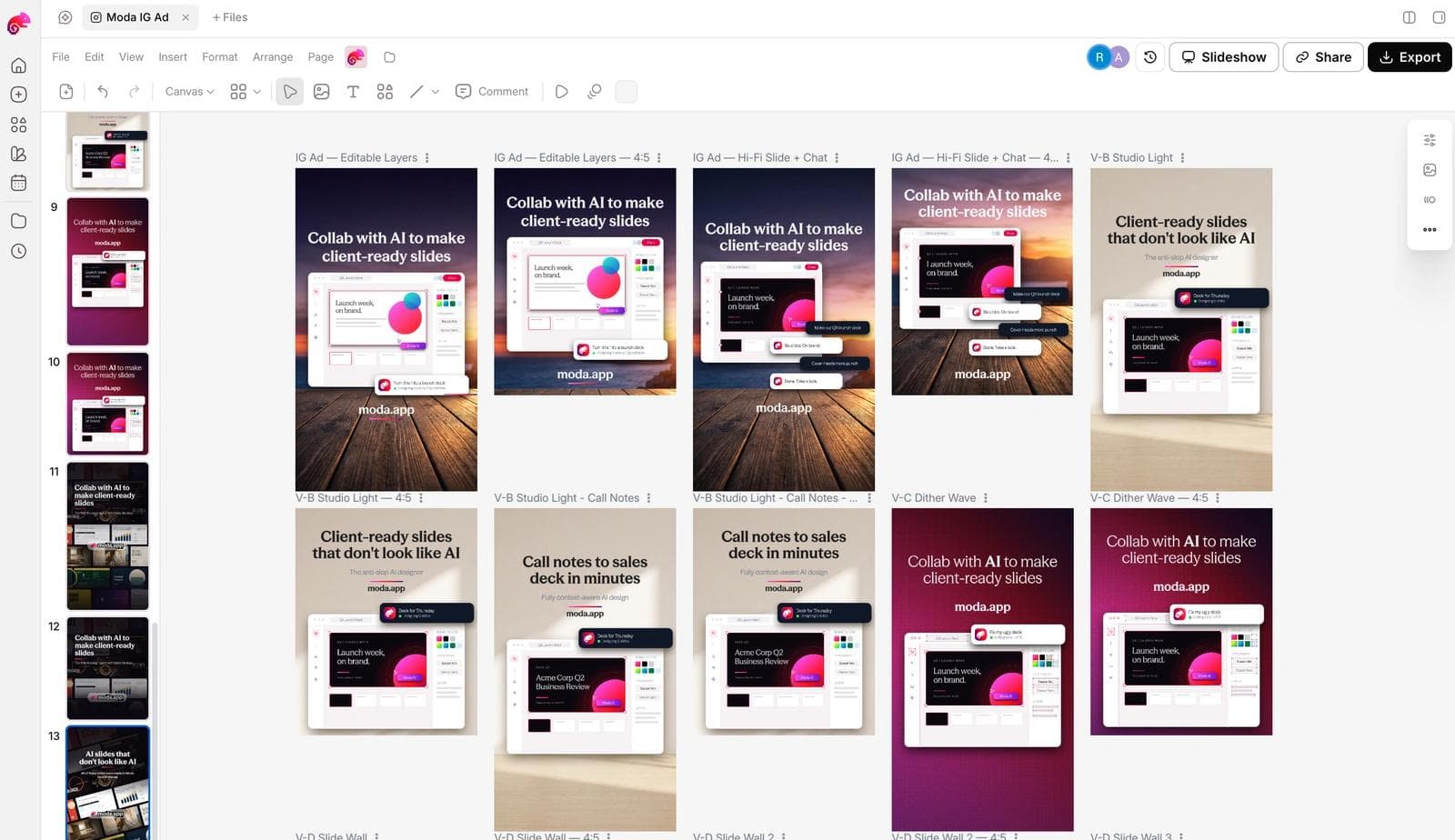
Moda is not a replacement for The Brief’s dynamic ad serving, live data feeds, or campaign reporting. It is also not a substitute for Canva’s enormous long-tail template ecosystem. Its fit is the AI-first creation layer: research, concept development, editable brand design, and production across static and motion formats.
For adjacent decisions, compare our best AI ad generators and Canva alternatives guide. If agent-led, editable campaign creation is the missing layer, explore Moda.
Who should use what?
- Use The Brief when multi-size, feed-driven, localized, dynamically served, or measurable ad operations justify specialized infrastructure.
- Use Canva when a broad team needs a familiar visual suite for many content types and only moderate advertising scale.
- Use Moda when non-designers want an agent to build editable, on-brand campaign creative and related visual assets from a brief.
- Use a professional design stack when specialist designers require deep typography, illustration, compositing, or custom production control before assets enter the campaign system.
How the choice changes by campaign
A local business making a handful of ads
Canva is usually the practical choice. The team can adapt familiar templates, keep a basic brand kit, resize the strongest concept, and use the same subscription for menus, flyers, social posts, and presentations. A specialized serving and feed system would add process without solving a current bottleneck.
A retailer with thousands of products and changing prices
The Brief becomes much more compelling. A feed can connect product information to a template, generate variants, localize offers, and update served creative when data changes. The relevant proof of value is not whether it can make one attractive banner. It is whether the system reduces the operational cost and error rate of maintaining the entire catalog campaign.
An agency adapting one concept across clients and markets
Evaluate governance and versioning alongside generation. The agency may need locked brand elements, separate workspaces, approval roles, multilingual feeds, many dimensions, and network-specific delivery. The Brief is closer to that operating model. Canva can still win when client teams must take over routine editing in a familiar interface.
A startup searching for ad concepts before it scales spend
An AI-first creator such as Moda may be the better first tool. At this stage the bottleneck is often finding distinct on-brand concepts, not serving thousands of variants. Once a concept proves itself and production volume grows, the team can move approved systems into specialized campaign infrastructure.
A better proof-of-concept than “make one banner”
- Start with one real campaign containing three sizes, two audiences, two offers, and one brand-controlled master.
- Change a product price and legal line after the first export. Count every place that must be updated.
- Ask a non-designer to adapt the campaign without changing locked brand elements.
- Export or serve the creative through the actual ad network path and verify animation, file weight, click behavior, and naming.
- Document what performance data returns to the creative team and whether it changes the next iteration.
Do not confuse generation with optimization
Both products can use AI to produce or adapt creative, but an attractive generated ad is not evidence that it will perform. Optimization requires a clear hypothesis, controlled variants, reliable delivery data, and a decision rule for what changes next. Canva’s breadth can accelerate concept production. The Brief’s serving and reporting can connect creative to campaign operations. Neither removes the need to design a valid test.
Keep the editable master, the audience and offer variables, the live version, and the performance record connected. If the team cannot explain which element changed between variants, a larger volume of creative creates noise rather than learning. This operating discipline matters more than any vendor’s generic performance score.
Frequently asked questions
Is Creatopy still available?
The company now identifies the product as The Brief, and former Creatopy URLs redirect to the new brand. Teams researching Creatopy should evaluate the current The Brief product rather than assuming an older review describes the interface or scope they will buy.
Can Canva create ads at scale?
Yes. Canva supports Resize, Bulk Create, brand controls, and advertising partner apps. The distinction is not “scale versus no scale.” The Brief goes further into feed-driven personalization, live serving, updates, and reporting as a connected ad-operations system.
Which is better for non-designers?
Canva is usually easier to introduce across a broad organization because the interface and template workflow are widely familiar. The Brief can be easier for a specialized team once a campaign system is configured because repetitive production is automated rather than delegated to individual editors.
For most buyers, the decision becomes clearer after mapping one campaign from approved master through every adaptation, approval, export, update, and result. That workflow reveals which product removes real work.
The bottom line
Canva is the better generalist. Creatopy, now The Brief, is the more specialized ad-production and activation system. The crossover sits in ordinary static and animated ad creation. Once a campaign depends on feeds, hundreds of variants, live updates, serving, and measurement, the products stop being direct substitutes.

Real editable visuals. Real canvas. Full control.
Fly through design work