Claude Design: What It Does, What It Costs, Where It Stops
A dated capability review of Claude Design: what Anthropic documents it can make, which plans include it, what it costs, and the limits Anthropic publishes itself.
 Anvisha Pai, Co-founder & CEO, Moda
Claude Design is Anthropic's design product. You describe a prototype, a deck, a landing page or a one-pager in a chat panel, Claude builds it on a canvas next to the chat, and you refine it by talking, commenting on elements, or dragging things around. It launched on 17 April 2026 out of Anthropic Labs, and it is now in beta on the Claude Pro, Max, Team and Enterprise plans. It is not on the free plan, and it does not run on mobile.
That is the short answer. The longer answer matters because the product has changed a lot since it launched in April. Anthropic has rebuilt the design system import, shipped a real editor, added nine partner destinations, and, most consequentially for anyone budgeting, folded Claude Design's separate weekly allowance into your plan's shared usage pool.
This is a capability review built from Anthropic's own current documentation, checked on 9 September 2026. We did not run paid generations for it, so there is nothing here about output quality, speed or how many decks a Pro plan gets you. Where a claim is a documented capability rather than something we measured, we say so.
What Claude Design is, and who ships it
Claude Design is a first-party Anthropic product, not a third-party wrapper. It came out of Anthropic Labs on 17 April 2026, described at launch as a research preview powered by Claude Opus 4.7.
Two things have shifted in the label since. Anthropic's help documentation, last updated 6 August 2026, and the FAQ on the product page both now call it beta rather than research preview. And neither the current product page nor the current help articles name the underlying model. Opus 4.7 is what the launch post said in April; it is not restated anywhere current, so treat the model behind today's build as unconfirmed rather than assuming April's answer still holds.
Anthropic's own adoption figure, from its 17 June product update, is that over one million people used Claude Design in its first week. That is a vendor number for a launch week, not a measure of retained usage, and we have no way to verify it.
You use it at claude.ai/design on the web, or from the sidebar in the Claude desktop app.
What it produces
Anthropic lists six work types on the product page: prototypes, wireframes and mockups, design explorations, pitch decks, marketing collateral, and documents such as a resume or a one-pager. The launch post adds a seventh category it calls frontier design, meaning code-powered prototypes with voice, video, shaders, 3D and built-in AI.
That spread is worth pausing on, because it explains a lot of the confusion around this product. Claude Design is not a slide tool that also does prototypes, or a prototyping tool that also does slides. The same canvas is being asked to hold an interactive dashboard and a ten-slide investor deck, and where you land on it changes which parts of the product you touch.
The interface is consistent regardless: chat on the left, canvas on the right. You refine four ways, all documented:
- Chat for structural changes: a new section, a different layout, a darker palette.
- Inline comments for targeted, component-level changes: this button's padding, this radio group should be a dropdown.
- Direct editing on the canvas: edit text in place, and drag, resize and align elements.
- Adjustment sliders that Claude generates for a given design, to tune spacing and colour live.
The direct-editing controls are new. They shipped in the June update, alongside what Anthropic describes as hundreds of stability fixes. Anything you read that says every change in Claude Design requires a regeneration is describing the April build.
What you can bring in
The import surface is unusually wide for a design tool, and it is the part that most clearly reflects that Anthropic builds coding tools:
| Input | Notes |
|---|---|
| Text prompt | The default entry point |
| Screenshots and images | Reference designs, competitor products, wireframes, hand sketches |
| DOCX, PPTX, XLSX | An existing deck or document, including as a style reference |
| A codebase | Link a GitHub repo, upload one, or sync a local one with /design-sync from Claude Code |
| Web capture | Grab elements directly from your own site so prototypes match the real product |
The codebase path is the differentiated one. Treating a component library as a primary brand input, rather than a logo and a palette, is unusual among design tools, and it follows naturally from the fact that Anthropic's other products are coding products.
Where the work goes
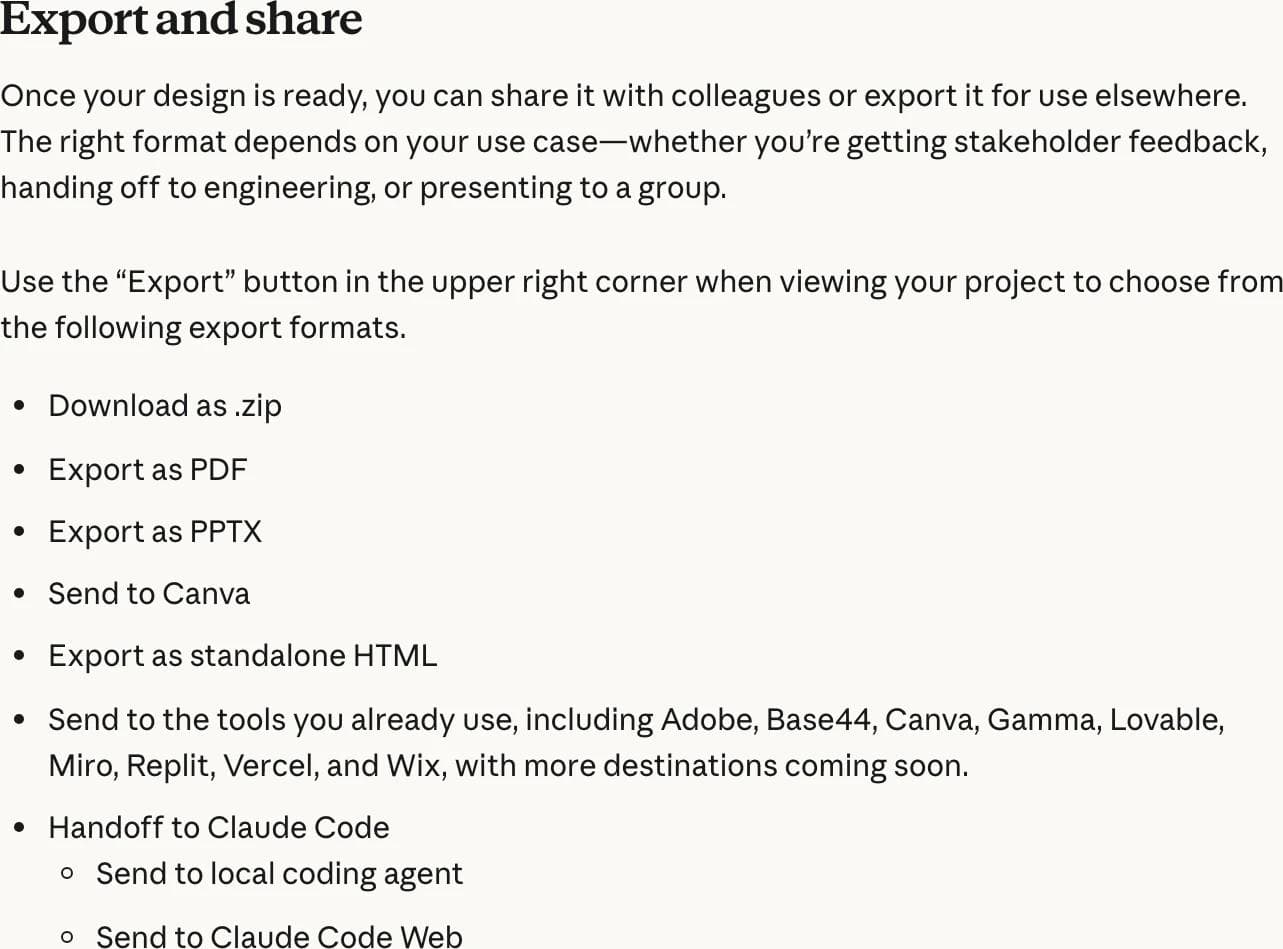
The documented export list is: download as .zip, export as PDF, export as PPTX, send to Canva, and export as standalone HTML. On top of that sit connectors to Adobe, Base44, Canva, Gamma, Lovable, Miro, Replit, Vercel and Wix, with more promised, and a handoff to Claude Code that goes either to a local coding agent or to Claude Code Web.
Two absences are worth naming precisely, because they shape who this product suits.
There is no documented image export. No PNG, no JPEG, no SVG anywhere in Anthropic's current export list. If you want a social graphic as a file, the documented paths are a PDF, an HTML page, or a handoff into Canva or Adobe Express to produce the image there.
There is no documented Figma export or Figma connector. The nine partner destinations are development, publishing and content tools. Adobe, Canva and Gamma cover the marketing side; Lovable, Replit, Vercel, Wix and Base44 cover shipping; Miro covers the whiteboard. Figma is absent from both the export menu and the connector list. That was true at launch and it is still true today.
Neither absence means the product is bad. It means Claude Design's handoff story points at code and at content platforms, not at the design file formats a design team already lives in.
Whether the output stays editable, and where
This is the question the demo videos skip, and the answer is: it stays editable, but the editable copy lives somewhere specific depending on which door you leave by.
Inside Claude Design, the project is fully editable through chat, comments, direct manipulation and the sliders. Outside it:
- PPTX lands in PowerPoint or Google Slides as a slide file you can keep working on. Anthropic does not publish anything about how faithfully its PPTX preserves fonts, charts or effects, and we have not tested it, so open one representative deck in the exact application your audience uses before you commit a workflow to this path.
- Standalone HTML and the .zip give you the design as web output, which is the natural continuation for a prototype.
- Canva and Gamma both describe, in statements Anthropic published on its own pages, work arriving in their editors fully editable. Those are the vendors' words about their own products, not a measured result.
- PDF is a delivery format, not an editing one.
- The Claude Code handoff is the interesting one: Anthropic says Claude Code continues from your existing work rather than starting over from a screenshot. If the deliverable is software, that is the shortest path in this product.
There is no documented formal version history. Anthropic's guidance for exploring a second direction is to tell Claude to save the current project and try a different approach, which the model confirms in the conversation. That works, but it is a chat convention rather than a versions panel.
Brand: how the design system actually works
Claude Design's brand model is an organisation-level design system rather than a per-file style setting, and it was rebuilt in June.
A designer or brand owner sets it up once. You upload source material, which can be a codebase with your component library, a well-designed deck or PDF, prototypes and screenshots, or individual assets such as logos and colour specimens. Claude extracts a UI kit from it: colour palette, typography, components, layout patterns. You review it, then flip a Published toggle, after which projects created in that organisation use it automatically.
Anthropic says Claude builds with those components, checks its own output against the design system, and corrects before you see the result. On Enterprise, a Claude Design Admin custom role can reserve publishing, setting the org default, and deleting design systems for named people, so a large company can hold one approved system.
Two honest caveats, both from Anthropic. The first is in its known limitations: design system import is only as good as its source, and a messy codebase or an incomplete file will show up in the output. The second is broader and comes from Anthropic's own frontend aesthetics cookbook, which says plainly that Claude "can generate high-quality frontends, but without guidance it tends toward generic, conservative designs" and defaults to safe choices unless pushed. That guide is about Claude generating frontends generally rather than about Claude Design specifically, but it is the vendor documenting the same tendency that designers describe as the house look. A real design system is the documented fix; a colour and a font are not.
What it costs

There is no separate Claude Design price. It is included in the subscription, and the entry point is any paid individual or team plan.
| Plan | Price (from claude.com/pricing, 9 September 2026) | Claude Design |
|---|---|---|
| Free | $0 | Not included |
| Pro | $17 per month billed annually at $200 up front, or $20 monthly | Included |
| Max | From $100 per month, at 5x or 20x Pro usage | Included |
| Team | $20 per seat per month billed annually, $25 monthly; premium seats $100 annually, $125 monthly | Included |
| Enterprise | $20 per seat plus usage at API rates | Included, but off by default |
The Enterprise line is the reason a lot of people search whether Claude Design exists or is still available. It does exist, and if you are on Enterprise and cannot see it, that is almost certainly because it ships off by default and an admin has to switch it on under Organization settings, Capabilities, in the Anthropic Labs section.
The usage change nobody has updated for
This is the single most important thing to know before you plan work around Claude Design, and it is where nearly every ranking article is now wrong.
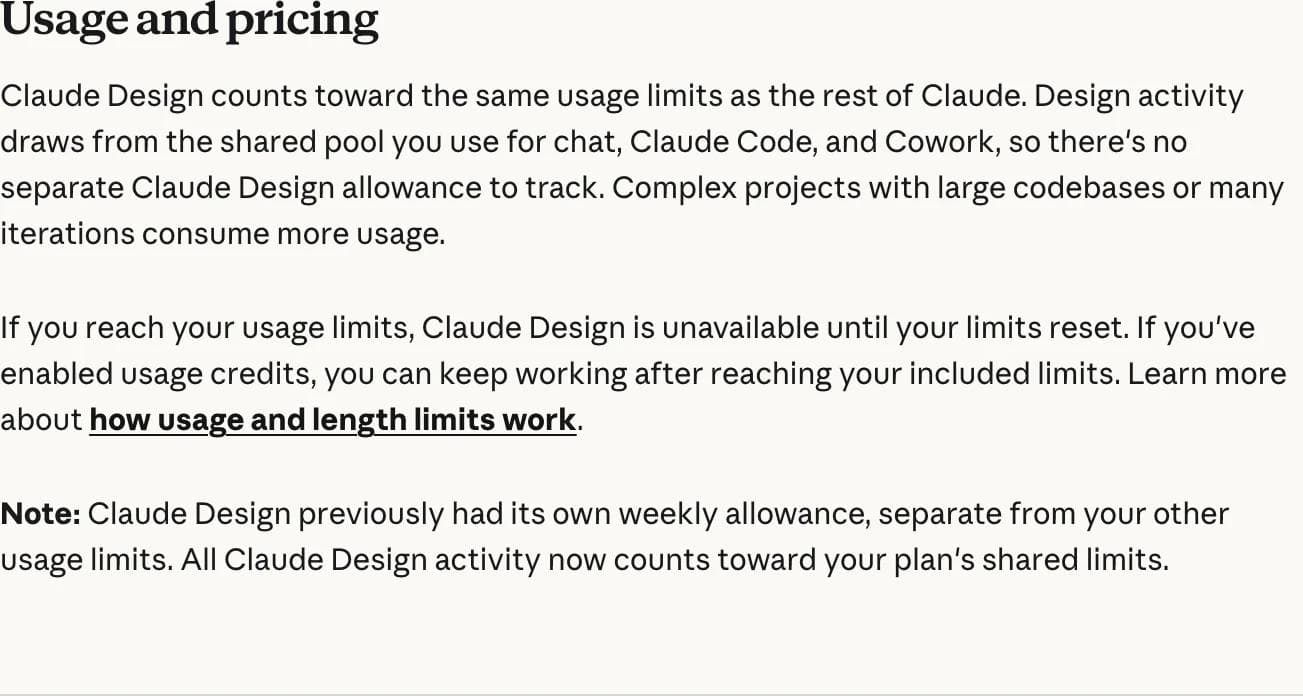
At launch, Claude Design had its own weekly allowance, separate from your chat and Claude Code usage. It no longer does. Anthropic's help documentation states that Claude Design counts toward the same usage limits as the rest of Claude, drawing from the shared pool you use for chat, Claude Code and Cowork, and adds an explicit note that this replaced the old separate weekly allowance. The June update frames the change as giving most people more headroom, and also says the average turn now uses fewer tokens for the same result.
What that means in practice:
- There is no Claude Design allowance to track separately any more. A heavy Claude Code week eats into your design capacity and the reverse is true too.
- Complex projects with large codebases or many iterations consume more usage. Anthropic says this directly.
- If you hit your limits, Claude Design is unavailable until they reset, unless you have enabled usage credits, in which case you can keep working and pay for the overage.
We have not measured how far a Pro subscription actually goes on design work, and neither has anyone else publishing a number we would trust. Anthropic does not publish per-plan limits in units you could budget against, so anyone quoting you "two or three sessions per week" is describing a metering model that Anthropic has since replaced.
Where it stops
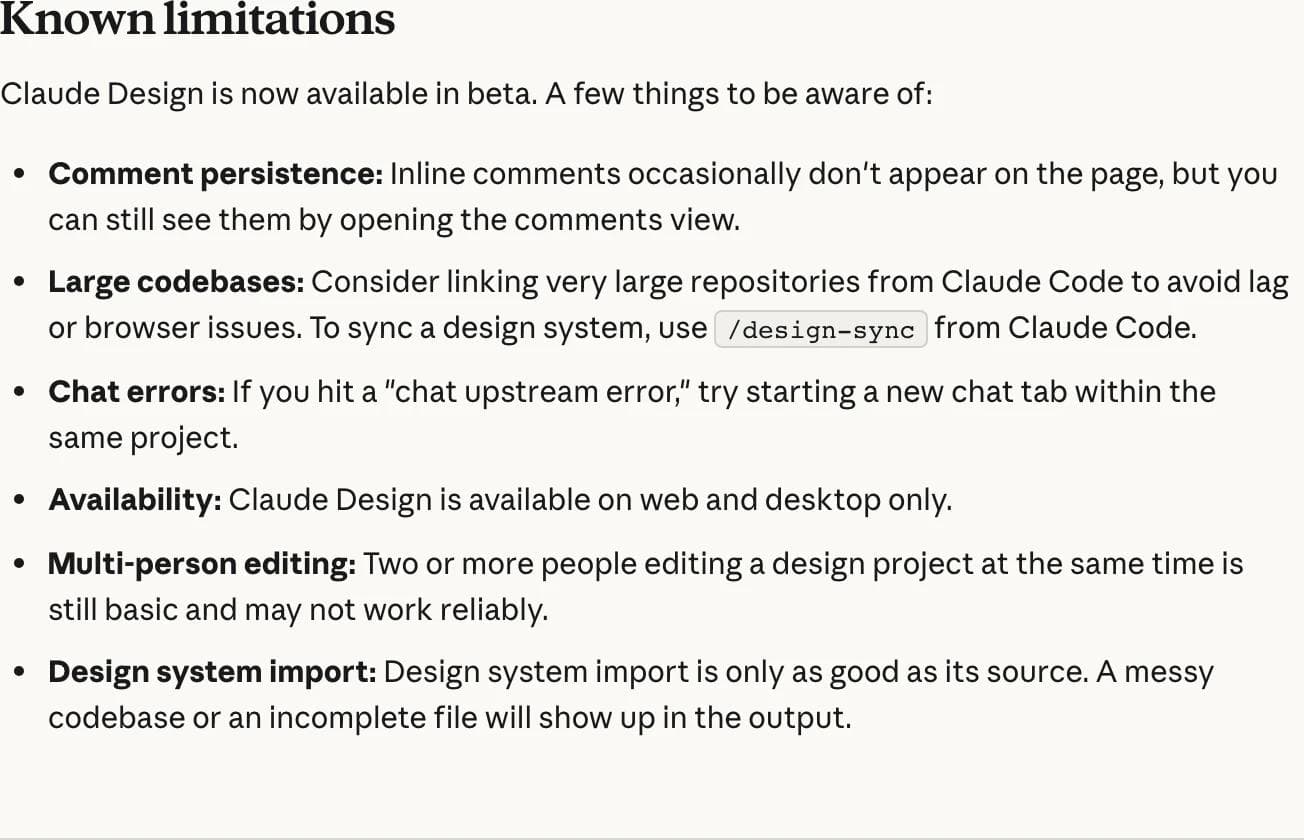
Anthropic publishes its own limitations list, which is more than most vendors do, and it is the most reliable source on this. As of 9 September 2026 it says:
- Comment persistence. Inline comments occasionally do not appear on the page, though they remain visible in the comments view.
- Large codebases. Very large repositories should be linked from Claude Code rather than the browser, to avoid lag or browser issues.
- Chat errors. A "chat upstream error" is resolved by starting a new chat tab in the same project.
- Availability. Web and desktop only.
- Multi-person editing. Two or more people editing the same project at once is still basic and may not work reliably.
- Design system import. Only as good as its source.
Add to that list four documented boundaries that are not framed as bugs but will decide the fit for some teams:
No mobile. There is no iPhone, iPad or Android version. Claude's chat apps are on mobile; Claude Design is not.
Sharing is organisation-scoped. Anthropic's June post says work is shareable only within your organisation. Share links come in view, comment and edit flavours, but if you need to send a prototype to a client, an investor or an agency outside your company, an org link is not the mechanism. Export a PDF, an HTML file or a PPTX instead.
Real-time co-editing is not the model. Anthropic's own word for simultaneous multi-person editing is basic. If several people revise a deck at the same time in the last hour before a meeting, that is not what this product is currently built for.
No image file export, no Figma path. Covered above, and worth repeating because these are the two questions designers ask first.
Who it fits, and who it does not
Claude Design fits well when:
- The deliverable is an interactive prototype, and especially when the next step is Claude Code building it.
- Your brand's real source of truth is a codebase or a component library, not a brand PDF.
- You already pay for Claude and want design work inside the subscription you have.
- You are a founder, PM or marketer producing a first version that a designer will finish.
It fits badly when:
- You need image files, or a route into Figma.
- The work must be shared outside your organisation as a live link.
- Several people need to edit the same design at once, in real time, today.
- You are on Free, or you need to work on a phone.
If you are weighing it against other tools rather than trying to understand it, we have covered that separately: Claude Design alternatives breaks down six products by the job they own, using Claude for pitch decks covers the three different Claude workflows that produce a deck, and Moda versus Claude Design is the direct comparison. For context on where our own product sits: Moda is an AI design tool built around agent-created, directly editable canvas work such as decks, social graphics and one-pagers, which is a narrower job than Claude Design's prototype-to-code range. It is genuinely a different shape of product, and for interactive prototyping Claude Design is the better tool.
What we verified, and what we did not
Everything above about capabilities, plans, exports, limits and usage comes from Anthropic's current public pages, read on 9 September 2026: the product page and its FAQ, the launch announcement, the June product update, the getting started, design system and admin help articles, and claude.com/pricing. Screenshots here are of those pages, not of the product interface.
We did not sign in, generate a design, or spend usage on this article. So we make no claim about output quality, generation speed, export fidelity, how much of a plan a design session consumes, or how the product feels to use. Where Anthropic states something about its own product, we have attributed it. Where a capability is absent from Anthropic's documentation, we have said it is not documented rather than that it is impossible.
Frequently asked questions
What is Claude Design?
Claude Design is Anthropic's design product, launched on 17 April 2026 out of Anthropic Labs. You describe what you want in a chat panel and Claude builds it on an adjacent canvas: prototypes, wireframes, pitch decks, landing pages, one-pagers and design explorations. You then refine it through chat, inline comments, direct canvas editing, or sliders Claude generates for the design.
Is Claude Design free?
No. Anthropic's plan comparison shows Claude Design excluded on the Free plan and included on Pro, Max, Team and Enterprise. Pro is $17 per month billed annually at $200 up front, or $20 billed monthly. There is no separate charge for Claude Design on top of the subscription.
Is Claude Design still available?
Yes. It is in beta on Pro, Max, Team and Enterprise as of 9 September 2026, at claude.ai/design and in the Claude desktop app sidebar. The most common reason someone cannot see it is that it ships off by default on Enterprise plans; an admin enables it under Organization settings, Capabilities.
Does Claude Design have its own usage limit?
Not any more. It had a separate weekly allowance at launch. Anthropic's help documentation now states that Claude Design draws from the same shared pool as chat, Claude Code and Cowork, with no separate allowance to track. If you run out, Claude Design is unavailable until limits reset unless you have enabled usage credits.
Can Claude Design export to Figma?
Figma does not appear in Anthropic's current export menu or in its connector list. The documented exports are zip, PDF, PPTX, standalone HTML and Canva, with connectors to Adobe, Base44, Canva, Gamma, Lovable, Miro, Replit, Vercel and Wix, plus a handoff to Claude Code.
Does Claude Design work on mobile?
No. Anthropic's known limitations list says Claude Design is available on web and desktop only.
The bottom line
Claude Design is a real product doing real work, and the parts that are strong are strong: the codebase-aware design system, the breadth of what it will accept as input, and a native path from a design straight into Claude Code. The limits are mostly the limits of a five-month-old beta being compared with tools that have had a decade, and Anthropic is unusually direct about publishing them.
The thing to carry away is that Claude Design changed materially in June. Before you decide anything about it, check the two facts that changed: it now shares your plan's usage pool rather than holding its own, and it has a direct-manipulation editor. Both of those change the answer to whether it fits your work.

Real editable visuals. Real canvas. Full control.
Fly through design work