Construction Company Website Design: 6 Full-Page Teardowns
See six construction company websites analyzed section by section, with lessons for project proof, service areas, trust, recruiting, SEO, and lead capture.
 Anvisha Pai, Co-founder & CEO, Moda
Construction company website design has one practical job: help the right buyer believe you can complete their kind of project, in their market, without creating avoidable risk. A strong site identifies the work, geography, project scale, delivery model, and next step quickly. It then earns confidence with specific projects, a visible process, credible people, and evidence that matches the buyer's concerns.
That standard changes by contractor type. A homeowner choosing a remodeler wants budget and communication clarity. A commercial owner may be assembling a shortlist and checking sectors, delivery methods, safety, and comparable projects. A facilities manager with a roof leak wants diagnosis and response. A prospective superintendent is deciding whether the company looks organized enough to join.
This guide studies six complete homepages from small and midsized construction businesses. The goal is not to crown the prettiest site. It is to understand what each section contributes, where the page loses momentum, and which patterns transfer to a different construction business.
Six construction website examples at a glance
- THE Remodel Group: A Portland design-build remodeler that qualifies residential clients through process, fixed-price positioning, and project stories.
- Fortin Construction: A Maine custom home builder that combines family history, financing help, customer tools, and broad residential services.
- Kaplan Construction: A Boston commercial contractor whose homepage acts as a compact project and activity dashboard.
- Crown Industrial Roofing: A Toronto specialty contractor that turns diagnosis, commercial focus, service detail, and buyer education into its sales argument.
- Spectrum General Contractors: A Denver contractor that differentiates through local market focus and three in-house craft shops.
- MidMountain Contractors: A Western Washington heavy-infrastructure contractor that routes project buyers and job candidates through the same restrained page.
The four questions every construction website must answer
Most construction website roundups emphasize photography, typography, or a list of required features. Those matter, but buyers are making a risk decision. Before you choose a visual style, make sure the page answers four questions.
- Do you build my kind of project? Name the sectors, scopes, project types, and delivery methods in language a buyer uses.
- Do you work where my project is? Put the service area in text. Google recommends that service-area businesses define accurate cities, postal codes, or other areas in their Business Profile rather than an arbitrary radius.
- Have you handled comparable complexity? Show projects with context such as client, location, size, scope, delivery method, constraints, and result. A grid of attractive images without facts cannot do all of this work.
- What happens if I contact you? A useful call to action explains the next step. An inspection, discovery call, project consultation, bid invitation, and careers inquiry are different actions and should not share vague copy.
A fifth question appears in commercial and public work: can this company pass prequalification? The homepage cannot replace a formal safety program, insurance certificates, bonding, licenses, references, or a bid package. It can make those signals easier to find and route the visitor to the right person.
1. THE Remodel Group: qualify homeowners with process, not luxury language
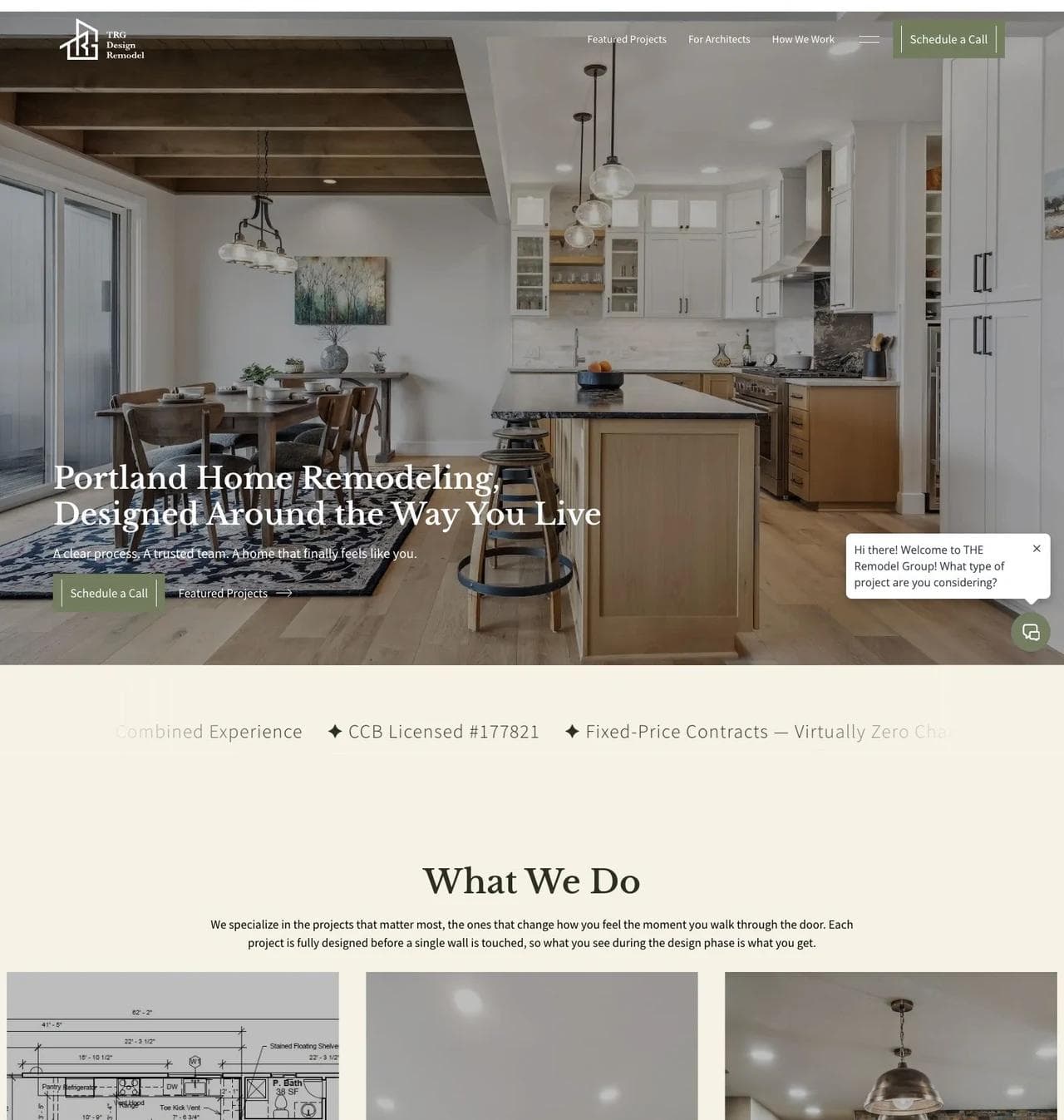
THE Remodel Group is a Portland, Oregon design-build remodeler. Its homepage is a useful example because the sale is not simply beautiful cabinetry. The buyer is inviting a team into an occupied home and committing to a long, expensive process.
What the opening contributes
The hero names the market, the service, and the desired outcome: Portland home remodeling designed around how the client lives. The CTA is a scheduled call, which fits a considered project better than a generic "Get Started" button.
Immediately below, the page supplies a compact qualification strip with years in market, combined experience, license number, contract approach, change-order positioning, and warranty. These details are doing more sales work than another sentence about craftsmanship. They translate a broad promise into purchase checks.
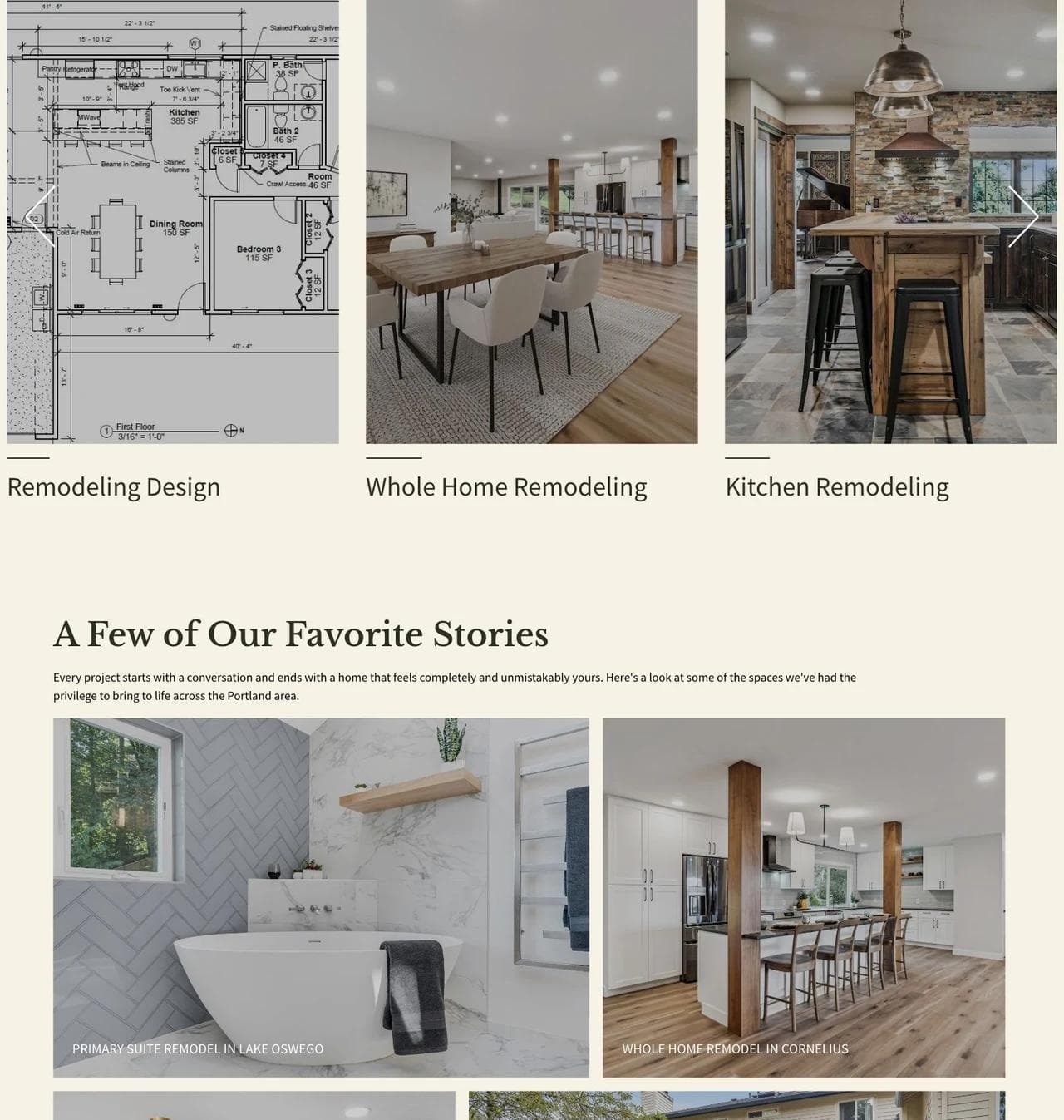
The services section then names residential scopes from whole-home remodeling and kitchens to additions, ADUs, primary suites, and aging in place. This lets a visitor self-select before reading the company story.
Why the project section works
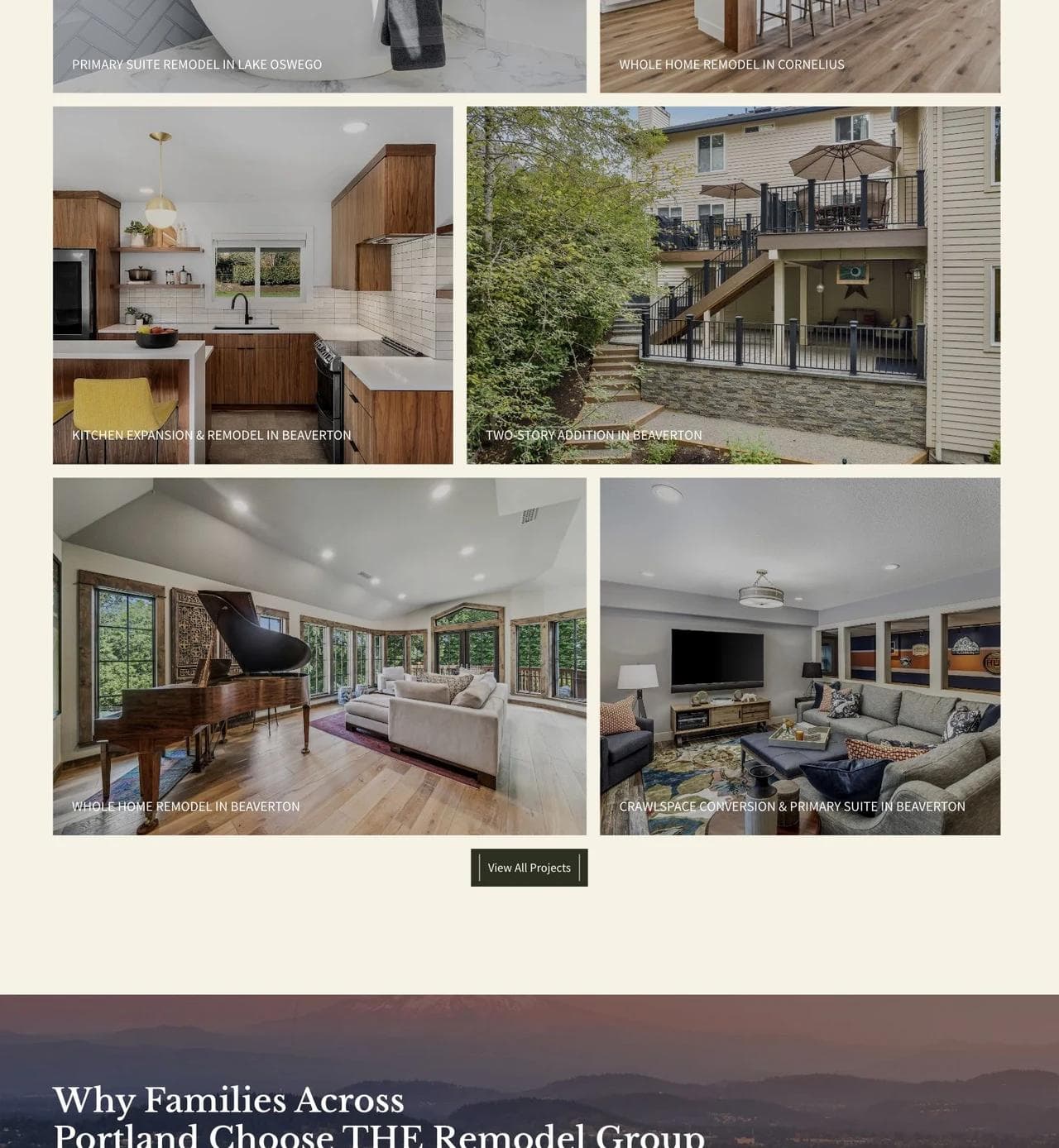
The project grid labels each story by scope and location. That matters for two reasons. First, it helps prospects find a comparable job. Second, it creates a path from visual inspiration to local relevance. A portfolio becomes more useful when each project page explains the initial condition, design problem, construction scope, decisions, and finished result.
The homepage then pivots from what the team built to how it reduces risk. Fixed-price contracts, one project director, and a documented design process address fears that often stop a homeowner from contacting a remodeler. This is a strong pattern: put your operating difference next to the point where a visitor starts wondering whether the project will be painful.
Where the page could be tighter
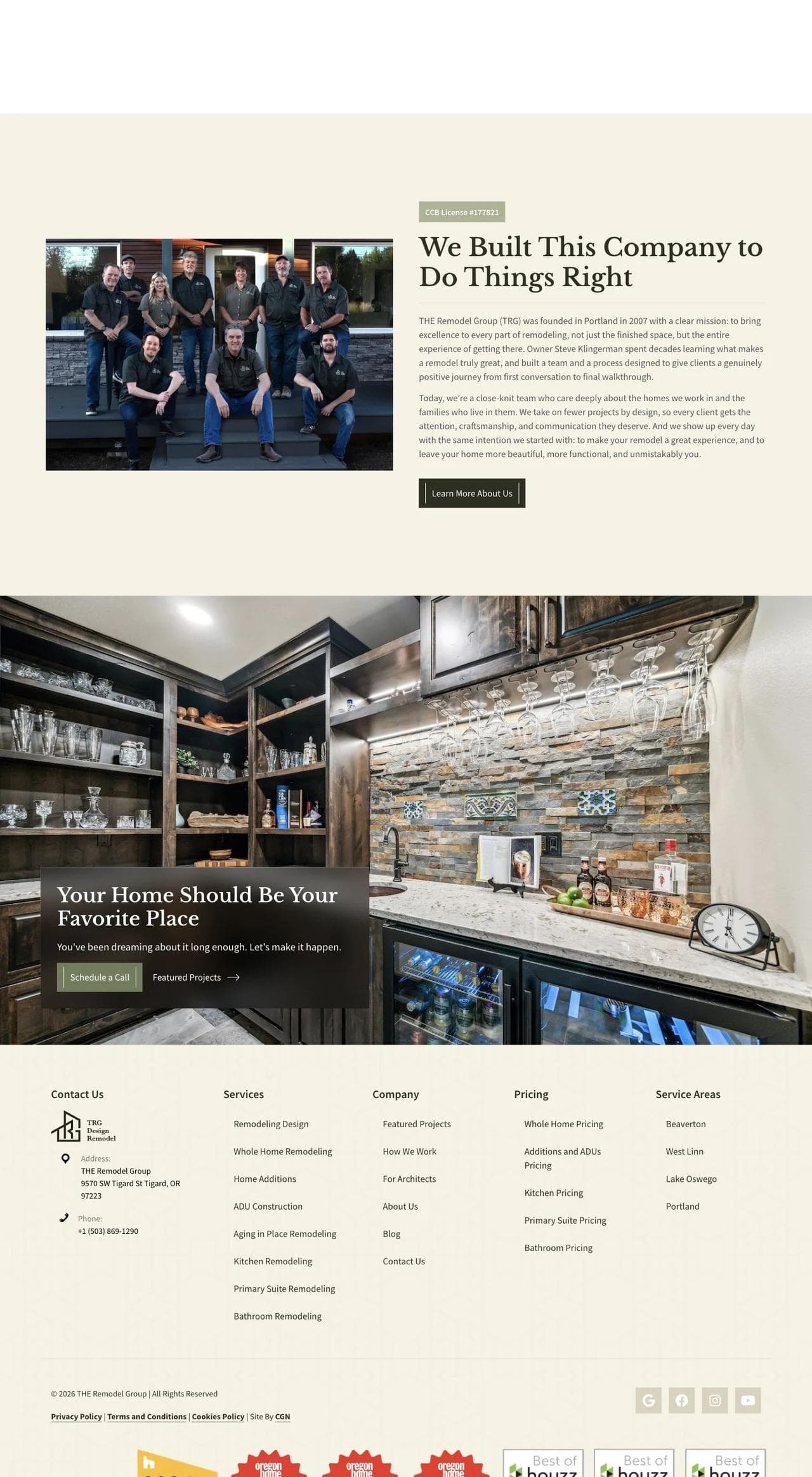
The long FAQ and company-story sequence creates a large amount of vertical travel. A remodeler with weaker photography or less specific proof could not sustain this length. The page works because sections answer different objections, but it would benefit from a persistent path to consultation and a short expectation about project fit, budget, or lead time before the final CTA.
The site also contains a large embedded section that produces substantial blank space when scripts do not load. That is a reminder to test the full homepage with embeds blocked, on slow mobile connections, and after third-party widgets change.
What to borrow
- Put license, warranty, contract, and experience signals near the first decision.
- Use project stories to connect scope, place, and finished work.
- Explain the operational behaviors that protect the client, not only the design result.
- Use the CTA to describe the next real step.
What not to copy blindly
Do not promise fixed pricing or minimal change orders unless your estimating and design process can support it. A powerful website claim becomes a liability when operations cannot deliver it.
2. Fortin Construction: support a complicated buying journey
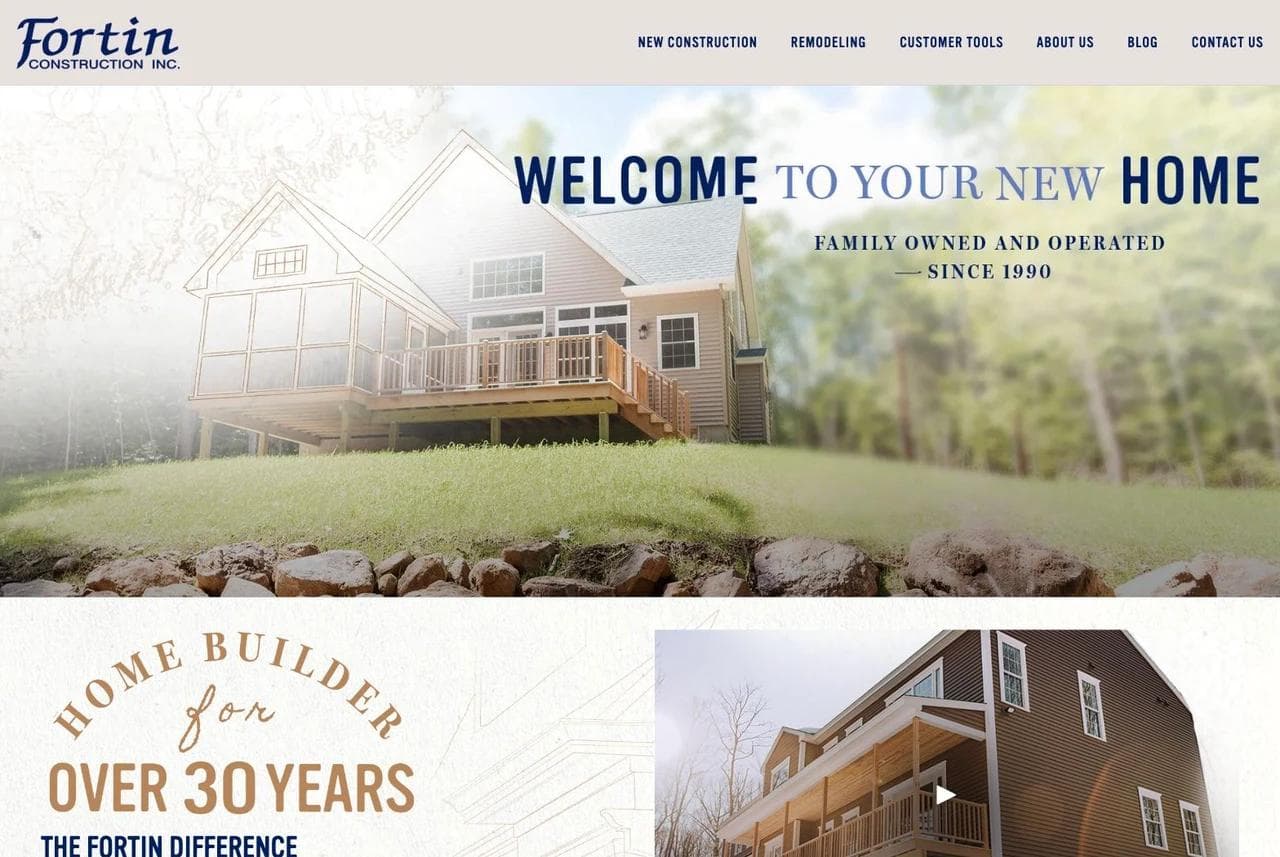
Fortin Construction is a family-run Maine builder offering new homes, remodeling, additions, and related services. The homepage is less visually contemporary than several examples in this guide, but its information architecture reflects how a custom-home buyer actually moves through a project.
What the opening contributes
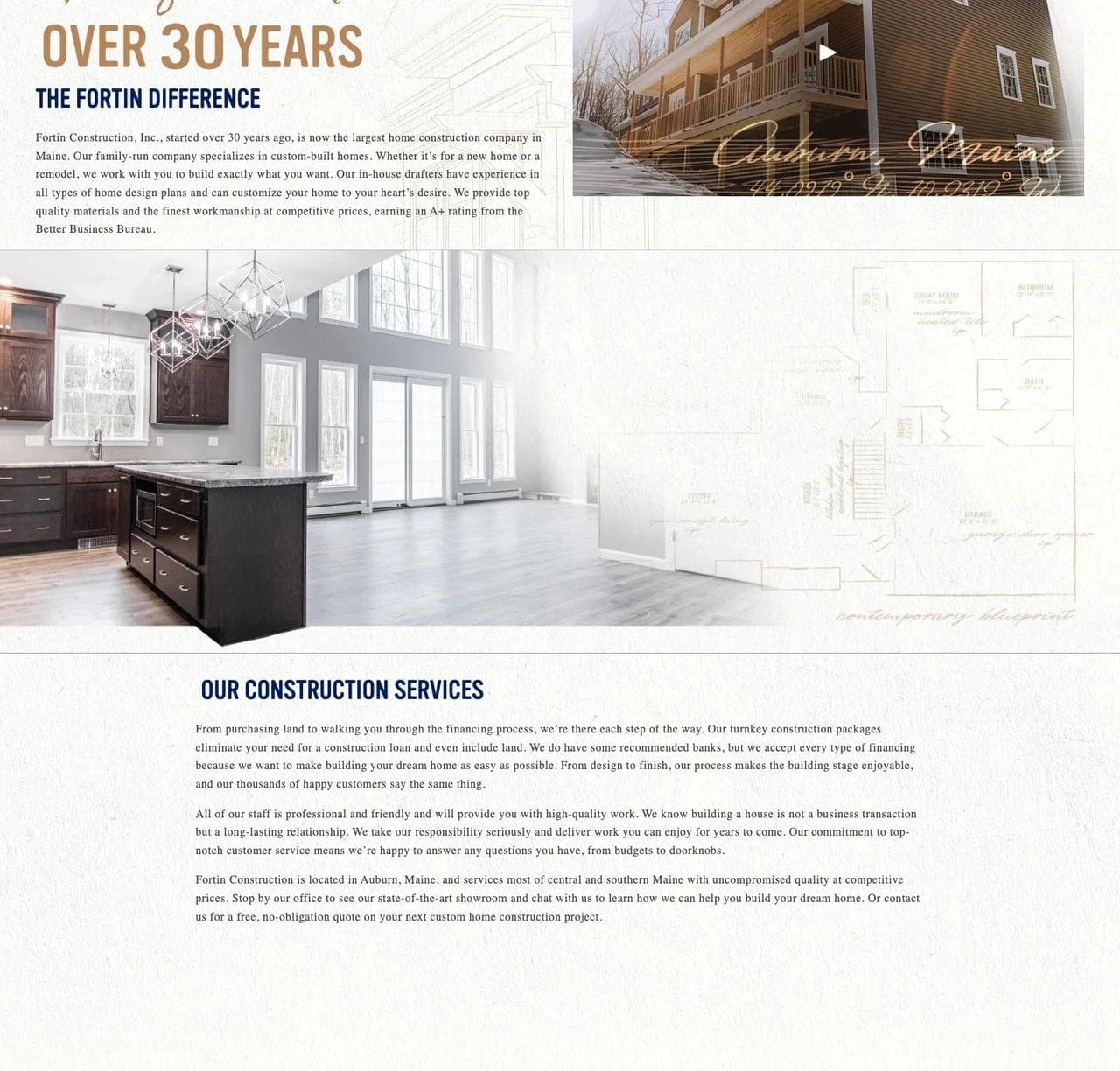
The hero quickly communicates family ownership, longevity, and residential specialization. Fortin then explains its scale and in-house drafting, positioning the firm as a guide from early planning through construction rather than a crew hired after the design is finished.
This is important for a custom builder. Prospects often arrive before they have land, plans, financing, or a realistic budget. A website that assumes every visitor is ready for a quote misses much of the buying journey.
How the middle of the page reduces uncertainty
The construction-services section mentions land purchasing, financing, design, and finish selections. It frames the builder's value around coordination and guidance. Service links then divide the work into new construction, decks and porches, remodeling, and garage additions.
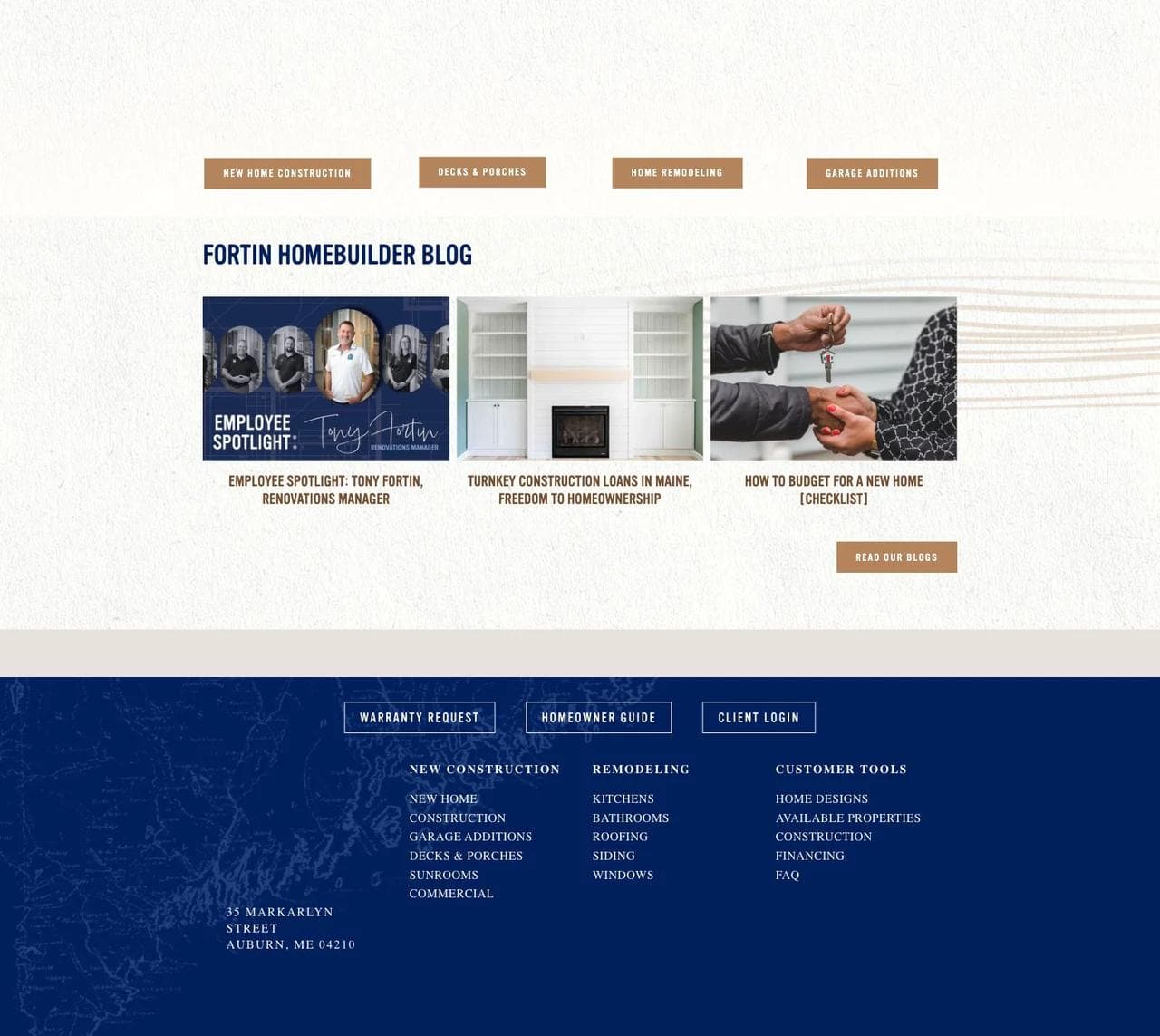
The strongest idea is not the visual treatment. It is the decision to treat financing and planning as content. Educational articles about construction loans and budgeting meet visitors before they are ready to contact a builder. This is a practical local SEO path because the content answers a real early-stage question and can lead naturally into service, process, and consultation pages.
Customer tools are a quiet trust signal
The footer includes a warranty request, homeowner guide, and client login. Those links tell a prospect that the relationship continues after the initial sale. They also separate active-customer tasks from new-business inquiries.
The main tradeoff is hierarchy. Dense body copy and many footer links make the page slower to scan. A redesign should preserve the financing guidance, customer utilities, and service breadth while improving typography, contrast, and mobile prioritization.
What to borrow
- Map content to the stages before a buyer is quote-ready.
- Separate prospects, active clients, and warranty customers.
- Make land, financing, design, and construction responsibilities explicit.
- Use educational content to answer questions that lead into the service.
What not to copy blindly
Longevity and family ownership are not a complete position. Connect them to a buyer benefit such as continuity, local knowledge, warranty accountability, or a named process.
3. Kaplan Construction: let project specificity carry the homepage
Kaplan Construction is a family-owned Boston general contractor and construction-management firm. Its compact homepage does not attempt to explain every capability. It uses current projects and company activity to prove that the firm is active in several commercial and institutional contexts.
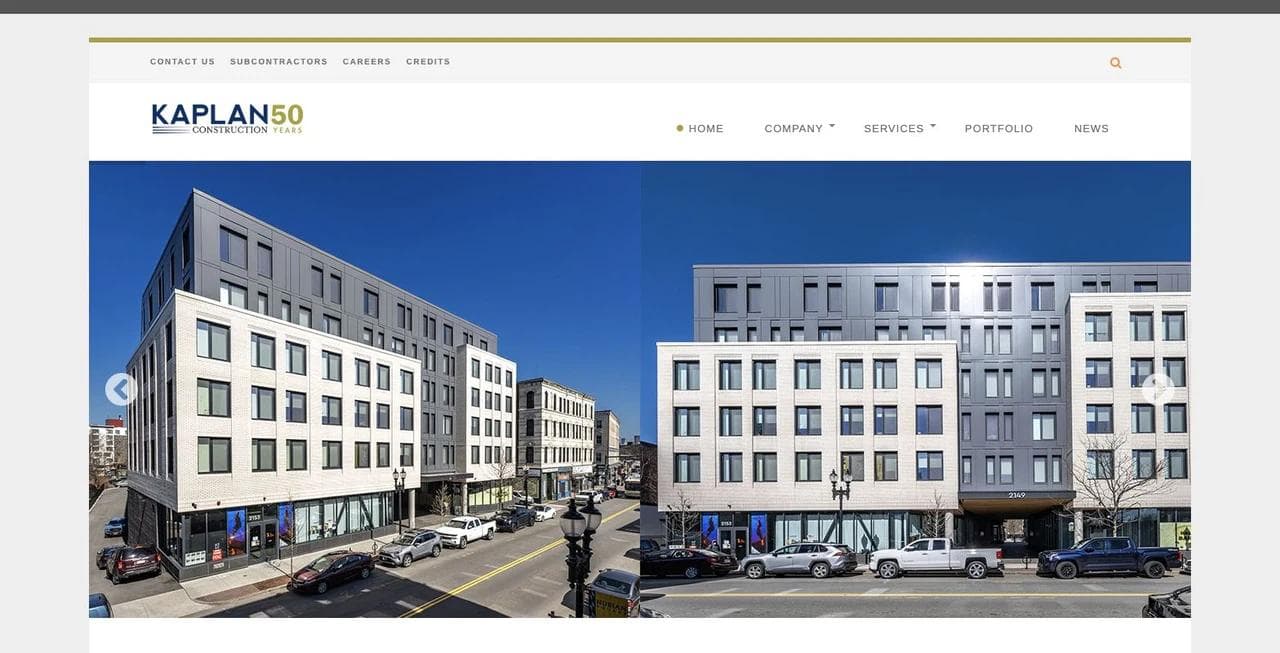
The hero behaves like a portfolio, not an advertisement
The opening is a large project carousel with minimal copy. This is a defensible choice for a business whose prospects may already know what a general contractor does. The project image establishes sector and scale before a visitor reaches the portfolio.
The navigation also exposes pages for subcontractors, careers, and credits. That acknowledges that a construction site has more than one audience. Owners, design partners, trades, and job candidates arrive with different tasks.
Project cards provide the useful level of detail
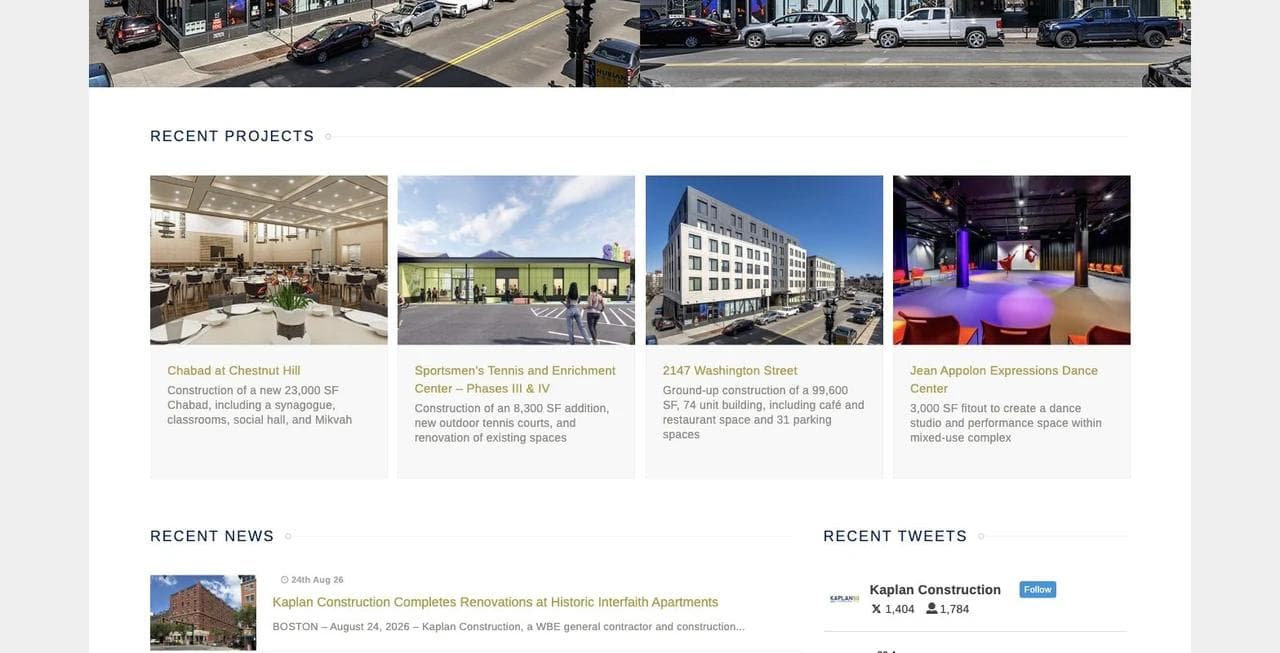
The recent-project cards include a project name and a short scope statement. One identifies a ground-up mixed-use building with apartment and retail components. Others distinguish new construction, additions, renovations, and fit-outs.
This is better than a generic gallery because it helps a buyer compare the work to an upcoming project. The deeper project pages are even more valuable when they name the client, architect, delivery method, square footage, schedule, sustainability target, and constraints. These facts turn a portfolio into prequalification evidence.
Current activity can reassure or distract
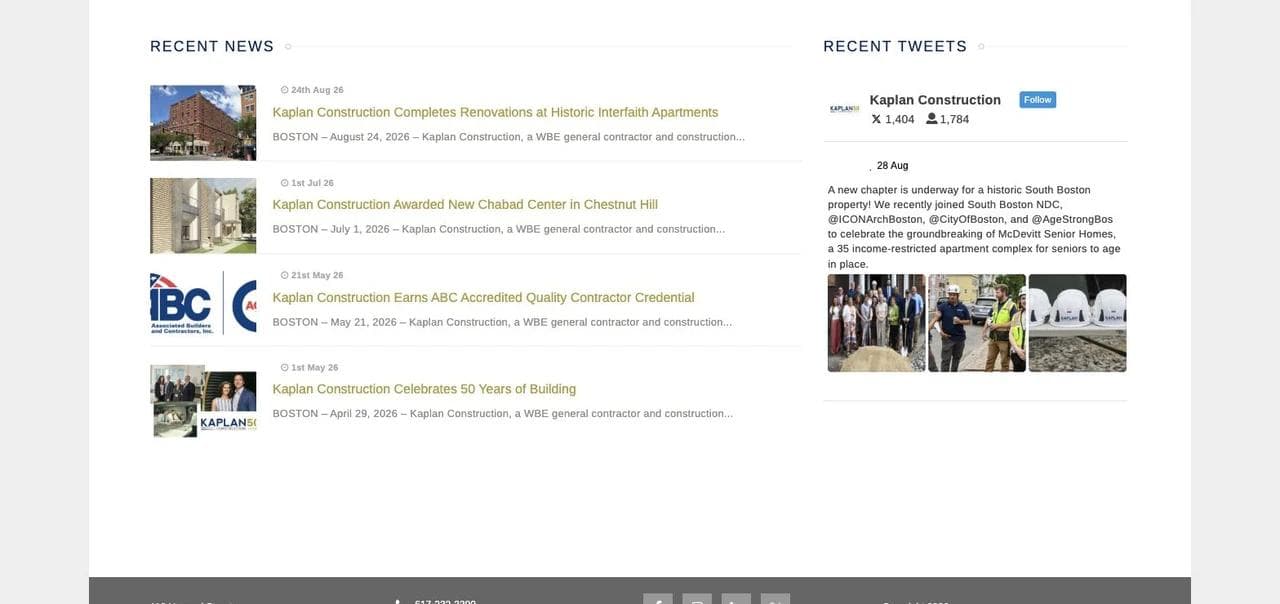
Recent news shows awards, project completions, and company milestones. It signals that the business is active and gives the site fresh internal links. The social feed, however, competes with more durable evidence and depends on a third-party platform. A short list of selected updates or case studies would be more reliable than a live feed.
The homepage is also unusually light on a direct buyer CTA, service-area statement, safety, and the firm's working process. That may be acceptable for relationship-driven commercial work, but a lesser-known contractor would need more guidance before expecting an owner to navigate into the site.
What to borrow
- Put project scope and type directly on portfolio cards.
- Create separate paths for project buyers, subcontractors, and candidates.
- Use current news to show real company activity, not generic thought leadership.
- Keep the homepage compact when deeper project pages carry the proof.
What not to copy blindly
A project-first page assumes the visitor understands the company. If your brand is not already known, add a clear sentence about geography, sectors, delivery methods, and the next step.
4. Crown Industrial Roofing: turn specialist knowledge into qualification
Crown Industrial Roofing serves commercial and industrial flat-roof clients in Toronto and the Greater Toronto Area. Its page is much longer than the others, but it demonstrates what happens when a specialty contractor builds the homepage around the buyer's diagnosis and purchase questions.
The opening filters for a specific job
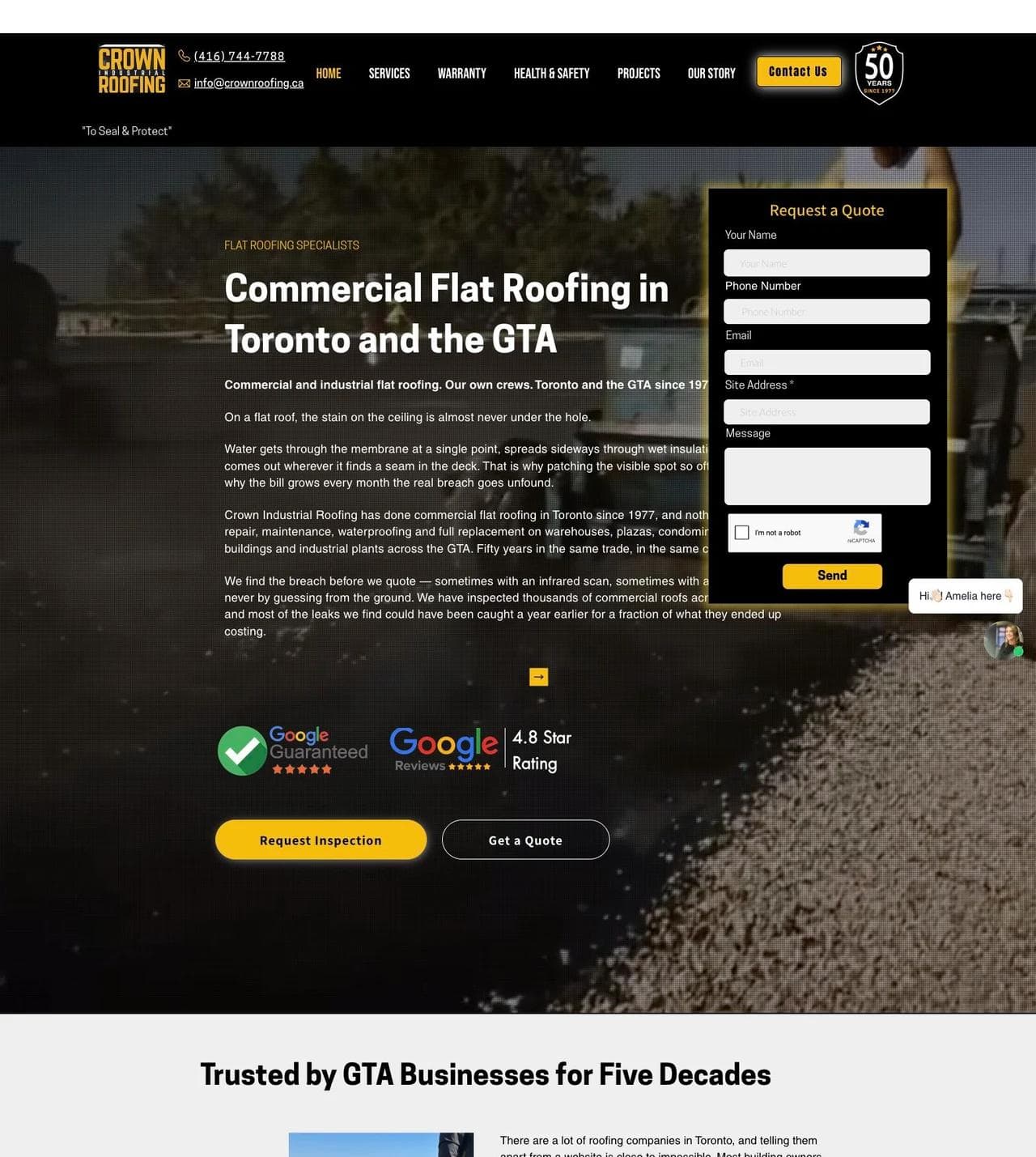
The hero states the trade, building type, geography, and tenure. It also offers two different actions: request an inspection or get a quote. That distinction matters because a facilities manager with an unexplained leak is not necessarily ready to specify a replacement.
The opening copy explains why a visible ceiling stain may not identify the roof breach. This is a strong sales mechanism because it teaches the buyer why diagnosis comes before price. The inspection form is prominent, and trust signals sit near it.
Proof is tailored to commercial risk
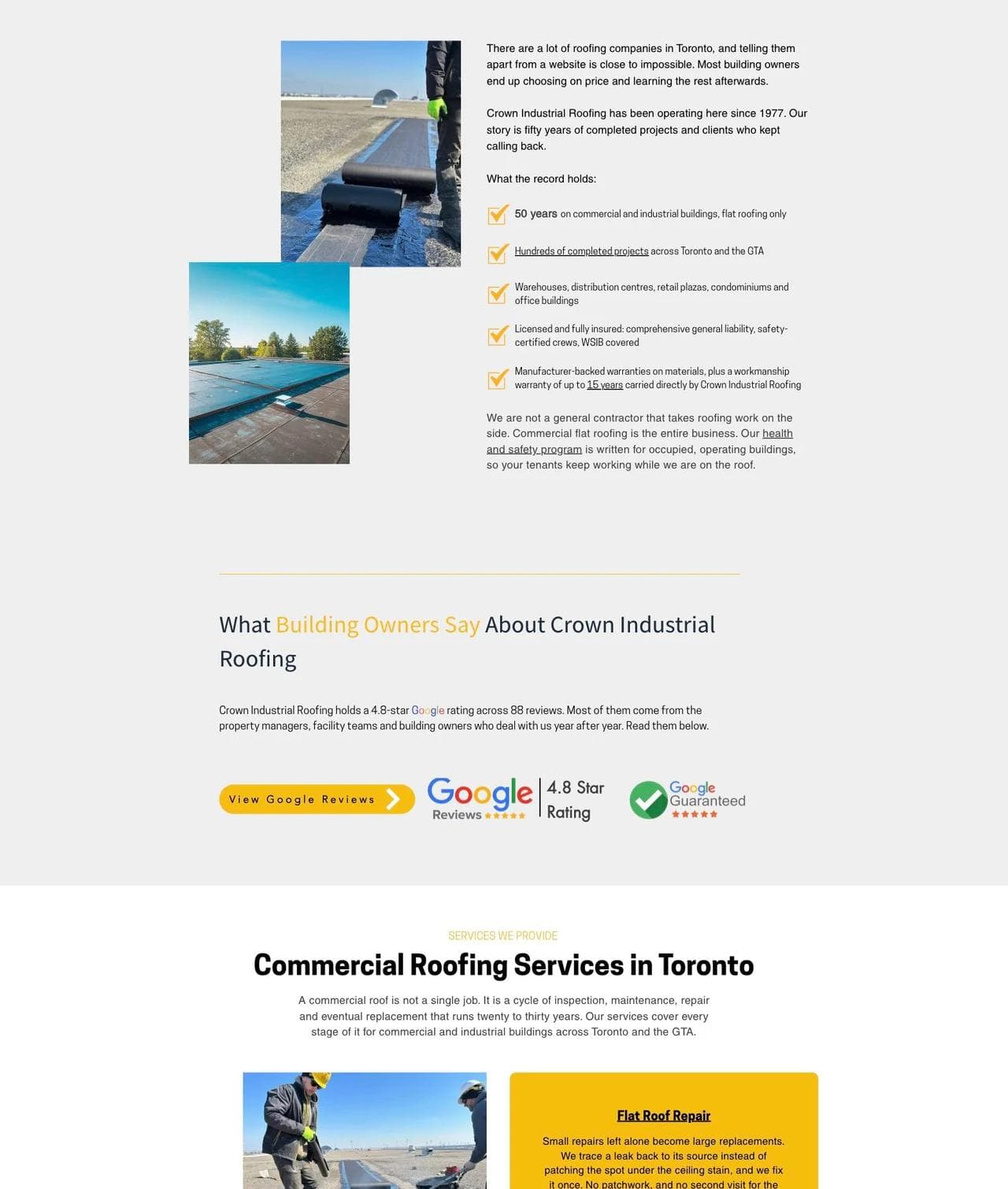
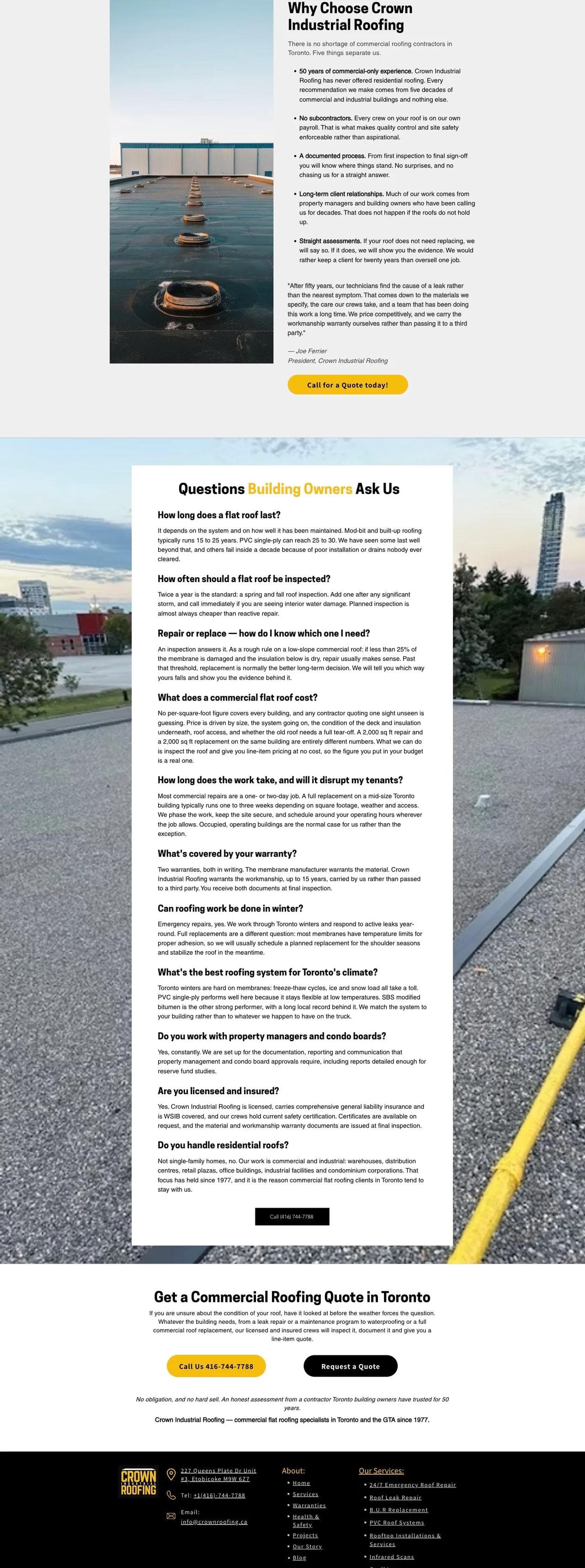
Crown emphasizes commercial-only experience, its own crews, occupied-building safety, insurance, coverage, warranties, and building types. These are not generic badges. They address control, continuity, and operational disruption.
The company also says what it is not: a general contractor taking occasional roofing work. Specialists should do this carefully. Narrow positioning can increase confidence when the buyer has the exact problem, but it also creates an obligation to keep every case study and service page aligned with that claim.
Services and systems are separated
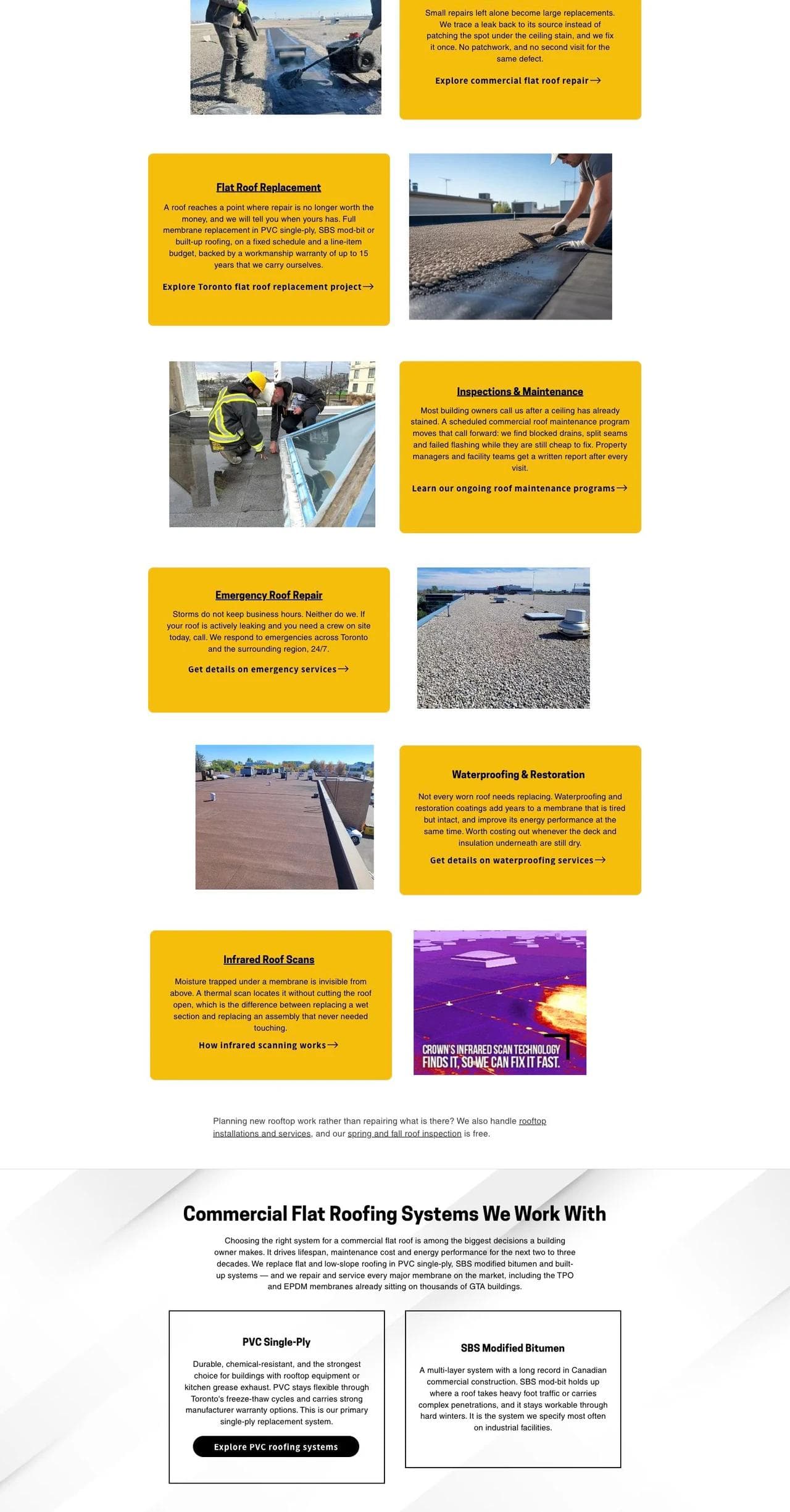
The page distinguishes actions such as repair, replacement, inspection, maintenance, waterproofing, and scanning from roof-system choices. This helps a buyer understand that a service need and a technical system are related but different decisions.
The service blocks use photos and explanatory copy, while system cards create a faster comparison. A specialty contractor can borrow this two-level structure: first help the visitor identify the job, then explain the methods available.
Process, geography, and cost drivers qualify the lead
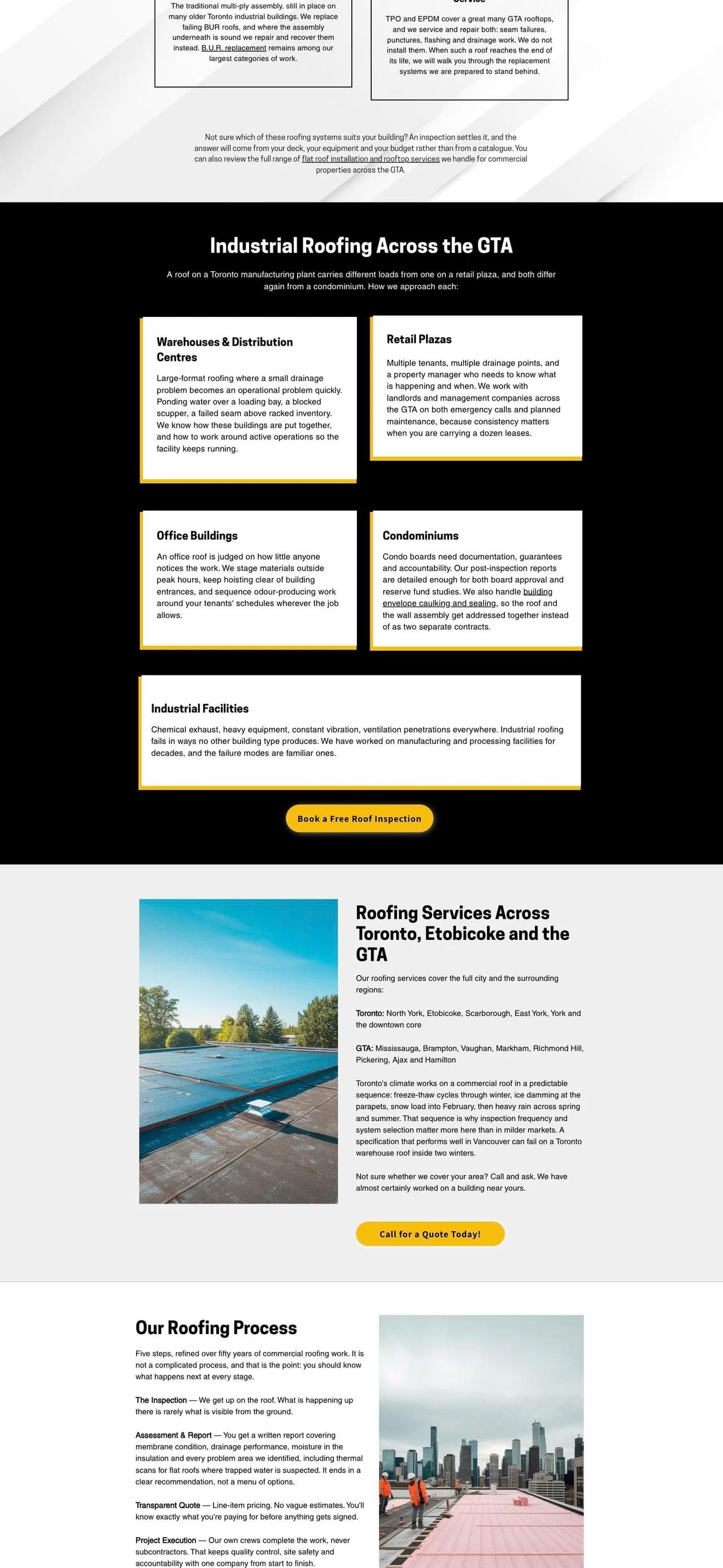
The page names the service area, describes the roofing process, and explains factors that affect price. This is especially useful in a category where an online fixed quote would be misleading. Transparent cost drivers help a buyer prepare without forcing the contractor to publish a number that ignores roof condition, access, occupancy, system, or scope.
There is a limit to this approach. The homepage repeats related calls to action and carries enough detail to become difficult to scan. Some content belongs on focused service, system, inspection, and cost pages with clear links from a shorter homepage.
What to borrow
- Explain why the diagnosis must precede the quote.
- Match trust signals to the commercial buyer's operational risk.
- Separate services from technical systems.
- Publish cost drivers and common questions without pretending every job is standard.
- Name the service area in visible text.
What not to copy blindly
Long-form expertise is useful only when the hierarchy remains clear. Do not repeat the same claim, CTA, or service summary simply to make the page longer.
5. Spectrum General Contractors: differentiate with operating capability
Spectrum General Contractors serves Colorado's Front Range and northwest mountain region across commercial, historic, restaurant, civic, industrial, and residential work. The site is distinctive because its central claim is an operating fact: it maintains three in-house craft shops.
Geography and sector are explicit
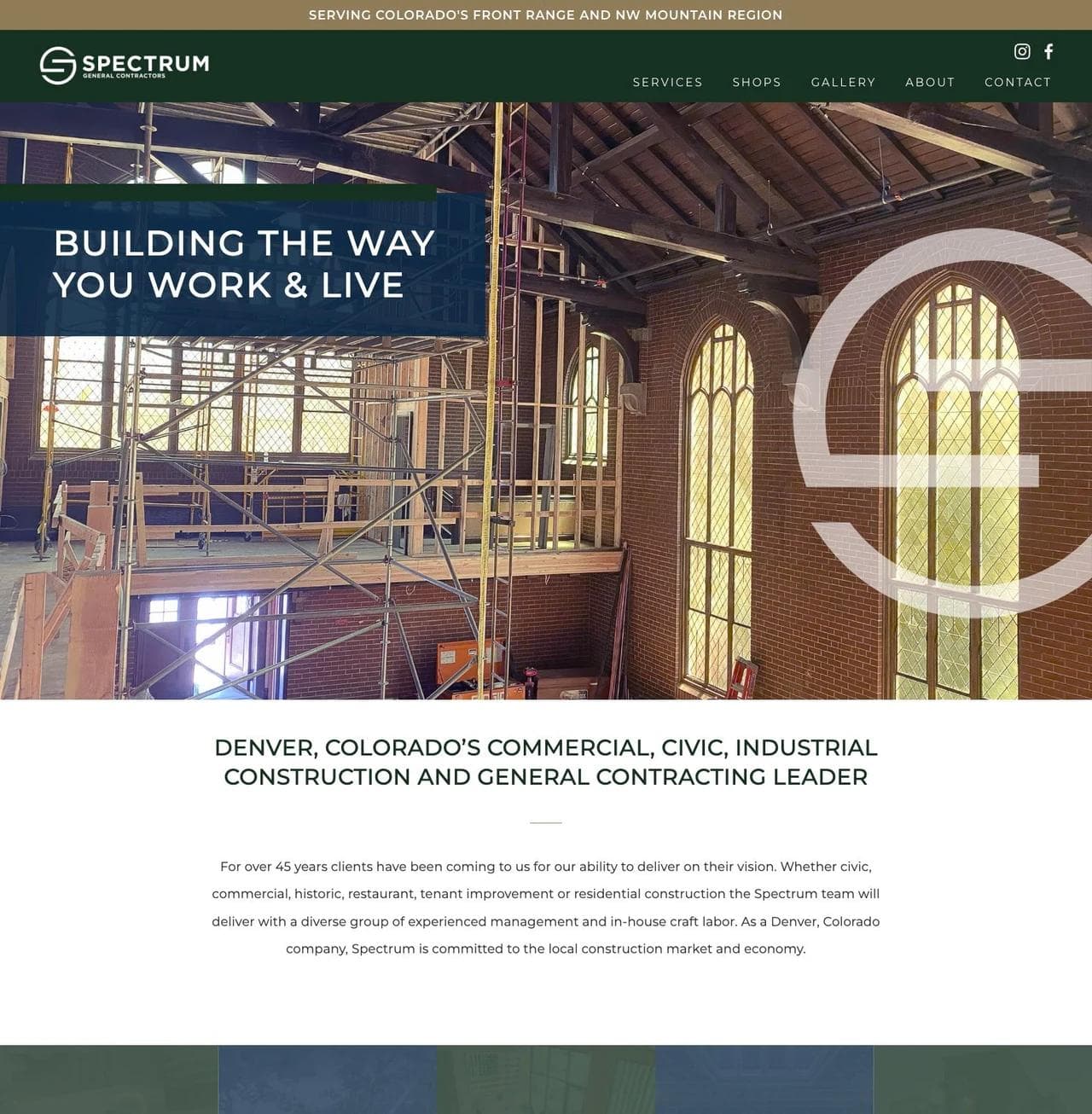
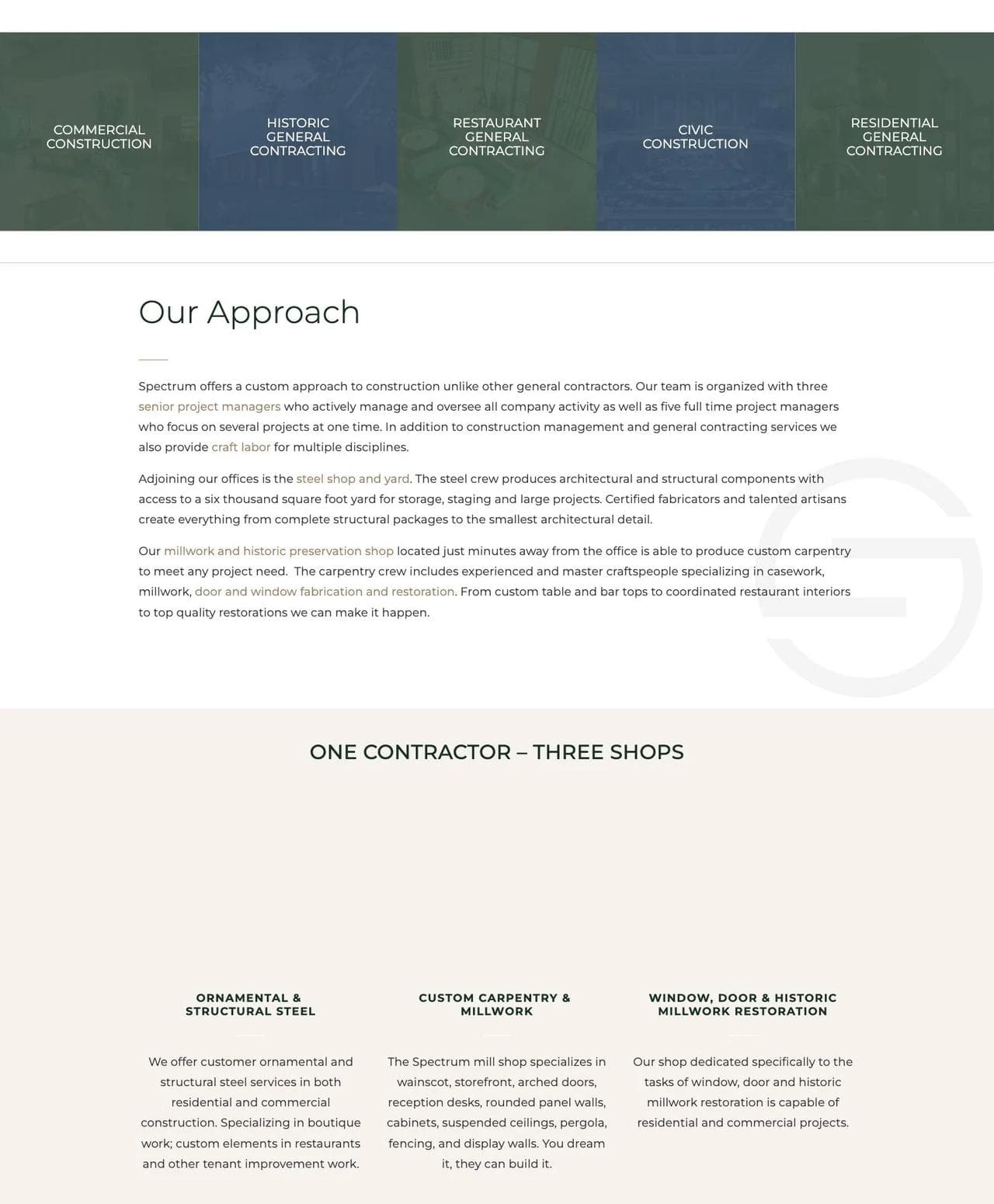
The service area appears at the top of the page, and the opening section lists the sectors below the hero. This lets a buyer answer the two fastest qualification questions without hunting through a footer or project archive.
The restoration image also signals a type of complexity. It supports the later discussion of historic work and in-house fabrication better than a generic crane or skyline image would.
The strongest section explains how work gets done
Spectrum describes its steel yard, millwork shop, and historic window and door restoration capabilities. It then separates the three shops into clear cards for ornamental and structural steel, custom carpentry and millwork, and historic restoration.
This is a stronger differentiator than "quality craftsmanship" because a buyer can understand what the firm controls directly. The website does not need to claim that self-performance is always superior. It needs to explain when the capability affects coordination, restoration fidelity, schedule, or a hard-to-source detail.
The gallery proves range but could teach more
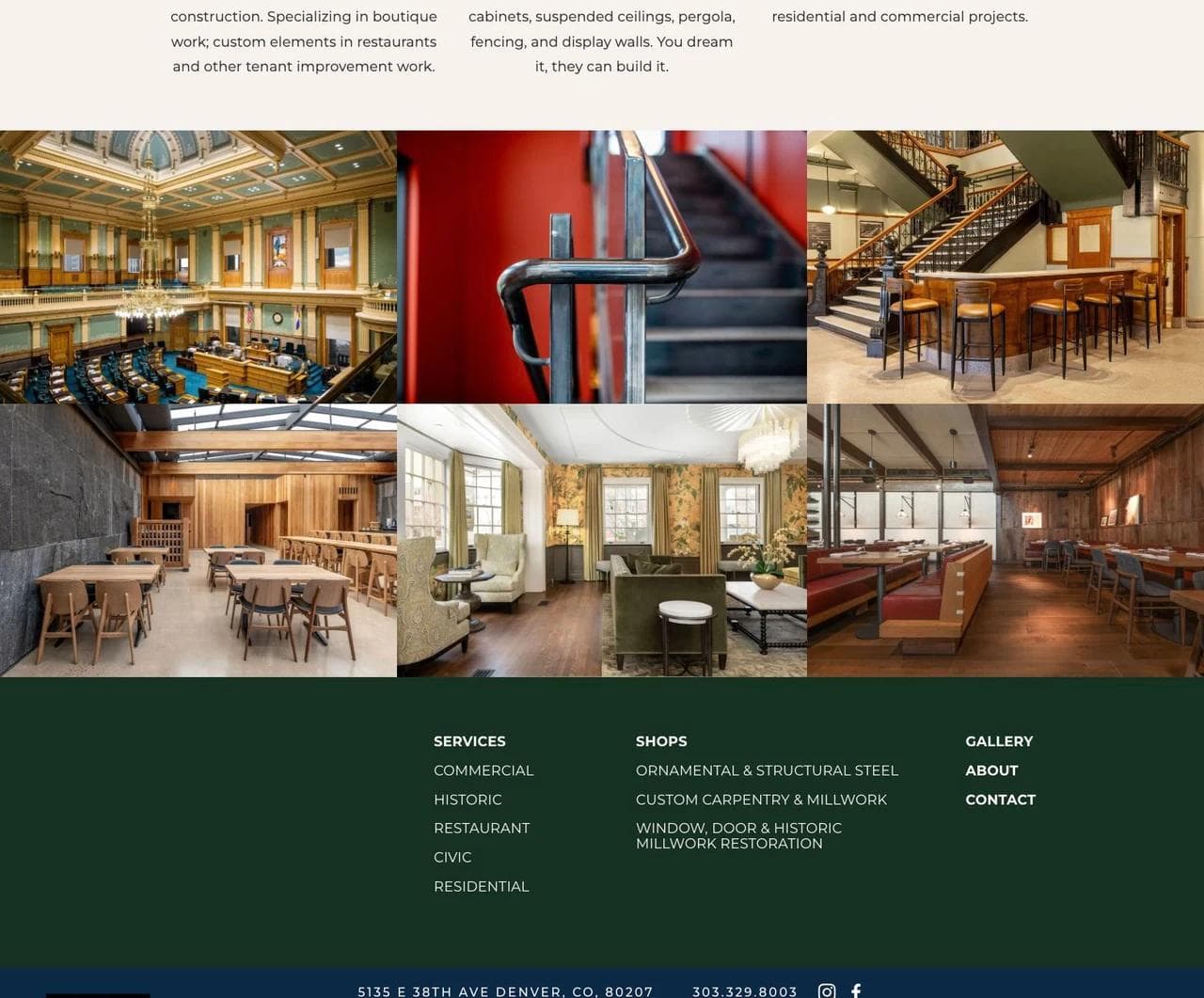
The final project grid shows civic, hospitality, residential, and restoration work. The range is visually persuasive, but captions or links visible on the homepage would make it easier to understand the relationship between project and in-house capability.
The page also gives little space to process, safety, client proof, or a direct inquiry route before the footer. A stronger version would connect each shop to one short project case and provide a clear path for project-specific questions.
What to borrow
- Build the position around a real operating capability.
- State geography and sectors early.
- Use project imagery that previews the company's actual complexity.
- Connect self-performed work to buyer-relevant outcomes.
What not to copy blindly
Do not list equipment, shops, crews, or certifications without explaining why they matter for the buyer's project. Internal capability becomes marketing only when the client can see the consequence.
6. MidMountain Contractors: serve buyers and recruits without confusing either
MidMountain Contractors builds heavy civil utility and roadway infrastructure in Western Washington. The homepage shows how a compact contractor site can communicate public-client credibility, services, experience, projects, inquiries, and employment without trying to turn every section into a lead form.
The opening establishes market and buyer proof
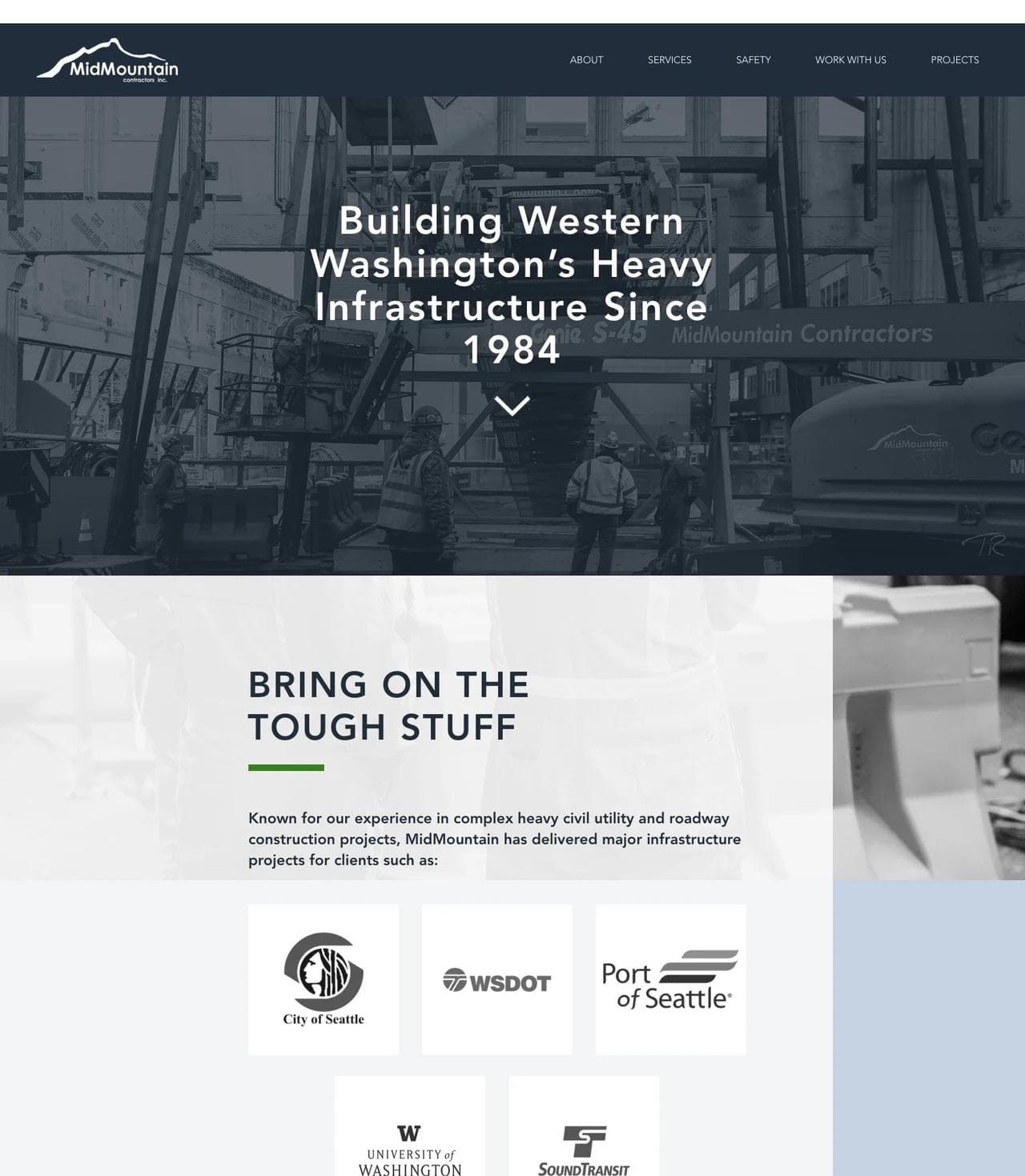
The hero names Western Washington, heavy infrastructure, and the company's founding year. The following section adds logos for recognizable public and institutional clients. For public and infrastructure work, this is stronger than a row of consumer review stars because it reflects the kind of organization evaluating the contractor.
Client logos should be used only with permission and should link to relevant project evidence when possible. A logo without a scope, outcome, or case study can imply more than it proves.
The middle is deliberately concise
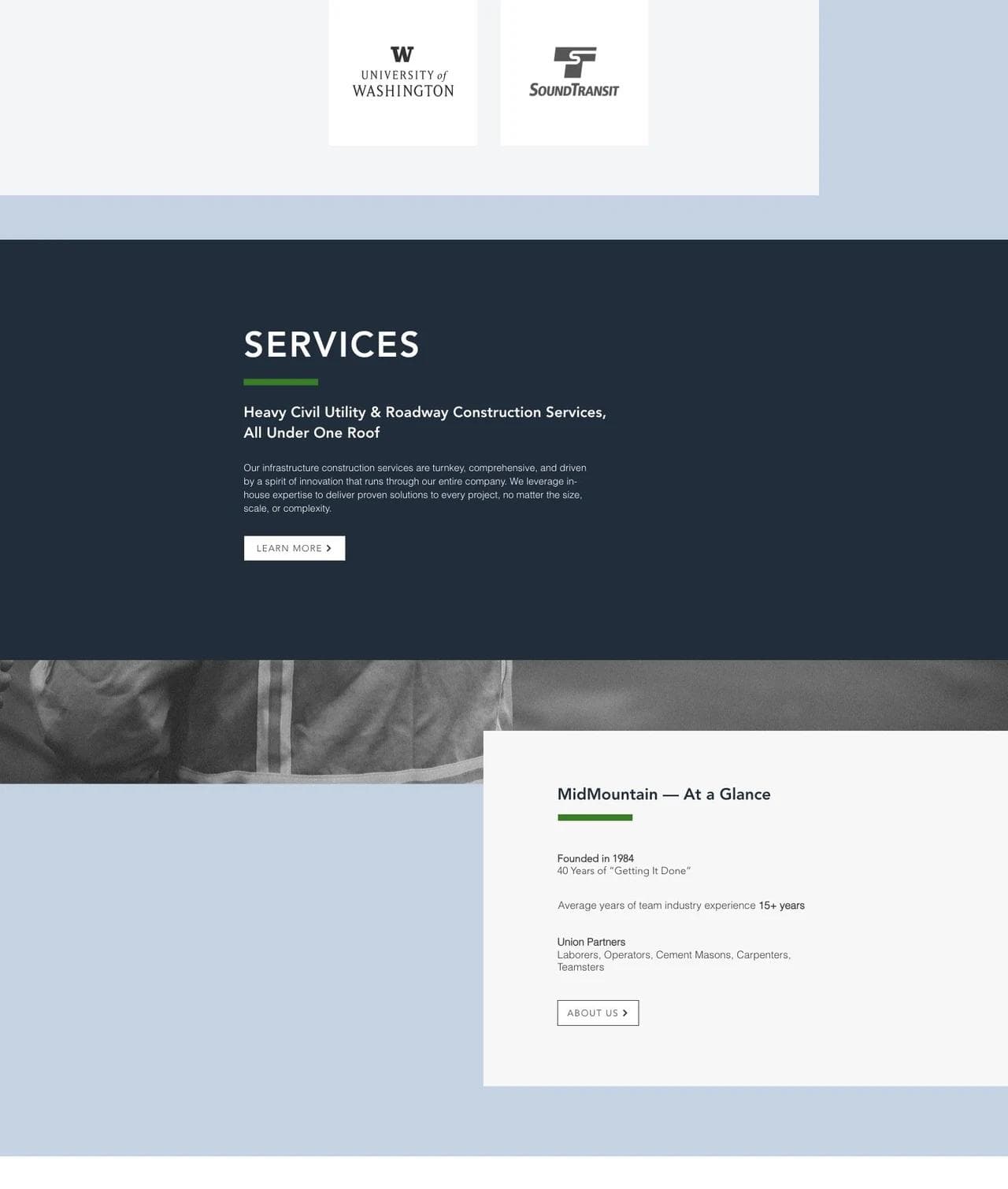
MidMountain summarizes heavy civil utility and roadway services, then presents a small fact panel with company tenure, team experience, and union relationships. This creates a useful scan path for an owner or partner who wants a fast qualification signal.
Safety is visible in the primary navigation rather than buried in the footer. OSHA notes that construction employers need safety and health program elements, and its recommended practices emphasize coordination among general contractors, contractors, subcontractors, and staffing agencies. A website safety page is not the program itself, but making it easy to find helps a buyer or candidate understand where to request the real documentation.
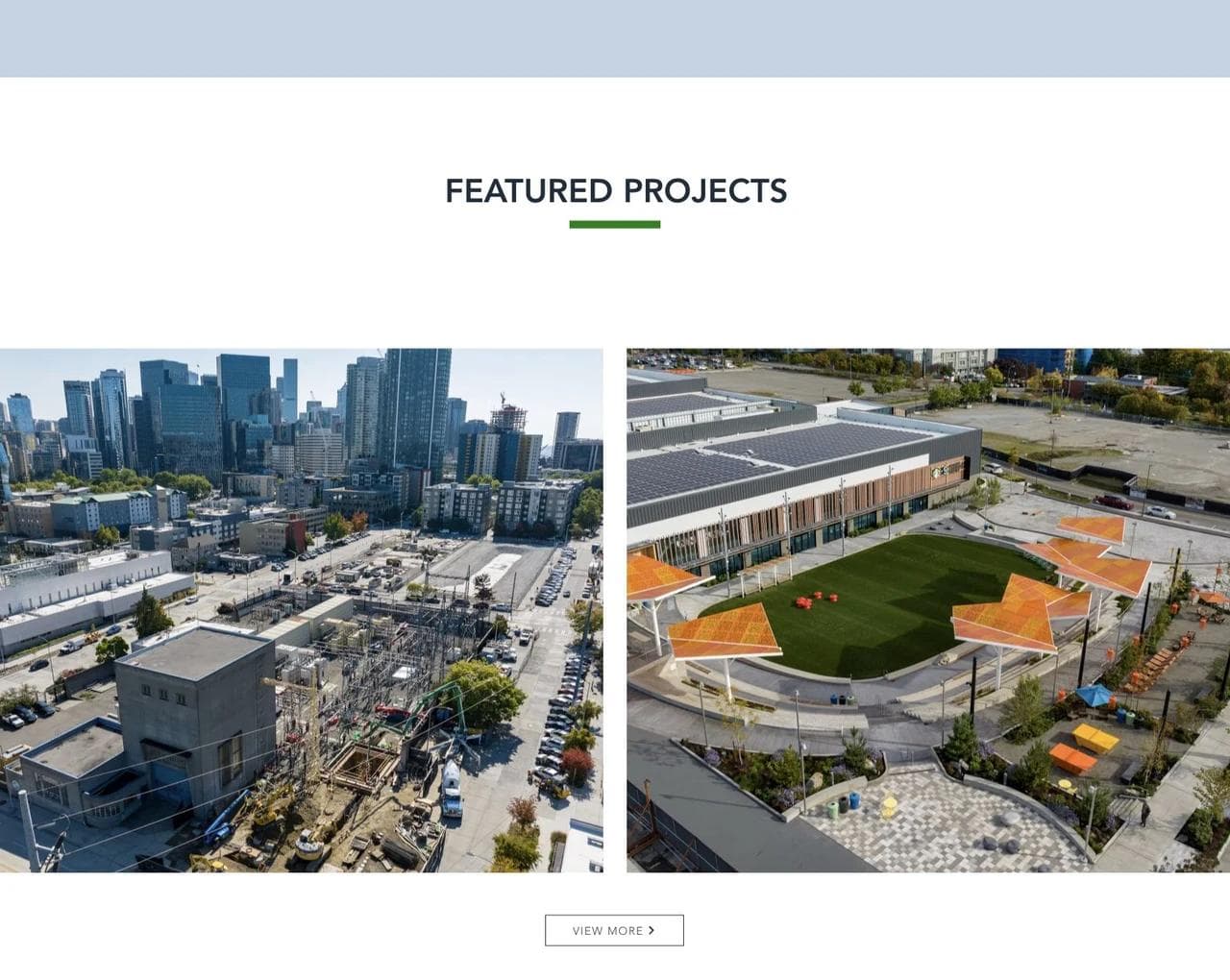
Featured projects deserve more context
The homepage uses large aerial images to show infrastructure scale. The photography is strong, but the cards could carry location, owner, scope, delivery method, constraints, and completion status. Heavy-civil buyers need evidence that goes beyond visual impact.
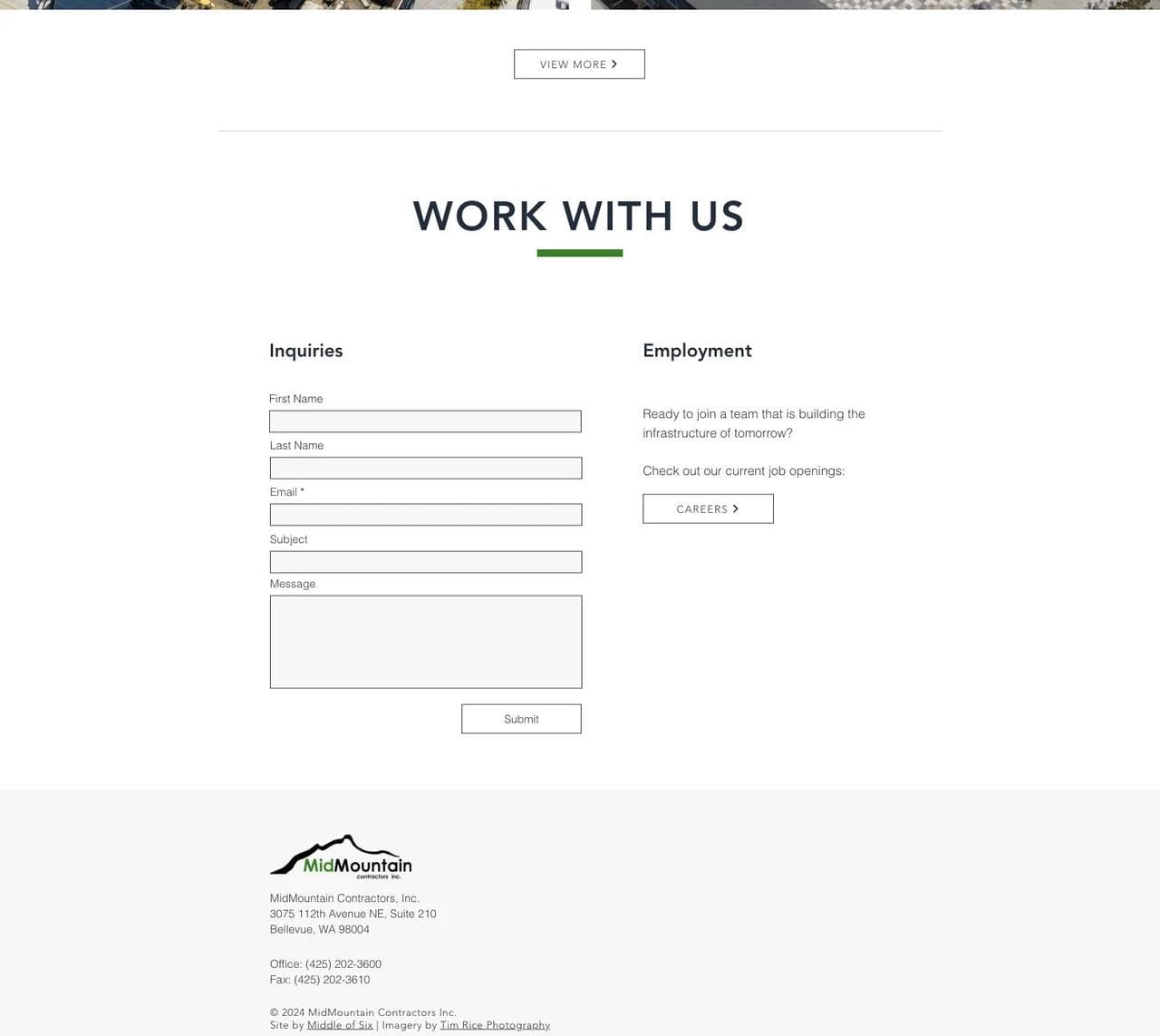
Two closing paths reflect two audiences
The final section places project inquiries and employment beside each other. This works because each has its own heading and action. A construction homepage often serves recruiting as well as business development, especially when field talent limits growth.
The inquiry form is simple, but it risks attracting vague or poorly qualified requests. Asking for project type, location, anticipated start, and how the visitor wants to be contacted could improve routing without turning the form into a bid package.
What to borrow
- Match proof to the buyer type.
- Give safety and careers first-class navigation when they matter to growth.
- Keep buyer and candidate actions separate.
- Add enough project metadata to turn impressive photography into qualification evidence.
What not to copy blindly
Do not ask every audience to use the same contact form. A project owner, subcontractor, applicant, vendor, and media inquiry need different routing and response expectations.
What the six sites have in common
The designs vary, but the useful pages repeatedly make five ideas visible.
1. The work is the primary visual system
Every example relies on actual homes, interiors, buildings, roofs, restoration, or infrastructure. Construction is unusually fortunate: the deliverable can also be the strongest marketing asset. Invest in consistent project photography, but pair images with context.
2. Geography is part of the product
A contractor does not offer an abstract national service. Crews, licensing, relationships, travel, climate, codes, and project economics create boundaries. Google recommends accurate service areas for service-area businesses, and the website should be at least as clear as the Business Profile.
3. Portfolios need facts
The best project entry answers: who was it for, where was it, what was built, how large was it, how was it delivered, what made it difficult, what did the contractor control, and what was the result? Residential projects may need privacy-safe descriptions rather than names. Commercial projects often benefit from naming the client and design partner with permission.
4. Trust is specific to the job
Homeowners may value reviews, warranty, communication, and budget process. Commercial owners may look for sectors, safety, bonding, insurance, delivery methods, references, and named project teams. Facilities buyers care about response, diagnosis, continuity, and minimizing disruption. Use the proof that reduces the actual buyer's risk.
5. The next step is not always a quote
An early residential lead may need a budget guide. A roof buyer may need an inspection. A commercial owner may want a credentials package. A subcontractor needs bid opportunities. A candidate needs open roles. One giant "Contact us" button makes all of these jobs harder.
Three construction homepage architectures
The right sequence depends on the business model. These are starting structures, not templates.
Residential remodeler or custom builder
- Scope, service area, and primary promise
- Trust strip with license, warranty, experience, and project-fit facts
- Core services or project types
- Relevant project stories
- Process and budget expectations
- Client proof
- Team and accountability
- FAQ and consultation CTA
- Warranty, client-login, and customer-support paths
Commercial general contractor or design-build firm
- Sectors, geography, and delivery model
- Selected projects with scope and size
- Services and differentiating operating capabilities
- Safety, quality, and prequalification path
- Team or local office accountability
- Case studies and client references
- Separate routes for owners, subcontractors, and careers
- Project inquiry or credentials-request CTA
Specialty contractor
- Exact trade, building type, service area, and response path
- Diagnose-first explanation
- Service choices
- Systems, methods, or technical options
- Licenses, insurance, safety, warranties, and crew model
- Relevant project evidence
- Process and cost drivers
- Inspection, emergency, or quote CTA
- Educational resources and FAQs
Construction website SEO that serves a buyer
Local SEO is not a license to publish dozens of thin city pages. Start with pages that reflect real services, projects, and markets.
- Create a page for each meaningful service or project type.
- Build service-area pages only when you can add local projects, conditions, permits, partners, or guidance that makes the page genuinely useful.
- Link project case studies to the relevant service and location pages.
- Keep the company name, phone, address, and service area accurate across the website and Business Profile.
- Add LocalBusiness structured data where appropriate. Google says it can communicate details such as address, hours, telephone, and URL, but the visible page still needs to help the human visitor.
- Publish educational content from recurring sales and project questions, then connect it to the next relevant action.
The objective is not maximum page count. It is a site where a buyer can move from a specific question to evidence, then to a sensible next step.
Lead forms should qualify without becoming a bid package
A useful construction inquiry form often asks for:
- Project type or service needed
- Project location
- New construction, renovation, repair, or assessment
- Approximate size or scope
- Desired start or decision timeline
- Budget range when it is appropriate for the market
- Whether plans, specifications, photos, or a site assessment exist
- Preferred contact method
Collect only what the team will actually use. Explain what happens next and when the visitor should expect a response. Keep emergency requests, warranty work, subcontractor outreach, careers, and new projects in separate paths.
Safety, licensing, accessibility, and credibility
A polished page cannot substitute for compliance. Link to verifiable information and keep it current.
- Display the legal business name and relevant license number where required, with the jurisdiction or verification link.
- Explain insurance, bonding, certifications, and warranties precisely. Avoid badges whose meaning a buyer cannot verify.
- Give commercial visitors a direct path to request safety, quality, insurance, and prequalification documentation.
- Make the website keyboard-accessible, readable at high zoom, and usable with adequate contrast. Forms need real labels, understandable errors, and a mobile layout that works on a job site.
- Obtain permission for client logos, testimonials, project addresses, and photography. Residential case studies may require more privacy than commercial work.
Where Moda fits in a construction website workflow
Moda can help a construction team create a branded static marketing site, service pages, project case studies, team pages, recruiting pages, and simple lead forms. It is also useful for the adjacent visual work contractors repeatedly need, such as capability decks, proposal graphics, project announcements, social posts, and recruitment creative.
Moda is not construction operations software. It does not replace estimating, scheduling, bid management, safety documentation, client portals, warranty systems, or project-management platforms. A contractor that needs complex CRM routing, a large CMS, customer logins, or live operational data should choose infrastructure built for those jobs and use the marketing site as the clear public layer.
If a branded static site and a straightforward inquiry path fit the project, try Moda today. For a broader view of platform choices, see our guide to the best AI website builders. The real estate website design and law firm website design teardowns show how the same trust framework changes in other high-consideration local services.
Construction website launch checklist
- The hero names the work, geography, and buyer.
- Services use customer language rather than an internal org chart.
- Project cards include scope and context, not only photos.
- Trust signals match the buyer's risk.
- The process explains who owns each phase and what happens next.
- License, insurance, safety, warranty, and certification claims are precise.
- Owners, homeowners, subcontractors, candidates, and active clients have distinct routes.
- Forms are short, labeled, mobile-friendly, and routed to a responsible person.
- Service-area and business details match current reality.
- Images have useful alt text and do not expose private client information.
- Embedded maps, feeds, videos, chat widgets, and forms fail gracefully.
- The site has been tested on a phone, slow connection, keyboard, and high zoom.
Frequently asked questions
What should a construction company website include?
A construction website should identify the work, service area, project fit, and next step quickly. It also needs specific project evidence, relevant trust signals, a clear process, named people or accountability, distinct contact routes, and accurate licensing, safety, warranty, and business information.
How many projects should a contractor show?
Show enough projects to represent the scopes, sectors, locations, and scale you want to win. A smaller set of detailed case studies is usually more useful than a large image gallery without context. Keep older projects when they remain relevant, but label dates and current capabilities accurately.
Should construction companies list prices on their websites?
Publish prices only when the scope is standardized enough for the number to be meaningful. Remodelers and custom builders may use project-fit ranges or educational budget guidance. Commercial and specialty contractors can explain cost drivers and the information required for a scoped estimate.
How can a construction website generate better leads?
Use service and location clarity to filter visitors, show comparable projects, explain the next step, and ask only for information the team will use. Route new projects, emergencies, warranty work, subcontractors, careers, and active clients separately.
What is the best website builder for a construction company?
The right platform depends on the operating requirements. A static builder can work for marketing pages, project case studies, recruiting, and simple lead forms. Contractors that need complex CRM routing, client portals, bid systems, warranties, or live project data should choose infrastructure designed for those functions.
How often should a construction website be updated?
Update the site whenever licenses, service areas, leadership, contact details, insurance or warranty claims, project availability, or job openings change. Add new project cases and review older claims on a regular schedule. Remove broken embeds, stale awards, unsupported metrics, and inactive services promptly.

Real editable visuals. Real canvas. Full control.
Fly through design work