Real Estate Website Design: 6 Full-Page Teardowns
See six real estate websites analyzed section by section, with lessons for agent positioning, IDX search, local SEO, lead capture, and trust.
 Anvisha Pai, Co-founder & CEO, Moda
Good real estate website design must answer two questions quickly: why should someone use this site instead of a national property portal, and why should they trust this agent or brokerage with the transaction?
Listings alone rarely answer either question. Zillow, Realtor.com, and large brokerage portals already offer broad inventory and familiar search tools. An independent real estate website earns attention by adding what a portal cannot: local interpretation, a clear service model, recognizable people, relevant proof, and a useful path from browsing to a conversation.
This guide analyzes six complete homepages from a solo residential agent, two independent residential brokerages, a boutique buyer and investment advisor, a commercial brokerage, and a firm that also recruits agents. We look beyond the hero to explain what every section contributes, what feels repetitive, and which patterns make sense for different real estate businesses.
Six real estate website examples at a glance
- Home in Amelia Island: A solo agent site organized around relocation, local expertise, and specific communities.
- Dwelling in Maine: An independent brokerage that turns Maine lifestyles into a browsing system.
- Campion and Company: A Boston boutique that leads with property search, market authority, and neighborhood navigation.
- Blooming Sky: A New York advisory that sells a guided process for buyers, sellers, and investors.
- City Commercial Realty: A compact commercial brokerage site centered on senior attention and specific services.
- Fifth & Forever: A family-owned brokerage serving consumers while also making a detailed case to prospective agents.
These sites are not ranked. They represent different business models, audiences, property types, and conversion goals.
The real job of a real estate homepage
A useful homepage performs five jobs.
- Define the market: Name the geography, property type, client, or transaction the business understands.
- Route the visitor: Give buyers, sellers, renters, investors, landlords, tenants, or prospective agents a relevant path.
- Add value beyond inventory: Supply interpretation, local knowledge, service, or access that a portal does not.
- Make trust concrete: Show real people, transactions, reviews, market knowledge, and an understandable working process.
- Offer the right next step: Let a visitor search, subscribe, request a valuation, download a guide, or start a conversation.
This distinction matters when deciding whether to add IDX. Under the National Association of Realtors' current Internet Data Exchange policy, participating brokers may display certain MLS listings subject to local rules and display requirements. That can make search useful, but it does not create a reason to choose the firm. IDX is infrastructure. Positioning, interpretation, and service are the strategy.
1. Home in Amelia Island: organize a solo-agent site around relocation
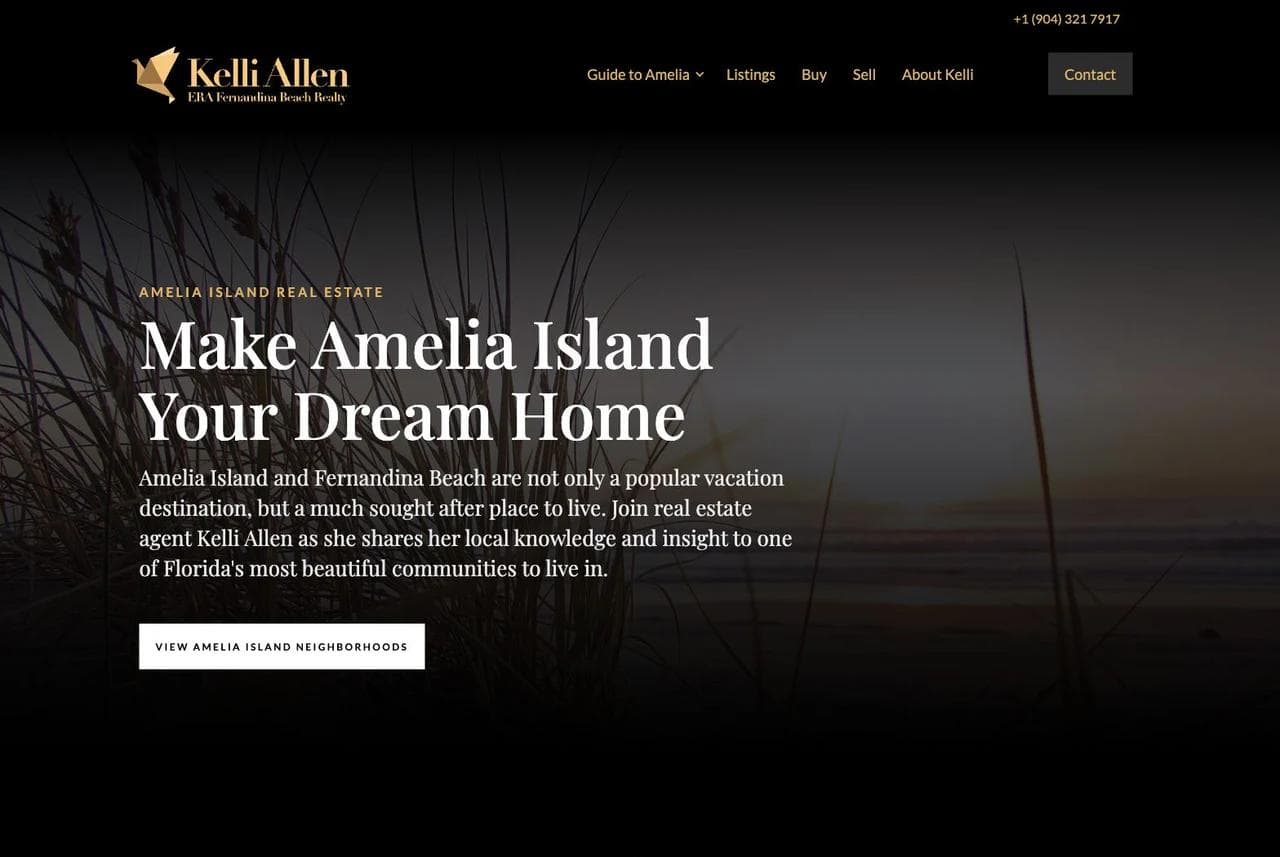
Kelli Allen's Home in Amelia Island site serves Amelia Island and Fernandina Beach, Florida. The page is a useful model for a local agent whose strongest advantage is not inventory breadth, but familiarity with a destination and the decisions involved in moving there.
How the page is structured
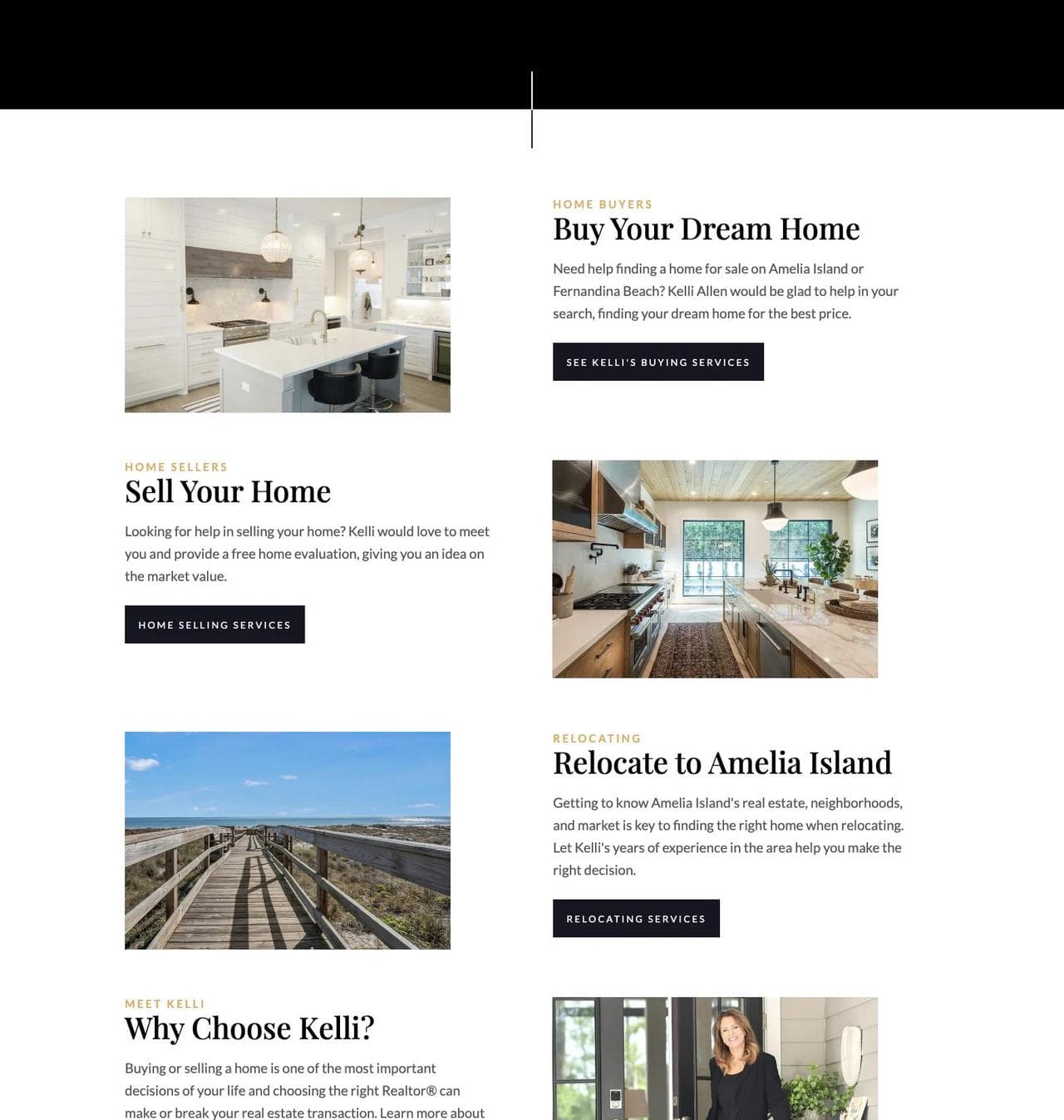
The hero says “Make Amelia Island Your Dream Home,” pairs the destination with local imagery, and introduces Kelli as the person behind the experience. The next major fork is practical: buy a home, sell a home, or relocate. This reflects three different visitor situations instead of treating every lead as a generic prospect.
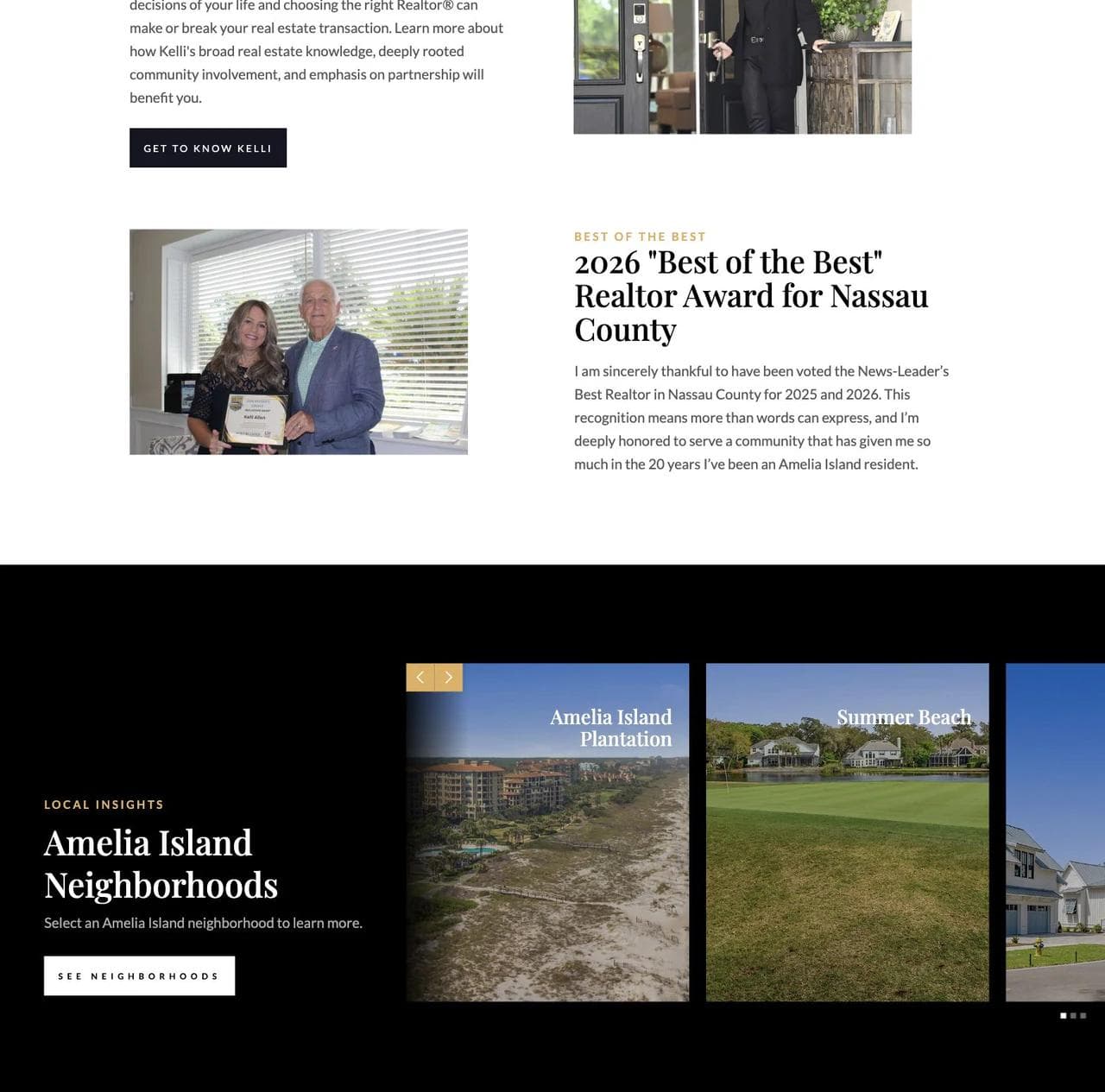
The page then makes the agent visible and explains why someone would choose her. Awards, local knowledge, and a personal story support the claim. Community cards lower on the page turn a broad destination into recognizable neighborhoods and include price context, giving visitors a more useful way to browse than a generic “areas served” list.
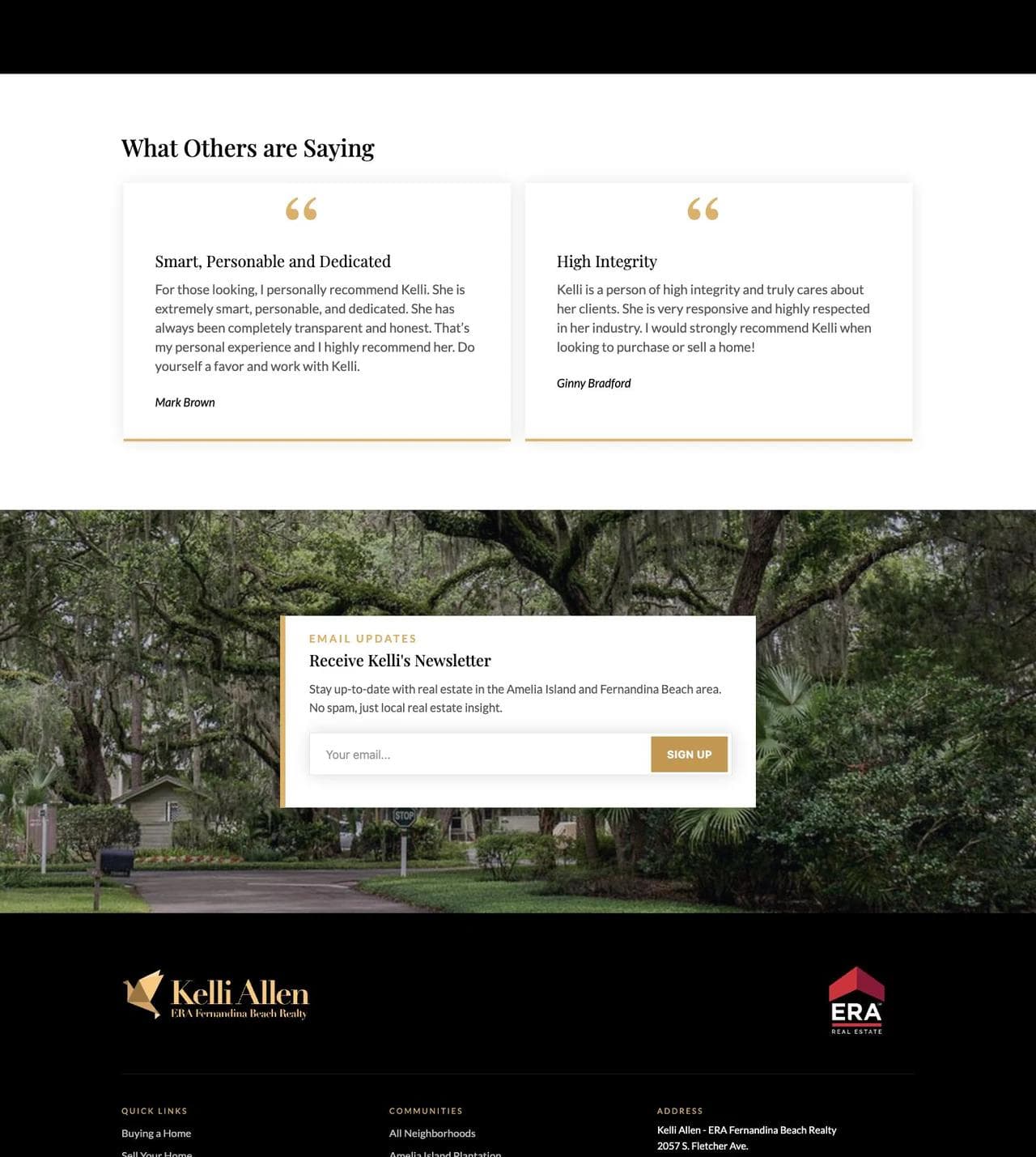
Reviews, a newsletter, and contact details close the page. The sequence moves from aspiration to transaction type, then agent, community, proof, and action.
What works
- Relocation is a real service lane. A visitor moving to the island needs more guidance than a resident who already knows the neighborhoods.
- The community section is decision support. Neighborhood names and price signals help a buyer begin forming a shortlist.
- The agent is part of the product. The page does not hide the person behind a generic luxury identity.
- The site offers a lower-commitment relationship. A newsletter can retain visitors who are months away from a move.
What to borrow
If relocation is important, treat it as a journey rather than one navigation label. Explain communities, tradeoffs, timelines, remote-viewing support, local services, and what happens before the buyer arrives. A useful relocation path can compete on knowledge even when the same listings appear elsewhere.
What not to copy blindly
Destination imagery can make a page feel like a tourism site. Pair the lifestyle promise with concrete real estate help, current community information, and a clear explanation of the agent's role.
2. Dwelling in Maine: make lifestyle a search taxonomy
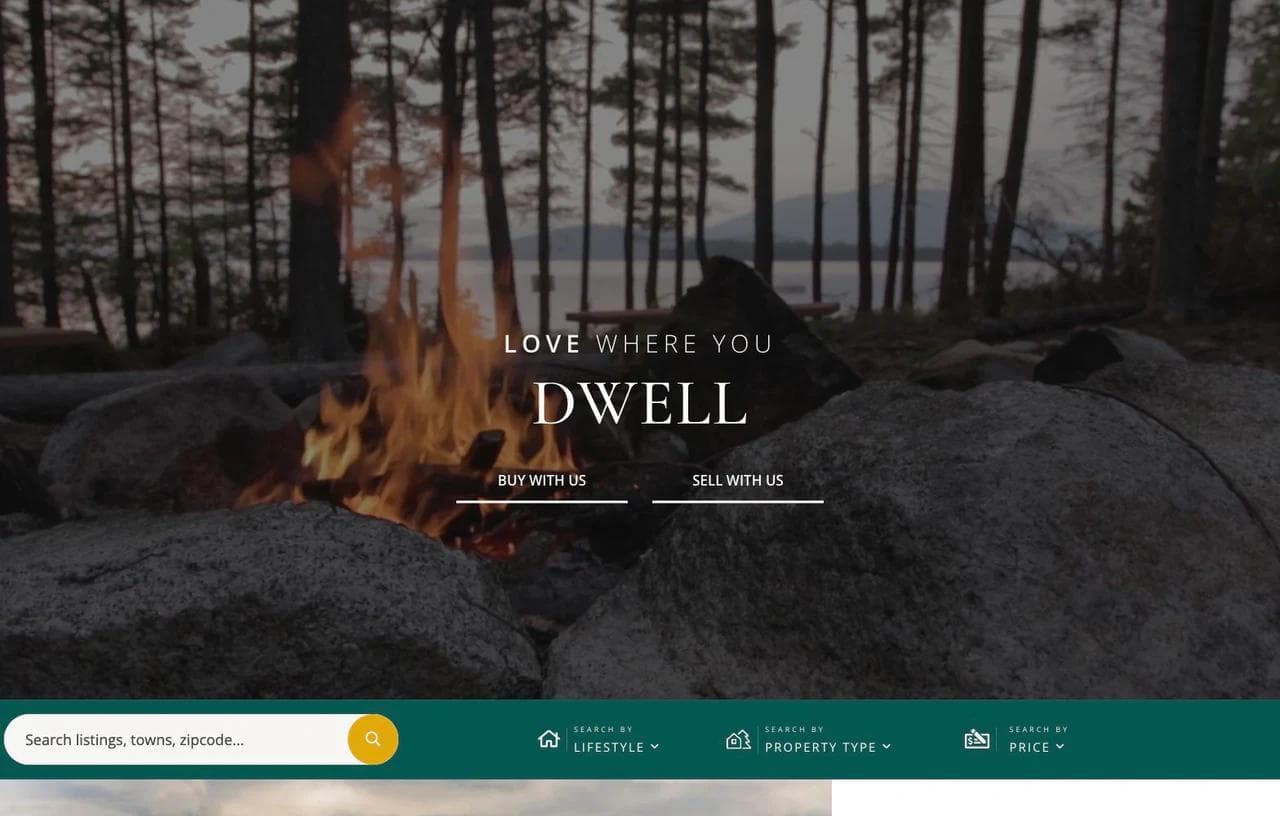
Dwelling in Maine is an independent, woman-owned brokerage. Its homepage uses Maine's identity as the unifying idea, then turns that idea into useful property and community paths.
How the page is structured
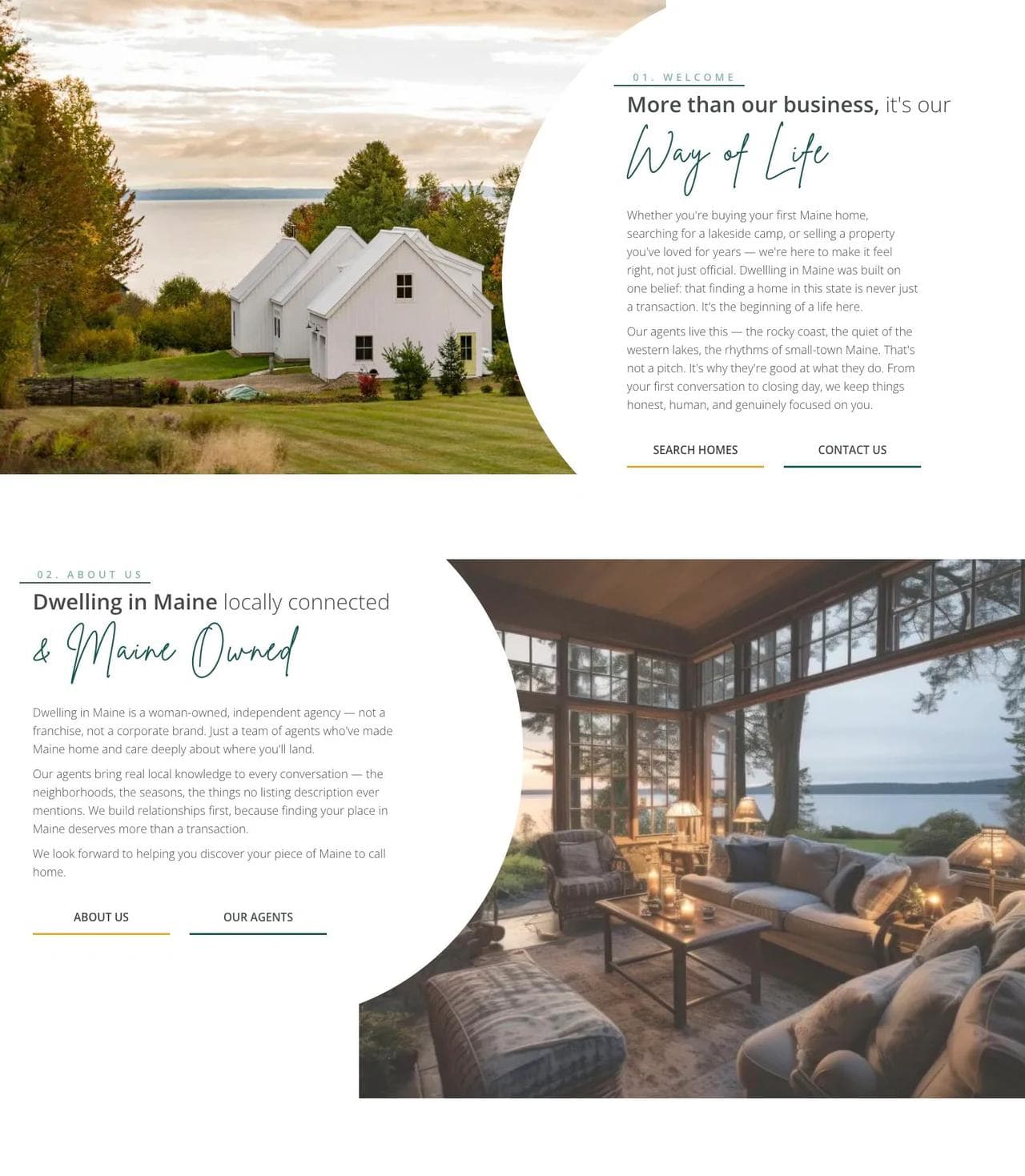
The hero's “Love where you Dwell” message is emotional, but the page immediately supports it with buy, sell, and property-search actions. A section on local ownership explains why an independent Maine brokerage may understand the market differently from a national brand.
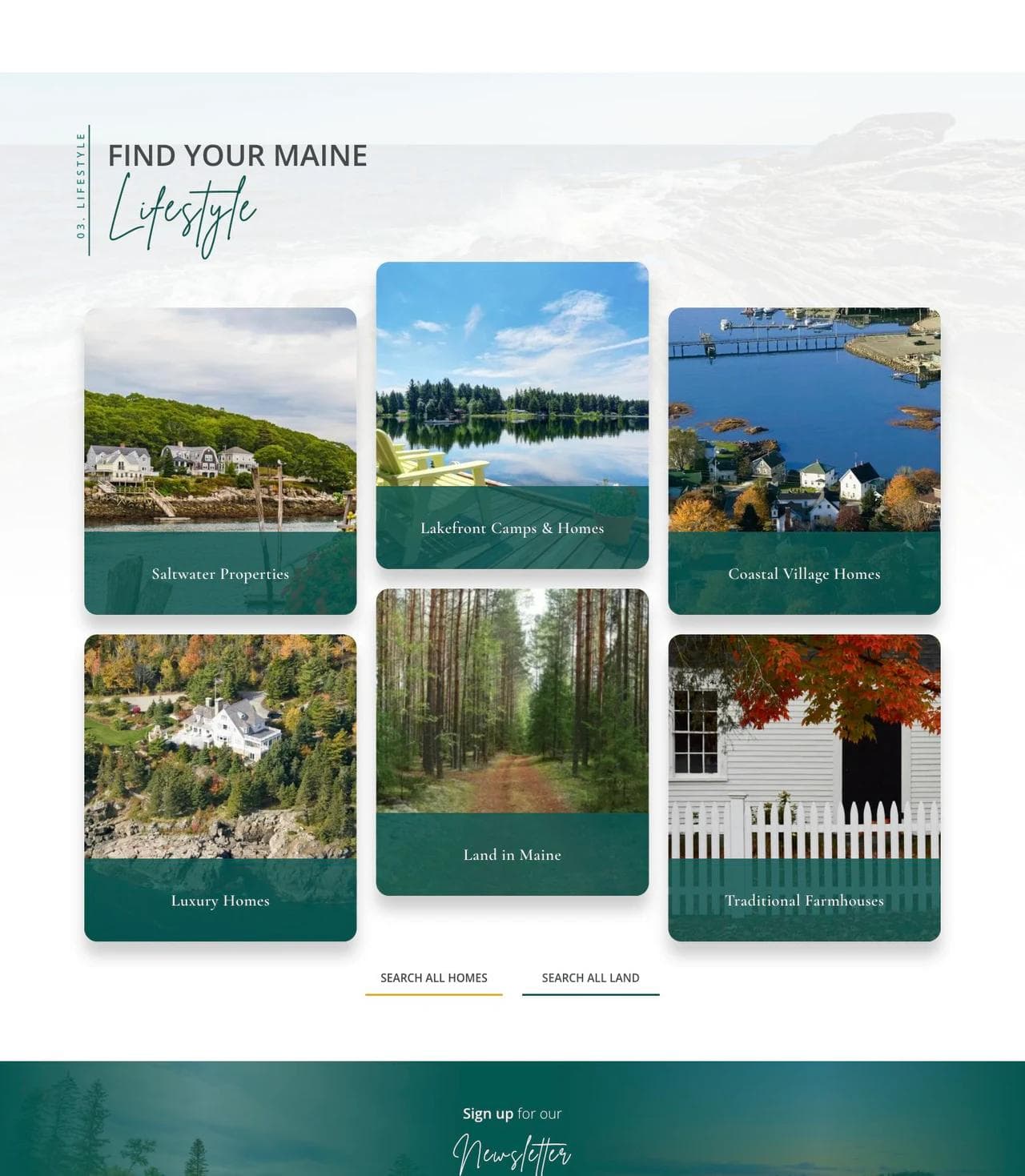
The strongest middle section groups properties by the way someone wants to live: saltwater, lakefront, village, farmhouses, historic homes, and other recognizable Maine contexts. That taxonomy is more human than asking a visitor to begin with beds, baths, and a ZIP code.
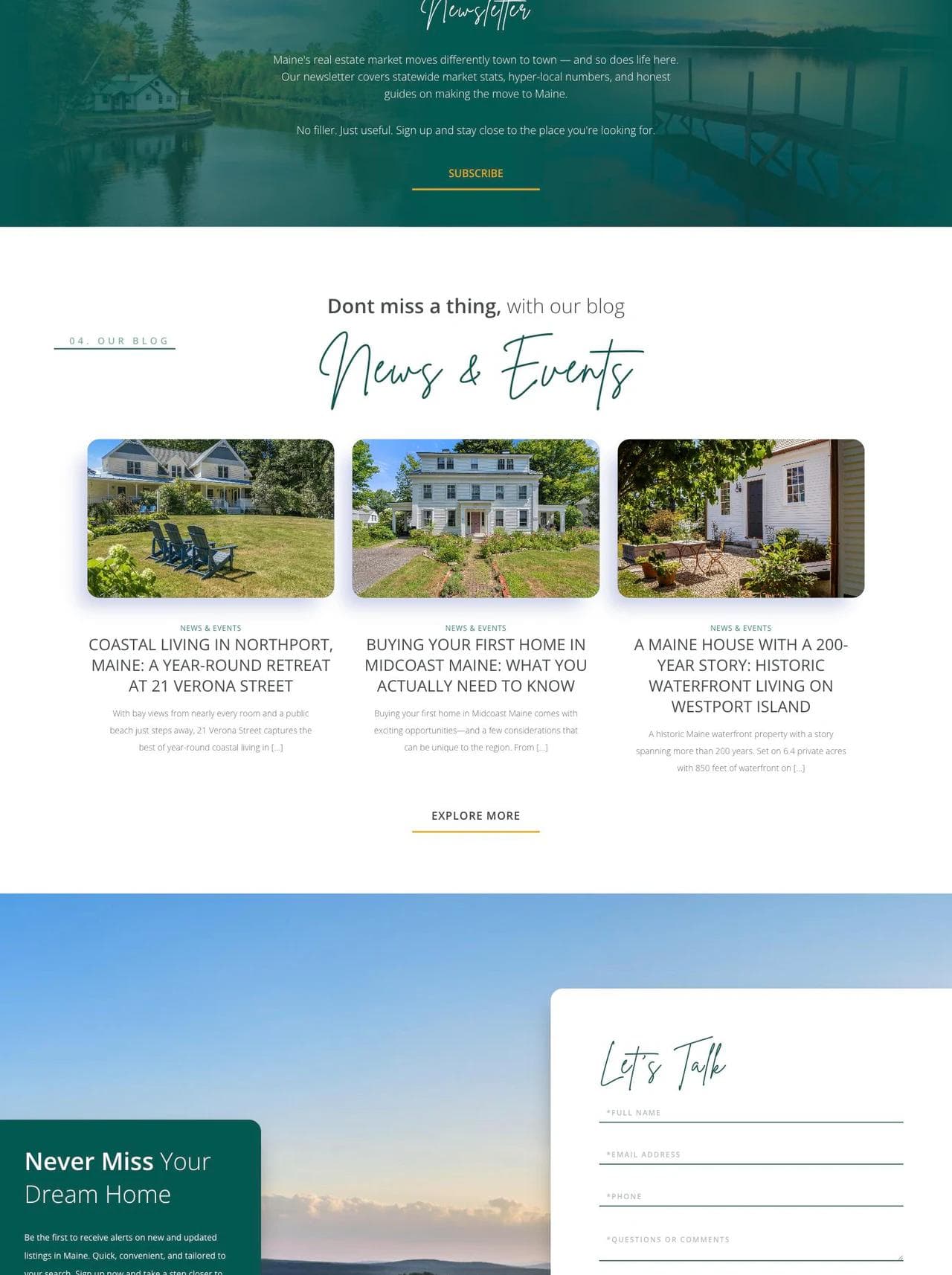
The lower page combines community information, current articles, events, listing alerts, a newsletter, and direct contact. It gives a visitor several reasons to return even when they are not ready to transact.
What works
- Lifestyle language becomes navigation. The brand idea changes how people explore inventory.
- Local ownership is framed as a customer benefit. It supports knowledge, relationships, and accountability rather than functioning as a badge alone.
- The site creates repeat visits. Events, articles, and alerts serve people with a longer search horizon.
- Search and story coexist. The visitor can browse immediately without losing the brokerage's point of view.
What to borrow
Build a taxonomy around how clients actually describe the move. That might be walkable neighborhoods, equestrian property, first homes, multigenerational living, ski access, or a short commute. Each path can connect editorial guidance to an appropriate filtered search.
What not to copy blindly
Lifestyle categories must be maintained. Empty search results, stale guides, or thin category pages turn an appealing idea into a dead end. Start with the few distinctions that reliably matter in the market.
3. Campion and Company: let search lead, then prove local authority
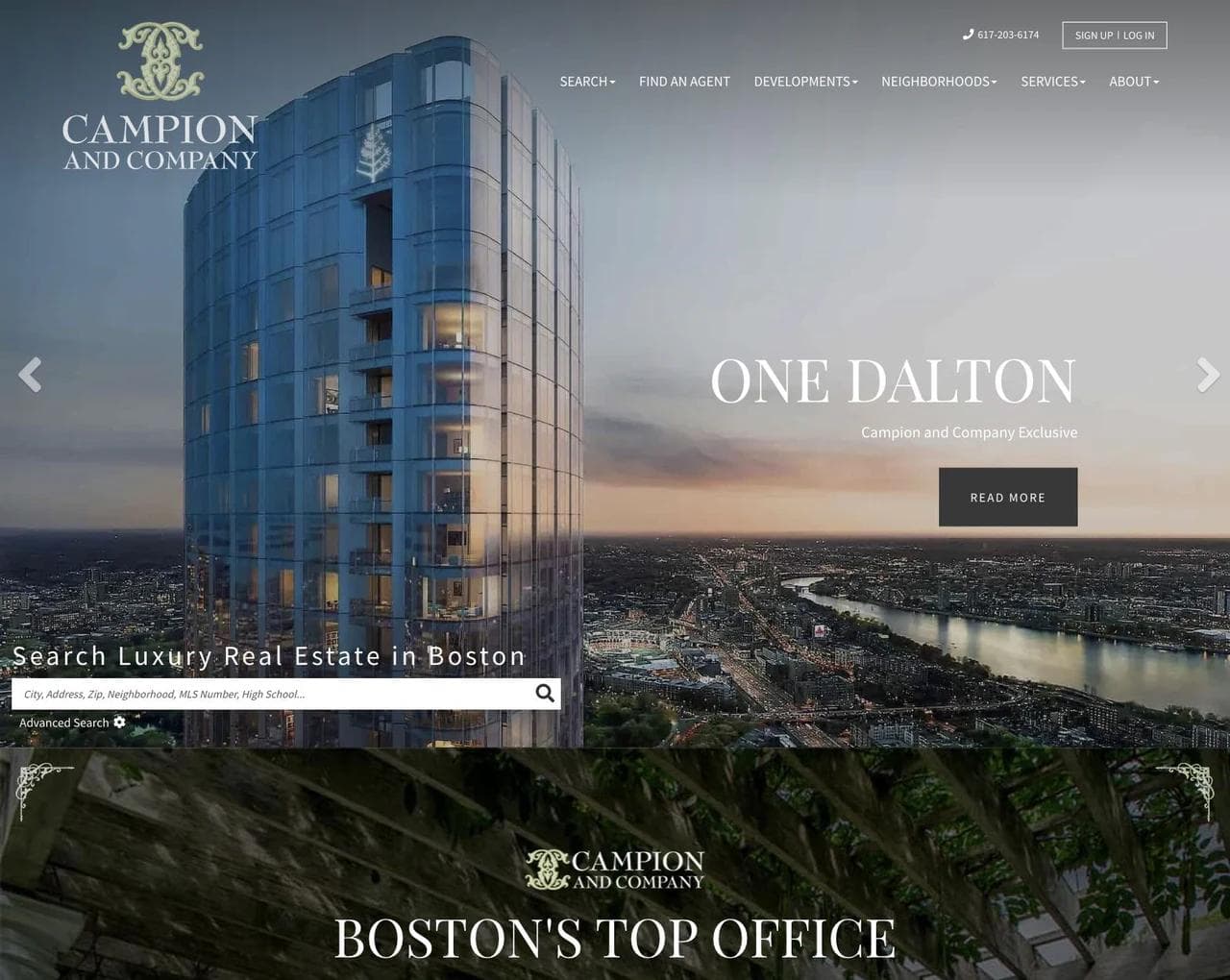
Campion and Company is a Boston boutique brokerage with a luxury orientation. Unlike the first two examples, it gives property search the most prominent role and uses the rest of the page to explain why its version of the market is worth exploring.
How the page is structured
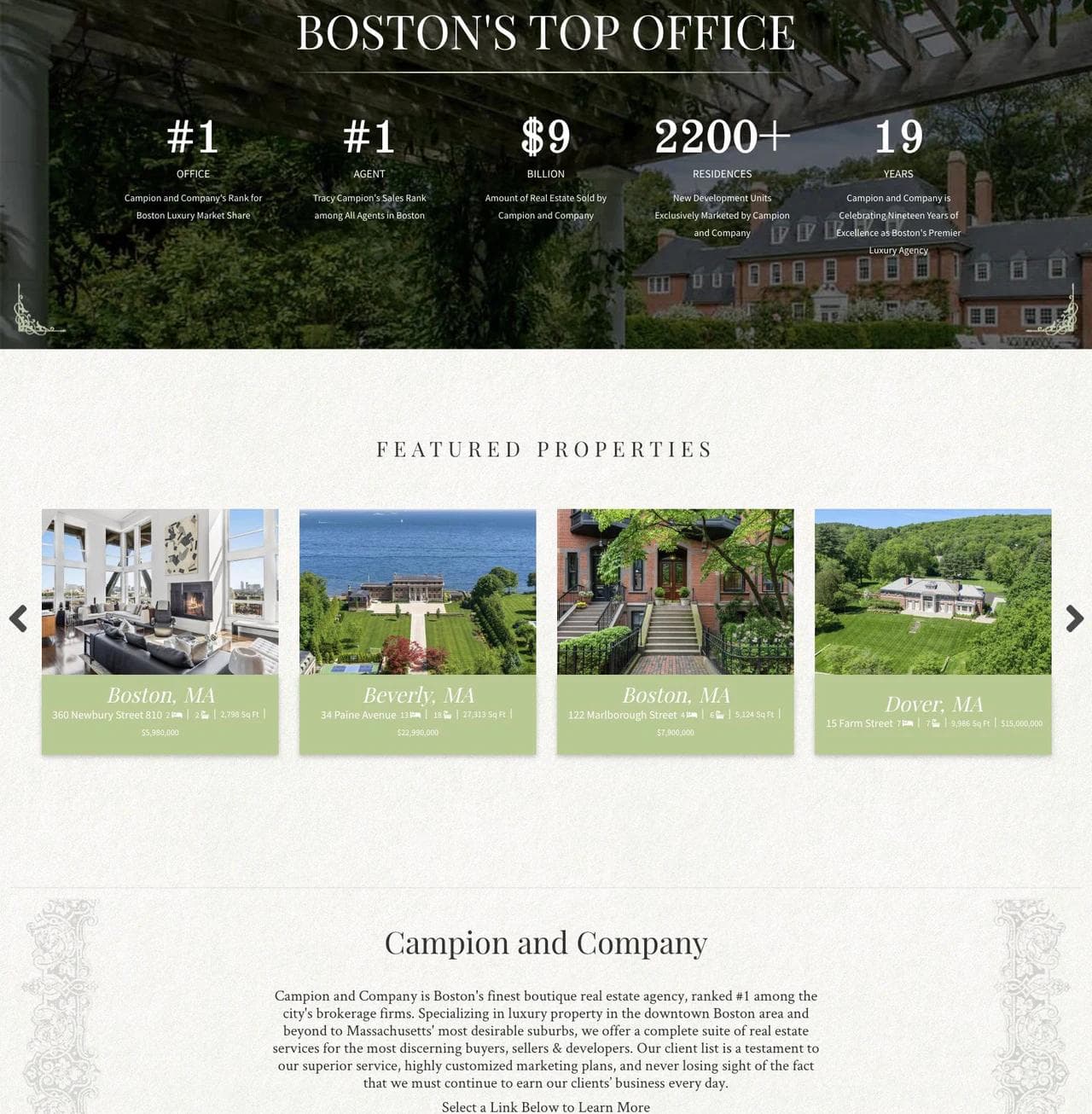
The hero places MLS search directly in the opening experience. Market-position proof follows, then featured properties provide an immediate inventory sample. A firm-story section introduces the brokerage behind the search.
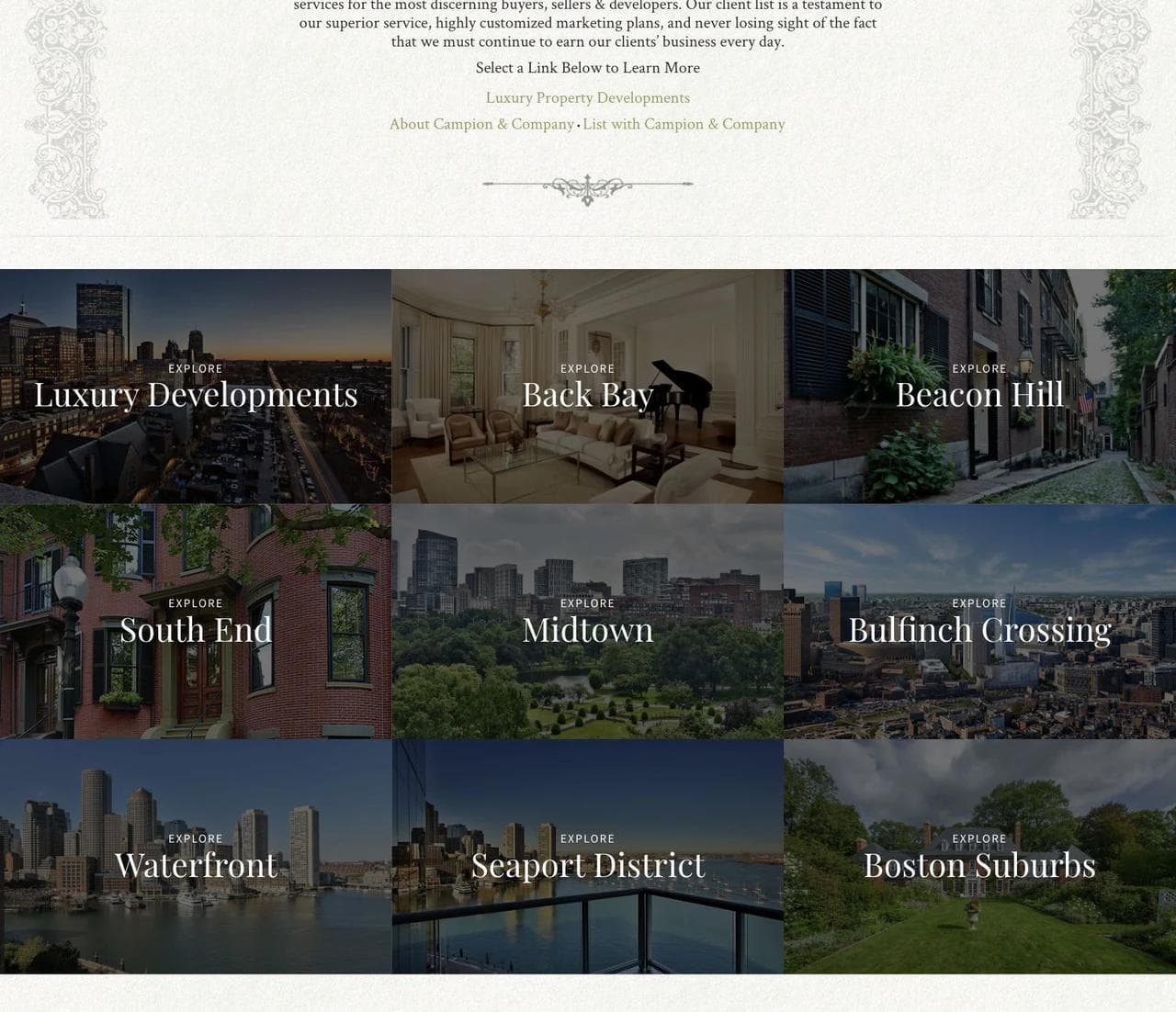
The page's neighborhood grid is the more defensible layer. Boston buyers often think in places such as Back Bay, Beacon Hill, the South End, Seaport, and nearby towns. The grid turns local geography into an information architecture rather than relegating it to a footer list.
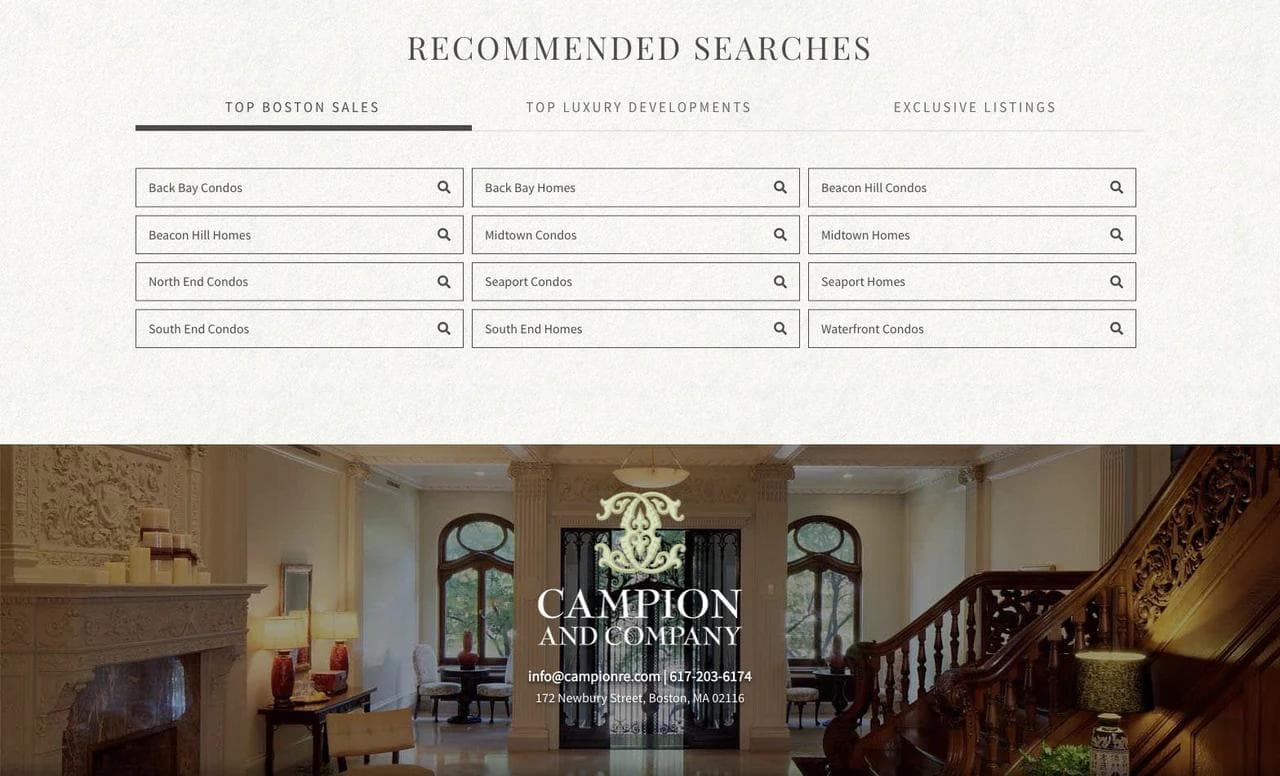
Recommended searches group common intents such as condos, homes, developments, exclusive listings, and waterfront property. The page closes with a direct contact block rather than another elaborate sales pitch.
What works
- The page respects high-intent visitors. Someone who came to inspect inventory can do so immediately.
- Authority is placed near search. Market proof gives the visitor a reason to trust the brokerage's local interpretation.
- Neighborhoods organize a complex city. The visitor can move from place identity to relevant listings.
- Recommended searches reduce configuration work. They expose useful inventory slices without requiring detailed filter knowledge.
What to borrow
If search is the primary product, surround it with curated paths. Use neighborhoods, property types, price bands, architectural styles, or buyer situations that reflect real demand. The page should make a complex market easier to understand, not simply reproduce an MLS form.
What not to copy blindly
Search-first design works best when the site has enough inventory, useful saved searches, and reliable feed maintenance. A solo agent with little differentiated search value may get more from a guide-first homepage that sends qualified visitors into listings later.
4. Blooming Sky: sell a guided decision process
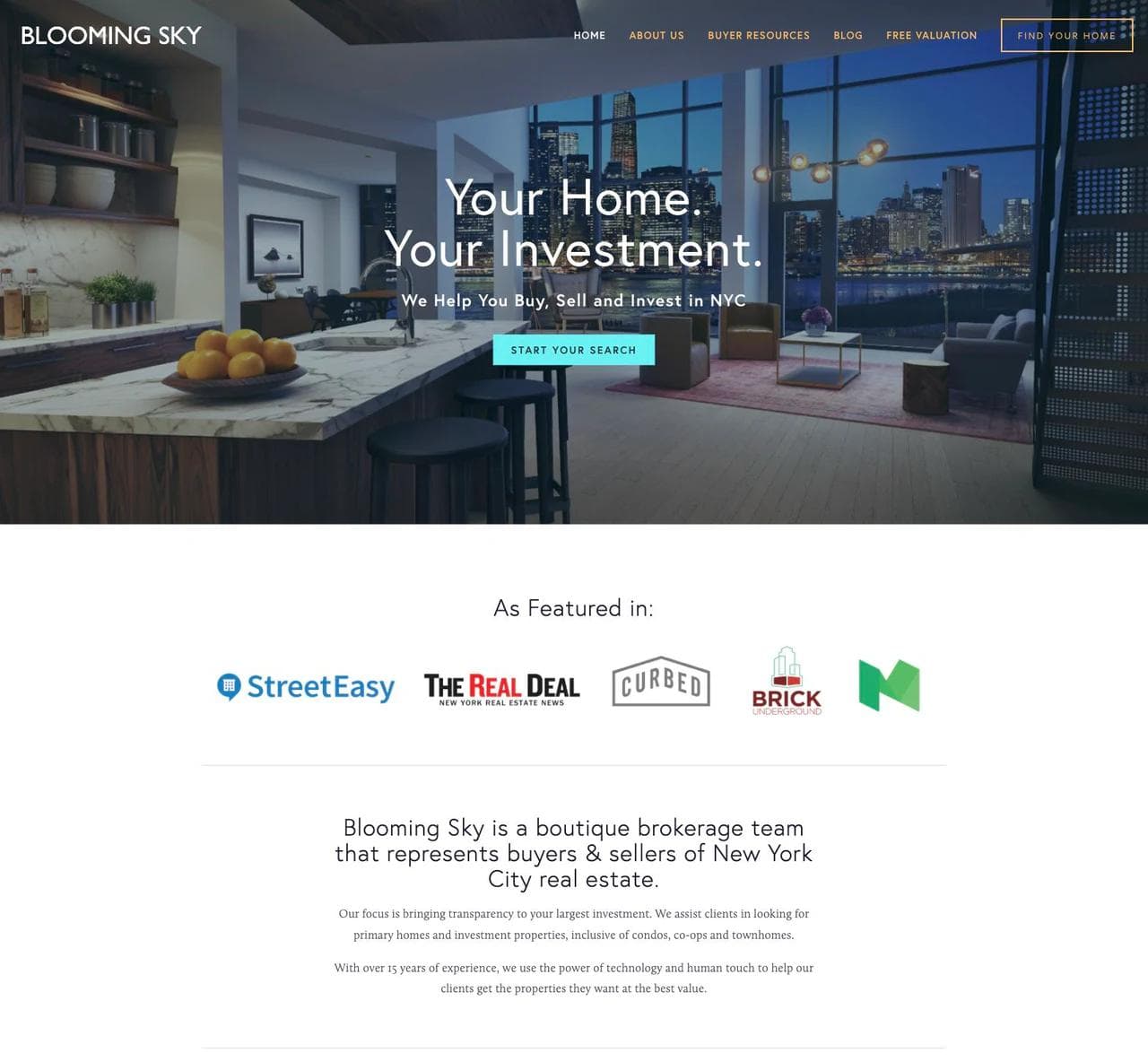
Blooming Sky is a New York boutique serving buyers, sellers, and investors. Its visual design is less contemporary than some examples here, but the page is valuable because it explains a service model instead of assuming visitors already understand what an advisor contributes.
How the page is structured
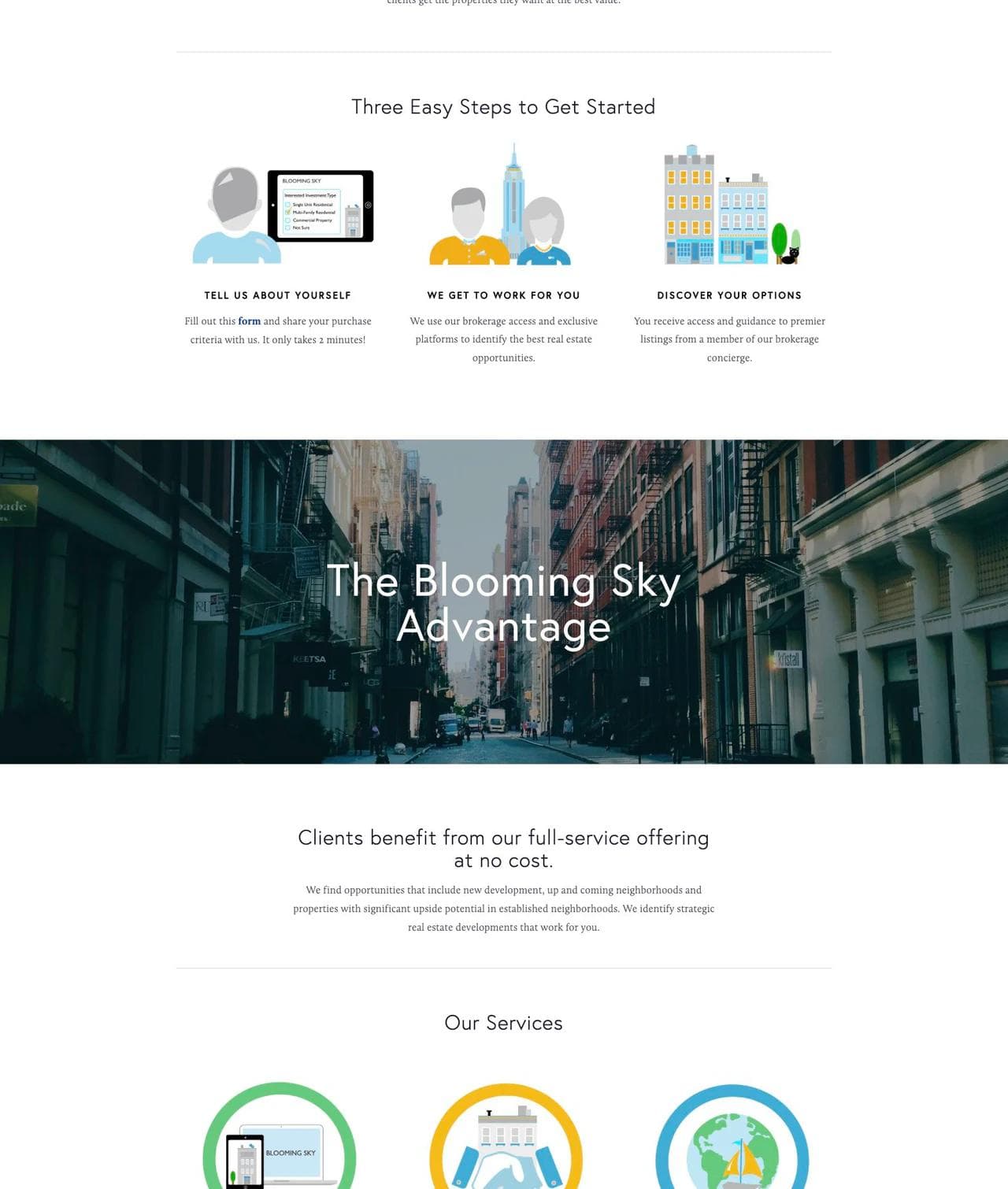
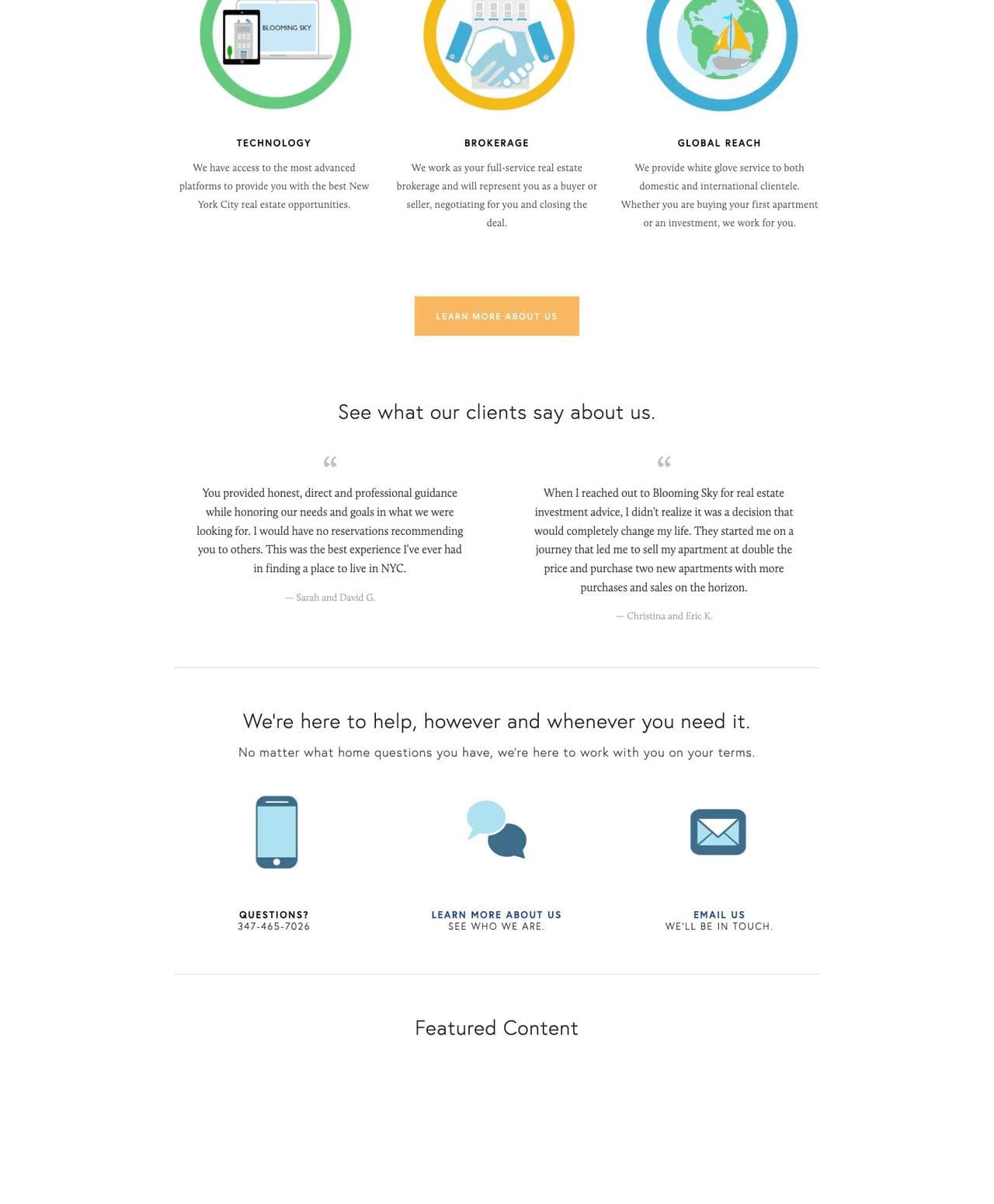
“Your Home. Your Investment.” defines the overlap between emotional and financial decisions. Press proof follows, then a three-step process explains how the relationship progresses. The middle organizes the value proposition around technology, brokerage guidance, and global reach.
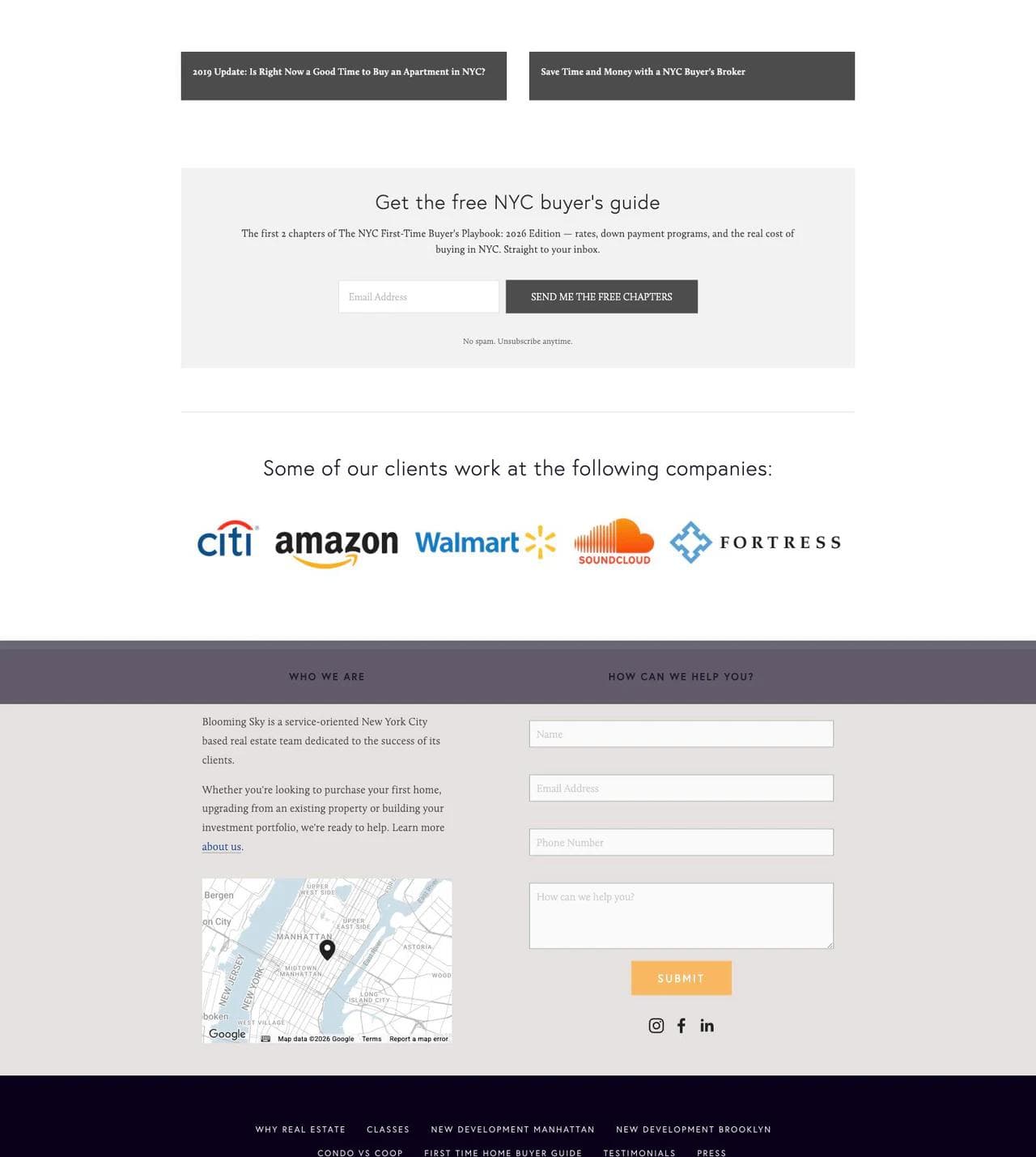
Testimonials and several contact paths support different readiness levels. The lower page adds educational articles and a free buyer guide, allowing the firm to build trust before a consultation.
What works
- The process makes an intangible service visible. A prospective client can see how advice enters the transaction.
- The positioning includes both home and asset. That is relevant in a market where many buyers weigh use, appreciation, financing, and resale together.
- Education creates a pre-transaction relationship. The buyer guide gives a researching visitor a useful next step.
- Multiple contact paths match different intent. Not every visitor is ready for the same conversation.
What to borrow
Explain the work between “contact us” and closing. Show the discovery, search, evaluation, offer, due diligence, negotiation, and handoff stages that apply to your model. This is especially important when the value is judgment rather than exclusive inventory.
What not to copy blindly
Process copy can become abstract. Tie each step to a customer question, decision, or deliverable. The page would be stronger if more proof and examples appeared directly beside the claimed advantages.
5. City Commercial Realty: design around representation, not residential browsing
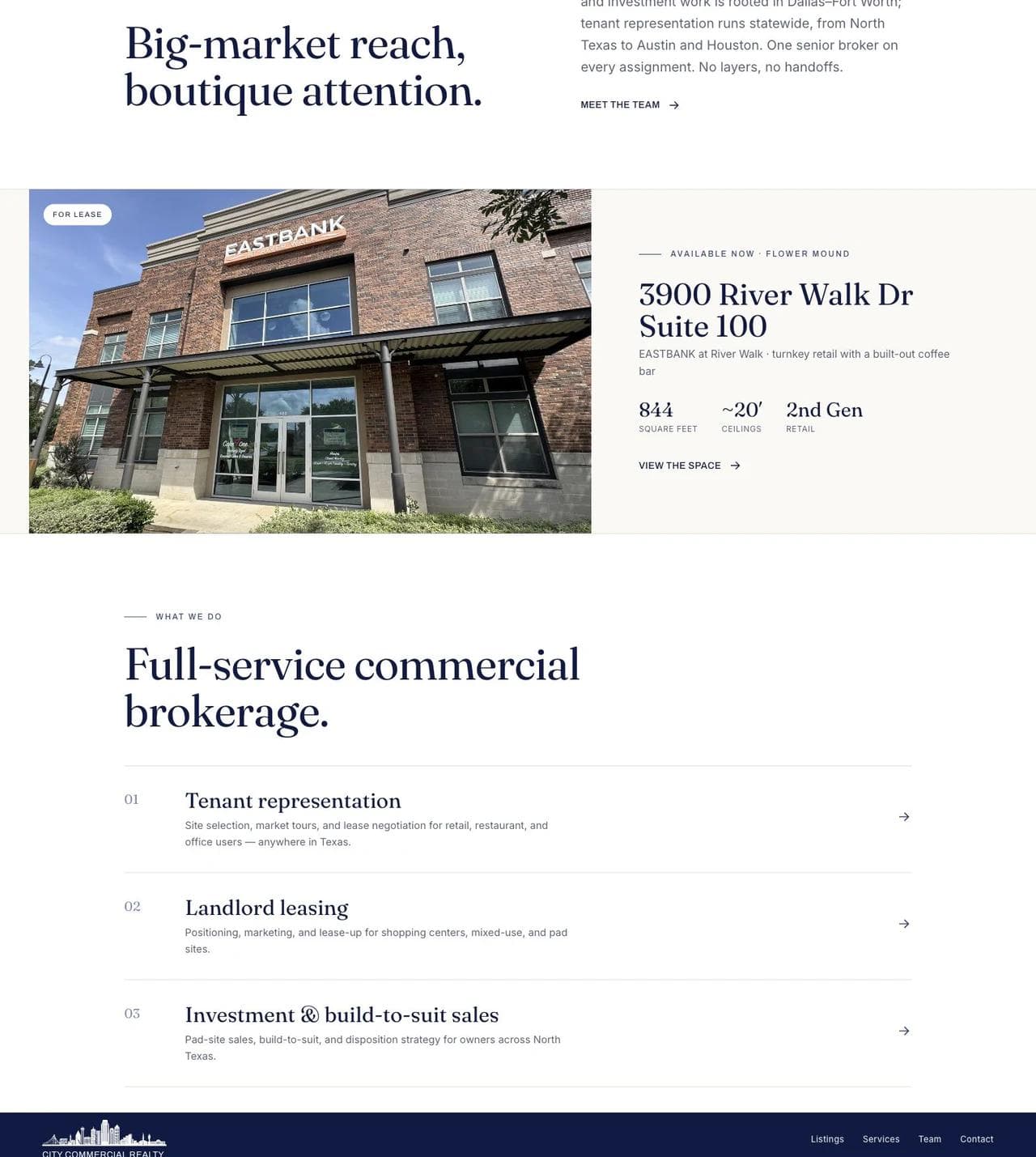
City Commercial Realty is a boutique Texas commercial brokerage. Its compact homepage shows why a commercial site should not imitate a residential agent template.

How the page is structured
The hero says “Opportunity at every corner,” then the supporting copy quickly defines geography and representation: Dallas-Fort Worth landlord and investment work, plus tenant representation across Texas. The next section emphasizes senior-broker attention and the absence of handoffs.
Featured availability gives tenants and brokers a concrete reason to inspect the site. The services section separates tenant representation, landlord leasing, investment sales, and build-to-suit work, each of which involves a different client and decision process.
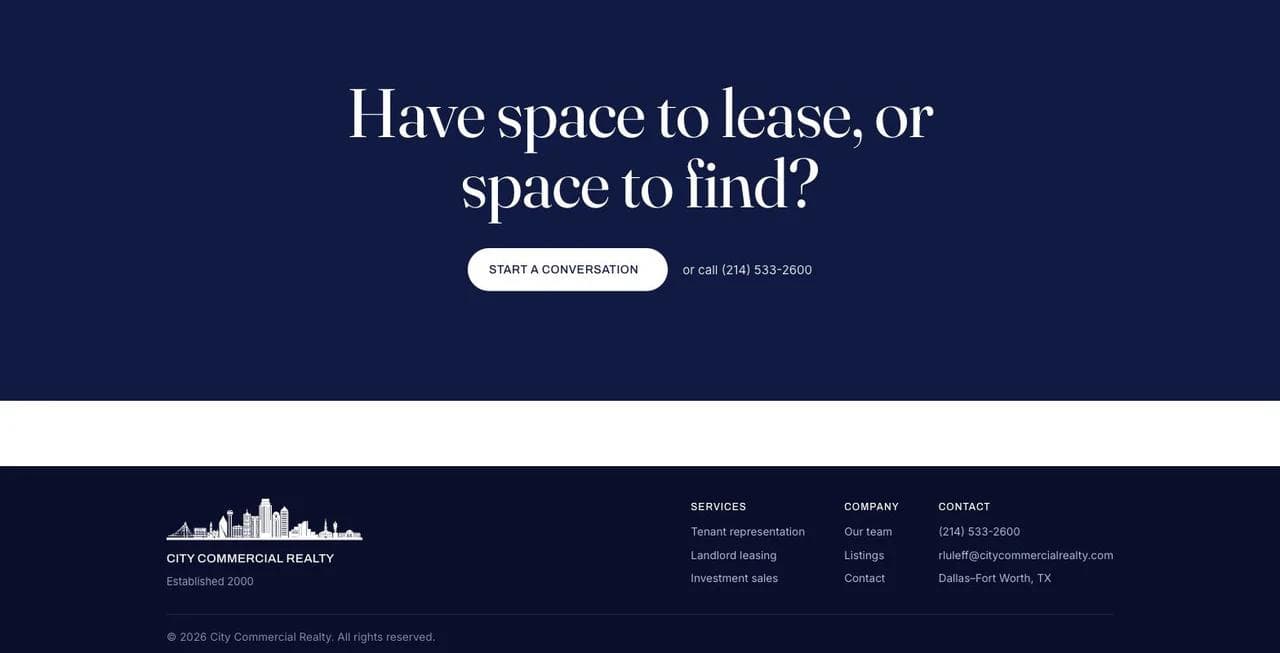
The page closes with one simple prompt, “Have space to lease, or space to find?”, plus phone, email, service links, company information, and required brokerage details.
What works
- The representation boundary is clear. Landlords, tenants, and investors can identify the relevant service.
- Senior attention is a meaningful boutique advantage. It addresses the risk of being passed to a junior team after the pitch.
- Available space creates immediate utility. The inventory supports the brokerage story without consuming the whole page.
- The final CTA uses the market's language. It describes the actual choice facing a commercial visitor.
What to borrow
Commercial firms should build around deal type, asset class, representation side, geography, and evidence of execution. Case studies, transaction maps, available properties, market briefs, and broker expertise are usually more persuasive than residential lifestyle imagery.
What not to copy blindly
A very short page depends on strong service pages and property detail elsewhere. If the homepage is the main discovery page, add selected transactions, broker profiles, client types, and market insight without turning it into a residential portal.
6. Fifth & Forever: serve consumers and prospective agents without blending them
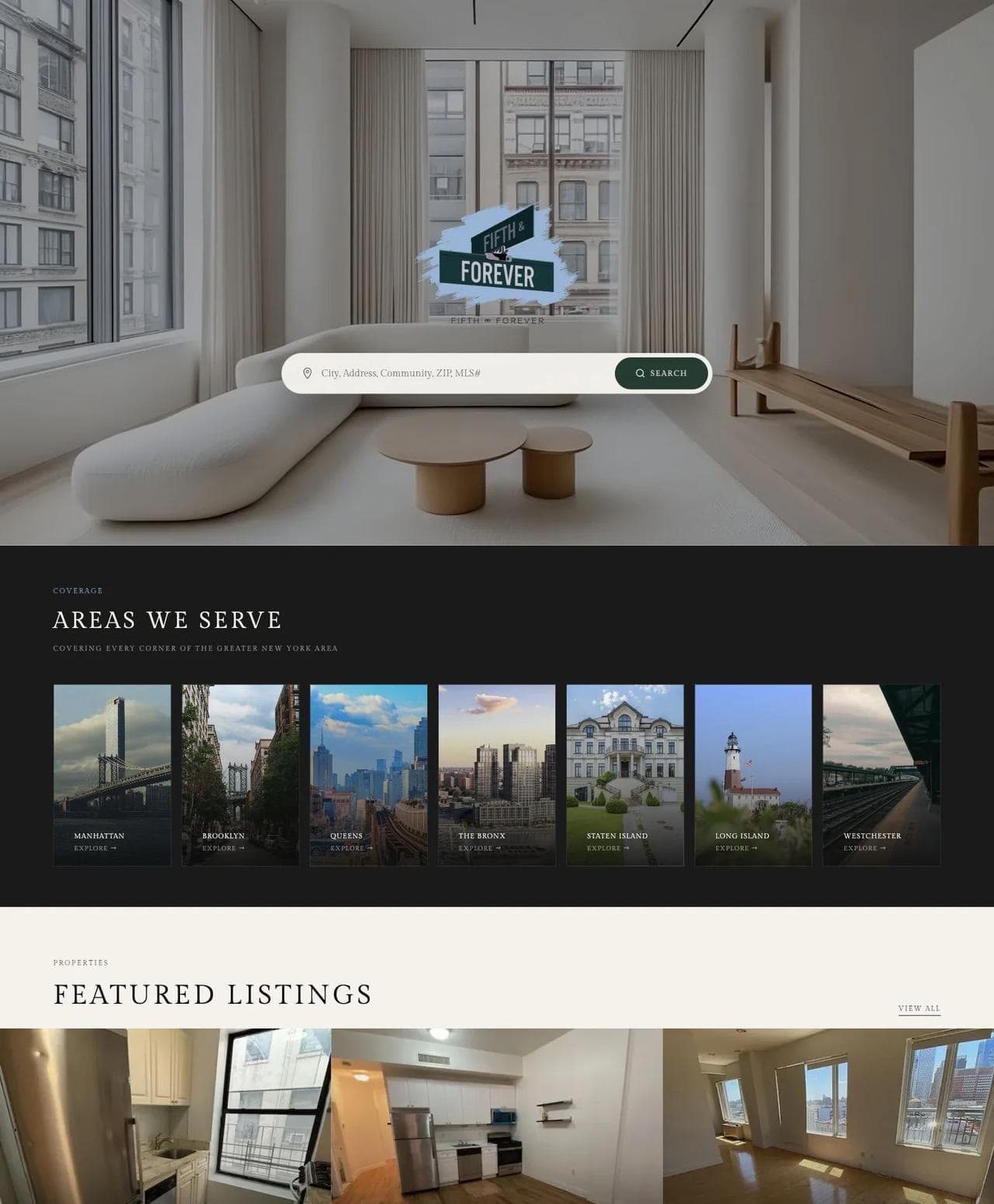
Fifth & Forever is a family-owned New York brokerage. Its homepage has two businesses to explain: helping clients transact and recruiting agents to operate under the firm.
How the page is structured
The top serves consumers with search, service areas, and featured listings. A company-story section explains the family-owned identity, while service paths help buyers, sellers, landlords, tenants, and investors identify themselves.
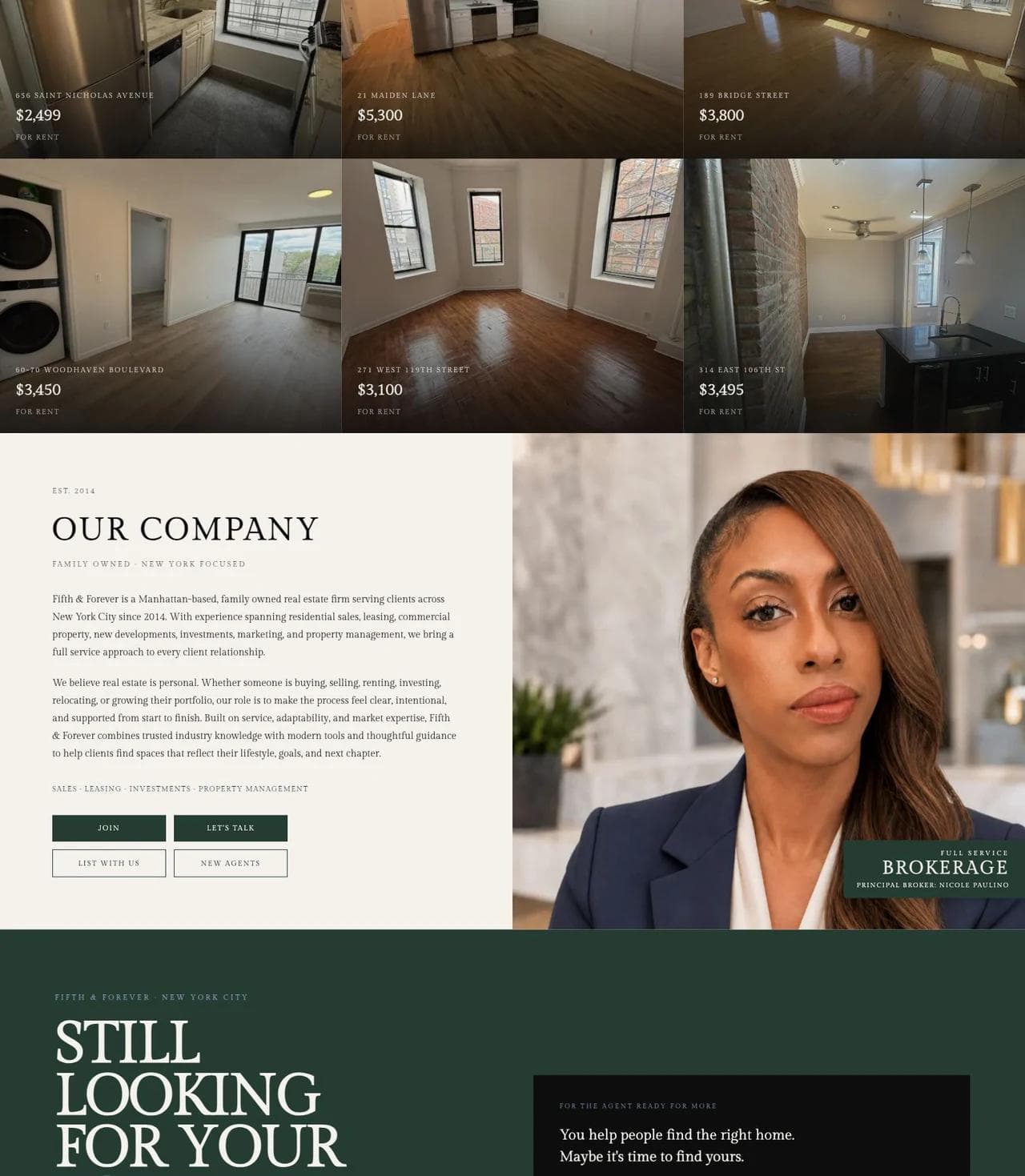
The agent-recruitment section is unusually substantial. It discusses compensation, support, culture, technology, and the reasons an agent might choose this brokerage. That path is visually and verbally distinct from the consumer proposition.
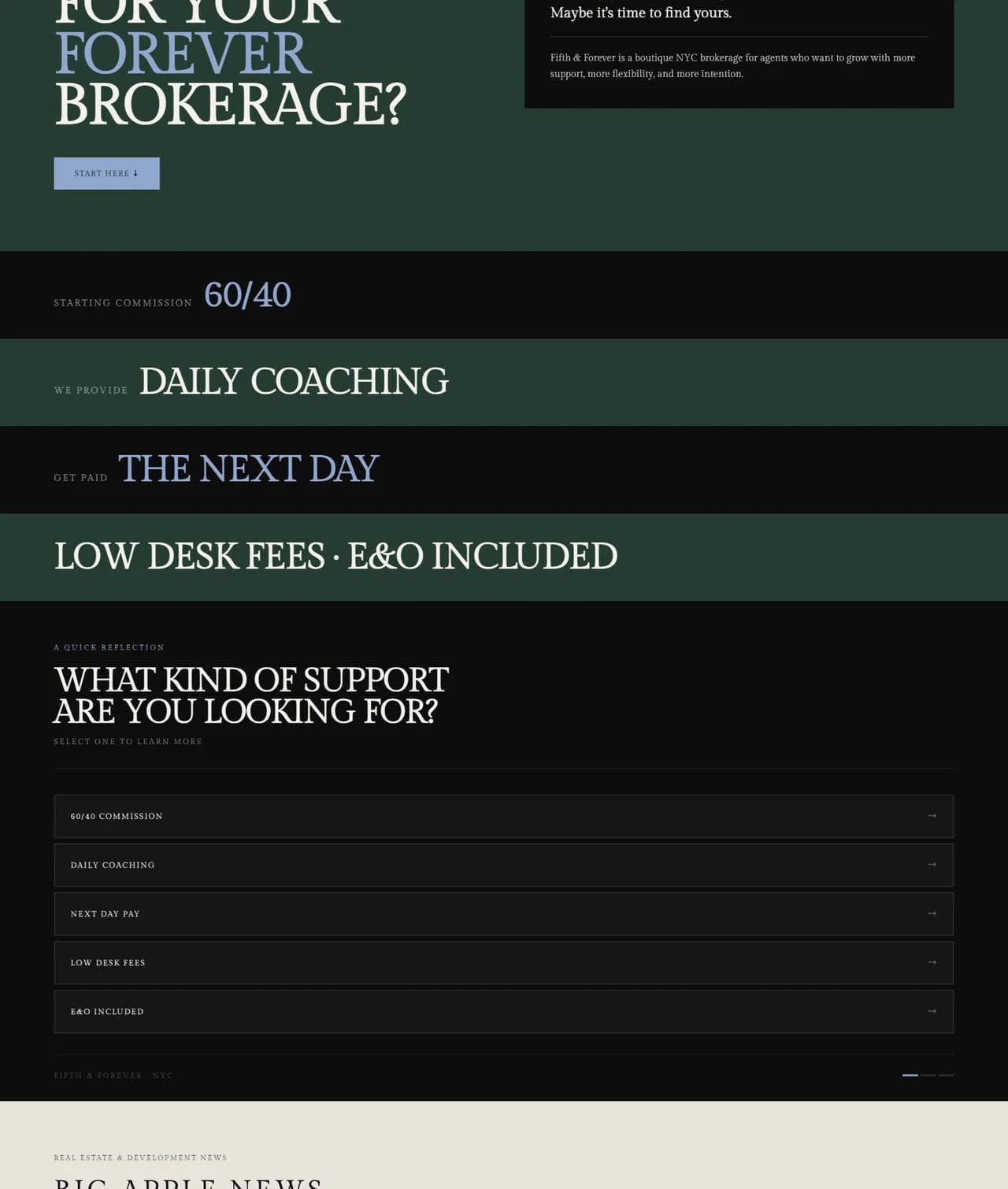
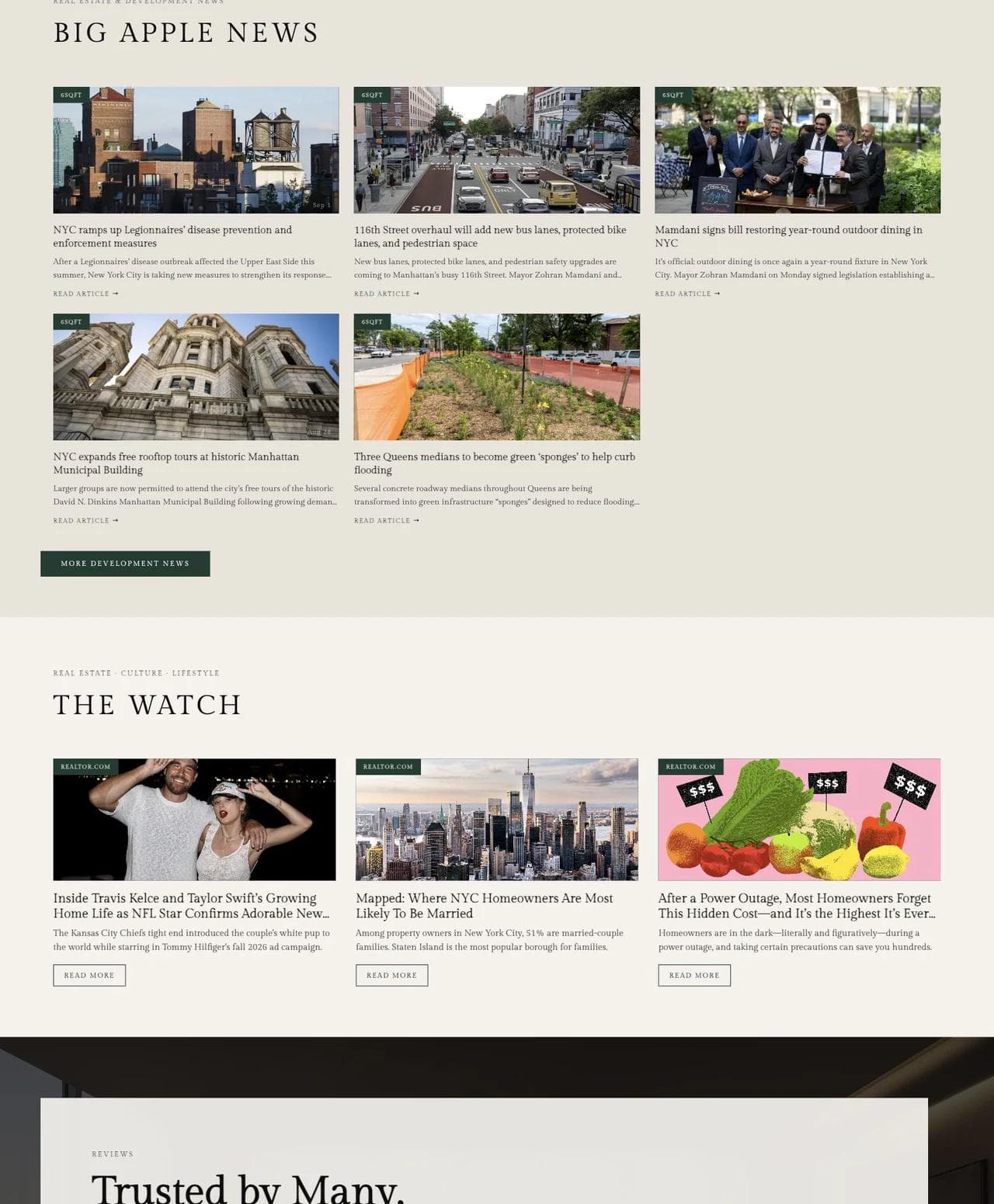
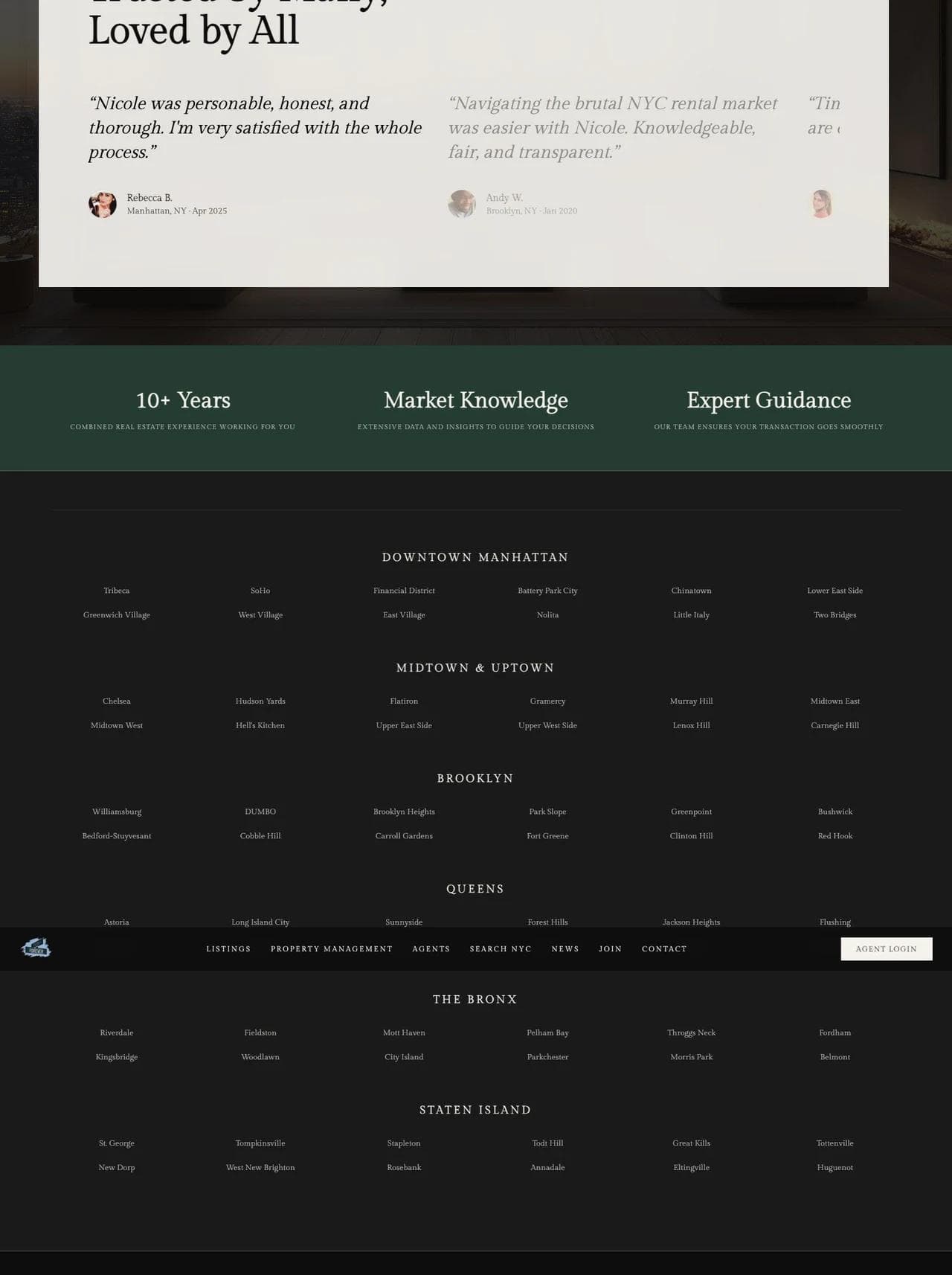
News, reviews, proof, market coverage, office information, and navigation complete the page. The breadth reflects a brokerage with several audiences rather than one individual agent.
What works
- The two audiences get separate arguments. Consumers see listings and services, while agents see an employment and operating proposition.
- Family ownership supports a specific identity. It gives the firm a human alternative to a franchise or large corporate brokerage.
- The page offers many self-selection paths. Different transaction roles can reach relevant information.
- Recruiting is treated as a product. Prospective agents are not sent to a generic contact form with no explanation.
What to borrow
If recruiting is strategically important, create a dedicated path with its own proof, process, compensation framing, support model, and CTA. Do not force agent candidates through consumer messaging. The same principle applies to developers, referral partners, landlords, and commercial tenants.
What not to copy blindly
A long homepage can become a directory. Make the first audience choice obvious, keep cross-audience sections visually distinct, and move detailed recruiting or service material to dedicated pages when it begins to interrupt the consumer journey.
What all six sites teach us
IDX is infrastructure, not a positioning strategy
IDX can be useful when visitors expect live inventory, filtered searches, map browsing, and property alerts. It also brings feed rules, attribution, data freshness, performance, and vendor dependence. The NAR IDX background guide makes clear that participation and display operate within MLS rules.
Ask what happens after the same listing appears on five sites. The winning independent site usually adds one or more of these layers:
- Better interpretation of neighborhoods, buildings, or property types
- Curated searches that match local language
- Off-market or firm-exclusive access where permitted
- A clear advisory process
- Market commentary and transaction evidence
- A more relevant relationship with a specific person or team
Local content should lead somewhere useful
A neighborhood guide should not be an isolated essay written only for search engines. Connect the guide to relevant properties, market updates, commuting or lifestyle information, and an agent who knows the area. The same applies to articles about buying, selling, financing, or investing.
IDX Broker's real estate SEO checklist similarly recommends connecting neighborhood and market content to useful listing paths. The principle is broader than SEO: editorial context and inventory become more valuable when each helps the visitor understand the other.
Route visitors by the decision they are making
“Buy, sell, or relocate” works for Home in Amelia Island. “Tenant, landlord, investor, or build-to-suit” makes more sense for City Commercial Realty. Fifth & Forever needs an additional route for prospective agents. The right segmentation depends on the business model.
Do not create ten equal cards because the firm technically offers ten services. Prioritize the few decisions that change what the visitor needs to see next.
Build a lead-capture ladder
Not every visitor should be pushed into a consultation form. A stronger site offers increasing levels of commitment:
- Browse a community, service, or curated search
- Read a guide or market update
- Subscribe to listings, a newsletter, or a local report
- Request a valuation, relocation guide, or property shortlist
- Schedule a call or submit a focused inquiry
Each step should deliver real value. A gated PDF with generic advice is not a relationship strategy.
Use proof that matches the promise
Awards and review totals establish baseline credibility, but more specific evidence is stronger. Show transactions relevant to the claimed market, testimonials that describe the working experience, local commentary that demonstrates judgment, and team biographies that explain who handles the work.
For commercial or investment work, case studies and deal context may matter more than lifestyle photography. For relocation, useful community knowledge and remote-service details can be stronger than a production ranking.
Three homepage architectures that work
Solo agent or small residential team
- Specific geography and client promise
- Buy, sell, and one strategic specialty such as relocation
- Agent or team introduction
- Communities or curated searches
- Process and service differentiators
- Reviews and relevant transaction proof
- Guide, alerts, or newsletter
- Contact and office details
Independent residential brokerage
- Search plus a distinctive market point of view
- Buyer, seller, and other core audience routes
- Featured or curated inventory
- Neighborhood and lifestyle navigation
- Firm story and team
- Market proof and testimonials
- Current local content and listing alerts
- Contact, locations, and brokerage information
Commercial or multi-service brokerage
- Geography, asset class, and representation side
- Service lanes for tenants, landlords, investors, or developers
- Available properties or selected transactions
- Senior team and sector expertise
- Process or case studies
- Market intelligence
- Focused contact paths
- Licensing, representation, and compliance information
Accessibility, fair housing, and technical basics
Real estate websites should be usable by people with disabilities. The US Department of Justice's web accessibility guidance explains that inaccessible web features can prevent people with disabilities from accessing goods and services. Use semantic headings, keyboard-accessible controls, descriptive alt text, sufficient contrast, labeled forms, captions, and manual testing alongside automated checks.
Housing advertising also carries fair-housing risk. HUD's digital-platform advertising guidance discusses how audience selection and delivery can affect access to housing opportunities. Website copy, imagery, targeting, lead forms, and neighborhood descriptions should be reviewed for discriminatory language or steering. Get qualified legal and brokerage guidance for the markets in which the business operates.
For local discovery, keep the firm's name, address, service area, and contact information consistent. Google's LocalBusiness structured-data documentation explains how business details can be represented for search, though markup does not guarantee a rich result.
Performance matters most on mobile, where large property images, map scripts, chat widgets, and IDX embeds can accumulate quickly. Compress images, lazy-load below-the-fold media, reserve image dimensions to prevent layout shifts, and measure the actual page on a typical phone connection.
Where Moda fits in a real estate website stack
Moda is a strong fit for the designed marketing layer of a real estate site: a branded homepage, agent and team profiles, community guides, service pages, single-property pages, relocation content, campaign landing pages, and simple lead forms. It is especially useful when visual quality and fast iteration matter.
Moda is not a drop-in replacement for MLS or IDX infrastructure, saved-search accounts, complex CRM automation, transaction management, or a large dynamic property database. A brokerage that needs those systems should keep them in a specialized platform or integration and decide whether Moda powers the marketing shell, selected campaign pages, or standalone content experiences.
Building a branded real estate marketing site or campaign page? Try Moda today.
If you are comparing broader site-building options, see our guides to the best AI website builders, law firm website design, and SaaS landing pages.
Real estate website design checklist
- Name the primary geography, property type, and client in the first screen.
- Explain why the site is useful even when listings also appear on a portal.
- Route the main buyer, seller, landlord, tenant, investor, or recruiting journeys.
- Show real agents and brokers with specific expertise.
- Use communities, lifestyles, or deal types as meaningful navigation.
- Connect local articles to relevant services and inventory.
- Offer a commitment ladder, not only a contact form.
- Keep listing data, availability, team information, and market content current.
- Test IDX, maps, filters, and forms on mobile.
- Compress property media and monitor page speed.
- Review accessibility, fair-housing language, privacy, and required brokerage disclosures.
- Measure qualified inquiries, valuation requests, alert signups, and appointments, not just page views.
Frequently asked questions
What should a real estate website include?
Most real estate websites need a clear market and client position, buyer and seller paths, agent or team profiles, community or service pages, relevant proof, a contact path, and required brokerage, privacy, accessibility, and fair-housing information. Add IDX search only when the business can maintain it and it improves the visitor journey.
Does a real estate agent need IDX on their website?
Not always. IDX is useful when live inventory and property alerts are central to the site. An agent focused on referrals, relocation, listings, a narrow property type, or campaign landing pages may get more value from strong local content and focused lead paths. IDX availability and display rules also depend on the relevant MLS.
How can a real estate website compete with Zillow?
It should not try to beat a national portal on inventory breadth. It can compete through local interpretation, curated searches, specialized expertise, a clear service process, useful community content, relevant transaction proof, and access to a specific person or team.
What is the best website builder for real estate agents?
The best choice depends on whether the site needs IDX, saved searches, CRM automation, a large publishing system, or mainly a highly designed marketing presence. A specialized real estate platform can simplify dynamic listing features. A visual or AI website builder can be stronger for branded static pages, local guides, and campaigns.
How do real estate websites generate leads?
Strong sites connect useful content and search paths to several levels of action, such as listing alerts, newsletters, relocation guides, valuations, property shortlists, and appointments. The goal is to help the right visitor advance without forcing every person into the same contact form.
How often should a real estate website be updated?
Listing data and availability should follow the freshness requirements of the relevant feed and MLS. Team information, office details, market statistics, guides, and service claims should be reviewed whenever they change and on a regular editorial schedule. Remove stale events, outdated rankings, and unsupported market claims promptly.

Real editable visuals. Real canvas. Full control.
Fly through design work