Franchise Marketing: Who Makes the Assets, and Who Pays
Franchise marketing splits between national media and local assets. Four 2026 FDDs show where ad fund money actually goes, and who is supposed to make what.
 Anvisha Pai, Co-founder & CEO, Moda
Franchise marketing is two different jobs wearing one name. The franchisor runs a national brand. Each location runs a local business. The fee that connects them mostly buys media, not the assets a location actually needs on a Tuesday morning.
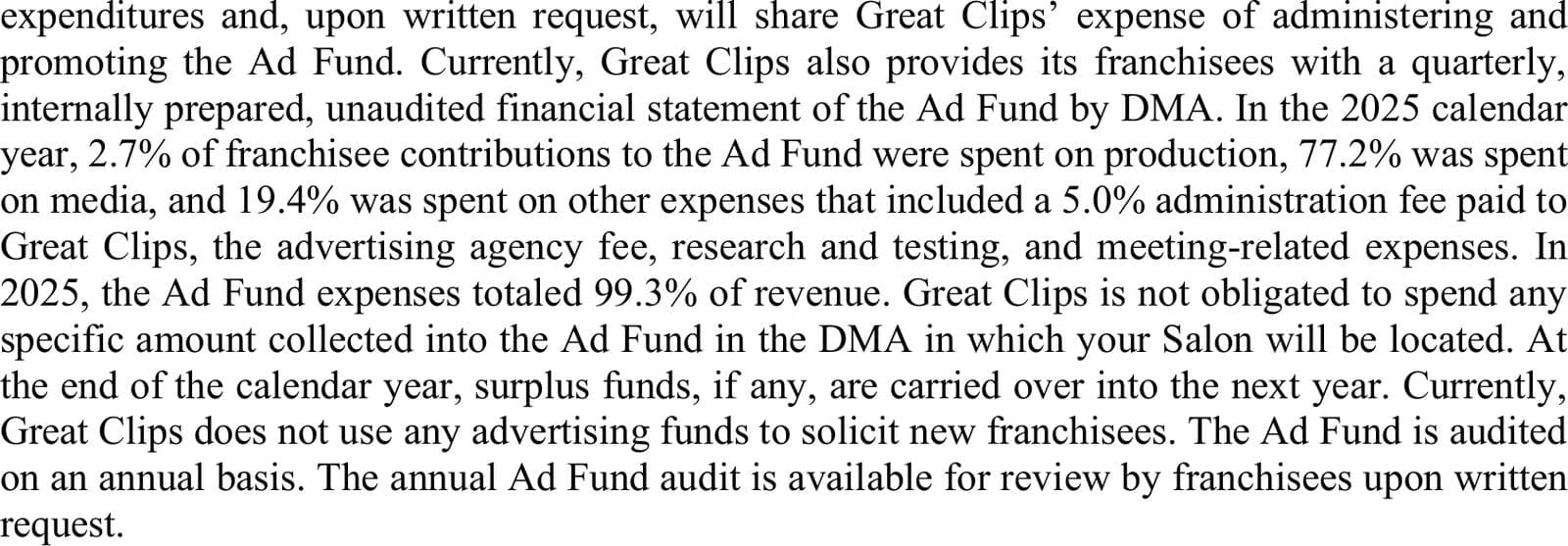
That is not a complaint. It is what the filings say. In its 2026 franchise disclosure document, Great Clips reports that in calendar year 2025, 2.7% of franchisee contributions to its Ad Fund were spent on production, 77.2% on media, and 19.4% on other expenses. The fund bought attention. Making things was almost a rounding error.
The standard advice on franchise marketing is a tip list: post more, claim your listings, run local ads. The harder problem is the one underneath. Somebody has to produce the actual creative for every location, in every format, every time an offer changes. This article is about that supply chain: how the money is structured, what each side is allowed to make, where it breaks, and a division of labor you can copy.
It is written primarily for the franchisor's marketing lead, because that is the person who can change the system. If you are a franchisee, there is a section for you further down, and the numbers below are worth reading first so you know what you are arguing about.
Franchise agreements, disclosure documents and ad fund obligations are legal instruments. This article describes how they commonly work and cites primary sources. It is not legal advice. Read your own FDD and franchise agreement, and take questions about them to a franchise attorney.
How to read a franchise ad fund disclosure
You do not have to guess at any of this. Several states publish filed franchise disclosure documents. Wisconsin's Department of Financial Institutions runs a free franchise search where you can look up a brand by name and download its current FDD as a PDF.
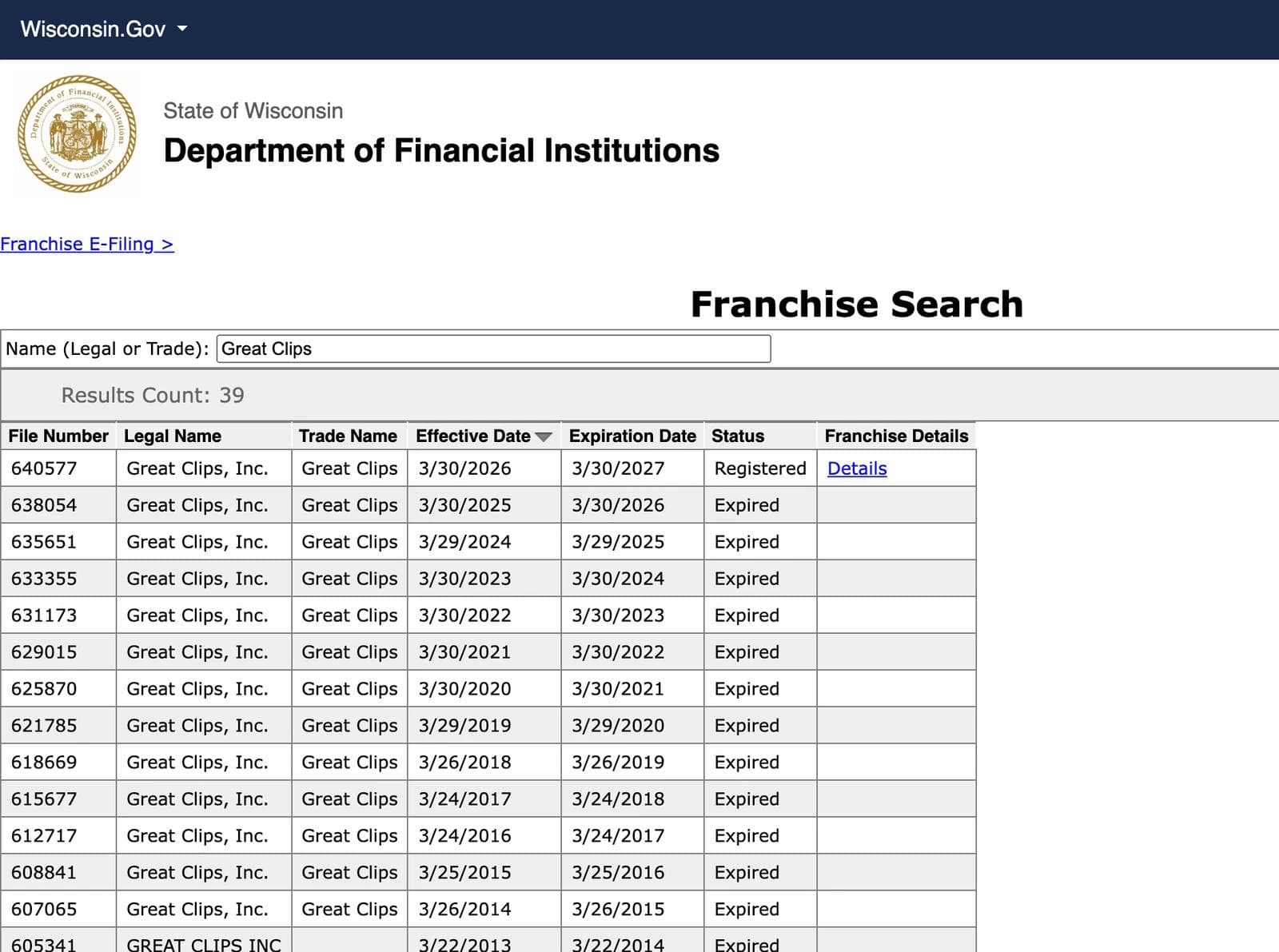
Item 11 of the FDD is the one you want. Under the FTC's Franchise Rule, a franchisor must disclose, for any advertising fund a franchisee is required to contribute to, "who contributes to the fund, whether other franchisees and franchisor-owned outlets contribute on the same basis, who administers the fund, whether the fund is audited, whether its financial statements are available for review, whether franchisees receive a periodic accounting of fund expenditures, and the percentage of the fund, if any, used principally to solicit new franchise sales" (FTC Franchise Rule Compliance Guide, p. 65).
The same guide requires disclosure of "the use of advertising funds in the last fiscal year, including percentages spent on production, media placement, administrative expenses, and other described expenses." That single sentence is why the numbers below exist at all, and it is the most useful lever a franchisee has.
Where the ad fund money actually went in 2025
We pulled four current FDDs from the Wisconsin registry, across four different franchise categories, and read what each fund reported spending in its last fiscal year.
| Fund (2026 FDD) | Required contribution | Production or creative | Media placement | Administration |
|---|---|---|---|---|
| Great Clips Ad Fund | 5% of gross monthly sales | 2.7% | 77.2% | inside a 19.4% other line that includes a 5.0% admin fee |
| Anytime Fitness General Advertising and Marketing Fund | up to the greater of $600 per month or 2% of gross revenue | 10% | 71% | 13% |
| Jersey Mike's Corporate Advertising and Development Fund | 1% of gross receipts | 67.6% | not a media fund | 31.7% |
| Jersey Mike's National Media Fund | 4% of gross receipts | 12.0% | 87.2% | under 1% |
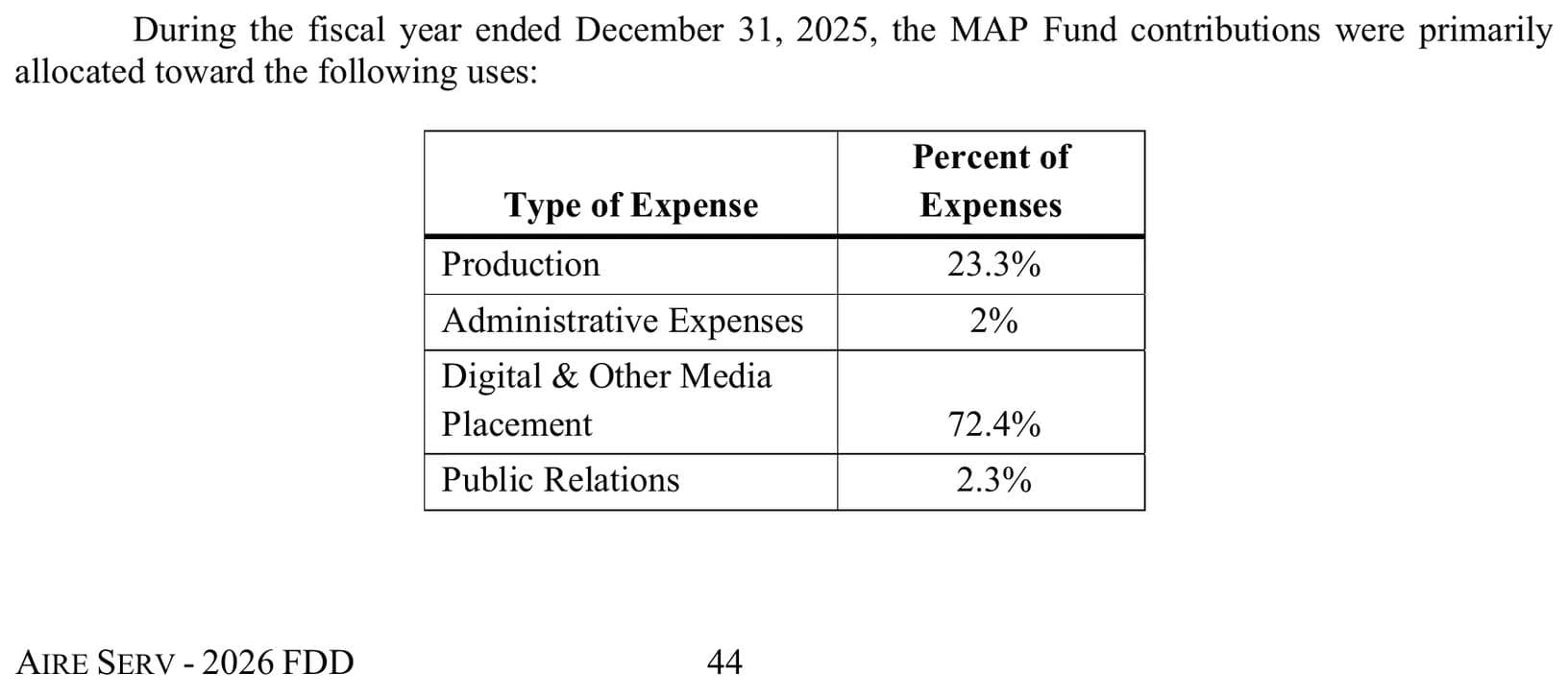
| Aire Serv MAP Fund | MAP fee, plus a separate local minimum | 23.3% | 72.4% | 2% |
Every figure is from Item 11 of the brand's 2026 FDD, reporting fiscal year 2025. The filings for Great Clips, Inc., Anytime Fitness Franchisor LLC, A Sub Above, LLC (Jersey Mike's) and Aire Serv SPV LLC were downloaded from the Wisconsin DFI franchise search on 9 September 2026. Search the legal name, open Details, and download the PDF to check any of it.
Three things fall out of that table.
Media dominates, but not uniformly. Aire Serv, a home services brand where the job is generating local leads, put 23.3% of its MAP Fund into production. Great Clips, a high-frequency retail brand running national awareness, put 2.7%. Neither is wrong. They are buying different things. But a franchisee moving between systems will find the creative support wildly different for a similar-looking percentage fee.
Some brands split the fund on purpose, and that is the clearest design in the set. Jersey Mike's runs two: a Corporate Advertising and Development Fund at 1% of gross receipts, which spent 67.6% on production and 31.7% on administration, and a National Media Fund at 4%, which spent 87.2% on media placement and 12.0% on production. One fund makes things. The other buys attention. Blended across the full 5%, roughly 23% of contributions went to production, by our arithmetic from the two disclosed splits. Separating the funds does not change the total, but it makes the creative budget a line item somebody owns rather than a residual.
The admin line is real money and it is disclosed. Great Clips discloses that it was compensated $4,568,138, or 5% of the Ad Fund's gross annual receipts, for administering the fund in calendar year 2025. Anytime Fitness reports 13% administration. Those are legitimate costs. They are also the kind of number that turns into a franchisee advisory council fight when nobody saw it coming.
What franchisees are actually owed, and what they are not
This is where "we pay into the fund and get nothing usable" usually starts, and most of the time both sides are right about different things.
What the disclosures in this sample commonly promise:
- An accounting. Great Clips provides an annual accounting of receipts and expenditures, plus a quarterly unaudited statement by DMA. Anytime Fitness makes an annual accounting available on request. Aire Serv's manager prepares an annual unaudited accounting available on written request. Jersey Mike's prepares an annual accounting summary of each fund, available on written request.
- Sometimes an audit. Great Clips states the Ad Fund is audited annually and the audit is available to franchisees on written request. Anytime Fitness states plainly that it does not audit its fund.
- Same-basis contribution from company outlets. Great Clips, Aire Serv and Jersey Mike's all disclose that company-owned or affiliate-owned units contribute on the same basis as franchisees. That is a fairness question worth checking, because it is not universal.
What they generally do not promise:
- That any of it gets spent near you. Great Clips: "Great Clips is not obligated to spend any specific amount collected into the Ad Fund in the DMA in which your Salon will be located." Anytime Fitness: "We have no obligation to spend any amount on advertising in your protected territory." Aire Serv says the same about its MAP Fund. This is standard and it is disclosed. It is also the single most common source of surprise.
- A vote. Franchisee marketing councils in this sample are advisory. Great Clips' Marketing and Advisory Review Council "is purely advisory in nature" and "Great Clips maintains all final decision-making authority." Aire Serv's Advisory Council decisions are "subject to our approval." Anytime Fitness states it does not maintain an advertising council at all. If your system has a council, read its charter before you treat it as governance.
Local advertising cooperatives sit in a third category. Great Clips requires membership in a DMA-level co-op that is self-governing and sets its own dues, and notes that co-ops "are not currently required by Great Clips to prepare any kind of periodic accounting." Jersey Mike's may require co-op membership with contributions not exceeding 2% of gross receipts. A co-op is often where local creative money actually lives, and it is frequently the least documented pot in the system.
Rules vary by country. Writing about the New Zealand market, franchise lawyer Stewart Germann argues that marketing fund accountability there lags Australia's and that franchisors should be required to hold marketing funds in separate accounts and publish an income and expenditure statement (Franchise Marketing: Who Pays?). Check what applies where you operate rather than assuming the US disclosure regime is the ceiling.
Brand control versus local relevance: what a location may change
Ask a franchisor's marketing lead what franchisees can change and you will usually hear "address, phone, hours, and the local offer." Ask what the agreement says and it is often narrower than that.
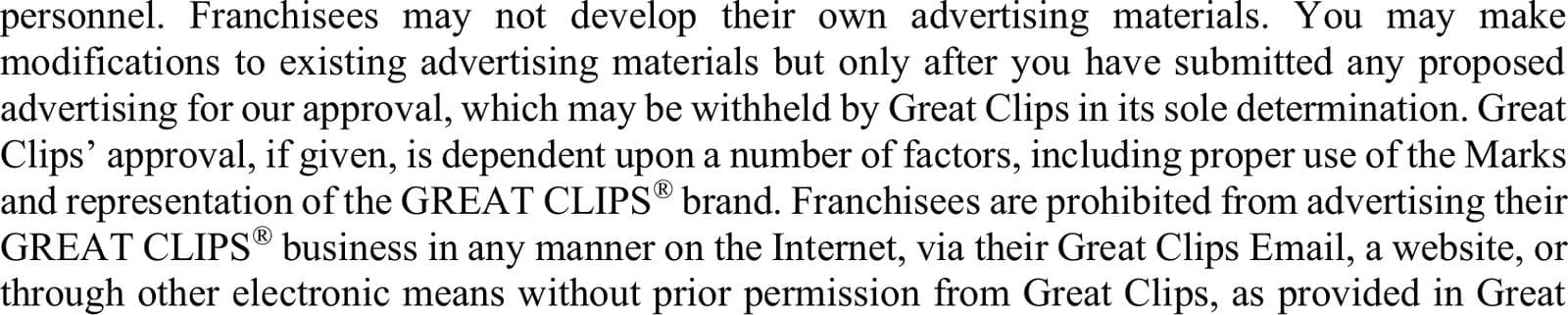
Great Clips is at one end: "Franchisees may not develop their own advertising materials." A franchisee may modify existing materials, but only after submitting the proposal for approval, which may be withheld. Internet advertising requires prior permission. The franchise agreement adds that a franchisee "will use only advertising programs or materials provided by Great Clips or that Great Clips has specifically designated in writing."
Jersey Mike's is at the other end of the same idea but with a clock on it. The company reviews and approves or disapproves all promotional materials, and "if Company does not approve, in writing, any advertising or promotional item submitted to Company within fifteen days of receipt of all pertinent materials, the particular materials will be considered disapproved." Silence is a no. A franchisee planning a local promotion has to build fifteen days of dead time into the schedule.
Aire Serv shows a third pattern: heavy local obligation with a vendor gate. Beyond the MAP fee, franchisees face an Initial Marketing Spend Requirement of $60,000 in year one and $75,000 in year two, and the franchisor reserves the right to require a Minimum Local Marketing Spending equal to the greater of $50,000 or 8% of gross sales annually, with the right "to require you to use one or more designated vendors in connection with your local marketing and promotional activities."
Read those three together and the design question gets sharp:
- If you forbid local authorship, you have taken on an obligation to supply everything, in every format, fast enough to be useful.
- If you require local spend, you have to give locations something worth spending it on, or they will make their own and you will find out later.
- If your approval loop is slower than a local promotion's planning window, you have not created control. You have created a workaround.
The template-and-variant problem
Here is the operating shape of the whole thing. National marketing decides on a promotion. It exists as one hero creative in a handful of master sizes. Now it needs to reach 40, 400 or 4,000 locations, each of which needs its own address, phone number, local offer, occasionally a local photo, and its own set of formats: a Meta ad, a story, a window cling, a door hanger, a menu insert, a Google Business Profile post.
That is not one design job. It is one design job multiplied by locations, then multiplied by formats, then repeated every time an offer changes.
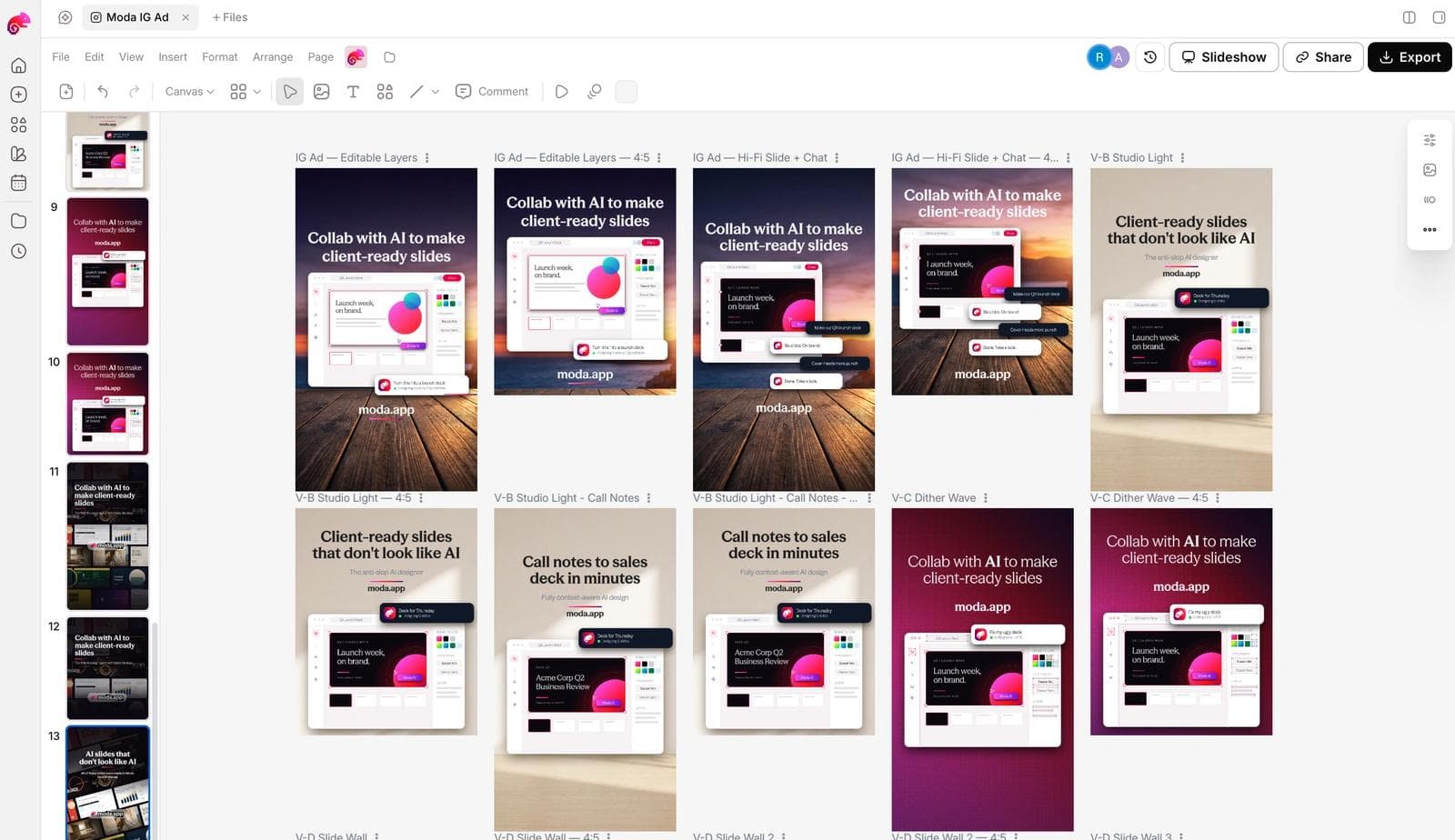
This is the step where franchise systems fail, and it fails in four recognizable ways.
Stale assets. The portal still has the spring promotion in October because refreshing 400 localized variants is a project, not a task. Locations use what is there.
Off-brand do-it-yourself. A location needs a graphic today, cannot get one, and makes one. The result is often fine at the store and wrong for the brand.
Shadow tooling. Related but worse: a multi-unit operator buys their own design subscription and builds a parallel asset library nobody at head office can see, version, or retire. This is invisible until the brand changes. When Dunkin' Donuts shortened its name to Dunkin', the new branding had to reach packaging, advertising, the website, social channels, and exterior and interior signage across the system, starting in January 2019. Every asset not in a central library is an asset that quietly does not get updated.
Format gaps. The system supplies social and print but nothing for the local landing page, or supplies English but not the Spanish version half the market needs.
None of those are fixed by better guidelines. They are fixed by making the variant production cheap enough that supplying it centrally beats doing without.
Systems that handle this well tend to say out loud what they supply. The UPS Store's public franchise FAQ states that it collects "8.5 percent of franchise owners' adjusted gross monthly sales, five percent of which covers royalties and 3.5 percent of which goes to local and national marketing efforts," then lists what that buys: localized advertising materials, center-specific websites, in-store promotional collateral, public relations and seasonal campaigns, and resources for promoting the center locally (The UPS Store franchise FAQ). A prospective franchisee can tell whether "localized advertising materials" is in the deal. Most systems distribute this through a brand portal, and most of those portals are closed: Domino's National Advertising Fund brand portal at brand.dominos.com, for instance, serves nothing but a sign-in form to the public. That is normal and reasonable. It also means a franchisee's only public view of the arrangement is the FDD.
Which category of product actually solves which piece
The vendor ecosystem here is real and mostly well-differentiated. Getting the category right matters more than getting the brand right.
| The job | The right category | Examples |
|---|---|---|
| Distributing approved assets to locations, managing co-op and MDF funds, localizing templates at scale | Distributed marketing or through-channel marketing automation | SproutLoud, BrandMuscle, Ansira |
| Listings, local pages, reviews and local social across hundreds of profiles | Multi-location marketing platform | SOCi, Yext, Uberall, Birdeye |
| Storing, versioning and retiring the master assets themselves | Digital asset management or brand portal | Bynder, Brandfolder, Frontify |
| Media buying, creative strategy and campaign management | Franchise marketing agency | Numerous; several rank for this query |
| Producing the many on-brand variants of a campaign asset in the first place | Design tool with a reusable brand kit | Canva, Moda, Adobe Express |
SproutLoud describes itself as a "distributed marketing platform" for "brand-to-local marketing" that lets partners "localize brand-compliant content," and it covers co-op and MDF fund administration. SOCi calls itself "AI-Powered Multi-Location Marketing" and covers local search, local pages, reviews, local social and local ads. If your problem is that 400 Google Business Profiles are drifting, or that co-op funds need to be claimed and reimbursed, a purpose-built multi-location platform beats a design tool and beats an agency retainer. Do not try to solve fund administration with a canvas.
The narrow slice where a design tool is the right answer is the last row: turning one approved campaign into many on-brand variants. This is where Moda fits. You give it a brand kit with your logos, colors, fonts and written guidance, describe the variants you need, and the agent builds them on a real canvas that stays editable, so a location-specific line or photo can be changed without rebuilding the file. It exports to PDF, images and PowerPoint.
Its limits should be as plain as its fit. Moda is not a DAM, not a brand portal, not a local SEO tool and not a franchise management system. It does not do approval workflows, locked template elements, or administrative brand controls, and if formal governance is the requirement, Canva's Brand Hub is the stronger choice. It has no fund accounting, no listings management and no franchisee permissioning. In a franchise system it is a production tool that sits behind whatever portal you already use to distribute and approve, not a replacement for it.
Whatever you use, the prerequisite is the same and it is not software: a brand system specific enough that a variant can be judged right or wrong quickly. If your guidelines cannot answer "may this location put its city name in the headline," approvals will stay slow. Our brand identity guide covers what a usable system contains.
Local SEO and Google Business Profile at multi-location scale
This deserves its own owner, and in most systems that owner should be the franchisor, with franchisee access rather than franchisee ownership.
The reason is structural. Google's guidelines are stricter than most local operators expect. Your name "should reflect your business's real-world name, as used consistently on your storefront, website, stationery, and as known to customers," and "including unnecessary information in your business name isn't permitted, and could result in the suspension of your Business Profile" (Guidelines for representing your business on Google). Marketing taglines, service descriptors and nearby-location references are all called out as prohibited. That rule alone is where a large share of multi-location listing suspensions come from, because a well-meaning local marketer adds the city name to help with search.
Google addresses chains directly, and the rules are tighter than most systems assume. "All locations must have the same name unless the business's real world representation consistently varies from location to location. All locations must also have the same category if they provide the same service." A co-branded site does not get a combined name: "If your business location combines two or more brands, do not combine the brand names into a single Business Profile. Instead, pick one brand's name for the Business Profile." Franchisees are explicitly allowed the brand name: "if the business is an authorized and fully dedicated seller of the branded product or service, sometimes known as a 'franchisee', you may use the underlying brand name when you create the Business Profile."
At scale, Google's bulk verification path applies "if you have 10 or more locations of the same business" and lets you verify them together instead of one at a time (Verify Business Profiles in bulk), with locations added and edited through a bulk upload spreadsheet. Two conditions bite in practice. Uploading the spreadsheet does not by itself request verification. And the eligibility list includes "Your business isn't a service-area business," which excludes a large share of franchised home services: the pest control, HVAC, plumbing, cleaning and lawn care systems that serve customers at the customer's address usually cannot use this path at all.
Practical consequences for a franchise system:
- Own the account structure centrally, and grant each location manager access rather than letting them create their own profiles. Google is explicit that there "should only be one profile per business" and that you should not "create more than one page for each location." Duplicates created by well-meaning franchisees are painful to merge.
- Standardize the name, category and attributes centrally. Let locations own hours, photos, posts and review responses, the fields that genuinely need local knowledge and fast turnaround.
- If you run a service-area brand, plan for per-location verification and for the rule that a service area "shouldn't extend farther than about 2 hours of driving time" from where the business is based.
- When a location's website is part of the system, keep the name, address and phone consistent between the profile and the page. We covered how that plays out on real sites in our teardowns of HVAC websites and restaurant websites, both categories where franchised and multi-location operators are common.
This section is deliberately a pointer. Listings management at hundreds of locations is a product category, not a checklist item.
If you are the franchisee
You did not write the rules and you cannot change them this quarter. Three things are still in your control.
Request the accounting, in writing, and read it. If your FDD says an annual accounting or an audit is available on written request, ask for it. Ask which line is production and which is media. A specific question about a disclosed number gets a better answer than a general complaint about value.
Find your real authority before you spend. Reread Item 11 and the advertising section of your franchise agreement. There is a large practical difference between "you may not develop your own materials," "you may modify approved materials with prior written approval," and "you must spend $50,000 locally on approved marketing." Some systems will supply anything you ask for and simply have never been asked.
Spend your local budget where the brand cannot help you. National creative cannot know your school calendar, your busiest intersection, the contractor next door, or which service your market actually buys. Community sponsorships, local partnerships, review generation and your own Google Business Profile posts are almost always within your authority and almost never something the ad fund does for you.
And use the co-op. In many systems the DMA co-op is the only pot of money franchisees actually control, and it is frequently underspent because nobody chairs it.
A division of labor you can copy
The version that works in most systems draws the line at who has the information, not at who has the budget.
| Work | Franchisor owns | Franchisee owns |
|---|---|---|
| Brand system, logo, type, color, voice | Yes | No |
| National campaign concept and master creative | Yes | No |
| Localized variants of a campaign (address, phone, offer, format) | Yes, produced centrally and supplied | No, but requests them |
| Approved local photography | Sets standards and supplies stock | Supplies local photos to the standard |
| Media planning and buying, national and regional | Yes | No |
| Local media buying inside a set budget | Sets rules and approved vendors | Yes |
| Google Business Profile account structure, names, categories | Yes | No |
| GBP hours, photos, posts, review responses | Sets standards and response time | Yes |
| Local website or landing page | Owns the template and hosting | Owns the local content |
| Community sponsorships, events, partnerships | Sets guardrails | Yes |
| Ad fund administration and accounting | Yes | Reviews it |
| Co-op governance | Enables and sets rules | Runs it |
Two rules make the table work.
If you forbid it, you supply it. Every row you take away from the location becomes an obligation to deliver, on the location's timeline. A system that prohibits local authorship and takes three weeks to fulfill an asset request has chosen the worst of both models.
Make the creative budget a number, not a residual. The Jersey Mike's structure is instructive whether or not you copy the two-fund mechanics: when production is its own fund with its own percentage, someone is accountable for whether locations have usable assets. When it is whatever is left after media, it will be 2.7%, and the complaints will be about the fund when the problem is the supply chain.
Neither of those requires renegotiating a franchise agreement. Both require deciding, on purpose, who makes what.
Franchise marketing FAQ
What is the typical marketing fee for a franchise?
There is no single figure, and anyone quoting one is averaging across systems that work differently. Among four 2026 FDDs filed in Wisconsin: Great Clips requires 5% of gross monthly sales to its Ad Fund, Jersey Mike's requires 1% plus 4% across two funds with a 6% aggregate cap, Anytime Fitness caps its fee at the greater of $600 per month or 2% of gross revenue, and Aire Serv charges a MAP fee plus a separate required local marketing spend. Several also require a separate grand opening investment, $20,000 to $25,000 in the Great Clips case. Your own FDD Item 6 and Item 11 are the only authoritative answer for your system.
Who pays for franchise marketing, the franchisor or the franchisee?
Franchisees fund most of it, through a required percentage-of-sales contribution to a national or system fund, often plus a local advertising cooperative contribution and a required local spend. The franchisor administers the fund and typically decides how it is spent. In the systems reviewed here, company-owned units generally contribute on the same basis as franchisees, which is a fairness term worth confirming in your own disclosure document.
Can a franchisee run their own ads?
It depends entirely on the agreement, and the range is wide. Some systems prohibit franchisees from developing their own advertising materials at all and require prior written approval for any modification of approved materials. Others require submission with a fixed review window, after which silence counts as disapproval. Others require a large minimum local spend and reserve the right to name the vendors you use. Check the advertising section of your franchise agreement, not the marketing team's informal practice.
Where can I read a franchise brand's marketing fund disclosures?
Several US states publish filed franchise disclosure documents. Wisconsin's Department of Financial Institutions franchise search is free, requires no account, and lets you download the current FDD for any registered franchisor. Item 11 covers advertising funds, councils, cooperatives and approval requirements; Item 6 covers the fees themselves.
Is national brand advertising or local marketing more important for a franchise location?
They do different jobs and the split should follow the buying cycle. National media builds the recognition that makes a location's local marketing cheaper to convert. Local marketing supplies the things national cannot know: your specific offer, your hours, your neighborhood, your reviews. The failure mode is not choosing wrong between them. It is funding one and assuming the other happens by itself.
The short version
Franchise marketing breaks at the point where a national campaign has to become a local asset. The money is usually structured for media, the approval rules are usually stricter than anyone remembers, and the production step is usually nobody's explicit job. Pull your own FDD, find the production percentage, and decide who owns the variants before the next campaign, not during it.

Real editable visuals. Real canvas. Full control.
Fly through design work