Pitch Deck Examples: What 8 Real Decks Actually Contain
Eight real pitch decks counted slide by slide: length, order, what every deck has and what almost none do, plus what is worth copying and what belongs to 2008.
 Anvisha Pai, Co-founder & CEO, Moda
Looking at real pitch deck examples is worth doing. Copying their slide order is not, and the reason is simple: the decks everyone circulates belong to companies that succeeded, so the sample was chosen by the outcome rather than by the deck. Airbnb's slide sequence did not cause Airbnb. You are looking at a correlation with a survivor.
The second problem is age. Most of the canonical decks were built between 2008 and 2016, for rounds that were smaller, diligence that was lighter, and a market that no longer exists.
So instead of admiring eight decks, I counted them. Slide by slide: how long each one is, what order the slides run in, which slides appear in every deck and which appear in almost none, how the ask is framed, where the numbers sit. The counts are below, then what they support and what they do not.
The eight decks
Every deck here is published publicly, most of them by the founders themselves. I read each one slide by slide from the source linked in the table and counted from the slides, not from a summary.
| Deck | Year | Stage | Slides | Source |
|---|---|---|---|---|
| AirBed and Breakfast (Airbnb) | 2008 to 2009 | Angel | 14 | SlideShare |
| UberCab (Uber) | 2008 | Pre-seed | 25 | SlideShare |
| Buffer | 2011 | Seed | 13 | Buffer's own account |
| Mattermark, first version | 2014 | Series A | 32 | Danielle Morrill |
| Mattermark, final version | 2014 | Series A | 30 | Danielle Morrill |
| WeWork | 2014 | Series D | 36 | SlideShare |
| Front | 2016 | Series A | 21 | Mathilde Collin |
| Front | 2020 | Series C | 25 | Mathilde Collin |
Two of the eight are not success stories, which is deliberate. WeWork raised $355 million at a valuation near $5 billion in December 2014 (VentureBeat, 15 December 2014) and filed for Chapter 11 in November 2023 (Forbes timeline, 7 November 2023). Mattermark raised a $6.5 million Series A announced on 24 December 2014, then sold to FullContact and shut down in December 2017 (TechCrunch, 21 December 2017).
Mattermark is in here twice for a better reason still. Danielle Morrill published two versions of the same Series A deck, labelled "1st" and "2nd (Final)". They are the closest thing available to a controlled comparison, and I will come back to what changed between them.
The counts
Median length across the eight is 25 slides. The range is 13 to 36. Two decks sit under 20 and three sit above 30, which is a wider spread than any slide-count rule allows for.
Here is what is actually on them.
| Element | Decks containing it |
|---|---|
| A slide whose headline states a problem | 6 of 8 |
| A market sized in dollars or users | 6 of 8 |
| Market sized as TAM, SAM and SOM | 1 of 8 |
| Named competitors | 4 of 8 |
| A team slide | 7 of 8 |
| A dollar amount asked for, on a slide | 3 of 8 |
| A use-of-funds or hiring-plan slide | 1 of 8 |
| A forecast running two or more years forward | 4 of 8 |
Four numbers in that table are worth stopping on.
Only one deck used TAM, SAM and SOM. Airbnb's slide 5 runs 1.9 billion trips booked worldwide, down to 532 million budget and online trips, down to 10.6 million trips with AirBed and Breakfast. It is the slide most people picture when they think of market sizing. Nobody else in the set does it. Front sized nothing at all in 2016 and built a market up from nine named segments in 2020. Mattermark counted buyers: 30,000 venture and private equity professionals, 568,000 sales managers. Uber gave one flat number, $4.2 billion, and moved on.
Five of the eight never put the amount on a slide. Airbnb did, on its last slide. Front's Series A did, on a full-bleed statement slide two thirds of the way through. Mattermark's first version did. Uber buried "raise a few million" in a sub-bullet on the final slide. Buffer, WeWork, Mattermark's final version and Front's Series C simply do not contain the number anywhere.
One deck out of eight had a use-of-funds slide, and it was the version of Mattermark's Series A deck that did not go out as final.
Numbers arrive early. Where a deck shows its own metrics, the first one lands about a quarter of the way in: slide 5 of 13 for Buffer, slide 5 of 21 for Front, slide 11 of 30 for Mattermark, and slide 2 of 36 for WeWork. Airbnb is the exception and it is instructive. Its slide 4 is headed Market Validation and consists of two numbers, 630,000 and 17,000, set in a deck that carries no usage figures of Airbnb's own anywhere in its 14 slides.
The two Mattermark decks
This is the most useful pair in the set, because the variable is not the company, the market, the team or the year. It is the deck.
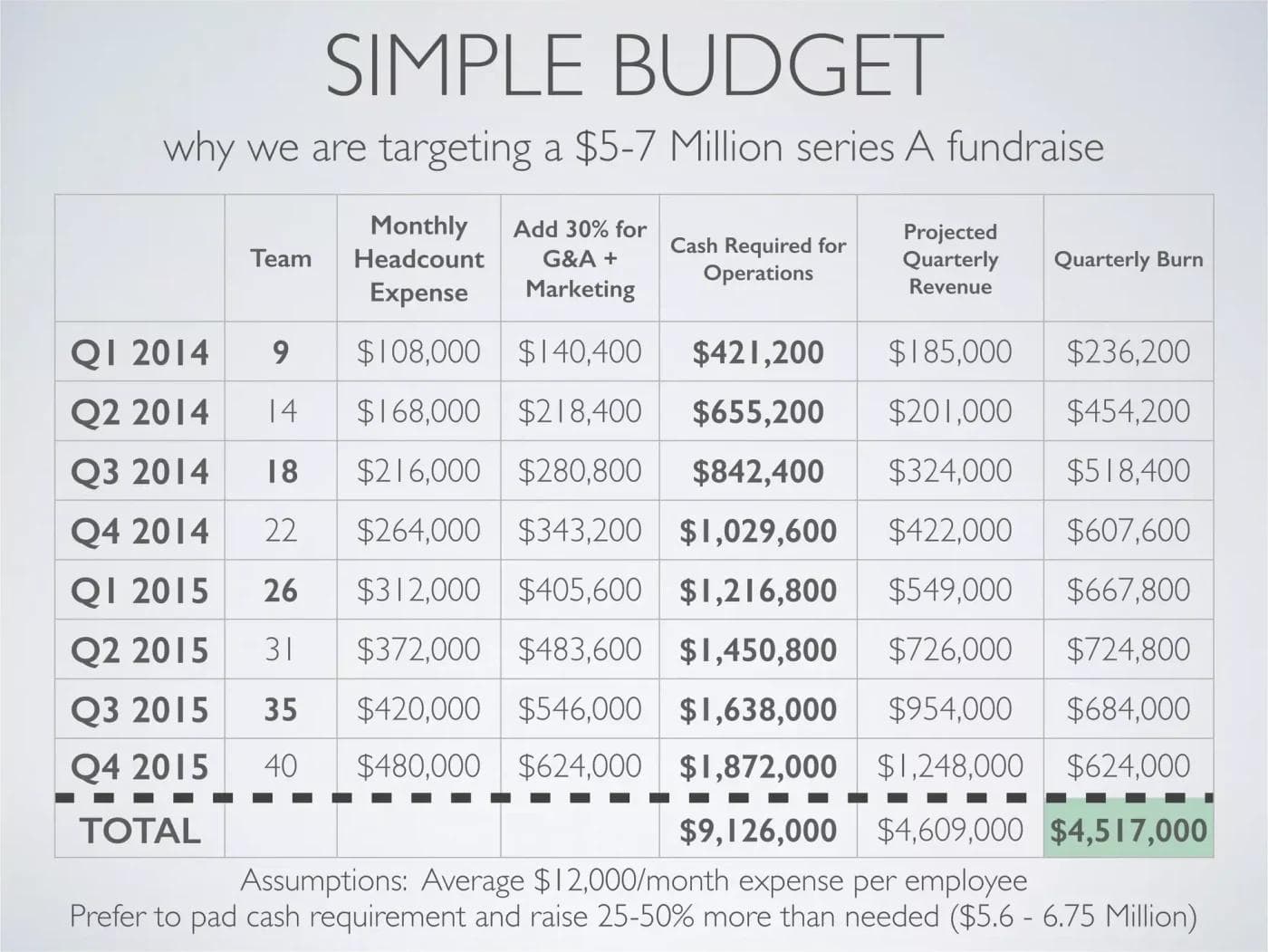
The first version is 32 slides. It opens on the founders, works through the problem, revenue by quarter, accounts, monthly and weekly active users, product usage, churn, email subscribers, newsletter readership, an acquisition funnel, signup conversion and trial-to-paid conversion. Then a lessons-learned slide, a hiring plan, four org charts at current, 6, 12 and 18 months, a quarterly budget table, and a compounding revenue projection out to 2018.
The final version is 30 slides and has none of that. No budget, no hiring plan, no org charts, no competitor comparison, no dollar ask. What it has instead is seven slides of team at the end and three screenshots of Google searches that return nothing useful, sitting where a product demo would normally go.
If you built a checklist from current fundraising advice, the first deck would score higher on almost every line. It is the one that did not go out.
Morrill wrote about it a year later, in October 2015: the deck, she said, "turned out to be more for me than for investors", and the actual pitch was an email exchange with Brad Feld and a handful of questions. She also noted that the round was priced on a multiple of current revenue, not on the projections in the deck.
That is one founder's account of one round, and it does not generalise into a rule. It does dispose of the idea that a deck's structure is doing the work.
What is genuinely transferable
Four things hold across all eight decks regardless of year, stage or outcome.
One sentence at the top that says what the company is. Airbnb: book rooms with locals, rather than hotels. Front: all your company's external communications in one collaborative inbox. UberCab: next-generation car service. Every deck in the set does this on slide 1, and none of them needs a second sentence.
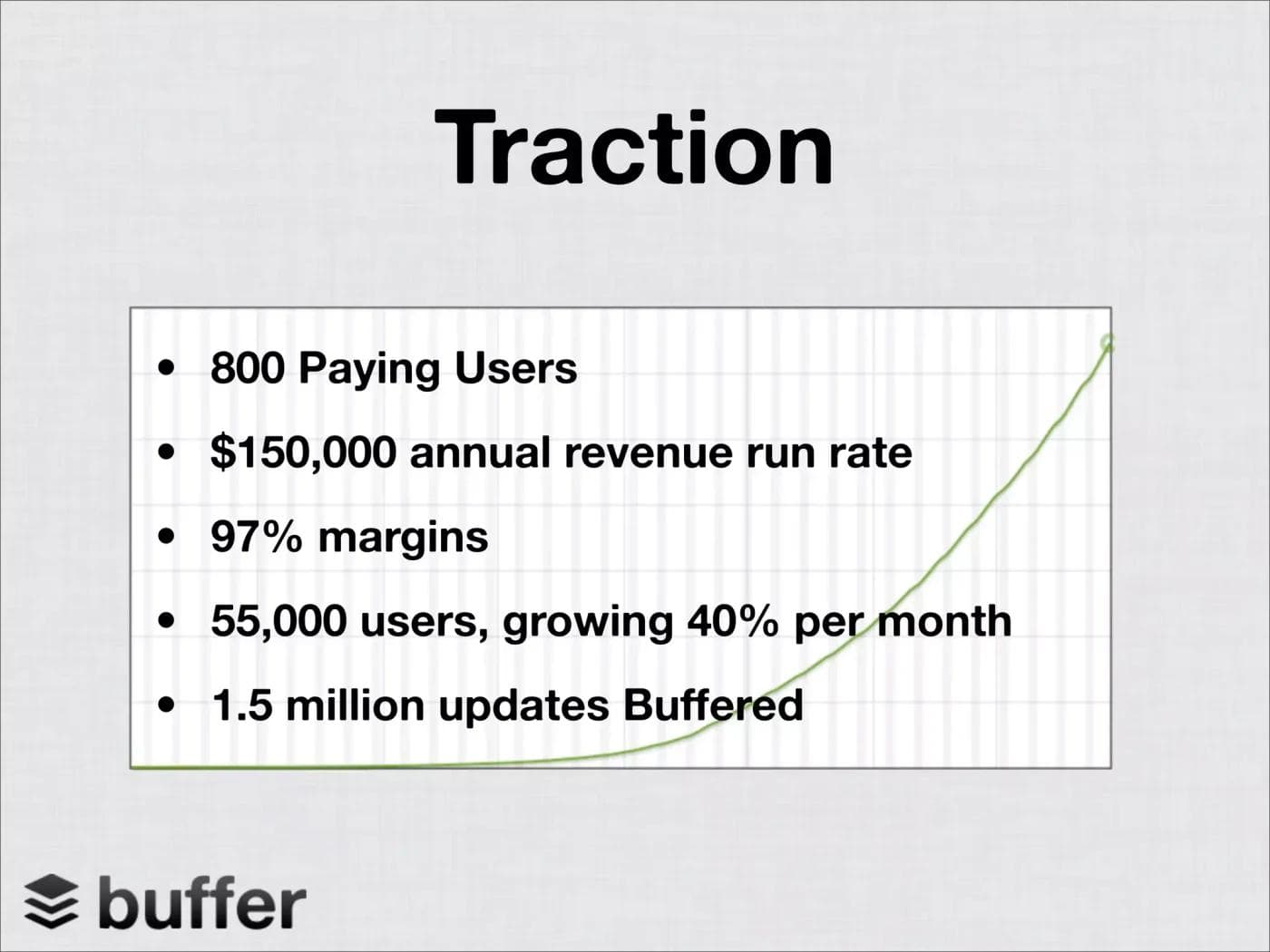
Numbers with no adjectives around them. Buffer's traction slide is five lines: 800 paying users, $150,000 annual revenue run rate, 97 percent margins, 55,000 users growing 40 percent per month, 1.5 million updates queued. Front's Series A capital-efficiency slide is four: $1.3 million spent in 18 months, $1.8 million left, $90,000 monthly burn, 5 months to profitable. Neither slide argues. It just puts the figures where they can be checked.
A market sized from the bottom up rather than from a research report. The decks that sized well counted something real: buyers, segments, transactions. Front's 2020 deck builds $5.5 billion of potential from nine named industry segments. Mattermark counted job titles. Airbnb's funnel is the exception that gets copied, and copying it usually produces a slide that says the market is $50 billion and proves nothing.
Show the product. Airbnb, Front and WeWork all put real interface on the page. Mattermark's final version put in three screenshots of Google failing to answer a business question, which is a demo of the problem rather than the product, and it is more memorable than most product slides.
What is era-specific, and should not be copied
The lengths belong to a different delivery method. These decks were presented in a room or emailed as a PDF attachment. Airbnb's first ten slides survive only as photographs of a projected screen, which tells you how the deck was actually used. Uber's is 25 slides of bullet lists that read as a business plan someone talks over, not a document anyone reads alone.
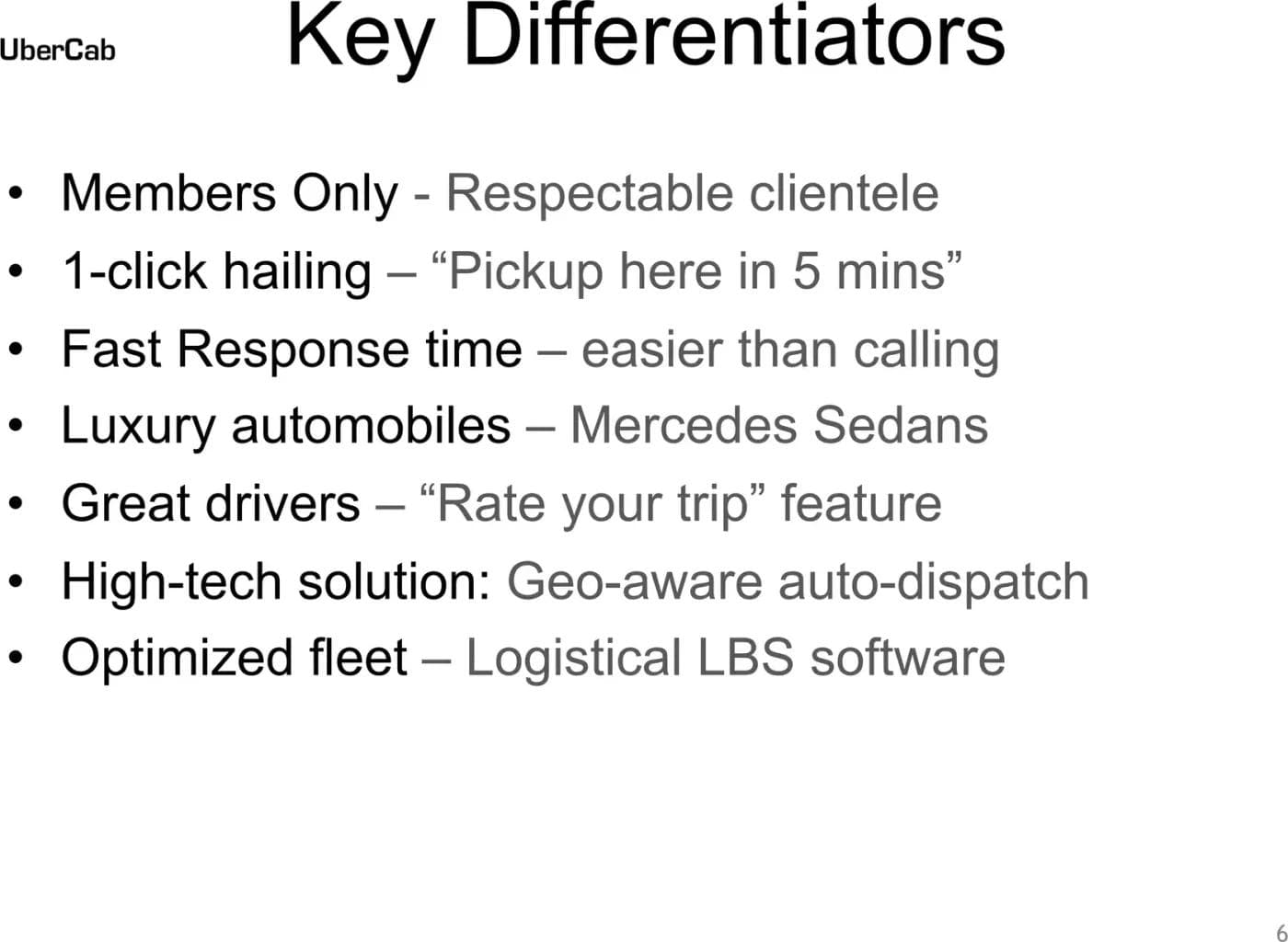
The numbers are period pieces. Airbnb asked for $500,000 and set a 12-month target of 80,000 transactions. Uber's entire addressable market was $4.2 billion and its best case was $1 billion of yearly revenue. Mattermark's 2014 budget assumed $12,000 per employee per month. None of these are benchmarks for anything you are raising now.
The market itself has changed shape. Carta reported that around 3,000 US startups on its platform raised pre-seed funding in Q1 2026, totalling over $2.3 billion, and that AI startups took about 50 percent of pre-seed dollars, up from roughly 30 percent a few years earlier (Carta, published 14 May 2026). Rounds between $1 million and $2.5 million fell from 24 percent of pre-seed rounds in Q1 2023 to 18 percent in Q1 2026. A deck built for the 2008 angel market is not addressing the same reader.
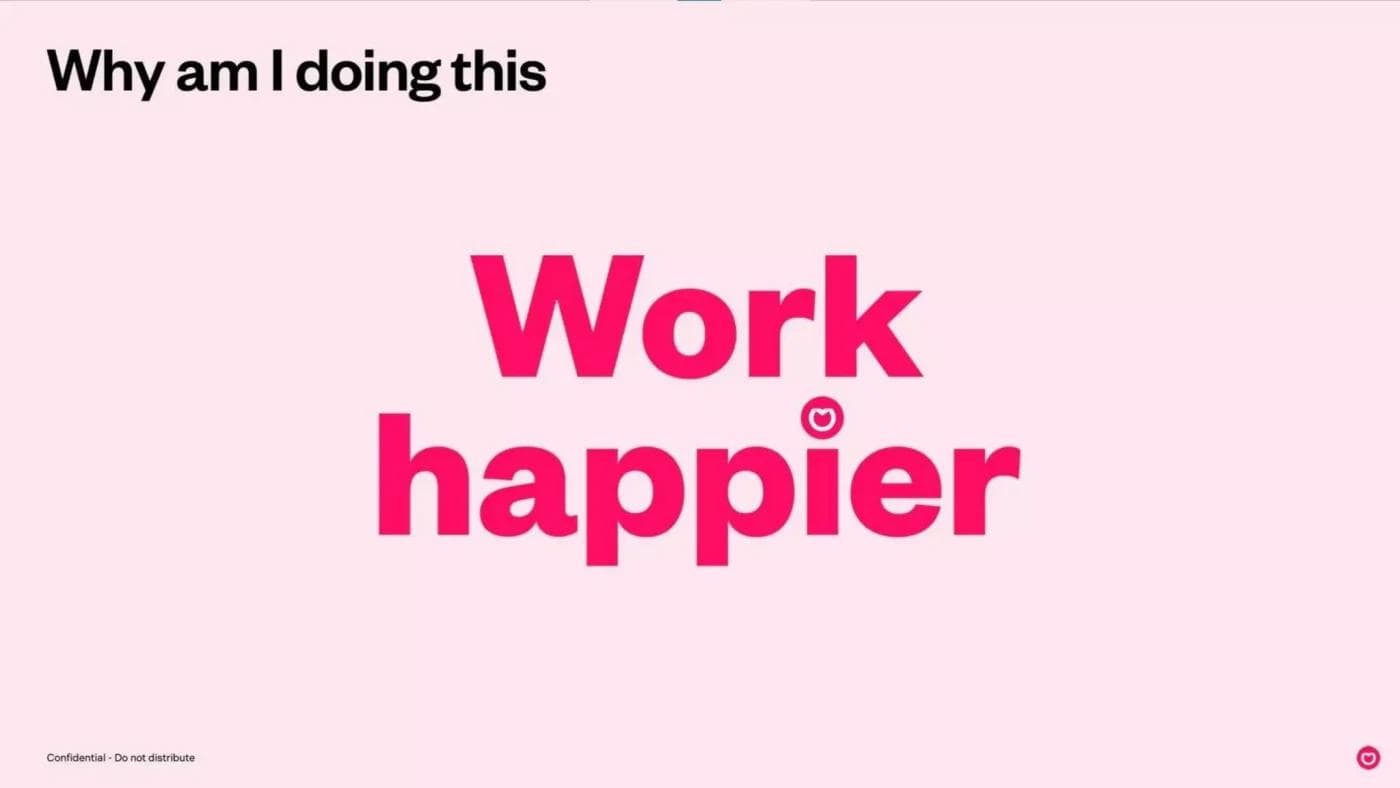
The polish is not the variable. WeWork's is the most complete deck in the set by a distance: 36 slides, a five-year forecast, member cohort economics, landlord partnerships, a leadership and board slide. It is also the deck from the company that went bankrupt. Front's 2020 Series C opens with five slides about why the founder is doing this at all, before the problem, and has no ask, no forecast and no team slide in the published version.
The structure to actually use
Read against the counts rather than the folklore, this is what the set supports.
- One line saying what you do. All eight decks.
- The problem as a fact about the world, not a complaint. Six of eight had a problem slide. The two that skipped it, Buffer and WeWork, replaced it with a trend the audience already believed.
- The product, shown. Not described.
- Your numbers, about a quarter of the way in. Whatever you have. If you have none, say what you have validated instead, as Airbnb did.
- The market, counted from the bottom up. Skip TAM, SAM and SOM unless the funnel is genuinely how your market works. Seven of eight did.
- Competitors, named, if you can name them honestly. Half the set did. The other half positioned on axes instead, which reads as evasion when the competitors are obvious.
- Team. Seven of eight. Near the end in every case except Mattermark's first version.
- The ask, if you have a number. Five of eight did not put one on a slide, so this is not the failure it is usually described as. Putting it in the email is fine.
On length: aim for the middle of the observed range, roughly 15 to 25 slides, and remember the shortest deck in the set was 13. There is no slide count that makes a pitch work, but there is a length past which a deck stops being read, and every deck here over 30 slides was written for a room.
Where to find more decks
Three public archives are worth your time, and they do different jobs.
- Failory's pitch deck library is the best-organised: several hundred decks, free, with stage, amount raised, year and industry tags on each. It is the only one that consistently gives you the year, which matters more than it sounds.
- Pitch Deck Hunt has the largest claimed collection and filters by industry and stage, but attaches less metadata.
- Slidebean's collection pairs each deck with a short commentary and covers the canonical set thoroughly.
All three curate on having raised money, so all three carry the survivorship problem this article started with. Read them for structure and for range, not for causation. When you find a deck you like, check its year before you copy anything about it.
Building your own
Once the argument is settled, the deck is a design job, and it is a smaller one than it looks. Buffer's deck is black text on grey with almost no chartwork, and it is the clearest of the eight. What carries these decks is the numbers and the order.
That is where Moda fits: describe the deck you need and its AI agent builds it on a real, editable canvas, applies your brand kit, and exports to PowerPoint or PDF. It is genuinely fast for turning a settled outline into slides that look considered, and for keeping fonts and colours consistent when you rebuild the deck for the fifth time in a week. It will not source your metrics, decide your market framing, or tell you whether the story holds, and a well-designed deck with a weak argument is still a weak deck. If you want a comparison of the tools in this category, we tested six AI pitch deck generators; if brand consistency is your problem, making an AI deck match your brand covers the workflow; and if you already work in Claude, using Claude for a pitch deck covers that path.
The short version
Study real decks for what a good slide looks like: one claim, checkable numbers, no adjectives. Do not study them for slide order, because the order in the famous ones is not a formula, it is eight different answers to eight different situations, six of them from a market that has since changed twice.
The most instructive artefact in the whole set is the Mattermark pair, where the more complete, more advice-compliant deck was the one that got replaced. Build the argument first. The deck is downstream.
Frequently asked questions
How many slides should a pitch deck be?
There is no reliable number. Across the eight real decks counted here the median was 25 and the range was 13 to 36, with the shortest raising a seed round and the longest coming from a company that later went bankrupt. A more useful constraint is delivery: a deck you will present in a room can carry more slides than one you send as an attachment.
Do you need a TAM, SAM and SOM slide?
Only one of the eight decks used that structure, and it was Airbnb's in 2008. The others sized their markets by counting buyers, segments or transactions, or did not size them at all. Use the funnel only if it reflects how your market actually narrows.
Should the funding amount be on a slide?
Five of the eight decks did not include a dollar ask anywhere. Airbnb put $500,000 on its last slide, Front put $10 million on a statement slide, and Uber left "raise a few million" in a sub-bullet. Naming the number in the conversation or the email rather than the deck is common and normal.
Where can I find real pitch decks to look at?
Failory, Pitch Deck Hunt and Slidebean all maintain free public archives, and many founders publish their own decks directly, as Mathilde Collin did for Front's Series A and Series C and Danielle Morrill did for both versions of Mattermark's Series A. Check the year on anything you find, since most widely circulated decks are more than a decade old.
Does a better-looking deck raise more money?
Nothing in this set supports that. The most elaborately produced deck here belonged to WeWork, and the more thorough of Mattermark's two versions was the one that was replaced. Design makes an argument easier to follow. It does not supply one.

Real editable visuals. Real canvas. Full control.
Fly through design work