10 Best Remotion Alternatives in 2026, by What You Need to Replace
Compare 10 Remotion alternatives for HTML, TypeScript, video APIs, visual editing, After Effects automation, browser rendering, and specialist motion.
 Anvisha Pai, Co-founder & CEO, Moda
Remotion is popular in 2026 partly because a user can prompt a coding agent to make motion instead of hand-authoring every React component. That changes what counts as a serious alternative. A conventional timeline editor may be excellent software while still failing the main test: can an agent create, inspect, revise, and render the durable composition from natural-language direction?
HyperFrames, Diffusion Studio, Creatomate, Shotstack, and Moda provide comparatively direct agent workflows. Motion Canvas, VideoFlow, and Manim are agent-friendly because their source is structured code, but teams must supply more of the prompting and validation loop. Plainly and DaVinci Resolve are automatable in narrower ways. They should not be confused with a prompt-native motion system.
Remotion alternatives at a glance
| Tool | Best fit | Agent fit | Durable source of truth | Main purchase check |
|---|---|---|---|---|
| HyperFrames | Agent-authored browser video | Strong: official skills and end-to-end agent workflow | HTML, CSS, and JavaScript project | Does your source material translate better as HTML than React? |
| Motion Canvas | Technical explainers and voiceover-synced vector motion | Good: TypeScript is agent-legible, but the workflow is self-assembled | TypeScript generator scenes | Does its vector-first scope cover your media workflow? |
| VideoFlow | Portable video JSON and browser export | Good but emerging: structured TypeScript and JSON without a mature agent layer | VideoJSON generated from TypeScript | Is the newer ecosystem mature enough for your production horizon? |
| Creatomate | Designer-built templates with many API variants | Strong: official hosted MCP creates and revises templates | Hosted template or RenderScript | Are vendor templates and usage pricing preferable to owning infrastructure? |
| Shotstack | Managed media composition inside an application | Strong: official MCP, CLI, skill, schema, and preview loop | JSON edits and templates | Do its timeline model and SDK fit the editor you need to expose? |
| Plainly | Data-driven video that must preserve After Effects | Limited for original creation: strong for parameterized variants | After Effects project plus parameter map | Are you comfortable keeping AE as a production dependency? |
| Diffusion Studio | Prompted editing with visual human handoff | Strong: official coding-agent skill, CLI, JSX, and editable timeline | TSX composition and visual project | Is its new, macOS-centered agent workflow mature enough for your team? |
| Manim | Mathematical and technical animation | Good: Python scenes are highly agent-legible | Python scenes | Is the job explanation rather than general media editing? |
| DaVinci Resolve and Fusion | Editing, compositing, and human finishing | Technically possible but tedious through Python, Lua, and UI inspection | Resolve project and Fusion node graphs | Are you automating a desktop post-production environment? |
| Moda | Editable campaign motion and companion assets | Strong: agent creation and visual revision share one project | Visual canvas project | Is visual campaign production the goal, rather than code-rendered infrastructure? |
First decide which Remotion contract you are replacing
Remotion occupies several layers at once. A useful replacement test starts by naming the contract that must change.
- Authoring language: React components, hooks, typed props, and frame-derived motion.
- Source of truth: a repository that can reuse application components, data, and design tokens.
- Preview and revision: Remotion Studio plus any controls or tooling your team builds around compositions.
- Rendering: local Chrome, a server, or Remotion's cloud infrastructure and operational model.
- Product surface: Remotion Player and code that turns runtime data into a personalized composition.
- Agent contract: official skills, machine-readable documentation, preview tools, and a revision loop that lets the agent recover from bad output.
A visual editor can replace authoring without replacing an embedded render API. A hosted API can replace infrastructure while giving up React as the durable source. An NLE can finish footage beautifully without becoming a deterministic template system.
This is where many alternatives lists become misleading. They rank generative models such as Kling beside code frameworks. A model creates source footage from a prompt; it does not replace the component, parameter, preview, and rendering contracts above. Our HyperFrames versus Remotion guide examines the closest architecture-level comparison in detail.
When staying on Remotion is the better decision
Stay on Remotion when React is an advantage rather than an inconvenience. If your product UI, charts, tokens, types, and data transformations already live in React, the video can reuse approved implementation instead of recreating it in another scene model.
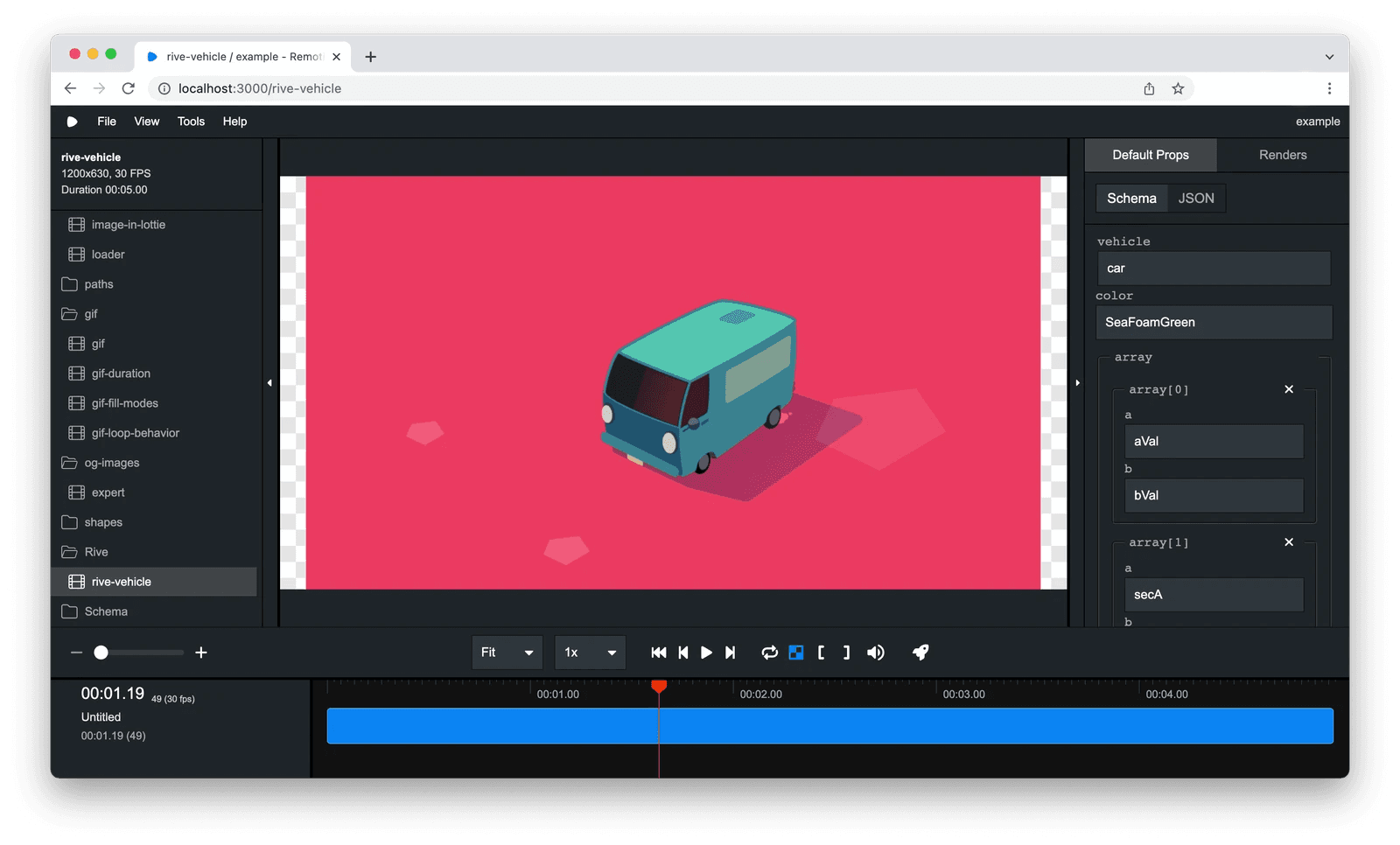
Agent tooling also changes the calculation. Remotion now documents skills and workflows for coding agents, so “I do not want to hand-write every animation” does not automatically require a different framework. In a 2026 practitioner discussion about Remotion alternatives, one commenter recommended using Claude or Codex with Remotion rather than adopting a thin wrapper. That is an anecdote, but it points to a sensible test: try the agent against your real repository before migrating the rendering architecture.
Licensing can still be a valid trigger. Remotion's current license allows free use for individuals, nonprofits, evaluation, and for-profit organizations with up to three employees. Other organizations need a company license, and teams embedding automated generation should review the terms for their exact version and use case. Licensing is an architecture input, not proof that another renderer will be cheaper or easier to operate.
Before migrating, distinguish an agent layer from a rendering alternative
If the goal is simply “I want to prompt an agent to make motion,” replacing Remotion may be unnecessary. Remotion already publishes agent skills and current AI guidance. Several open projects add a richer prompting layer while continuing to render through Remotion.
- Agent Motion gives coding agents a registry of tested, editable Remotion components with machine-readable props, timing, dependencies, and usage guidance.
- Open Animate packages an Apache 2.0 creative toolkit, asset generation, reusable components, and an agent skill around Remotion rendering.
- OpenMontage coordinates research, scripting, generated assets, narration, and final Remotion composition as a broader production pipeline.
These can make Remotion easier to prompt, but they are not independent replacements for its renderer or license. Evaluate them when the missing piece is agent context, reusable scenes, or production orchestration. Migrate the engine only when React, licensing, rendering operations, browser dependence, or source ownership is the actual mismatch.
Code-first alternatives to Remotion
1. HyperFrames: best for agent-written HTML and browser animation
HyperFrames turns HTML into deterministic video. An agent can work with ordinary HTML, CSS, JavaScript, GSAP, Lottie, and browser assets, while the project remains a folder that Studio, the CLI, and the renderer can all read.
This is a genuine alternative when React is the wrong translation layer. A website animation or an existing GSAP timeline can remain closer to its original form. HyperFrames Studio adds visual frame and timeline editing to the same project, which helps a designer or producer make bounded changes without converting the source into a separate editor format.
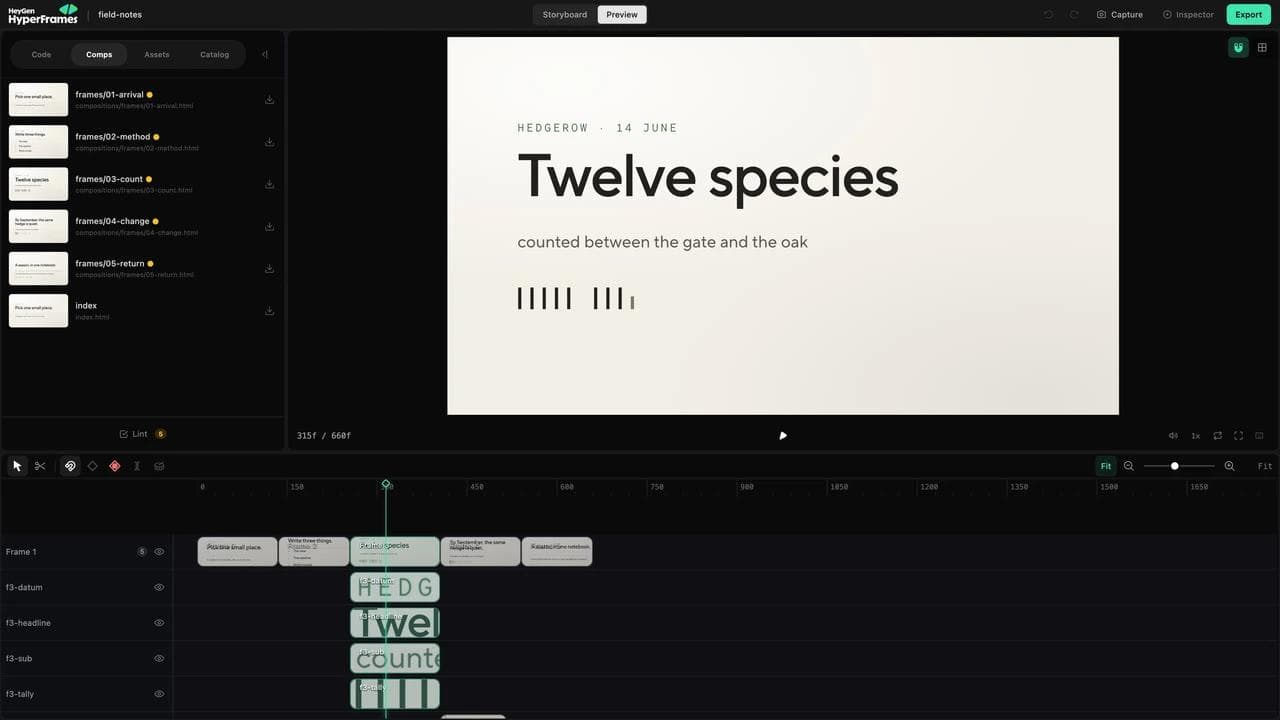
The tradeoff is not “easy HTML versus hard React.” Browser animation still needs deterministic timing, registered timelines, controlled randomness, asset loading, and validation. HyperFrames also has several deployment paths, but Remotion's longer production history remains relevant if you already operate Lambda renders at scale.
Choose HyperFrames when browser-native source fidelity and Apache 2.0 licensing matter. Do not migrate a stable React system merely because HTML produced a faster first demo.
2. Motion Canvas: best for technical explainers
Motion Canvas combines a TypeScript animation library with a web editor for real-time preview and audio synchronization. Its generator functions describe motion as a sequence of actions, which reads naturally for explainers, animated diagrams, code walkthroughs, and voiceover-led technical content.
That scope is a strength. Motion Canvas explicitly says it is designed for informative vector animation and is not intended to replace traditional video editing software. Its rendering tools can output frames or use an FFmpeg exporter, but teams that need a hosted personalization API must build the surrounding service.
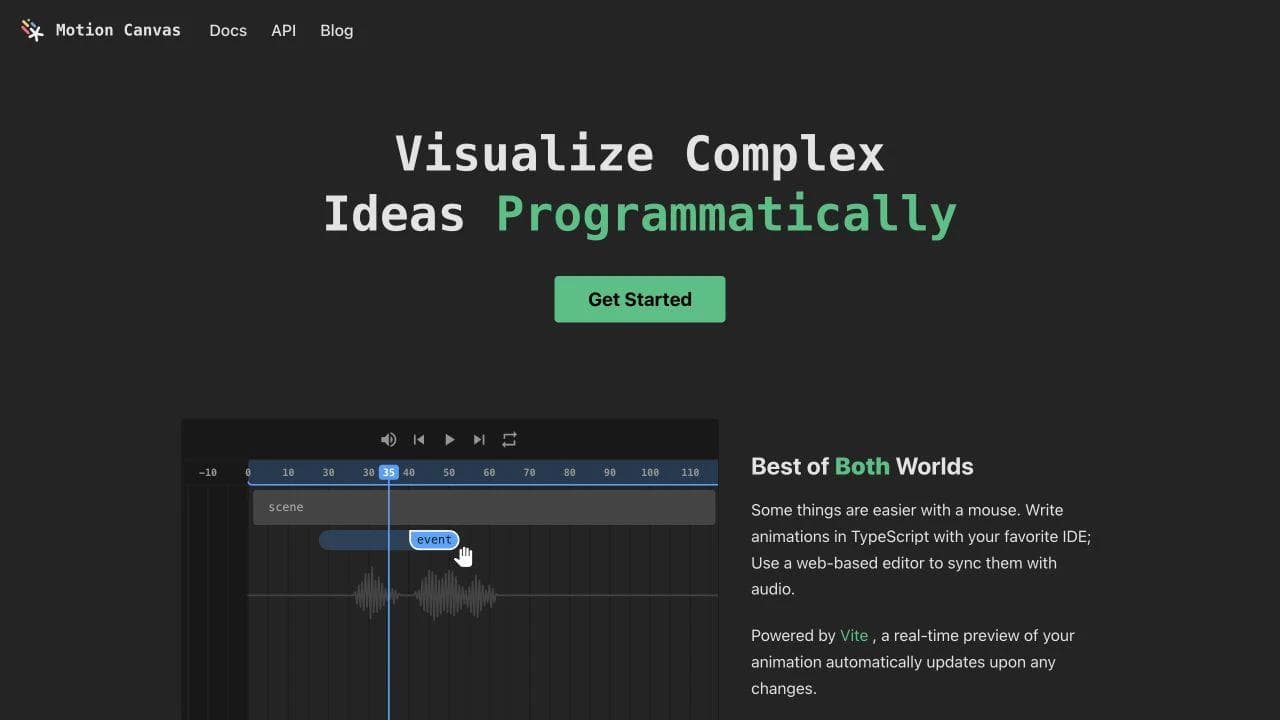
Choose Motion Canvas when the hard part is explaining a complex idea with precise, code-owned vector motion. Choose Remotion when deep React reuse, embedded playback, and a broader application-video ecosystem are more important.
Motion Canvas does not currently provide the same official agent skill and end-to-end prompt workflow as Remotion. An agent can still produce excellent work because the TypeScript sequence is explicit, but you must provide examples, asset constraints, preview commands, and visual checks.
3. VideoFlow: best emerging option for portable JSON
VideoFlow takes a different approach to source ownership. You can author through a fluent TypeScript builder, compile the result into portable VideoJSON, and feed that document to browser, server, or DOM-preview renderers. Its React editor uses the same underlying JSON model.
That separation is attractive when the video must be stored, transmitted, inspected, or edited as data rather than only as a component tree. Browser-side MP4 export can also move some rendering away from your servers, subject to client capabilities and the composition's resource needs.
The caveat is maturity. VideoFlow is a much newer public project than Remotion. Its documentation is detailed and the Apache 2.0 repository is active, but feature lists do not establish production behavior under your codecs, fonts, concurrency, and error cases. Treat it as an architecture pilot: build one representative template, test browser and server output, and inspect failure recovery before committing customer workflows.
Why Revideo is not a top recommendation here
Many 2026 roundups call Revideo the closest open-source Remotion replacement. That description now needs context. Revideo's own site says the team primarily works on the commercial Midrender editor and that recent engine changes have not yet been upstreamed to the public repository.
The supplied Reddit thread independently flagged the lack of recent public updates. Community comments are not authoritative on their own, but the project's primary-source statement confirms the maintenance split. Existing Revideo users may have a working system. A new adopter should compare the public package they can actually depend on, not features that currently live elsewhere.
Managed template and rendering APIs
4. Creatomate: best for templates shared by developers and designers
Creatomate joins a browser template editor to a hosted rendering API. A designer can create the structure visually, mark elements as dynamic, and let an application change text, media, colors, timing, or other properties through a template ID and modifications object. More dynamic projects can use its JSON-based RenderScript.
The key advantage over Remotion is organizational. Routine variations do not need to become React pull requests, and your team does not operate the render workers. The tradeoff is that the durable model moves into Creatomate's template and API system. Before switching, test versioning, template promotion, font and asset handling, webhooks, retention, concurrency, and how you recover a failed batch.
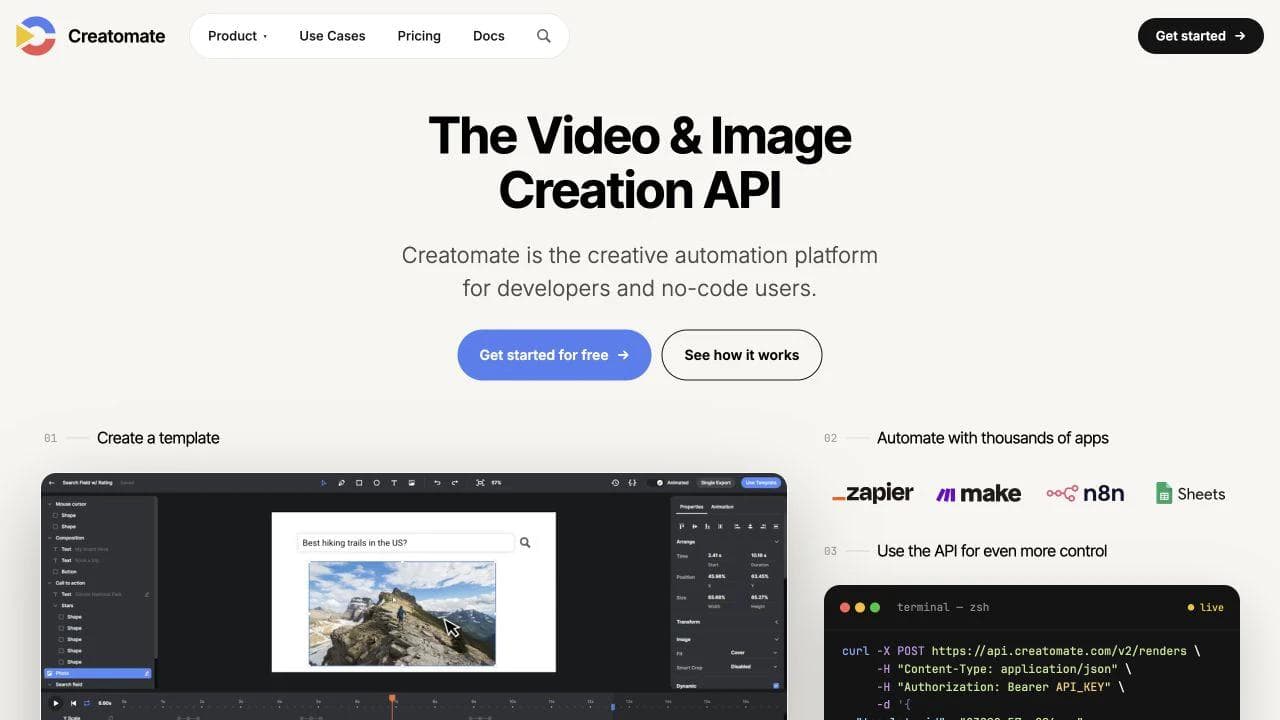
Choose Creatomate for personalized marketing, listings, announcements, and social variants where a visual template owner and an API consumer need to share control.
Creatomate's official hosted MCP server can browse, create, and update templates, perform free dry runs, start renders, and inspect failures. This makes it one of the few alternatives that directly satisfies the prompt-to-template workflow rather than merely exposing an API an agent could theoretically call.
5. Shotstack: best for a managed JSON media pipeline
Shotstack's Edit API represents video, image, and audio edits as JSON and renders them through a managed service. Its Studio uses familiar tracks and clips, can save reusable templates with merge fields, and can generate the JSON an application sends to the API.
Shotstack becomes especially relevant when you are building a media product rather than a library of React compositions. The current Studio SDK can be embedded into React, Vue, Next.js, Angular, or vanilla TypeScript applications, giving end users a visual timeline that writes to the same edit model the API renders.
That is a different form of extensibility from Remotion. You customize and validate a media schema instead of executing arbitrary React. Shotstack's official agent tooling includes an MCP server, CLI, coding-agent skill, schema guidance, validation, and Studio preview. Verify that its schema covers your typography, animation, compositing, audio, and transition requirements before assuming the stronger agent workflow is a complete creative substitute.
6. Plainly: best when After Effects must remain the source
Plainly turns an uploaded After Effects project into parameterized templates and cloud renders. Teams can expose selected text, media, color, effect, or other layers, then trigger variants through a UI, CSV, integration, or REST API.
This is the right alternative when the approved motion system already lives in After Effects and preserving that craft matters more than moving to web code. A motion designer can keep using AE's effects and composition model while developers integrate a render service instead of rebuilding the design in React.
It is the wrong choice if the goal is to remove After Effects from the workflow. Project packaging, fonts, layer naming, plugins, and template parametrization remain part of the production system. Our After Effects alternatives guide covers tools for replacing the authoring environment itself.
Agent-editable and specialist alternatives
7. Diffusion Studio: best open-source agent and editor handoff
Diffusion Studio is an open-source editor explicitly built for coding agents and human editors. Its official skill and CLI let an agent create or edit JSX compositions, while generated nodes remain first-class objects that a person can adjust on the canvas and timeline.
This is a direct answer to one Remotion limitation: code can remain agent-readable without requiring React to be the only practical editing surface. It is especially relevant for prompted motion, footage editing, captions, and campaign work that needs a visual handoff after the first agent pass.
The caveat is maturity and environment. Diffusion Studio is much newer than Remotion, and its coding-agent workflow currently runs through the macOS application. Pilot asset handling, fonts, rendering, broken-edit recovery, and human revision before treating it as production infrastructure.
8. Manim: best for mathematical and scientific animation
Manim Community is a Python engine for precise programmatic animation. Scenes are built from mathematical objects, transformations, equations, graphs, and animation commands, making it a natural fit for educational explanations where visual relationships must follow the underlying math.
This is not a broad React replacement. It does not provide Remotion Player or a marketer-friendly template editor, and conventional footage editing is outside its center of gravity. It wins when Python, equations, geometry, and reproducible technical diagrams are the source material. Because the scene grammar is plain Python and the output is deterministic, it is also one of the strongest unbundled options for a coding agent in that narrow category.
Choose Manim for math and science communication. Keep Remotion or another media framework when the composition is primarily product UI, branded typography, or personalized application content.
9. DaVinci Resolve with Fusion: best for editing and finishing
DaVinci Resolve combines a conventional NLE with Fusion's node-based compositing, color, and audio tools. Its scripting environment supports Python and Lua, scripts can run from the Fusion console or command line, and Resolve 20.2 added further scripting API operations. That means a coding agent can technically create projects, import media, assemble or modify timelines, manipulate parts of Fusion, and start renders through generated scripts.
A practitioner in the supplied Reddit discussion made the important distinction: Resolve automation is not the same paradigm as video as code. Resolve must be running, external scripting must be enabled, the API does not expose every desktop action as a clean declarative primitive, and visual verification still happens inside a large stateful application. An agent may need to alternate between Python or Lua, UI automation, and screenshots. It works, but it is tedious and brittle compared with editing a repository or validated JSON document.
Choose Resolve when humans need to cut footage, mix audio, grade, composite, and finish. It may sit after Remotion or a hosted renderer rather than replace it. If the main job is editorial video, our CapCut alternatives guide compares that category directly.
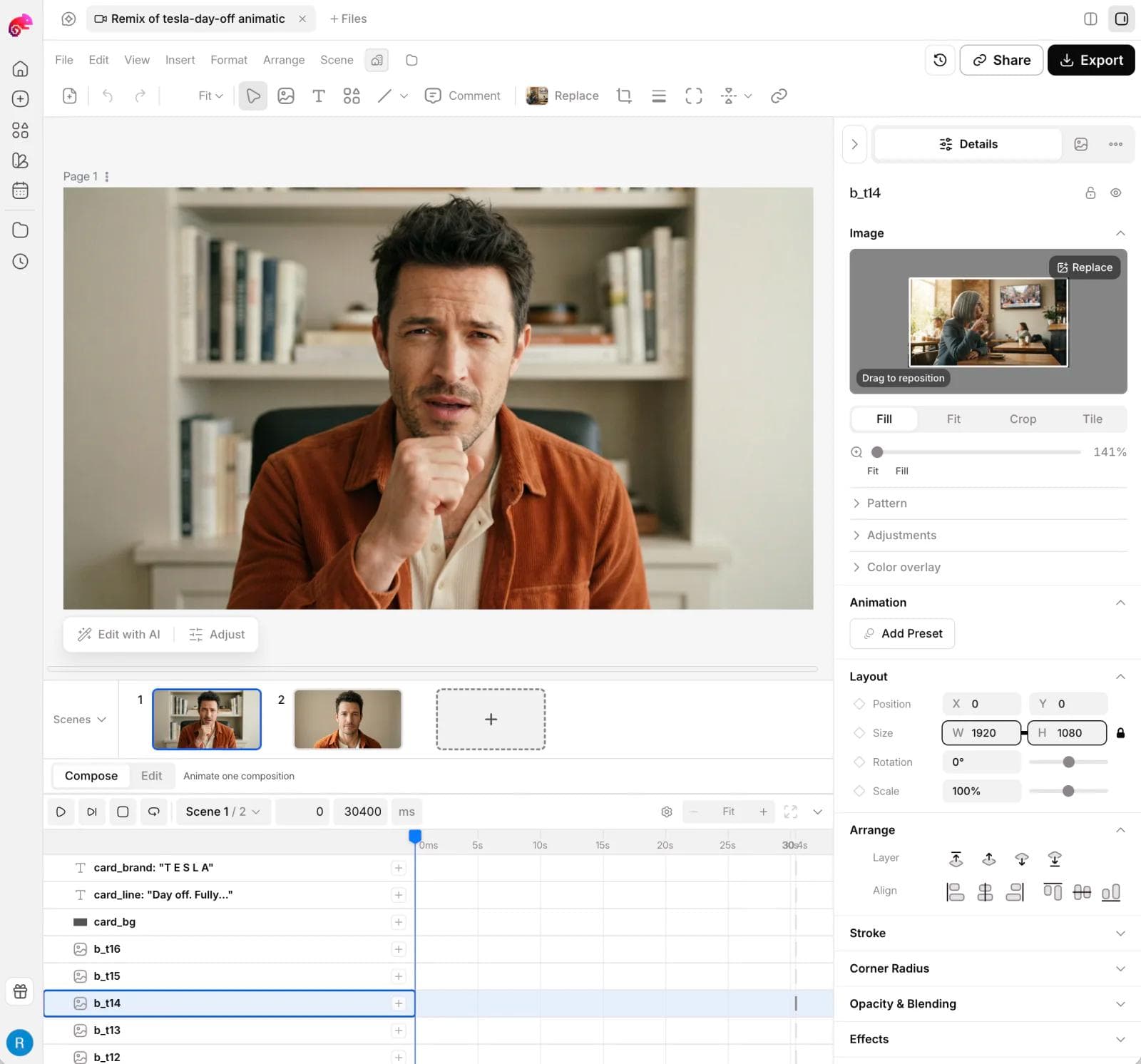
10. Moda: best for editable campaign motion and companion assets
Moda fits when the problem begins with a campaign brief rather than a rendering SDK. An agent can create branded layouts and motion on an editable canvas, while a marketing or design team revises text, images, timing, and composition visually. The same workspace can produce related ads, social graphics, slides, and documents.
That is useful for a product launch that needs a short motion piece plus static and presentation assets. It does not make Moda a substitute for Remotion Player, a customer-specific render API, or a source-controlled React pipeline. Choose Moda when visual campaign creation and human revision are the bottleneck. Choose a code or template API when each video is a software output.
Other open-source video libraries worth evaluating
Beyond the ranked choices, a few smaller libraries can be useful when an agent only needs a narrow, structured target.
- Editly is an MIT-licensed Node and FFmpeg tool for declarative edits written as JSON5 or JavaScript. It is easy for an agent to target, but its motion vocabulary and ecosystem are much narrower than Remotion's, and the project is maintained by one person.
- Etro is a GPL 3.0 TypeScript library for browser-side video layers, effects, keyframes, and JSON serialization. It is more useful as an engine inside an editor than as a finished agent workflow.
- Diffusion Studio Core is an MPL 2.0 browser compositing engine built on WebCodecs. The higher-level Diffusion Studio editor ranked above is the more direct choice for prompting an agent, while Core is relevant to teams building their own timeline product.
- Rendervid exposes JSON templates, validation, browser and Node renderers, React components, and machine-readable capabilities for agents. It is promising but young, and its custom attribution license should not be described as standard permissive open source without legal review.
None should be adopted solely because an agent can emit the syntax. Check maintenance, licensing, deterministic output, codec support, font handling, preview ergonomics, and whether the agent can repair a bad composition without starting over.
A five-part migration test
Do not choose from a homepage demo. Build one representative composition and force it through the work that happens after launch.
- Source test: reuse one approved component, animation, or After Effects template without recreating it from screenshots.
- Variation test: change copy, brand, data, and aspect ratio without breaking timing or layout.
- Ownership test: ask the person who will handle next month's revision to make it without the original implementer.
- Operations test: exercise a failed asset, missing font, retry, cancellation, webhook, and concurrent render.
- Exit test: identify what remains portable if the service, license, or team changes.
Measure the second and tenth revision, not only time to first MP4. Remotion's value often appears in reuse and typed integration. A visual template's value appears when non-developers can safely change it. A managed API's value appears when the queue fails at 2 a.m. and your team does not own the workers.
Which Remotion alternative should you choose?
Choose HyperFrames if HTML, CSS, GSAP, Lottie, or agent-written browser projects should remain the source. Choose Motion Canvas for technical vector explainers. Pilot VideoFlow when portable JSON and browser rendering are architectural requirements.
Choose Creatomate when an MCP-connected agent and designers should share hosted templates. Choose Shotstack when an agent should produce and validate a managed JSON editing pipeline. Choose Plainly when After Effects projects must stay visually authoritative.
Choose Diffusion Studio for an open prompt-to-editor handoff, Manim for agent-written mathematical explanation, and Resolve with Fusion when desktop editing and finishing justify a more tedious scripting loop. Choose Moda for editable campaign motion and companion design assets, not programmatic rendering infrastructure.
Keep Remotion if React reuse, typed inputs, embedded playback, and your existing render system are already strengths. The best alternative is not the product with the longest feature list. It is the architecture that leaves the next owner with the right source, controls, and operational burden.
Frequently asked questions
What is the closest open-source alternative to Remotion?
HyperFrames is the strongest current option when ordinary HTML, CSS, JavaScript, GSAP, or Lottie should replace React as the source. Diffusion Studio is the most direct open-source agent-plus-editor option. Motion Canvas is stronger for TypeScript-based technical explainers, while VideoFlow is an emerging Apache 2.0 option when portable JSON and browser or server rendering matter. Compare actual project maturity and maintenance, not only license labels.
Is Remotion free for commercial use?
It is free under the current Remotion License for individuals, nonprofits, evaluation, and for-profit organizations with up to three employees. Other organizations need a company license. Automated or embedded workflows should review the current terms for the exact Remotion version and use case.
What is the best no-code Remotion alternative?
Creatomate is a strong choice when a designer builds templates and an MCP-connected agent supplies or revises the structure and changing data. Moda fits broader campaign creation with editable companion assets. Diffusion Studio includes a visual editor but is still a code-aware agent workflow rather than conventional no-code software. None is a drop-in replacement for React code and self-owned rendering.
Can a coding agent replace Remotion?
A coding agent can write or revise Remotion, HyperFrames, Diffusion Studio, Motion Canvas, Manim, and other structured projects. Creatomate and Shotstack also provide official MCP or skill-based paths. An agent can technically script Resolve or After Effects, but the desktop state and UI make the loop slower and more brittle. None removes the need for art direction, validation, licensed assets, or production checks.
Should I migrate an existing Remotion project?
Usually not without a concrete mismatch. Keep proven React templates and rendering infrastructure unless licensing, source format, revision ownership, or operations create durable cost. Pilot a new tool on one representative composition, run the five-part migration test, and move only if the future workflow becomes simpler.

Real editable visuals. Real canvas. Full control.
Fly through design work