Social Media Audit: I Audited Three Live Brand Accounts
Most social media audit guides are numbered checklists. This one audits three live brand accounts on YouTube, Threads, and Pinterest from public data, then shows the report structure to present.
 Anvisha Pai, Co-founder & CEO, Moda
A social media audit is a dated inventory of what your accounts actually look like and how they actually behave, written down so someone else can check it. It is diagnosis, not strategy. You run one before you make anything new, because most social problems turn out to be a stale bio, a channel nobody has posted to since 2023, or three tabs that tell a visitor three different stories.
Every page I read on the first results page explains the method as a numbered list. None of them run one. So I did: three live public brand accounts, three different platforms, audited on 8 September 2026 from what any signed out visitor can see. Then I show the report structure, because an audit is not a spreadsheet, it is something you have to present to a boss or a client.
What you can see without account access, and what you cannot
This is the part every checklist blurs, and it decides how you write your findings.
Signed out, from a public profile, you can observe: profile completeness, bio copy, link destinations, handle consistency across platforms, date of last post, posting cadence where dates render, format mix, titling and caption conventions, visual consistency across a grid or shelf, how the account organizes itself into playlists, highlights, boards or pins, and whatever engagement counts the platform chooses to display.
You cannot observe: reach, impressions, click through rate, follower growth or churn, audience demographics, best posting times, paid versus organic split, or conversions. I have none of those for the three accounts below, so I make no claim about whether any of them performs well or badly. Where a number below looks like performance, it is a public display count, and I say so.
That split is not a limitation of this article. It is the shape of every audit you will ever run on a competitor, and half the shape of an audit you run on your own accounts before anyone gives you logins.
Method. Headless Chromium, desktop user agent, signed out, no login and no forms, on 8 September 2026. Facebook, Instagram, and LinkedIn all put a login wall or a modal in front of the content I would have needed, so I did not use them. YouTube, Threads, and Pinterest all render a full public profile to a signed out visitor, so those are the three platforms here. One extra capture, of the same brand as the third audit, is included at the end as a cross channel comparison rather than a fourth audit.
Audit 1: Warby Parker on YouTube
Warby Parker's channel is verified, carries 13.5K subscribers, and holds 773 videos. The bio leads with a price and the buy a pair, give a pair program, which is the right information for someone who arrived from a search. There is one link, to warbyparker.com.
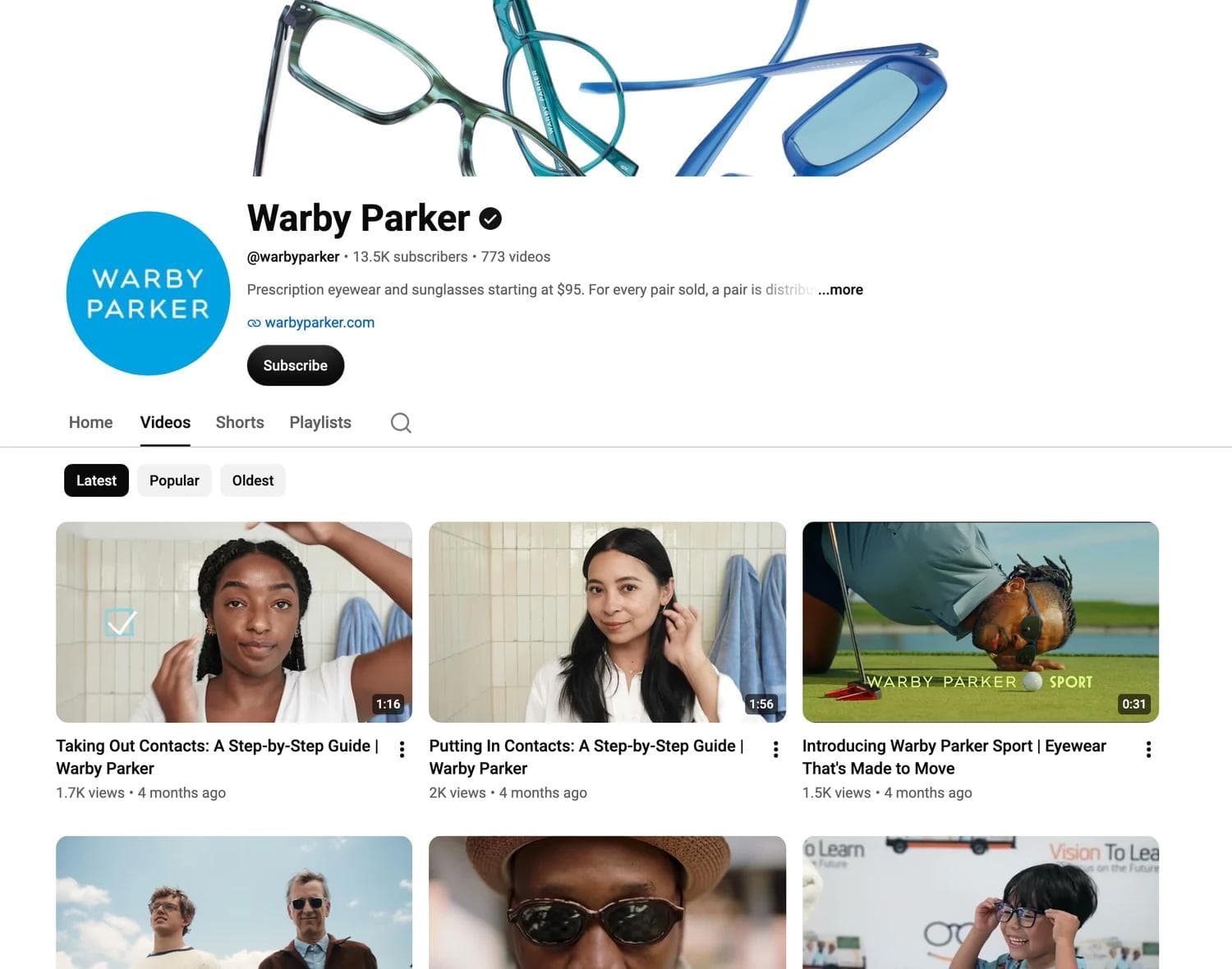
Observed. On the Videos tab, the three newest uploads are dated four months before capture, with 1.7K, 2K, and 1.5K views. Scrolling further, most of the catalogue sits in the hundreds to low thousands, with two outliers: a spot featuring Arch Manning at 1.9M views and another at 1.1M, both a year or two old.
I cannot see why those two are three orders of magnitude above their neighbours. Promotion, distribution, and organic pickup are indistinguishable from outside. That gap is a question for whoever owns the channel, not a finding.
Observed. The Shorts tab tells a different story from the Videos tab. Its top item carries copy that also appears on the brand's Threads account dated four days before capture, which suggests the Shorts shelf is current. YouTube does not print upload dates in the Shorts grid, so I could not confirm the dates directly.

Observed. Shorts titles are social captions moved across unchanged: "Some of you have been waiting", "Lens tints, as seen outside." Two adjacent Shorts carry the identical truncated title, showing 169 and 1K views. On the Videos tab the same pattern is older and worse: a clip titled with a hashtag heavy caption fragment about a casting call sits at 914 views, a few rows from a properly titled video out of the same campaign, "Emma Chamberlain Casts Her First Warby Parker Photo Shoot", at 3.5K views.
Observed. The playlist shelf holds fifteen playlists, and several of them are the strongest thing on the channel: "An Optometrist Explains" (5 videos), "An Optometrist Debunks" (3), "FAQ" (18), "How Warby Parker Glasses are Made" (5). The shelf opens with a one video playlist called "Creative Focus".
Interpretation, clearly labelled as mine. This channel is not neglected. It is mislabelled. The evergreen library, including titles like "Putting In Contacts: A Step-by-Step Guide", answers questions people type into YouTube on purpose, and it is buried behind a Videos tab that reads as four months dormant and a Shorts shelf whose titles were written for a feed where nobody searches.
Recommendations. Retitle Shorts for search rather than pasting the caption. Resolve the duplicate title pair. Reorder the playlist shelf so the optometrist and FAQ sets lead instead of a single video playlist. None of this needs new footage.
Audit 2: Chobani on Threads
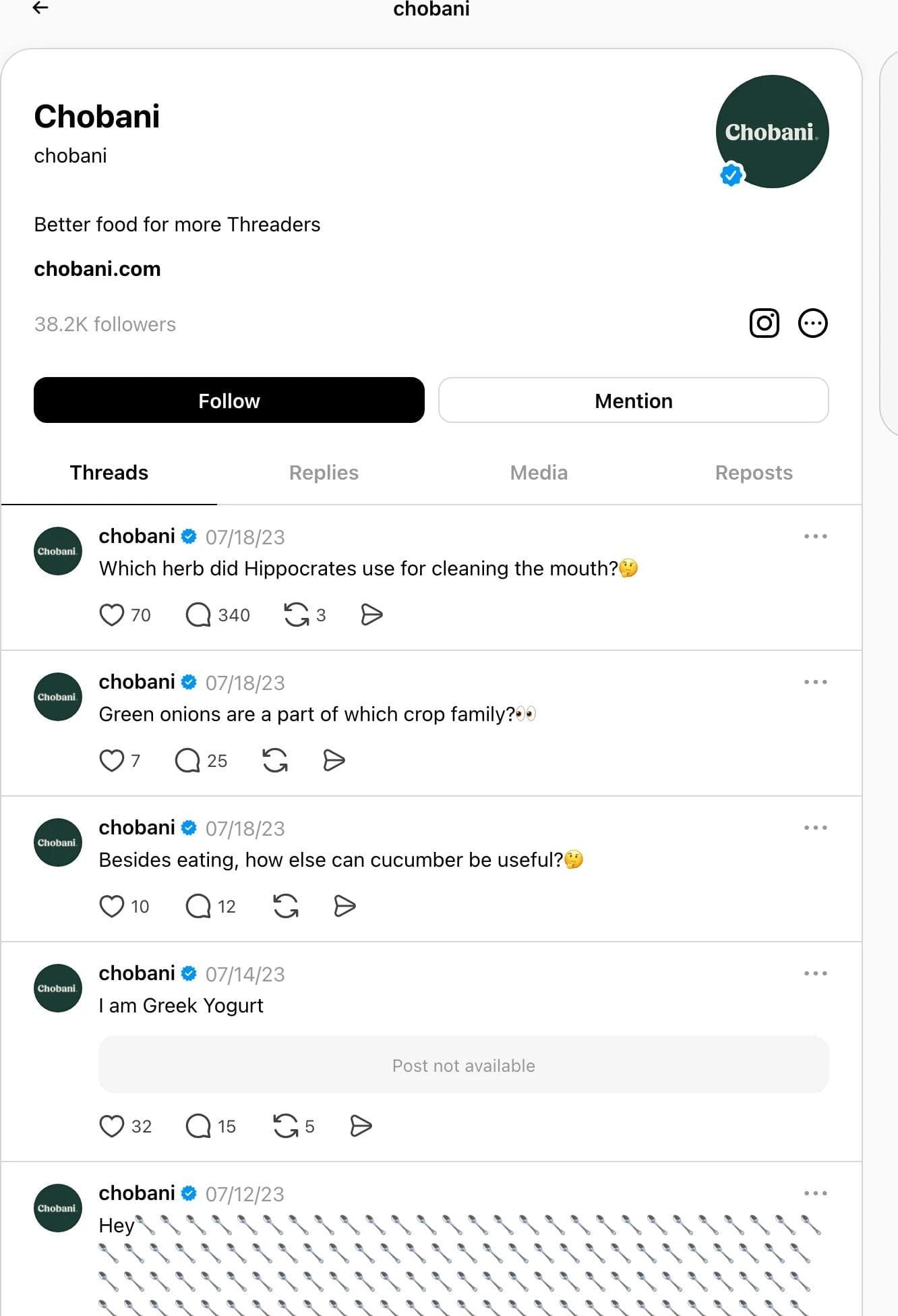
Observed. Verified, 38.2K followers, linked to chobani.com, cross linked to Instagram. The bio reads "Better food for more Threaders", a platform specific rewrite of the brand's usual line. The newest post on the profile is dated 07/18/23. Three posts share that date, all trivia questions; the top one displays 70 likes, 340 replies, and 3 reposts. A post from 07/14/23 renders in the feed as "Post not available".
Interpretation. The launch content was well judged. A reply count roughly five times the like count is the shape of a question people actually answered, which is what the trivia format was for. Then it stopped, more than three years before capture, while the account stayed verified, discoverable, and linked from Instagram.
I cannot see whether this was a deliberate retirement, whether mentions and DMs are still monitored, or what the follower count has done since. Those all need account access.
Recommendations. A dormant verified account with 38.2K followers is a support surface as much as a marketing one, because people will still tag it and message it. Pick one: resume posting, or leave one pinned post that routes people to the channel you do run. Either way the bio should stop being an in joke about a platform the brand left, because it is currently the funniest thing on a three year old page.
Audit 3: sweetgreen on Pinterest
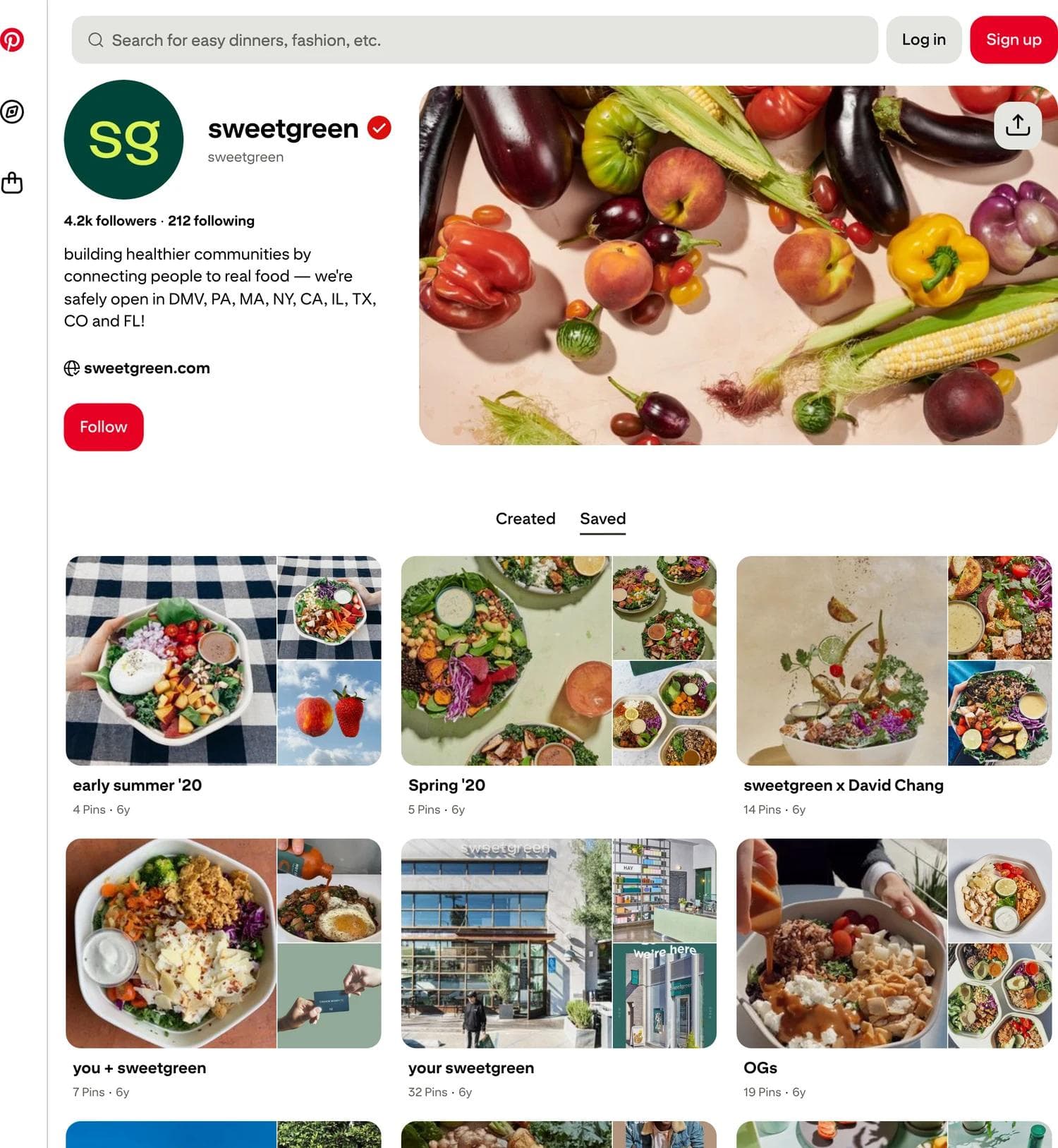
Observed. Verified, 4.2k followers, 212 following. The bio still describes the brand as safely open in a nine item list of states and regions. sweetgreen's own locations page lists more than 25 states and regions. Twenty three boards are visible, every one of them labelled 6y or 7y, with names that stamp their own date: "Fall Menu '19", "Winter is Here '20", "early summer '20", "Late Summer Menu '19".
Interpretation. The board taxonomy is genuinely good. Menu seasons, collaborations, store design, community, product. Pinterest content also ages more slowly than feed content, so a six year old board is not automatically waste. The problem is narrower and more embarrassing than dormancy: the profile copy makes a factual claim about the business that stopped being true years ago, and the board titles date themselves in the one place where old content otherwise passes unnoticed.
I cannot see whether these boards still receive impressions or saves. Pinterest surfaces old pins for a long time, and that would change the recommendation, so it is the first thing to check with account access.
Now the comparison that makes this an audit rather than three reviews. The same brand, on Threads, posted five days before capture, with a current seasonal campaign and a consistent lowercase voice.
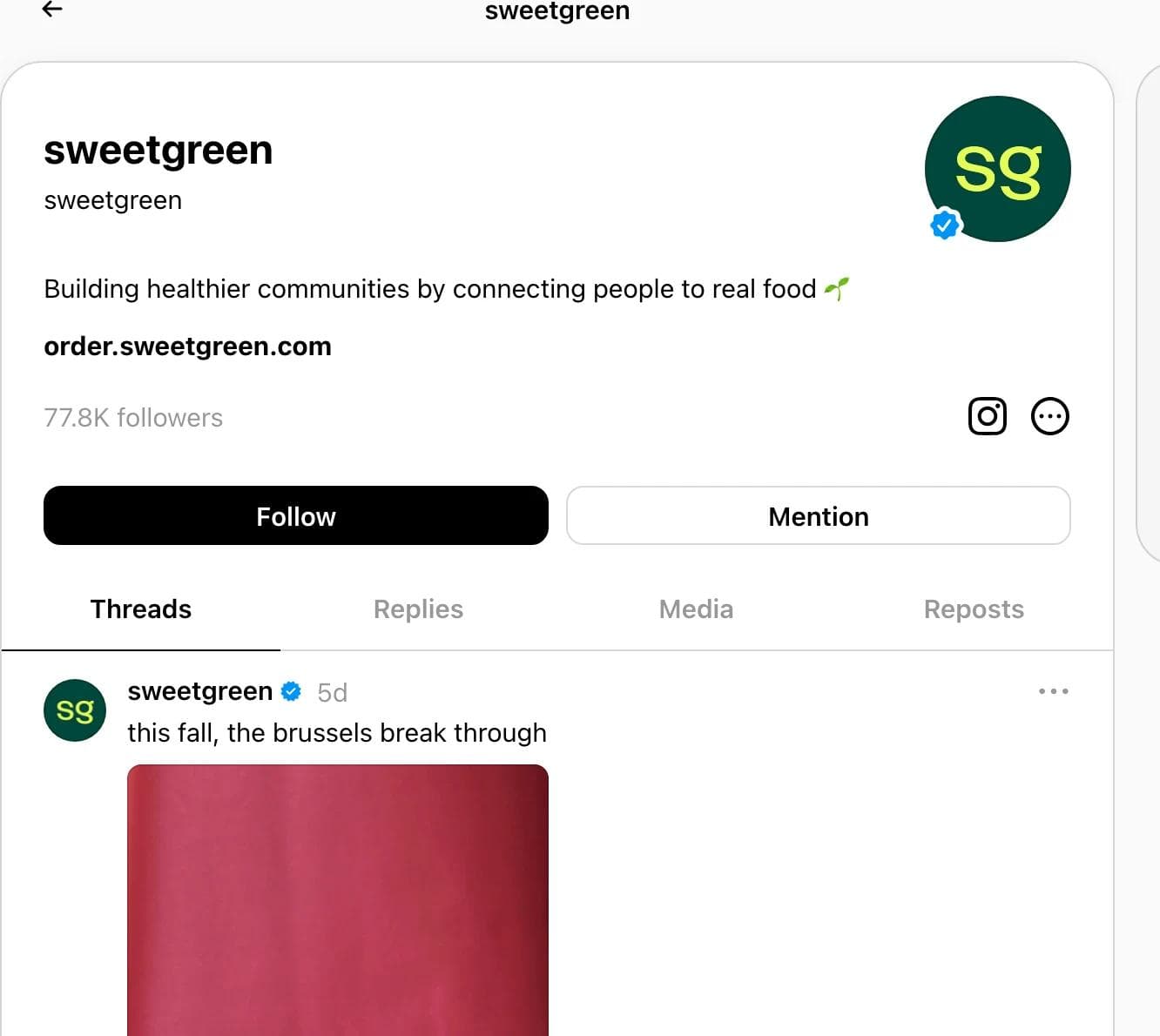
One brand, two channels, six years apart in state of repair. Nobody decided that. It happened because one channel is in somebody's weekly routine and the other is not.
What all three have in common
Three accounts is a small sample, and these are patterns from it rather than laws. They repeated cleanly enough to be worth checking on your own accounts.
1. Every brand had at least one channel in good shape. None of these is a bad social team. The damage is concentrated in the channel nobody looks at, and it is invisible precisely because nobody looks at it. An audit's main job is to make you look at the boring one.
2. Profile copy rots faster than posts. A post is understood to be from its date. A bio is read as a present tense claim about the business, forever. Two of the three bios here carry something that is either out of date or unintentionally funny, and both were free to fix.
3. Repurposing moved the asset but not the metadata. The same short video is a fine Threads post and a weak YouTube Short, because on one platform the caption is the caption and on the other it is the title people search. If you are moving one asset across channels, the repurposing workflow has to include rewriting the title, not just the crop.
4. The tab you manage is not the tab a visitor lands on. Warby Parker's Videos tab and Shorts tab describe two different companies. Check what a stranger sees first, in a signed out window, on every channel.
The deliverable: what an audit report actually looks like
This is the part the ranking guides skip. An audit that lives in a spreadsheet gets read by the person who made it. An audit that changes anything is one page that a manager or a client can act on in five minutes.
Structure it in four blocks.
The verdict, one sentence. Not "here are our findings." Something like: three of five channels are current, YouTube is mislabelled rather than dormant, and Pinterest is publishing a factual error about our footprint.
The channel inventory, one table. Channel, handle, followers, date of last post, and a one word status: current, thin, dormant, or unclaimed. This table is the whole audit for anyone who reads nothing else, and it is entirely buildable from public data.
The findings, each split into three fields. This is the discipline that makes an audit survive disagreement:
| Field | What goes in it | Example |
|---|---|---|
| Observed | A fact, with a date and a screenshot | On 8 Sep the Pinterest bio names nine states; the locations page lists more than 25 |
| Interpretation | Your judgment, labelled as judgment | This reads as abandoned to anyone who checks |
| Recommendation | One action, one owner, one effort estimate | Rewrite the bio. Social lead. 10 minutes |
Keep those three in separate columns, not blended into a paragraph. If your boss disputes the recommendation, the observation is still true, and the conversation stays about what to do rather than about whether you are right.
What we could not see. Write this list down and put it in the report. Reach, growth, demographics, click through, conversions, paid split. It sets the boundary of the audit, and it is also your access request: the rows you cannot fill are the logins you need.
Two more rules that keep an audit presentable. Date every observation, because a social profile can change the week after you write it and an undated claim is unfalsifiable. And end with two or three decision asks, not twenty findings. An audit with twenty equal priorities is a list, not a recommendation.
The rubric
Run this on your own accounts. It is split honestly: the first table is everything I could fill from a signed out browser, the second is everything I could not, and you can.
Rows you can fill in an afternoon with no logins
| Check | What good looks like |
|---|---|
| Profile completeness | Name, handle, avatar, banner, category and verification all present and current |
| Bio accuracy | No claim that has since become false, and no date stamped language |
| Link destination | Resolves, goes somewhere current, matches this channel's job |
| Handle consistency | The same handle across platforms, or a documented reason it differs |
| Recency | Date of the most recent post on every channel you own, including the ones you forgot |
| Cadence | Number of posts in the last 90 days, and the longest gap in them |
| Format mix | Static, carousel, video, short and story equivalent in a deliberate proportion |
| Titles and captions | Written for the platform they are on, with no accidental duplicates |
| Visual consistency | The grid, shelf or board reads as one brand from a distance |
| Organization | Playlists, highlights, boards and pinned posts are current and ordered on purpose |
| Public engagement counts | Displayed likes, replies and views on recent posts, recorded as displayed counts |
| Unclaimed or impostor accounts | Your brand name searched on every platform, including ones you do not use |
Rows that need the account access you have and I did not
| Check | What you are looking for |
|---|---|
| Reach and impressions | The trend over the period, per channel, not a single headline number |
| Follower growth and churn | Gross adds and losses, not just the net figure the public sees |
| Audience demographics | Who is actually there, against who you thought you were targeting |
| Click through and outbound traffic | Sessions attributed to social, split by channel |
| Posting time performance | When your audience is actually present |
| Paid versus organic split | Which results on a given post were bought |
| Conversions | Signups, orders or leads, and which channel preceded them |
| Inbound messages and response time | Message volume, and how long people wait for an answer |
Twelve of the twenty rows need nothing but a browser and a screenshot folder. That is a real audit, and in all three accounts above it is where the fixable problems were.
Two scope notes. This rubric covers organic accounts. Paid creative is a different audit with different evidence, and if you want to see what that looks like from public data, our teardown of live Instagram Stories ads works from the Meta Ad Library. And it covers channels you own; competitor benchmarking uses the same signed out half of this table applied to somebody else.
Tools, honestly
For the access required half of the rubric, the native analytics tab in each platform is free and covers most of it for a single brand. If you manage several channels or have to produce this on a schedule, Sprout Social, Hootsuite, and Buffer all make genuinely good audit tooling and publish genuinely good templates with theirs. Sprout's guide is the most thorough of the ones I read and its spreadsheet is a reasonable starting shape for the inventory table. Use them. They are the right answer for the measurement half, and they are the right answer for cross channel reporting.
Nothing in this article replaces them.
Where Moda fits, and where it does not
Moda is relevant at exactly one point in this workflow: after the audit, when findings become assets. Some of what you found is a text edit you make inside the platform in ten minutes. Some of it is not: a set of channel banners at the correct size for four platforms, a refreshed set of highlight or board covers, or the deck you have to present the audit in. Moda is an AI design tool where an agent builds those on a real editable canvas, applies a brand kit, and exports to PDF or PowerPoint, which matters when the audit is going to a client.
Being plain about the boundary: Moda has no analytics and no reporting features, does not connect to social accounts, and does not schedule or publish anything. It cannot tell you your reach and it cannot run the audit. Every row in the right hand column above belongs to the platforms or to the tools named in the previous section. And if what you need is the creative itself rather than the presentation of it, our comparison of AI social media post generators is the more useful page, because the four categories in that market return four very different files.
FAQ
Social media audit questions
How often should I run a social media audit?
Quarterly is the common recommendation and it is a reasonable default. The signed out half of the rubric above is cheap enough to run monthly on your own profiles, and the profile rot in all three accounts here is exactly the kind of thing a monthly ten minute pass would have caught.
Can I audit a competitor?
Yes, and you already know how much: the twelve signed out rows, and nothing below them. Any competitor audit claiming to know a rival's reach, conversion, or paid split is either estimating or using a third party panel, and the report should say which.
What is the difference between a social media audit and a social media strategy?
An audit is a dated description of what is true now. A strategy is a decision about what to do next. Auditors get into trouble when they blend the two, which is why the report structure above keeps observation, interpretation, and recommendation in separate columns.
Do I need a tool to run one?
Not for the signed out half. A browser, a spreadsheet, and a screenshot folder are enough, and dated screenshots are what make findings defensible weeks later. You need a tool, or platform analytics, for the access required half.

Real editable visuals. Real canvas. Full control.
Fly through design work