HeyGen Alternatives: 9 AI Video Tools Compared by the Job They Do (2026)
Compare 9 HeyGen alternatives for training video, UGC ads, API volume, real-footage editing, and self-hosted lip sync. Pricing verified on each vendor's page, September 2026.
 Anvisha Pai, Co-founder & CEO, Moda
The best HeyGen alternative depends on which part of HeyGen you are replacing. For presenter-led training and internal video, start with Synthesia or Colossyan. For UGC-style ads, start with Creatify or Arcads. For cheap volume, photo avatars, or an API inside your own product, start with D-ID. If your videos are real footage of a real person, Captions replaces a different part of the job than any avatar studio does.
This guide is not written by an avatar vendor. Every page that ranks for "HeyGen alternatives" today is published by a company that puts itself first, and several of them carry pricing that is a year out of date. We build a design tool, not an avatar product, so the shortlist below has no home team. Every plan, minute allowance, and feature gate was read on the vendor's own pricing page on September 3, 2026.
Why people use HeyGen, and what a replacement must preserve
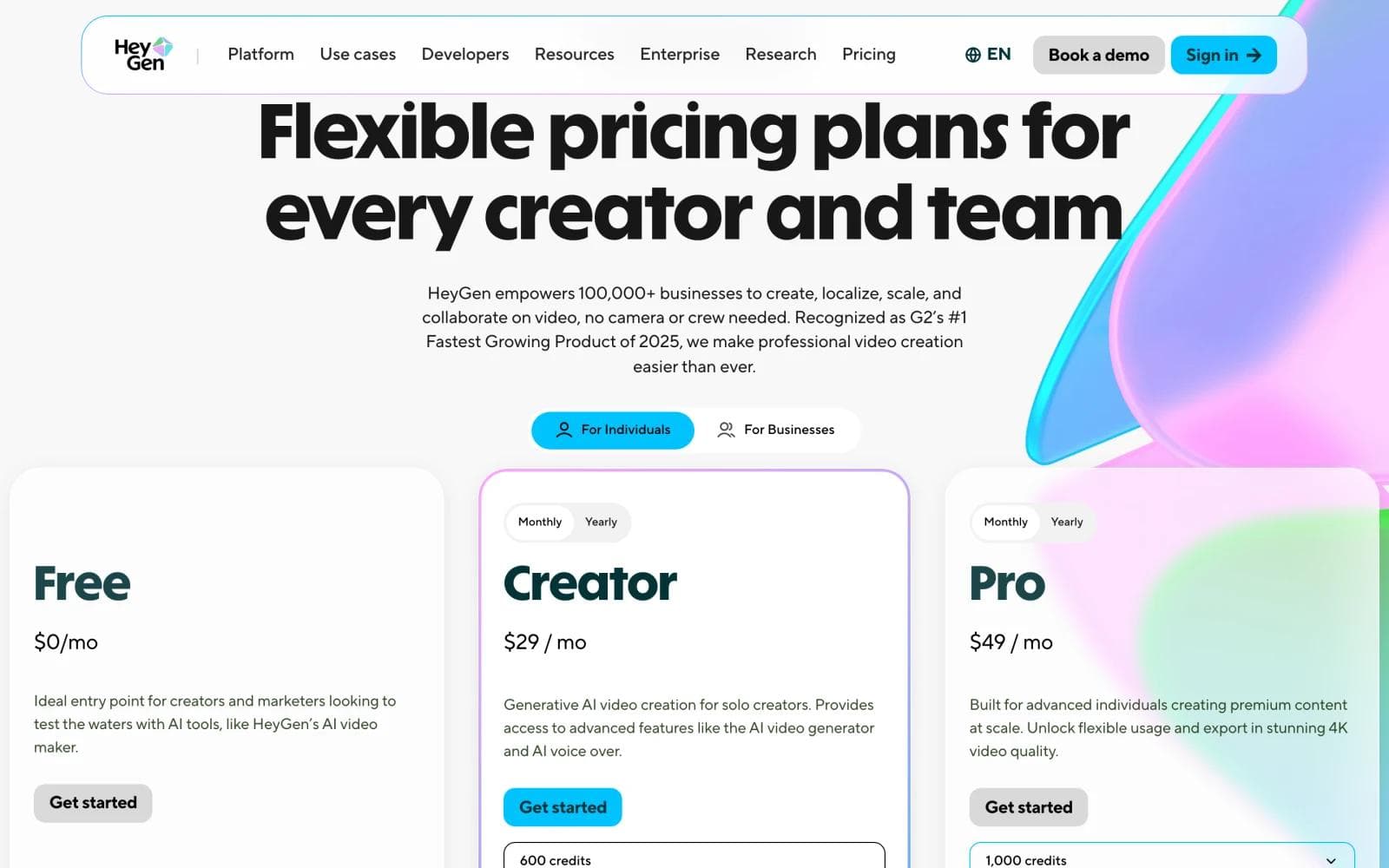
HeyGen is a script-to-video studio built around a strong avatar engine. On its current pricing page, the Free plan gives three videos a month of up to one minute with access to Avatar IV and 500+ stock avatars. Creator is $29 a month ($24 billed yearly) for 600 credits, videos up to 30 minutes, 1080p export, unlimited photo avatars, voice cloning, and translation across 175+ languages and dialects. Pro is $49 for 1,000 credits and 4K, with tiers that run to 100,000 credits at $4,300 a month. Business is $149 a month plus $20 per additional seat, and it is the first plan with SAML/SSO, interactive video, SCORM export, LMS integrations, and n8n, Make, HubSpot, and Zapier integrations. HeyGen pricing
Three things keep serious users on HeyGen, and a replacement has to match them:
- The avatar engine. Avatar IV, photo avatars, custom video avatars, and gesture control are the reason most people signed up. A replacement with a weaker engine has to win on something else.
- Translation with lip sync. Upload a file or paste a YouTube link, get a dubbed version with matched lips in 175+ languages, with a brand glossary and proofreading on Pro and above. Few competitors cover the same breadth from one product.
- The API and agent surface. HeyGen sells a separate pay-as-you-go API wallet from $5, plus an MCP server and agent Skills, with video generation, translation, text to speech, and a Video Agent endpoint. API usage bills from a balance that is separate from the web plan's credits. HeyGen API pricing
The usual reasons people leave are just as specific. Credits are HeyGen's single currency and, by its own FAQ, the cost of a video "can vary based on which AI model is used, video duration, and the complexity," so a plan's minute output is hard to predict. SCORM, interactive video, and SSO live on the $149 Business tier. And an avatar reading a script is the wrong format for a product walkthrough, which is why several of the pages ranking for this query are screen-recording tools.
The five layers you might be replacing
Avatar products are bundles. Decide which of these layers you need before reading the shortlist:
- Avatar generation. The model that turns a script or audio into a moving, speaking presenter. This is where realism, gestures, and lip sync live.
- The studio. Templates, brand kits, PowerPoint or PDF import, a screen recorder, and a scene editor. This is the layer that decides how long a video takes to make and revise.
- Voice, translation, and dubbing. Stock voices, cloning, one-click translation of a finished video, and dubbing of footage made elsewhere.
- Delivery. SCORM export, LMS integrations, quizzes and branching, share pages, and analytics. Training teams live here.
- API and automation. Programmatic generation, per-minute or per-credit billing separate from seats, and agent integrations.
HeyGen alternatives at a glance
| Tool | Job it fits | Avatar engine | Studio | Translation | API | Pricing basis (read 2026-09-03) |
|---|---|---|---|---|---|---|
| Synthesia | Enterprise training and comms | Stock, personal, and studio avatars | Slide-style editor, templates, PPT import, screen recorder | 160+ languages; dubbing metered with video minutes | From Creator, 360 min/yr | $14/mo yearly ($19 monthly) for 10 min/mo; Creator $59/mo yearly for 30 min/mo |
| Colossyan | Training with SCORM without an enterprise contract | NEO and NEO2 models; 300+ stock, 15 to 20 custom | Course builder, PPT/PDF import, screen recorder | 120+ languages; 15 to 20 auto-translations/mo | From Professional, 360 min/yr | Free 20 min/mo; Professional $59/mo yearly, $30 per extra editor, 30 NEO + 10 NEO2 min/mo |
| D-ID | Cheap volume, photo avatars, agents, API | Photo and video avatars, V4 Expressive | Lighter studio; videos up to 30 min | 120+ languages; Video Translate shares the minute pool | On every plan, including trial | Lite $4.70/mo yearly for about 10 min; Pro $16 yearly ($29 monthly) for about 15 min |
| Elai | Deck and document to video | 80+ stock avatars; selfie and studio avatars as add-ons | PPT, URL, and doc to video, screen recorder, storyboard | 75+ languages, automatic translation | From Creator | Creator $29/mo for 15 min ($1.93/min); Team $125 for 50 min; add-ons $199 to $500/yr |
| Creatify | UGC-style ads from a product URL | 300 to 1,500 AI actors, 3 custom avatars on Pro | Ad templates, batch mode, Ad Flow, launch to Meta, TikTok, AppLovin | 75+ languages | Separate API plans | Starter $39/mo for 100 credits; Pro $99 for 300 credits, tiers to 5,000 |
| Arcads | High-volume actor-led ads with several video models | 1,000+ AI actors or your own avatar | Presets, UGC Studio, Create Workflow canvas | Translate-video tool | AI video API page | Not published on the marketing site; shown after sign-in |
| Captions | Real footage edited by AI, plus a digital twin | AI Twin and AI actors | AI Edit styles, chat-based editor, clips | 100+ languages, AI Lipdub | Not on the pricing page | Max $24.99/mo for 500 credits; Scale $69.99 for 1,400; prices reflect iOS plans |
| Runway | Generated scenes, lip sync, and edits to existing footage | Not an avatar studio; lip sync with custom voices on Pro | Edit Studio (Aleph 2.0), Gen-4.5 | Text to speech and lip sync, not dubbing workflows | Separate Runway Dev plans | Standard $12/mo yearly ($15 monthly) for 625 credits; Gen-4.5 is 60 credits per 5 s |
| LatentSync (open source) | Self-hosted lip sync on your own footage | Diffusion lip-sync model, no presenter library | None; command line and Gradio demo | None built in | Your own | Apache 2.0; your GPU time |
List prices for one editor; minute figures are each vendor's own conversion, not our measurement of output.
What an included minute costs
Four of the studios above meter video minutes directly, which makes their entry paid plans comparable. HeyGen is missing from this chart on purpose: its credits convert to minutes at a rate that depends on the model, so a per-minute figure would be a guess.
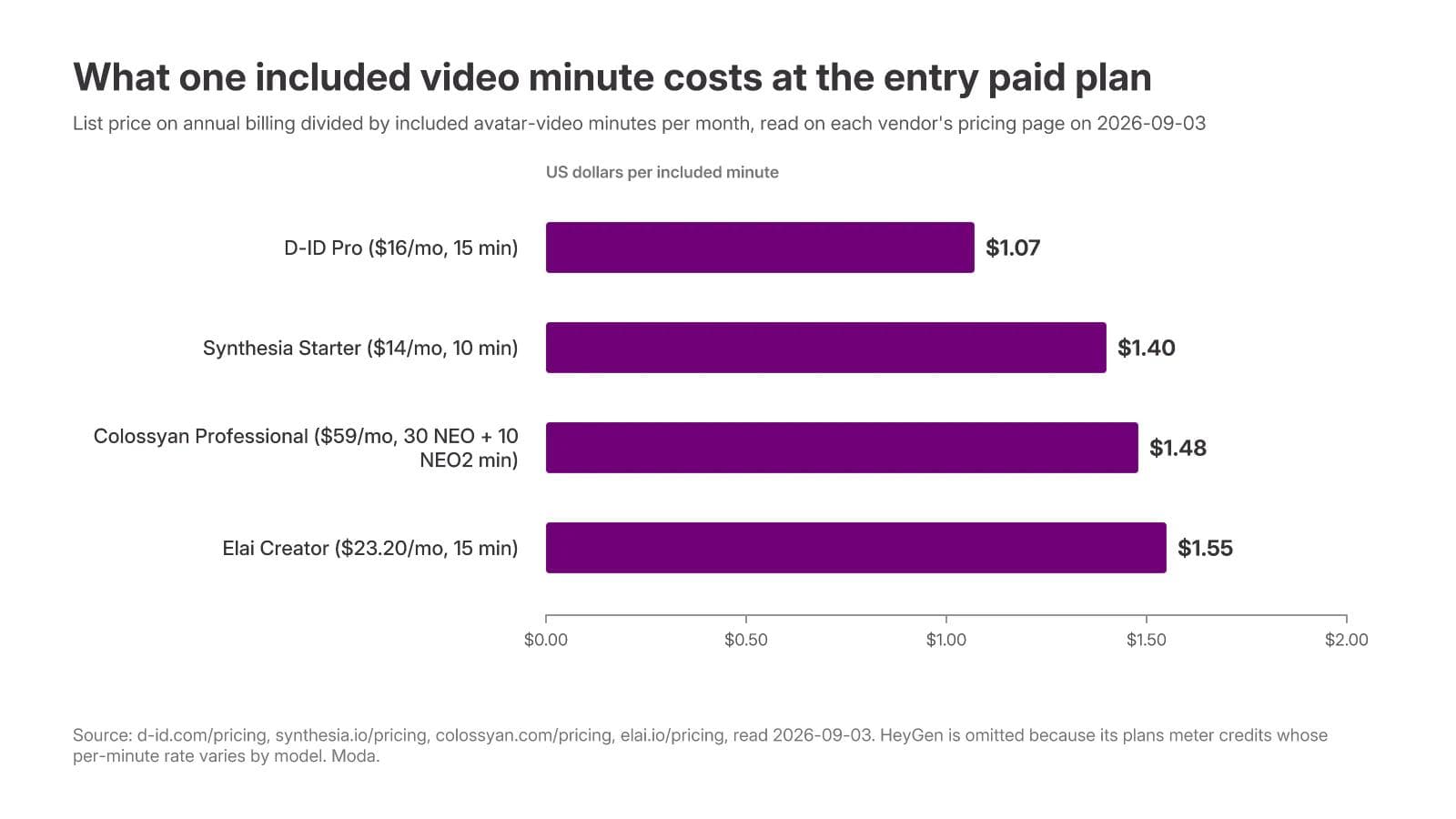
The spread is narrow, about $1.07 to $1.55 per minute, so the entry price will rarely decide this. What varies more is what happens after the first render. Synthesia's FAQ says an edit only charges the new seconds. Colossyan and Synthesia both say unused minutes do not roll over, while HeyGen rolls monthly credits over for one extra month and lets annual subscribers accumulate them. Match the rule to how you work: heavy revisers care about edit charging, bursty producers care about rollover.
Presenter-led training and internal video
1. Synthesia: the closest direct replacement, priced by the minute
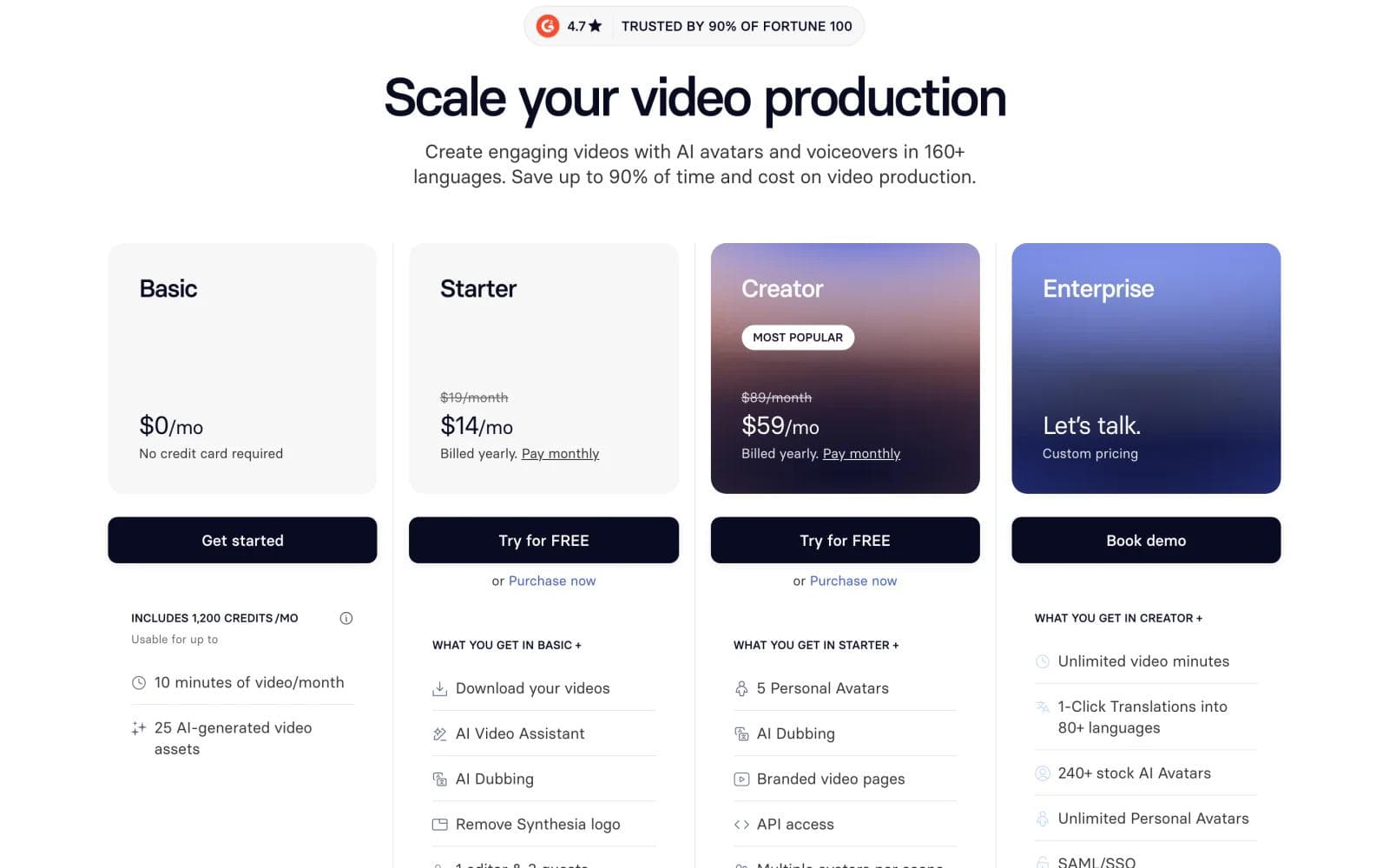
Synthesia's current pricing page lists a free Basic plan with 1,200 credits a month, usable for about 10 minutes of video and 25 AI-generated assets. Starter is $19 a month, or $14 billed yearly, for 120 minutes a year, with 125+ avatars, three personal avatars, AI dubbing, and video downloads. Creator is $89, or $59 yearly, for 360 minutes a year, five personal avatars, API access, interactive videos, and multiple avatars per scene. Enterprise adds unlimited minutes, 240+ stock avatars, SCORM export, SAML/SSO, brand kits, and one-click translation into 80+ languages. Synthesia pricing
Choose Synthesia if you want a slide-style editor, a brand kit, screen recording, PowerPoint import, and multilingual delivery in one governed workspace, and you are willing to pay by the minute for the predictability.
The purchase check is the minute budget. 360 minutes a year on Creator is 30 minutes a month, and dubbing draws from the same pool. Two claims that circulate on competitor pages did not hold up on the live page today: SCORM export is still marked Enterprise-only in Synthesia's comparison table, and the API on Creator is capped at the plan's own minutes rather than sold separately. Studio avatars are a $1,000-a-year add-on on every self-serve tier.
2. Colossyan: SCORM and courses at a small-team price
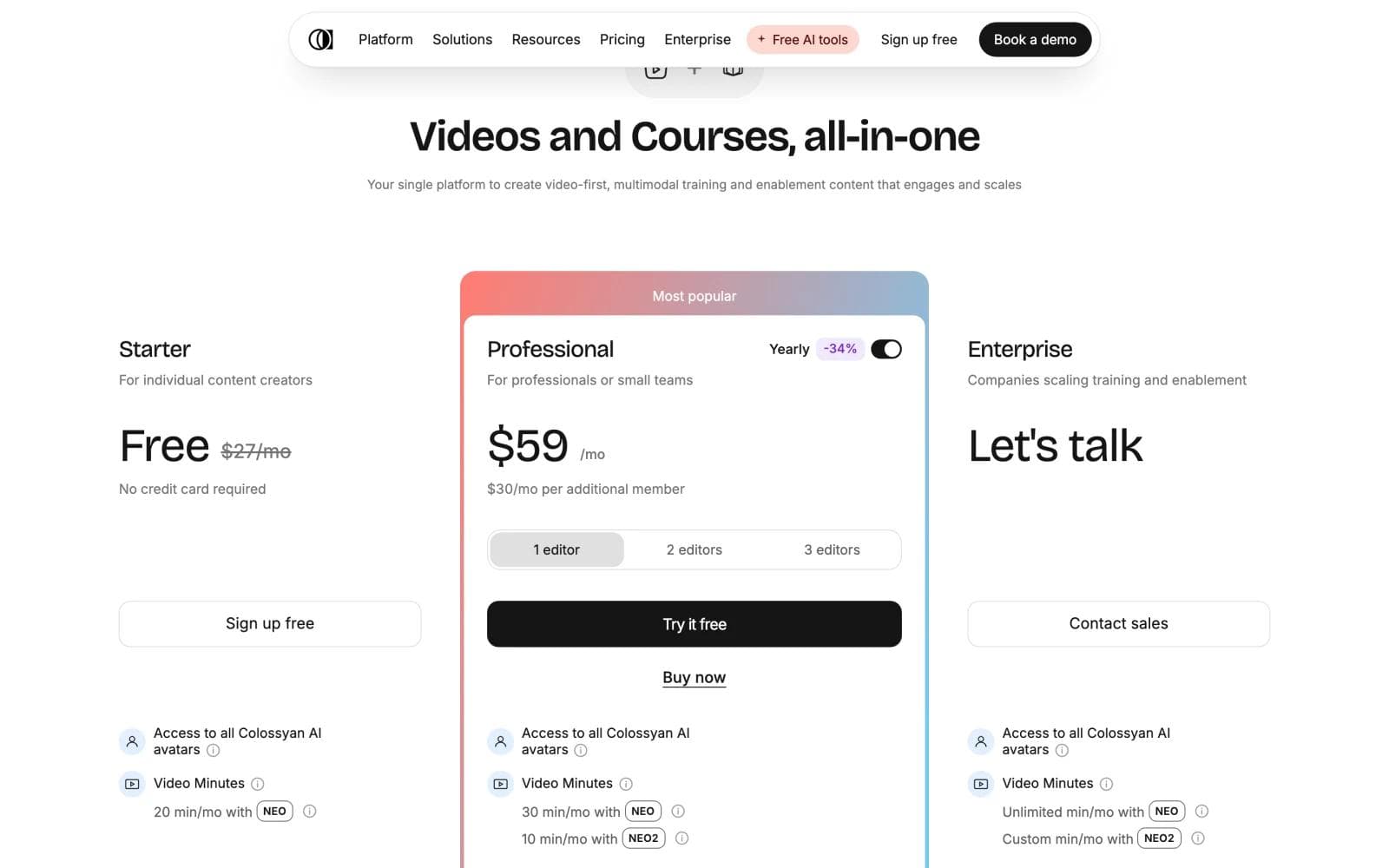
Colossyan has moved from "avatar video" to "videos and courses." Its free Starter plan is unusually complete: 20 minutes a month on the NEO model, 15 custom avatars and 3 cloned voices, brand kits, 10 interactive videos and 15 auto-translations a month, and unlimited course creation. Professional is $59 a month on the yearly plan for one editor, $30 a month for each additional editor up to three, with 30 NEO minutes and 10 NEO2 minutes a month, watermark removal, and five SCORM exports a month. Enterprise removes the caps, adds unlimited SCORM in streaming and self-contained formats, completion analytics, SSO, and EU or US data residency. Colossyan pricing
Choose Colossyan if the deliverable lands in an LMS and your budget does not stretch to an enterprise contract. It is the only tool in this list where a $59 plan includes SCORM, and its pricing FAQ says it does not train models on customer content and offers migration help from Synthesia and HeyGen on Enterprise.
The purchase check is the two-model split. NEO2 is the newer model and Professional includes only 10 minutes of it a month; extra NEO2 minutes are sold as a $1,500-a-year pack of 600. If the newer model is the reason you are switching, price your real volume against that pack, not the headline 30 minutes.
3. Elai: turning decks and documents into narrated video
Elai, now labelled "powered by Panopto" on its own site, is the straightforward deck-to-video option. The free plan is one minute. Creator is $29 a month for 15 minutes, which the page itself prices at $1.93 a minute, with 1080p export and the full avatar, voice, and language library. Team is $125 a month for 50 minutes, three editors and three guests, 4K, premium voices, custom fonts, and a brand kit. Annual billing takes 20 percent off. Custom likeness is an add-on: a selfie avatar is $199 a year, voice cloning $200, a studio avatar $500, with one selfie avatar and one voice clone included on Team annual. Elai pricing
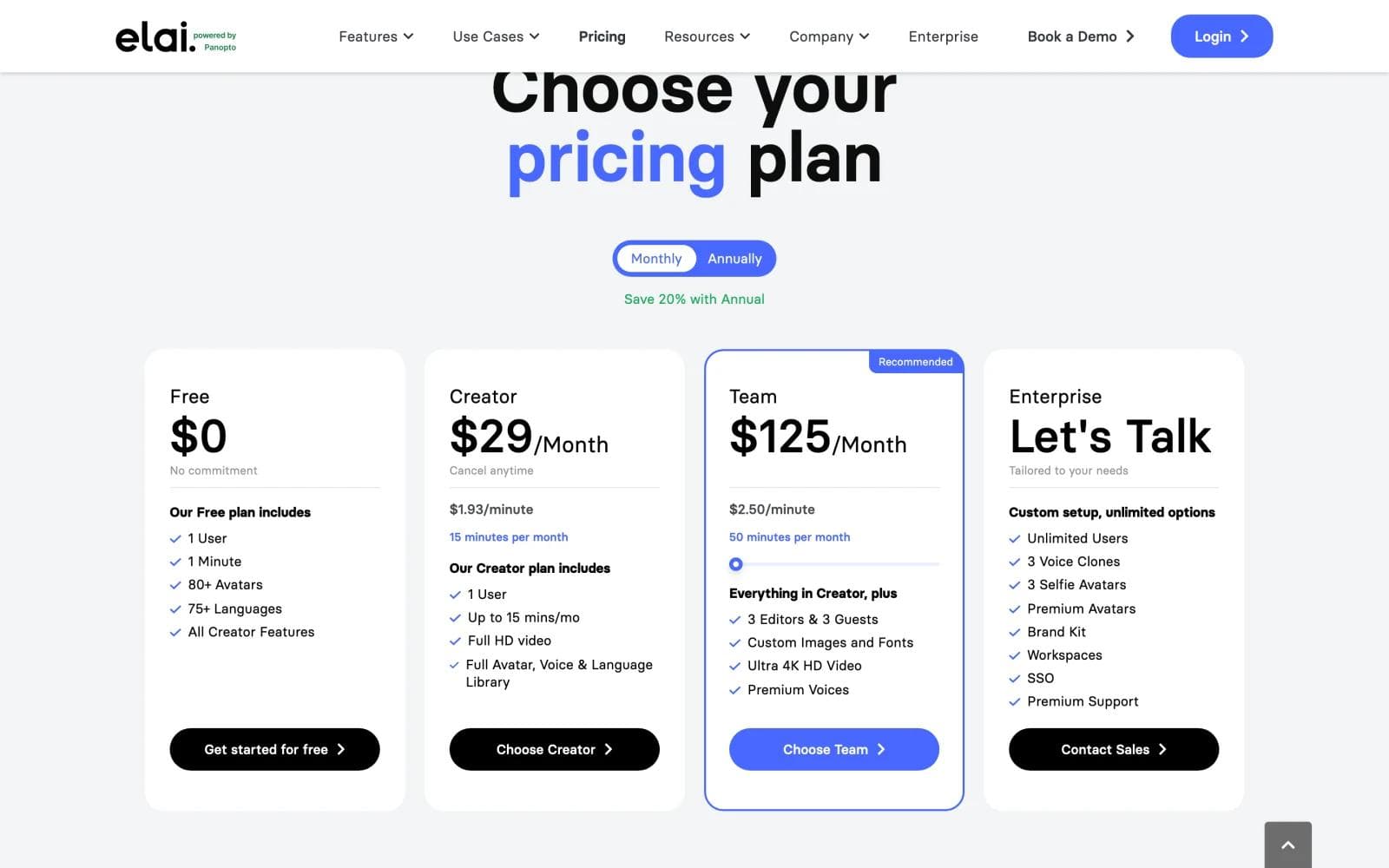
Choose Elai if you have a library of PowerPoints, URLs, or documents to convert and you want interactivity such as branching and quizzes without paying for an enterprise training suite. SCORM export, SSO, and workspaces are Enterprise-only, so LMS delivery on a budget still points to Colossyan.
The purchase check is the add-on bill. A Creator plan with your own face and voice is $29 a month plus $399 a year before you have made a video.
Volume, photo avatars, and an API you can build on
4. D-ID: the lowest entry price and API access on every plan
D-ID animates a photo or a short video into a presenter, and it sells the same minutes to its studio, its conversational Agents, Video Translate, and its API. The trial is 14 days with three minutes. Lite is $4.70 a month billed yearly ($5.90 monthly) for 40 credits, about 10 minutes, with a D-ID watermark. Pro is $16 billed yearly ($29 monthly) for 60 credits, about 15 minutes, with a commercial-use license, three personal avatars, one voice clone, subtitles, and premium voices. Advanced is $108 yearly ($196 monthly) for about 100 minutes. API access is listed on every tier, including the trial, and the site's navigation lists a self-hosting option for enterprise. D-ID pricing
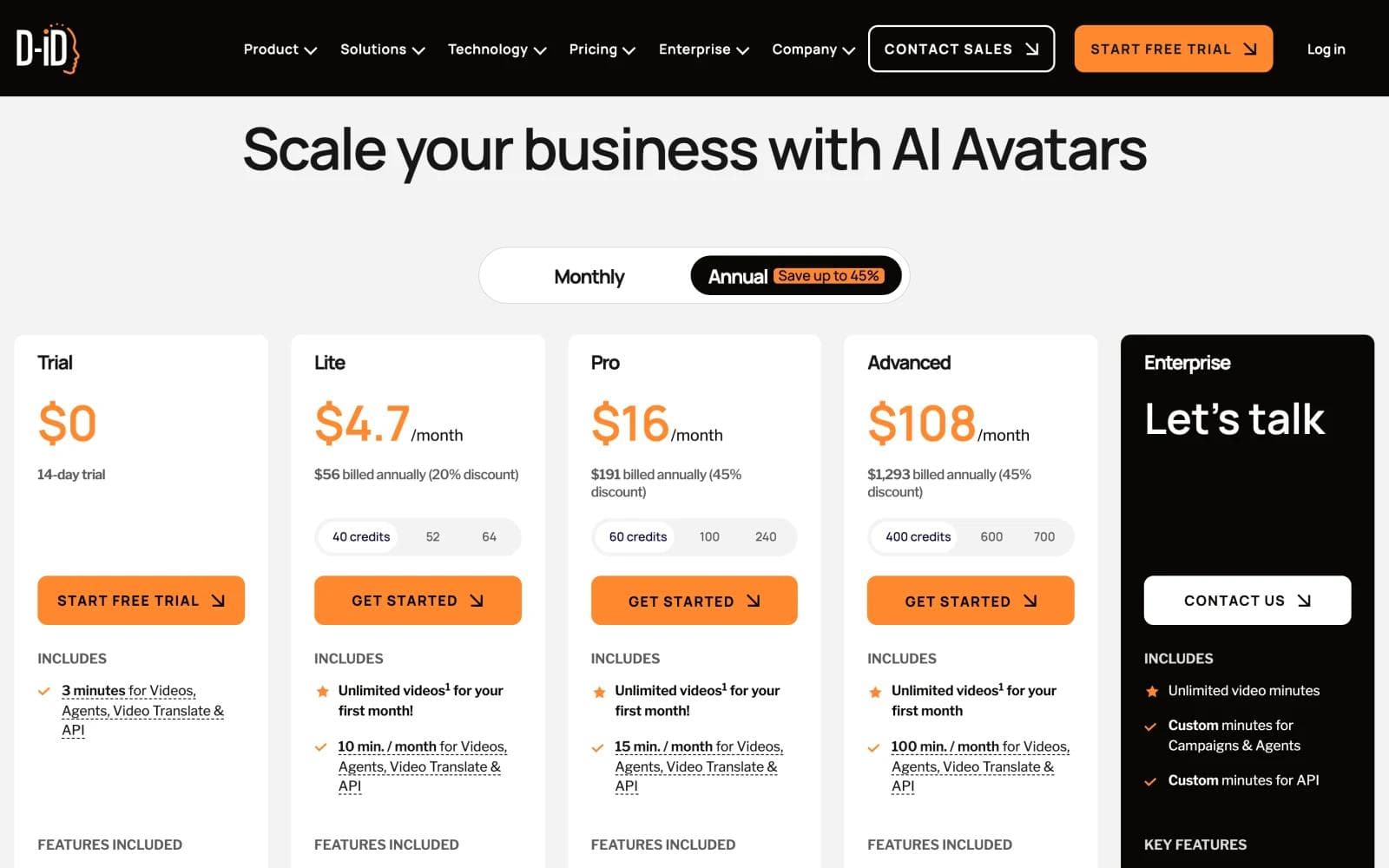
Choose D-ID if you are embedding avatar generation in your own product, you need a real-time conversational agent, or you want many short personalized clips from photos at the lowest list price here.
The purchase check is the license line. Lite is a personal-use license with a watermark; commercial use starts at Pro. And a photo avatar is a different thing from HeyGen's video-trained custom avatar; judge it on your own footage before you migrate a spokesperson.
UGC-style ad creative
5. Creatify: product URL in, ad variants out
Creatify starts from a product page rather than a script. The free plan is 10 credits a month, enough for about two video ads or 20 image ads, watermarked. Starter is $39 a month for 100 credits, 300 AI actors, 200+ ad templates, and videos up to two minutes. Pro is $99 for 300 credits, with usage tiers up to 5,000, 1,500 actors plus three custom avatars, 500+ templates, videos up to 10 minutes, up to five seats, an MCP server for Claude and ChatGPT, a Performance Agent that launches to Meta, Google, TikTok, and AppLovin, and a competitor ad tracker. Annual billing advertises up to 50 percent off. API access is sold as separate plans. Creatify pricing
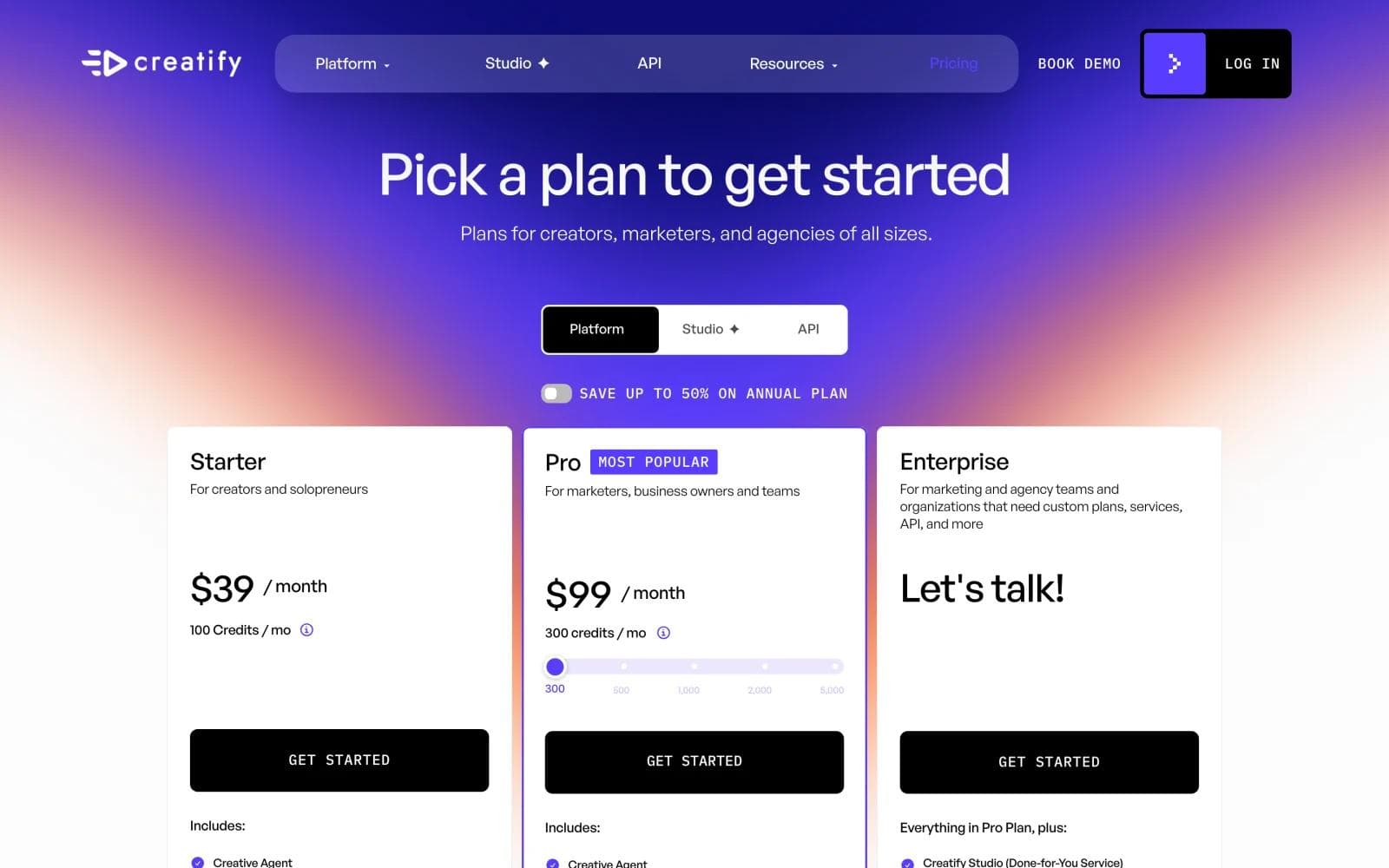
Choose Creatify if the job is testing many direct-response variants and you want the launch and reporting loop in the same tool. Our AI ad generator comparison covers the surrounding static and campaign tools if you need more than presenter clips.
The purchase check is the credit model. Credits are Creatify's currency, not minutes, and its FAQ page explains that revisions count. Run one real ad through the free plan and read the credit ledger before you pick a tier.
6. Arcads: actor variety and a workflow canvas
Arcads leads with a library of 1,000+ AI actors, the option to use your own avatar, and a tool strip that now includes several third-party video and image models (Seedance 2.5, Sora 2 Pro, Kling, and Nano Banana appear on the current homepage) alongside ad-specific operations such as replace actor, translate video, captions, product showcase, and an unboxing format. A new Create Workflow puts those tools on an infinite canvas so a team can build and rerun an ad recipe. Arcads
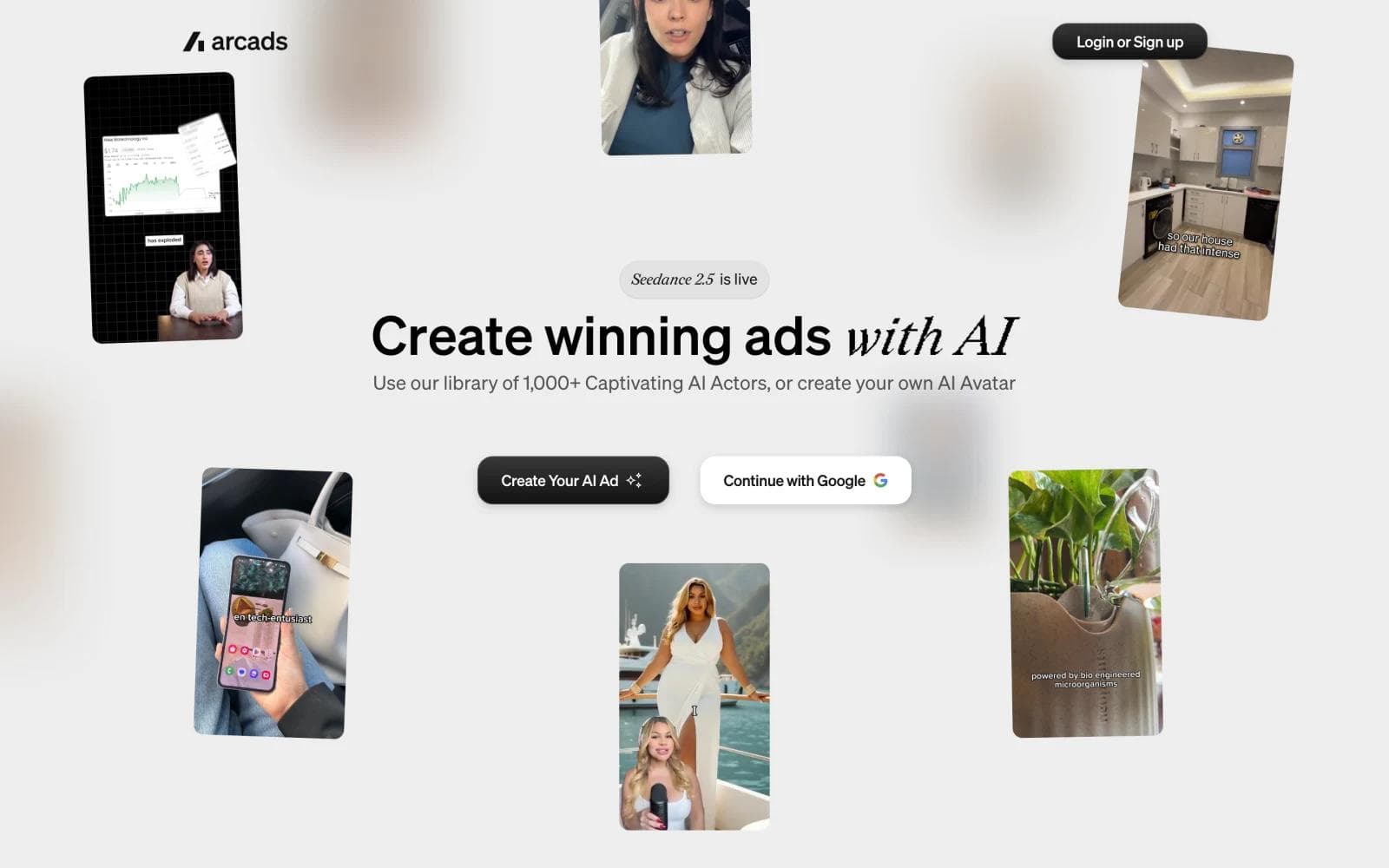
Choose Arcads if you need many different faces and delivery styles for creator-style ads and you would rather compose an ad from model calls than script a corporate presenter.
The purchase check is that pricing is not published on the marketing site. The pricing URL returns a 404 and the app asks you to sign in first, so budget the evaluation time to get a quote in hand.
Creatify or Arcads?
Both make presenter-led ads with synthetic actors and both are far more ad-specific than HeyGen. Creatify's center of gravity is the product URL and the launch loop: paste a listing, get variants, push them to the ad platforms, and read performance in the same place. Arcads' center is the actor library and the model toolbox, with a canvas for repeatable recipes. If your bottleneck is producing and launching volume from a catalog, Creatify. If it is finding the right face, format, and shot for each concept, Arcads.
Real footage with an AI editor
7. Captions: when the presenter is you
Captions is not an avatar studio with an editor attached; it is an editor that also makes AI twins. Its Max plan is $24.99 a month for 500 credits and includes AI Edit styles, a chat-based editor, long-video-to-clips, AI Twin and custom AI actors, and generated B-roll, music, and sound effects. Scale is $69.99 for 1,400 credits with usage multipliers. The free tier keeps the traditional editing tools and captions in 100+ languages. The pricing page notes that features and prices reflect iOS plans. Captions pricing
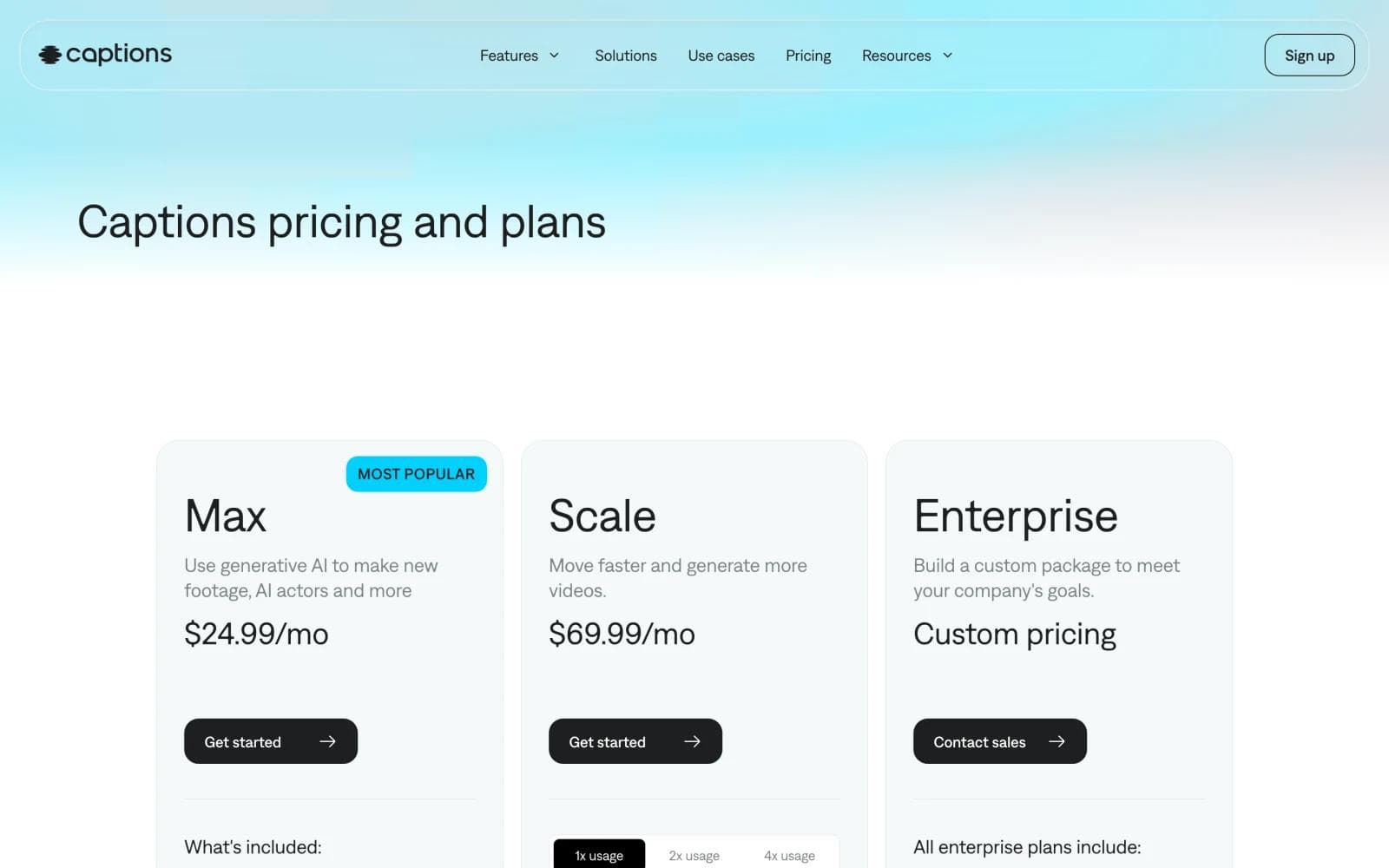
Choose Captions if most of your videos are you or your team on camera and HeyGen was mainly a way to avoid editing. Eye-contact correction, filler removal, AI Lipdub translation, and clip generation replace a different part of the workflow than a stock avatar does.
The purchase check is platform and export. Read the plan on the platform you edit on, and confirm that the subtitle files and aspect ratios you deliver come out of the app. If transcript editing of long recordings is the real job, our Descript alternatives guide compares that lane directly.
When the replacement is not a presenter at all
8. Runway: generated scenes and lip sync on existing footage
Runway is on this list for the reader who realizes the avatar was never the point. Its current plans are a free tier with 125 one-time credits, Standard at $15 a month or $12 yearly for 625 credits, Pro at $35 or $28 for 2,250 credits, and Max at $95 or $76 for 9,500 credits with one month of rollover. Gen-4.5 costs 60 credits per five seconds; the Aleph 2.0 editing model is 140. Pro adds custom voices for lip sync and text to speech. Gen-3 Alpha, still cited on some ranking pages, was retired in July 2026. Runway pricing
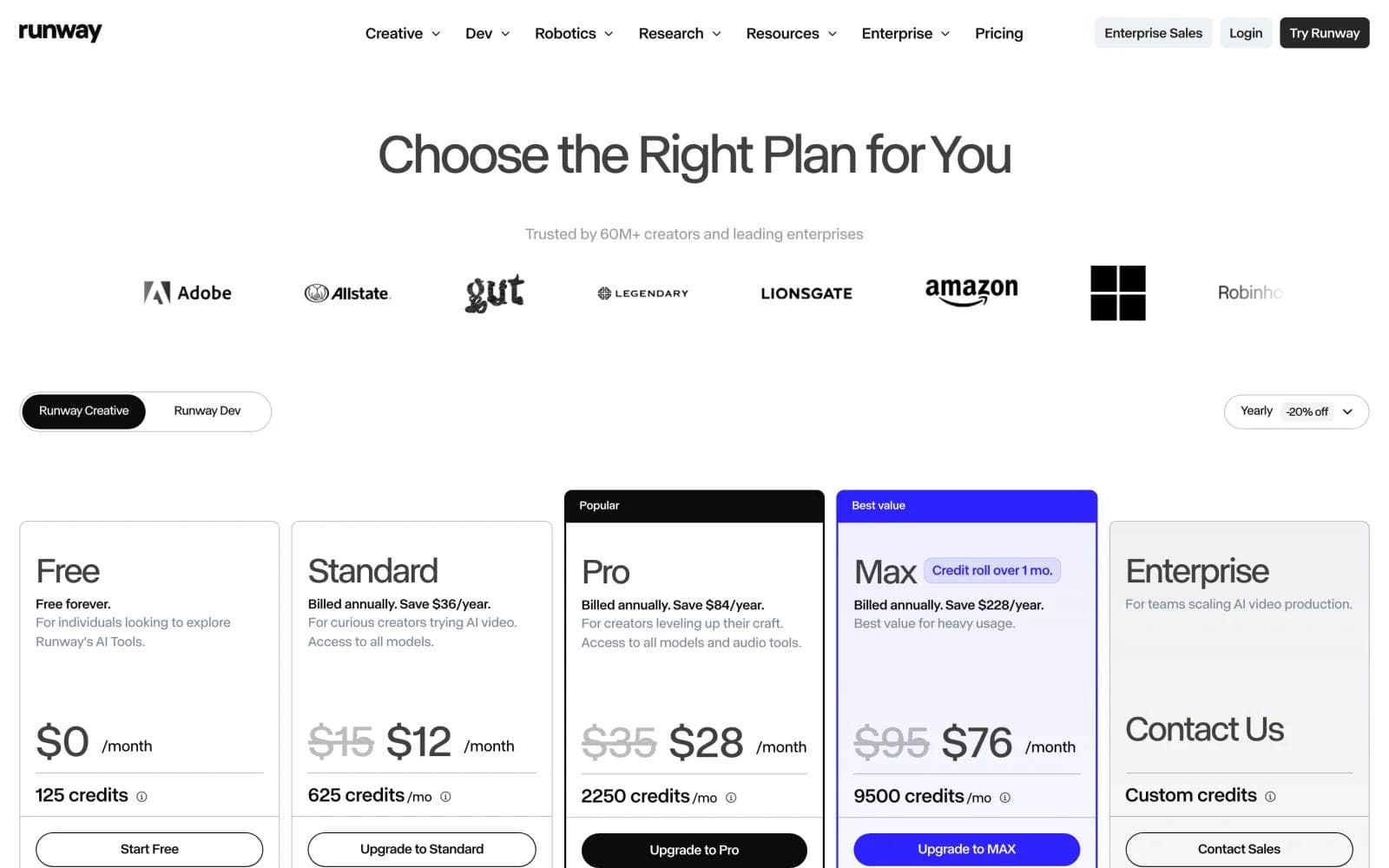
Choose Runway if the deliverable is a product scene, a brand film, or an edit to footage you already shot, and any spoken parts can be lip-synced onto real people or characters rather than delivered by a stock presenter.
The purchase check is the credit arithmetic. 625 credits is 52 seconds of Gen-4.5 a month, so it is a generation budget, not a video-minute budget. For a broader look at that category, see our Higgsfield alternatives guide.
Self-hosted
9. LatentSync: open-source lip sync you run yourself
If the part of HeyGen you rely on is lip sync rather than a presenter library, an open model may cover it. LatentSync, from ByteDance, is a diffusion-based lip-sync model released under the Apache 2.0 license, with about 6,000 GitHub stars, versions 1.5 and 1.6 released in 2025, and a Gradio demo in the repository. It takes a video of a speaking person and new audio and produces matched lips; it does not generate a presenter from a script. LatentSync on GitHub
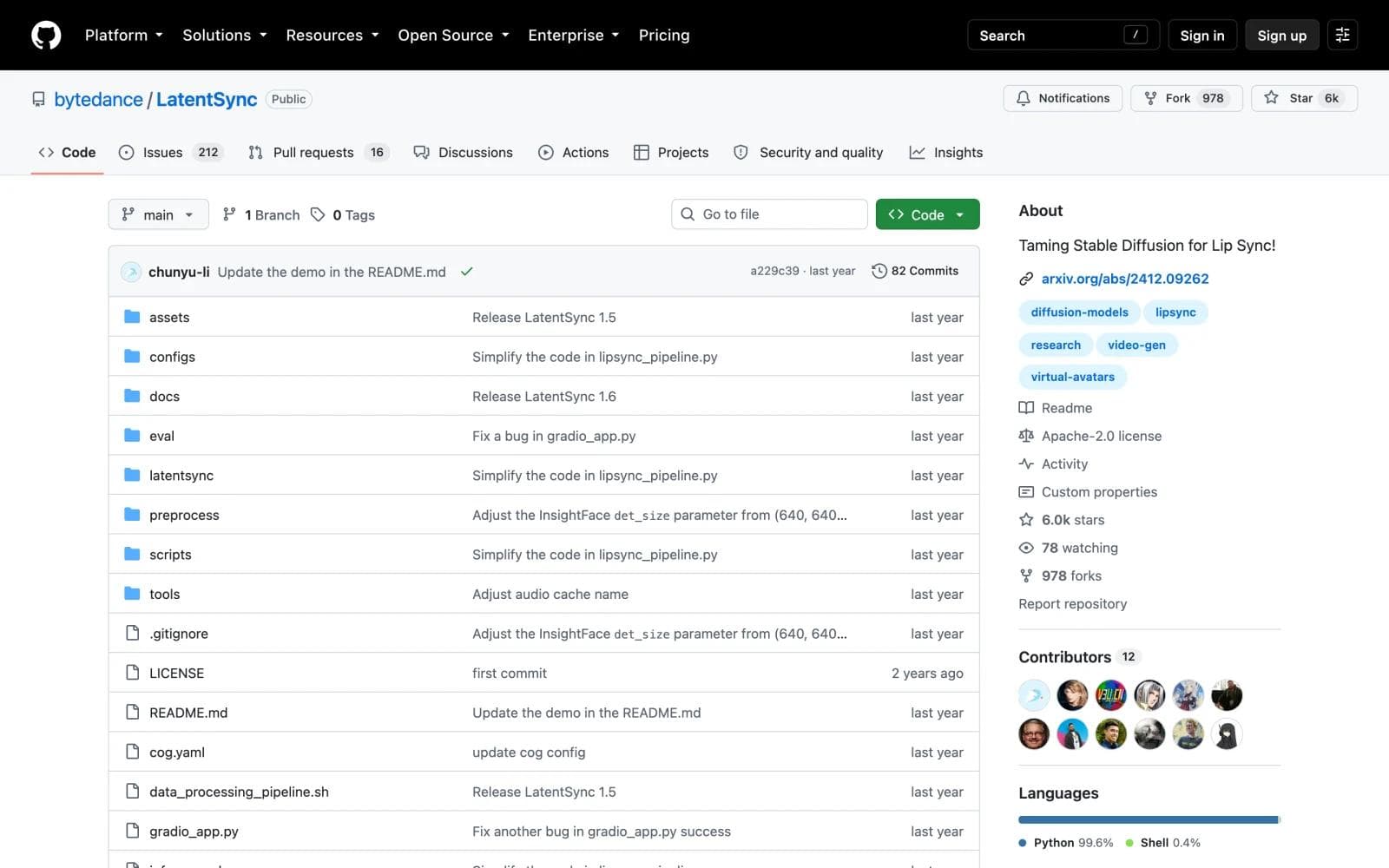
The maintenance check matters here. The repository's last push was June 2025, so treat it as a stable model rather than an actively developed product. MuseTalk, from Tencent Music, is the MIT-licensed alternative for real-time lip sync, last updated September 2025. SadTalker, which older roundups still recommend for animating a single photo, has not been pushed since mid-2024 and uses a custom license rather than a standard open-source one.
Choose a self-hosted model if you have footage of your own presenter, a GPU, and an engineer, and the recurring per-minute bill is the problem. You give up the studio, the voices, the translation pipeline, and support.
Also worth knowing
VEED is a browser editor with avatars and dubbing attached; on its current pricing page Creator is $12 per user a month billed yearly and Pro is $22, with translation into 50+ languages on Pro. Our CapCut alternatives guide compares that lane. Puppydog, Arcade, and Clueso rank for this query because they answer a different question: they record your real product instead of rendering a presenter, which is the right move for a software walkthrough and the wrong one for a compliance module.
One layer that no avatar tool owns is the design around the clip. End cards, thumbnails, captions styled to a brand, and the static and animated ad variants that sit next to a presenter video are a design job, and that is the part Moda handles, not the avatar.
Who should stay on HeyGen
Stay if the avatar engine is what you are paying for and your videos are short marketing or social clips. HeyGen's translation pipeline, its photo avatars, and its API with MCP and Skills are a broad bundle, and nothing else on this list matches all three from one account. Business at $149 a month now includes SCORM, interactive video, and SSO, so a training team that outgrew Creator should price that tier before assuming it has to migrate.
Leave when the reason is specific: metered minutes you can predict (Synthesia, Colossyan, Elai), SCORM under $60 (Colossyan), an API on the cheapest plan (D-ID), a launch loop for ads (Creatify, Arcads), real footage (Captions), or scenes without a presenter (Runway).
Before you switch
- Export the assets HeyGen owns: scripts, custom avatar source footage, voice clone samples, brand kit values, and the rendered masters of anything you might need to re-dub.
- Re-record a consent video where the new vendor asks for one. Synthesia, D-ID, and Colossyan all require it for a personal avatar.
- Take one real video through the free tier of your top two choices and count minutes or credits consumed, including one round of edits.
- Confirm the delivery format last: SCORM version, subtitle file type, and the aspect ratios you publish.
Frequently asked questions
What is the closest alternative to HeyGen?
Synthesia is the closest like-for-like replacement for a script-to-video avatar studio, with a slide-style editor, personal avatars, dubbing, and per-minute pricing from $14 a month billed yearly. Colossyan is closest for training teams that need SCORM on a small-team plan.
What is the cheapest HeyGen alternative?
D-ID has the lowest list price, at $4.70 a month billed yearly for about 10 minutes with a watermark, or $16 a month yearly for 15 minutes with a commercial license. Colossyan's free plan includes 20 minutes a month. Among tools that meter minutes, entry paid plans work out to about $1.07 to $1.55 per included minute on annual billing.
Is there a free HeyGen alternative?
Colossyan's free Starter plan is the most generous: 20 minutes a month, 15 custom avatars, brand kits, and unlimited course creation. Synthesia's Basic plan covers about 10 minutes a month but does not include video downloads. HeyGen's own free plan is three one-minute videos a month.
Which HeyGen alternatives support SCORM export?
Colossyan includes five SCORM exports a month on its $59 Professional plan and unlimited exports on Enterprise. Synthesia and Elai list SCORM export on their Enterprise plans only. HeyGen itself includes SCORM export on its $149 Business plan, which some comparison pages still describe as unavailable.
Is there an open-source HeyGen alternative?
Not a complete one. LatentSync (Apache 2.0) and MuseTalk (MIT) are open lip-sync models that sync new audio to footage of a real speaker, and D-ID lists self-hosting for enterprise customers. None of them ships the presenter library, voices, translation pipeline, or editor that make up the rest of HeyGen.
HeyGen or Synthesia?
Choose Synthesia when you want predictable per-minute pricing, edits that charge only the changed seconds, and enterprise governance for training and internal comms. Choose HeyGen when the avatar engine, photo avatars, and the API with MCP and Skills matter more, and your content is short marketing or social video.

Real editable visuals. Real canvas. Full control.
Fly through design work