Creative Testing for Static Ads: How to Run a Test That Tells You Something (2026)
How to run a creative test on a static ad: one variable, a hypothesis, a stop rule, what Meta and LinkedIn automate and hide, what tests look like in the ad libraries, and a one-page plan.
 Anvisha Pai, Co-founder & CEO, Moda
Creative testing is running two or more versions of an ad that differ in one way, with the same audience, budget, and dates, long enough to see which one earns its spend. That is the whole method. Most of what goes wrong with it is a test that changes three things at once, runs for four days, and gets read off a dashboard that was already shifting budget toward the early leader.
This guide is for static ads on Meta and LinkedIn, because a static is the cheapest thing to make variants of and the format most accounts test first. It covers what a test is and is not, what the platforms' own tools do and hide, what a test looks like from the outside in the public ad libraries (counted across 1,642 captured ads), which variables to change and in what order, how many variants and how long, the fatigue loop, and how to produce the variants without rebuilding the ad. The library evidence carries dates and IDs and shows no results, so nothing here says an ad "converted". It says an ad ran, and for how long.
What you will end up with
A test plan you can ship this week: one control ad, three to five variants that each change one variable, a hypothesis, a budget, a date on which you will read the result, and a rule for what happens to the winner and the losers. The one-page template near the end is the deliverable; everything before it is the reasoning that fills it in.
What a creative test is, and is not
A creative test has three parts, and a test missing any of them is a launch, not a test.
- One variable. The variants are identical except for the thing under test: the hook, the image, the proof line, the offer, the button, or the format. Meta's guidance says the same in one line: ad sets identical except for the variable give conclusive results (Meta Business Help Center, "What are best practices for A/B tests", read September 3, 2026). If two things changed, the winner tells you nothing about either.
- A hypothesis. A sentence you could be wrong about: "a question hook will get a lower cost per click than a claim hook for this audience." Write it down before launch, because it decides what you measure.
- A stop rule. A date, a spend, or a result count at which you will read the test and act. Without it a test runs until someone notices, and by then the platform has spent most of the budget on the early leader.
Two things that look like tests are not. Turning ads on and off by hand is not a test; Meta says informal testing of that kind "can lead to inefficient ad delivery and unreliable test results" because audiences overlap (Meta, "About A/B testing", read September 3, 2026). And launching six ads in one ad set and watching the platform pick one is a delivery decision, not a comparison: spend shifts to the early leader within days, so the losers never get enough delivery to lose fairly.
What the platform automates, and what it hides
Meta and LinkedIn each offer a controlled test and one or more automated variant systems. They answer different questions, and the automated ones do not tell you which variant won.
| Mechanism | What it does | What it gives you | What it hides |
|---|---|---|---|
| Meta A/B test (Experiments or the Ads Manager toolbar) | Splits the audience so nobody sees both versions; compares cost per result; simulates outcomes to attach a confidence level | A winner with a confidence percentage; a minimum recommended 7 days, maximum 30 | Needs an audience large enough to split, and a budget that produces enough results |
| Meta creative test inside an existing campaign | Makes 2 to 7 copies of an ad, spends a share of the campaign budget on them (Meta suggests at most 20 percent), keeps the campaign's learnings | A ranking of the copies on your comparison metric, and survivors that keep running after the test | No confidence level; Highest volume bidding only; the test does not change anything for you afterward |
| Meta dynamic creative and the flexible format | Combines the images, videos, texts, and headlines you upload into variations and serves the ones it predicts will perform | Reach across combinations without building each ad | Results are aggregate; Meta's own page says using it "as a substitute for split testing is not recommended". Since June 2024 not available for new sales or app promotion ad sets |
| Meta Advantage+ creative | Enhances your image or video per viewer: crops, overlays, background generation, text improvements, animation | Variants you did not make, shown to the people predicted to respond | Which enhancement ran for whom; some cannot be previewed |
| LinkedIn A/B test (Campaign Manager, Measure, Test) | Two ad sets with separate budgets that differ by one variable; audience split; winner by cost per KPI with a P-value | A winner or a "difference is negligible" verdict; minimum 14 days, recommended 21, maximum 90; minimum $700 lifetime or $20 a day; one ad per ad set recommended | Cannot start the same day it is created; conclusive results are not guaranteed |
| LinkedIn ad rotation | Up to 100 creatives in one ad set, served evenly at first, then more impressions to the best performers (Optimize for performance), or entered into the auction evenly throughout (Rotate ads evenly) | A cheap way to run four or five variations, which is the number LinkedIn recommends | No audience split, no significance; the even option still delivers unevenly because the auction decides |
Sources: the Meta Business Help Center pages on creative tests, A/B testing and its best practices, dynamic creative, the flexible format, and Advantage+ creative; the LinkedIn Marketing Solutions Help pages on A/B testing, its best practices, and ad rotation. All read September 3, 2026.
The practical reading: use the controlled test (Meta A/B, LinkedIn A/B) to learn something you will act on for months, such as which hook family works for this audience. Use the in-campaign creative test or LinkedIn rotation to screen a batch of variants cheaply before promoting one to a controlled test. Use dynamic creative, the flexible format, and Advantage+ creative to get reach out of a winner, not to find one, because they report in aggregate.
What a test looks like from the outside
The public ad libraries do not show tests, but they show their footprints. Two signals are visible, and this guide counted both across the captures made for the Meta Ad Library and LinkedIn Ad Library guides: 1,402 Meta cards from 16 keyword searches in the United States on September 2 and 3, 2026, and 240 LinkedIn cards from five start cohorts seen from Germany on the same days.
The versions flag
A Meta card says either "This ad has multiple versions" or "N ads use this creative and text". The first means the advertiser is running variants of that ad, usually through dynamic creative, the flexible format, or Advantage+ creative; the second means the same ad is duplicated into several ad sets. LinkedIn's detail pages say every ad "may have multiple versions" and list none.
How often the flag appears depends on what you filter for. Across the four image-only searches (skincare, haircare, supplements, cosmetics; active US image ads, September 2, 2026) it sat on 6 to 20 percent of cards: 17 of 125 skincare, 7 of 57 haircare, 7 of 118 supplements, 23 of 117 cosmetics. Across the twelve all-media searches with the Instagram or Facebook platform filter it sat on 10 to 55 percent: 39 of 71 budgeting app, 45 of 99 running shoes, 42 of 87 mattress, 9 of 88 language app. Pooled, 419 of 1,402 cards carried it, 30 percent. Video and app-install advertisers use Meta's variant systems far more than the image-ad persona pages that dominate beauty searches, and the flag says "this advertiser lets Meta make versions", not "this advertiser tested".
Sibling sets
The second footprint is the sibling set: several cards from one advertiser in one search that share the opening of the primary text or the headline. We counted them by advertiser, treating cards as siblings when the first 80 characters of the text matched or the headline matched.
| Sibling sets, captured September 2 and 3, 2026 | Meta, 16 searches, US | LinkedIn, 5 start cohorts, from Germany |
|---|---|---|
| Cards | 1,402 | 240 |
| Distinct advertisers | 821 | 124 |
| Advertisers with one card | 596 (73%) | 85 (69%) |
| Advertisers with 2 to 3 cards | 153 | 28 |
| Advertisers with 4 to 7 cards | 55 | 7 |
| Advertisers with 8 or more cards | 17 | 4 |
| Sibling sets found | 191 | 36 |
| Cards inside a sibling set | 590 (42%) | 115 (48%) |
| Sets of 2 to 3, 4 to 7, 8 or more | 147, 35, 9 | 25, 10, 1 |
Two readings. Most advertisers in a keyword search show one ad, so "everyone runs ten variants" is wrong for the median advertiser. And the minority that run several near-identical ads account for close to half the cards, which is why the competitor ads guide says to dedupe by advertiser before calling anything a pattern.
What varies inside a set is the more useful number, because it separates a test from a duplication.
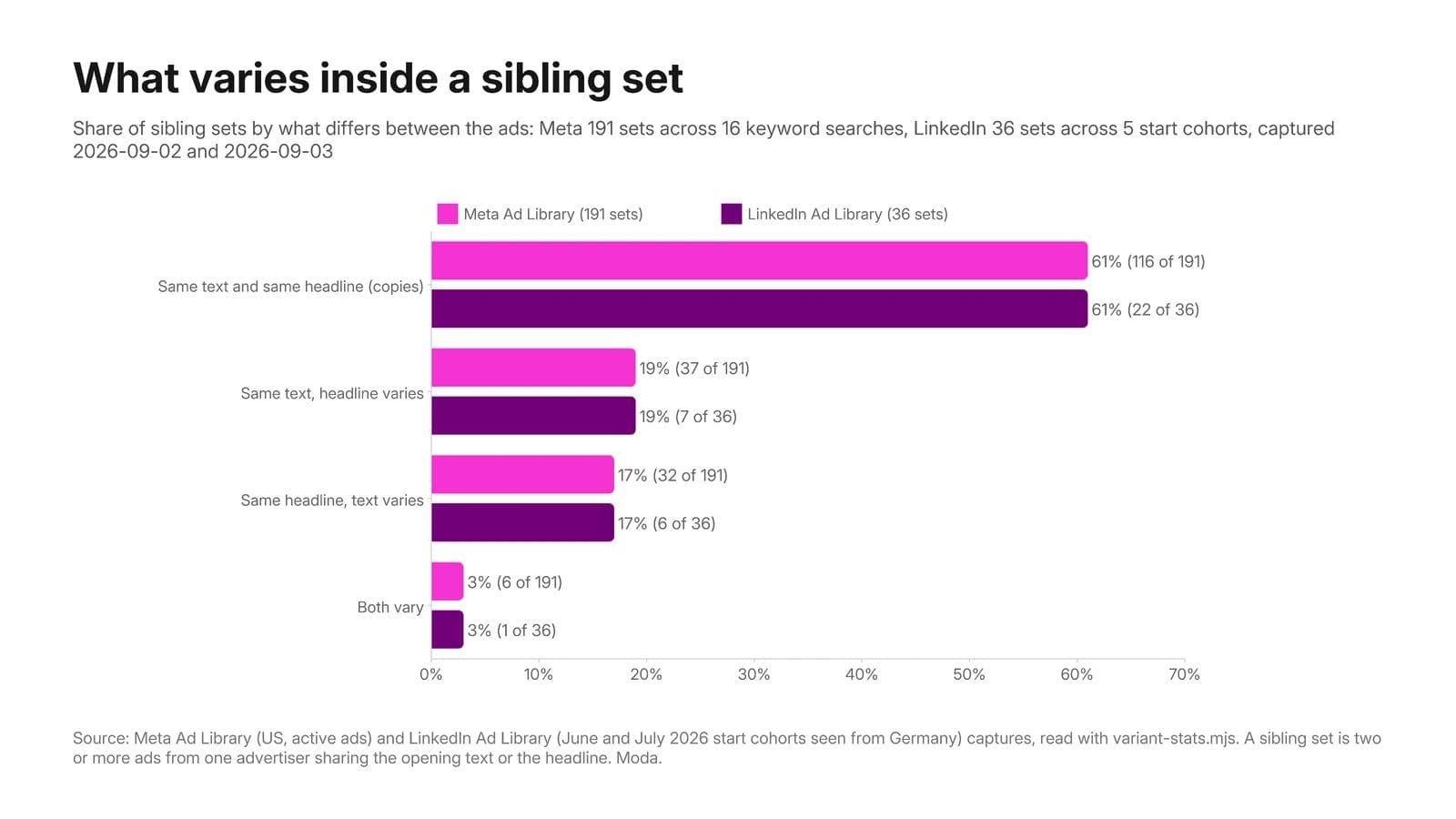
Six in ten sibling sets, on both platforms, are copies: the same text and headline, 116 of 191 sets on Meta and 22 of 36 on LinkedIn. Those are one ad placed in several ad sets, usually different audiences: a targeting test or a scaling move, not a creative test. The creative tests are the other four in ten: 37 Meta sets and 7 LinkedIn sets where the headline changes under the same copy, 32 and 6 where the copy changes under the same headline, and a handful where both move. The captures cannot compare images, so an image-only test is counted with the copies; it is the one kind of creative test the outside view underestimates.
Survival
The libraries show dates, so we asked whether ads inside a sibling set outlive ads without one. They do not.
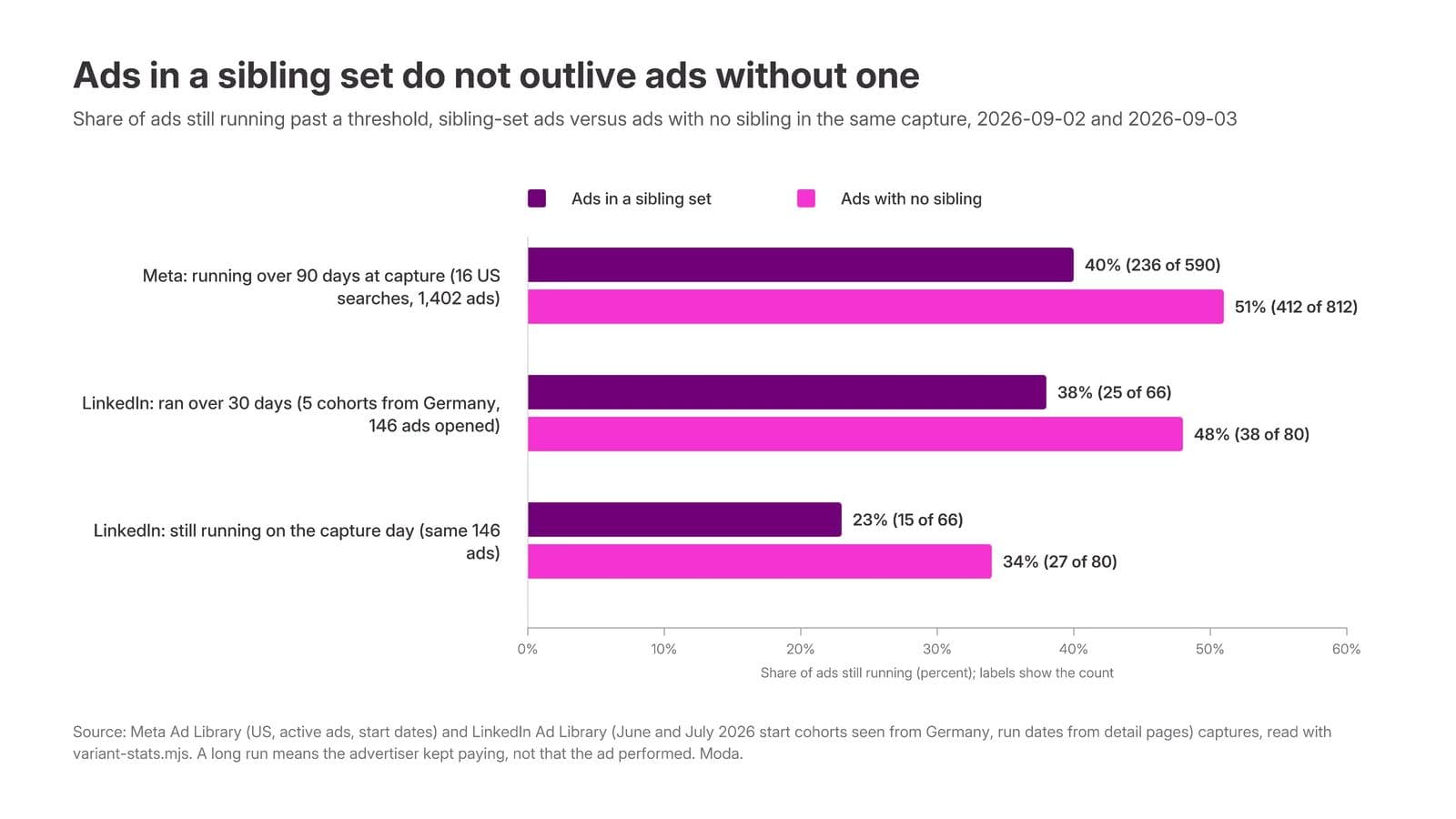
On Meta, 236 of the 590 sibling-set cards had run more than 90 days at capture, 40 percent, against 412 of 812 cards with no sibling, 51 percent; the median sibling had run 69 days, the median singleton 93. In the LinkedIn cohorts, 25 of 66 opened sibling ads ran more than 30 days against 38 of 80 singletons, and 15 against 27 were still running on the capture day. The direction is the same on both: a set is a test, and most members of a test are supposed to lose. The survivor inherits the run, its siblings are switched off, and what you see in the library later is the one that made it, sitting alone. That is a correction to the "long-running means proven" rule: a lone old ad may be the last survivor of a set whose losers left no trace, and a versions flag or a sibling with a different headline is the only evidence the test happened.
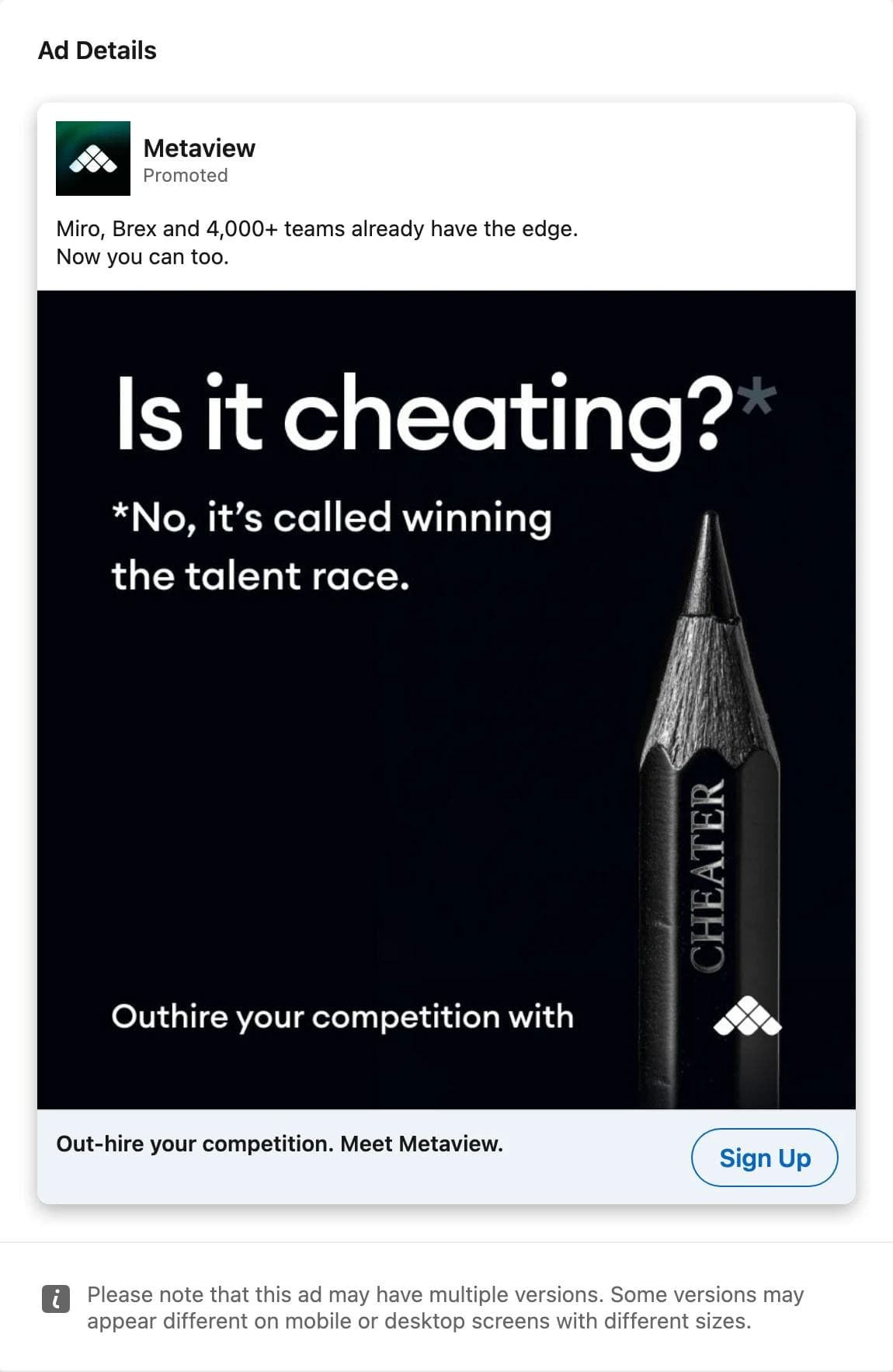
One LinkedIn nuance cuts the other way. Advertisers running many distinct ads, not copies, kept them running: Metaview had 12 different intro-and-headline pairs in the July recruiting-software cohort, and all nine we opened were live at 37 days on under 1,000 impressions each. That is a rotation set, LinkedIn's four-or-five-variations advice taken to twelve, and it survives as a set because nothing in it is being compared.
Four sibling sets, read as tests
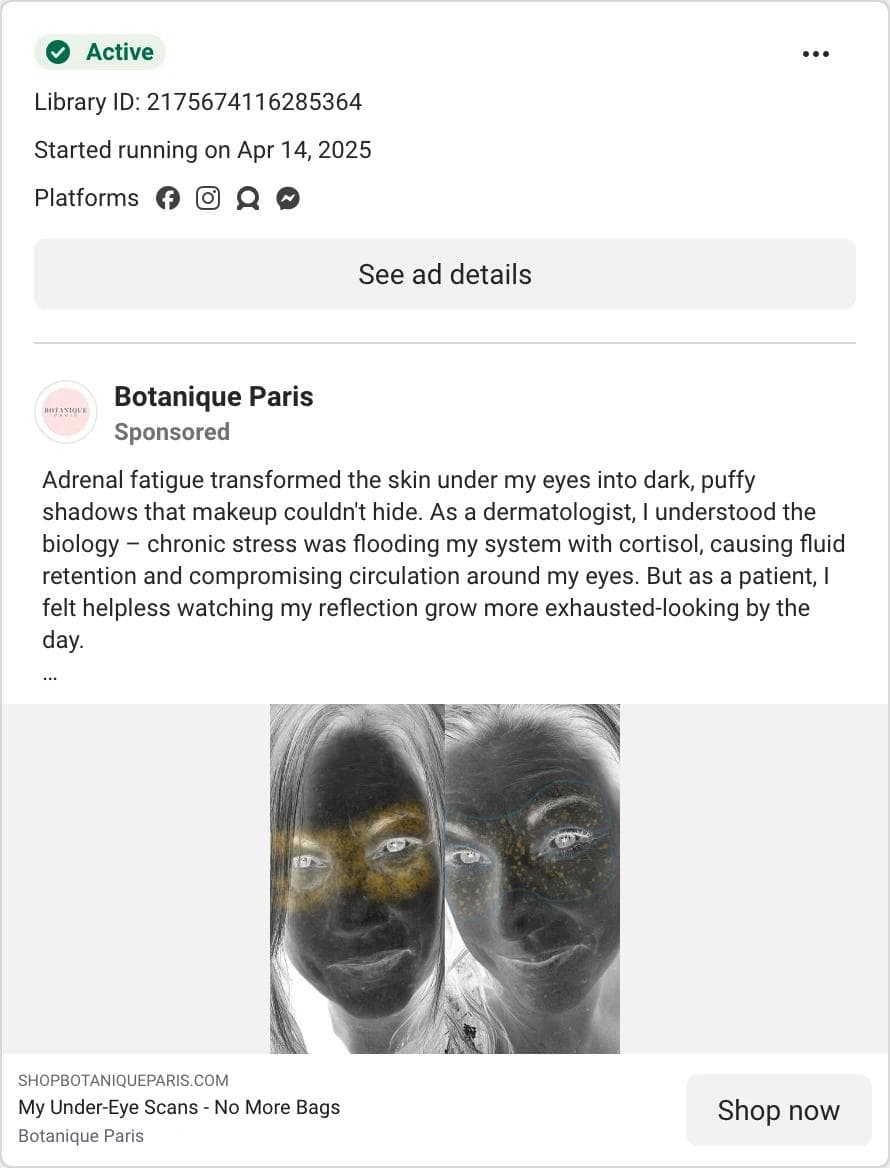
Botanique Paris: a headline test that kept its survivors. Three ads, Library IDs 2175674116285364, 1184005883466211, and 1629164315138321, share one first-person primary text and differ only in the headline: "My Under-Eye Scans - No More Bags", "My Under-Eye MRIs - No More Bags", "Adrenal Fatigue Erodes Collagen". All started April 14, 2025 and were live at 507 days on September 2, 2026. A fourth sibling, 863874133438013, started May 29, 2026 with the same text, a lower-case headline with an emoji, a See details button, and a different domain: the refresh, thirteen months later. It is the cleanest one-variable test in the captures, and three headlines surviving together says the advertiser never switched the losers off, a choice the library cannot explain.
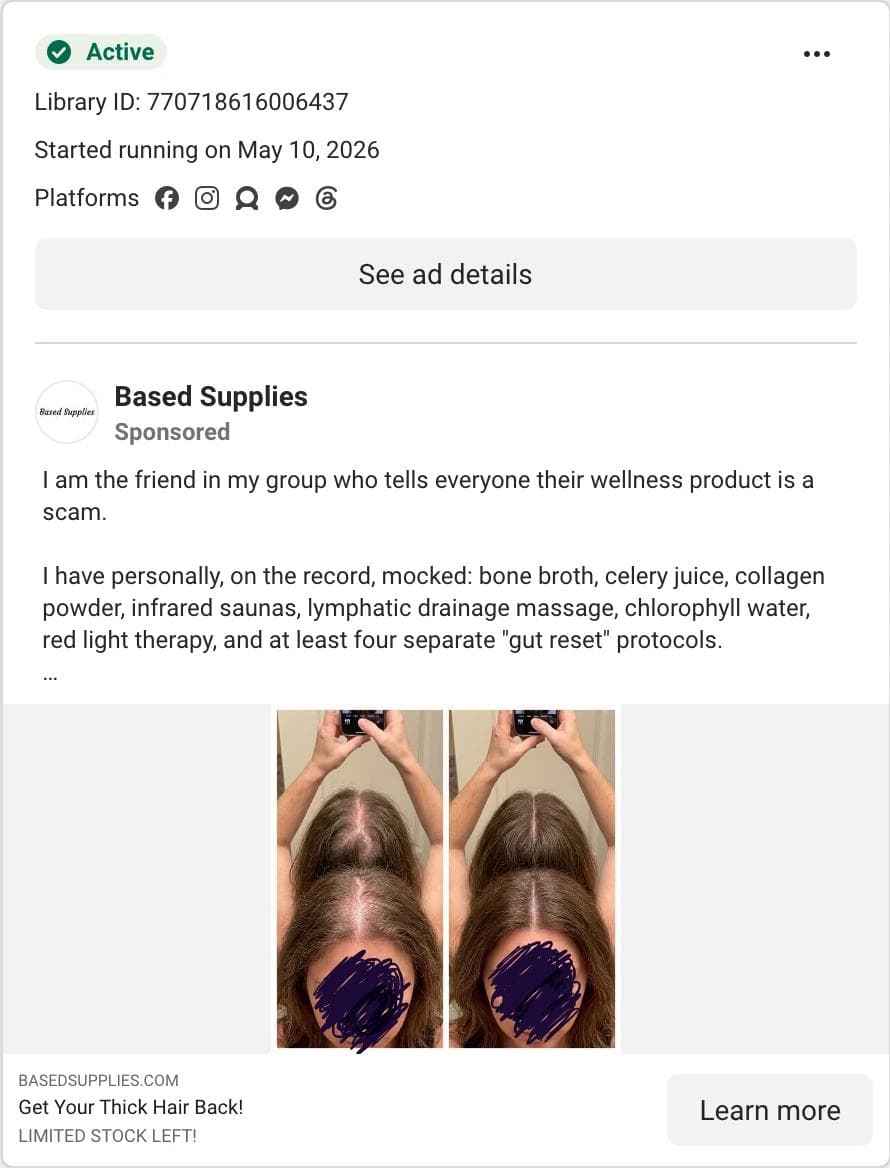
Based Supplies: copies, not a test. Ten haircare cards with the same text, headline, and Learn more button, started May 9 and 10, 2026 and live at 116 to 117 days; six more in the supplements search started April 10 to 27 with the same headline; two in the Facebook-filtered skincare search since September and October 2025. None carries a versions flag. That is one ad placed in many ad sets, a distribution decision. It says the advertiser has one creative it trusts, and nothing about how it was chosen.
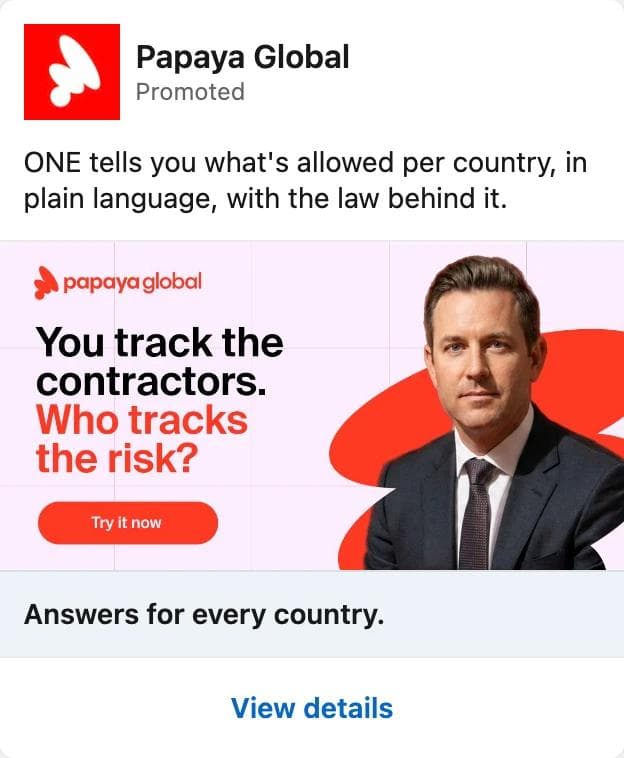
Papaya Global: a message test run as copies. In the June payroll cohort seen from Germany, Papaya held 28 of 48 cards. They resolve into six messages, each duplicated two to seven times: "Compliance built into every payroll run", "Answers for every country.", "The right contract for the right country", "Start smarter. Review faster.", "Cited answers. 95+ countries.", "AI Built for Global Compliance." Every copy we opened was under 1,000 impressions and off within 15 days of its June 28 or 29 start. Six messages in several ad sets each, all small, all short: a screening round whose results left the library when the ads did.
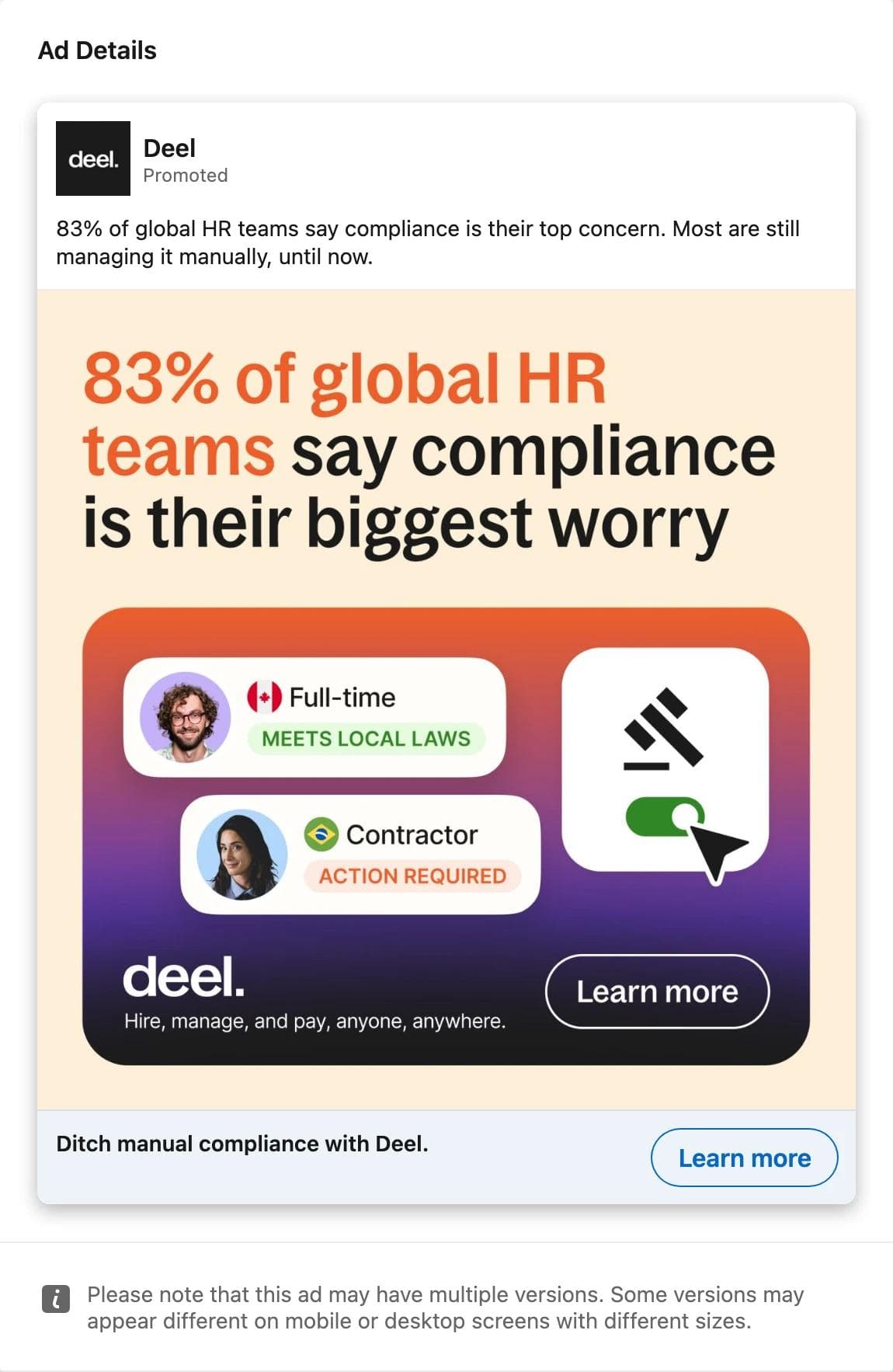
Deel: the survivor and its format sibling. Deel's compliance message ran as a single image (ad 1441537503, a large 83 percent statistic) and a carousel (1441597583) from June 29, both still live on September 2 at 1k to 5k and 10k to 20k impressions. Same message, two formats, both kept: a format test whose answer was "both". The LinkedIn guide counted two more single images with the same message in Deel's wider set, also live after ten weeks.
And one that shows the delivery problem. Faddom ran five identical copies of "Map All Your Servers in 60 Minutes" in the June CRM cohort. The three we opened got 10k to 20k impressions over 11 days, under 1k over 5 days, and under 1k over 8 days. Same ad, three ad sets, one getting nearly all the delivery: the uneven distribution a controlled test exists to prevent.
Which variables to test, in order
A static ad has six parts, the anatomy the static ads guide lays out: hook, hierarchy, proof, offer, call to action, format. Test them in that order, because each one bounds the next. A hook decides whether the ad is read at all; there is no point tuning a button under a hook nobody stops for.
- Hook. The first thing processed: on Meta the first line of primary text, on LinkedIn the words in the image. Vary the kind of hook, not the wording: a question against a claim against a confession. Botanique Paris's three headlines are three framings of one claim, a narrow hook test; a wider one would put a question against them.
- Hierarchy. What is biggest. Deel's stat-first layout against a person-first layout with the same message would be a hierarchy test.
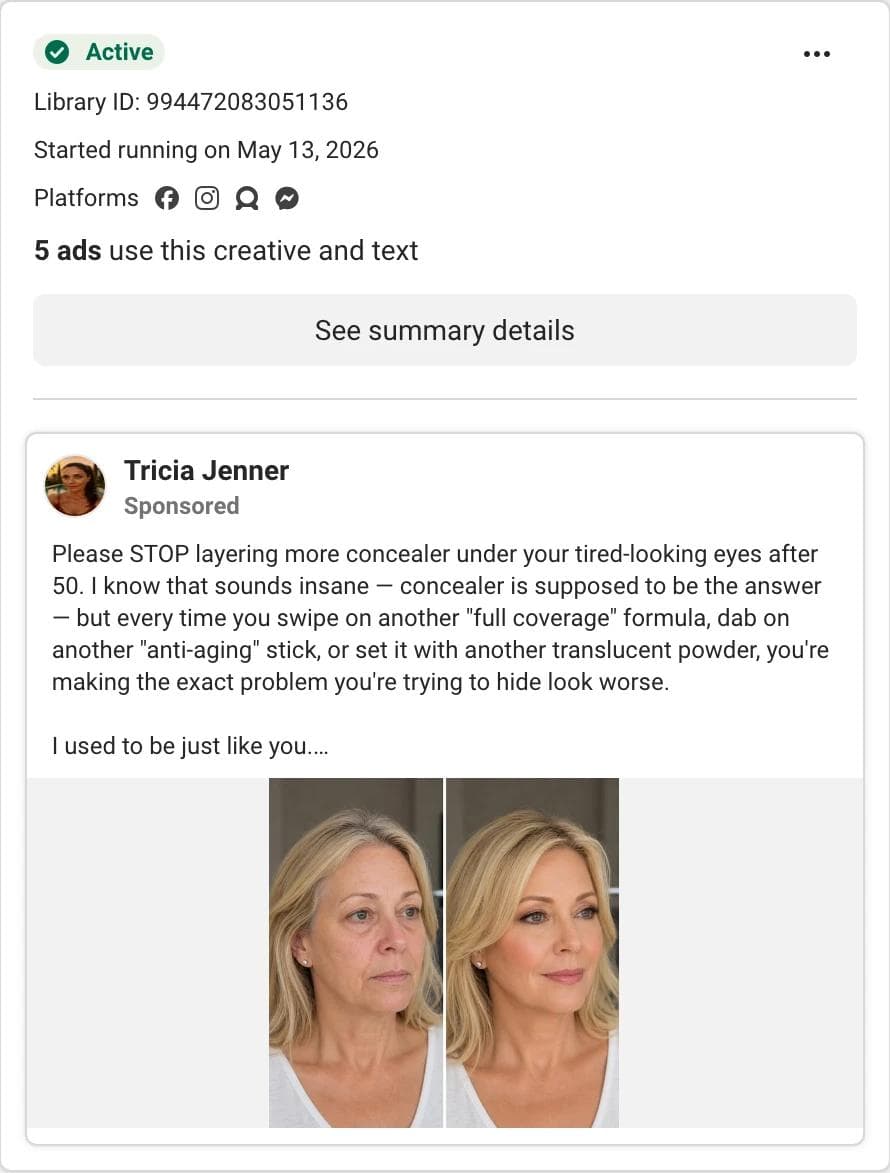
- Proof. Where the reason to believe lives: a number, a badge, a before-and-after, a named customer. Swap the proof type, keep everything else. Tricia Jenner's five copies of one before-and-after become a proof test the moment one copy carries a review count instead.
- Offer. What the click gets: a code, a guide, a demo, a trial. Papaya's six messages are six offers on one layout, which is why the round needed six ad sets.
- Call to action. The button label is a platform control, so it is the cheapest variable and the one with the least room: Learn more against Shop now, Download against Register. Test it last, on a winner.
- Format. Single image against carousel, 4:5 against 1:1. Deel's image-and-carousel pair is the example; LinkedIn's A/B tool has a checkbox for it ("Test ads using different ad formats").
The order is roughly the order of what the category tests. In 16 Meta searches, headline-only and text-only siblings were the two visible creative-test types (37 and 32 sets); format and button tests were rare enough that Deel's pair is the only clean one. Test the words first.
How many variants, and how long
What the platforms say. Meta's in-campaign creative test takes 2 to 7 copies and suggests spending no more than 20 percent of the campaign or ad set budget on them. Meta's A/B test should run at least 7 days and can run at most 30, and Meta warns that shorter tests "may produce inconclusive results". LinkedIn recommends four or five variations in one ad set for rotation, and for an A/B test a minimum of 14 days (21 recommended, 90 maximum), at least $700 lifetime or $20 a day, and one ad per ad set. All from the help pages cited above, read September 3, 2026.
What the survivors suggest. The June LinkedIn cohorts had median runs of 8 days (CRM, 40 opened) and 14 days (payroll and cybersecurity, 25 each), and 14 of the 40 CRM ads were off within three days, below every minimum LinkedIn publishes. Most of what looks like testing in the cohort was a screening round that ended before it could say anything. On Meta the sibling-set median was 69 days, but that median is measured on ads still running at capture, so it describes the ones that were kept.
The hub guides' caveats apply. A long run means the advertiser kept paying at that budget. Tiny budgets run forever, page-like and profile-visit ads top every longevity sort, and persona pages run copies rather than tests. Compare within one advertiser, weight the versions flag and the sibling count, and read the numbers above as what the category does, not what works.
A working default for a static-ad test: one control, three to five variants on one variable, equal budgets, seven days on Meta and fourteen on LinkedIn, and a result count set in advance. On a cost-per-click test that is a few hundred clicks per variant; on a cost-per-lead test it is dozens of leads per variant, which is why small accounts should test hooks on clicks first and offers on leads second.
The fatigue and refresh loop
A winner does not stay one. Meta's Ads Manager names the decline: an ad whose cost per result rises above its past results but stays under twice them shows a Creative limited delivery status; at twice or more it shows Creative fatigue. Meta counts every recent exposure of the same image or video, including other campaigns from the same Page, and can warn before publishing if it predicts fatigue in the first seven days (Meta, "Creative fatigue recommendations", read September 3, 2026). Its remedies, in its order: a new ad with an image or video "materially different from the original", a larger audience, or Advantage+ creative. It also says to keep the original running rather than pausing it.
LinkedIn's equivalent is the rotation setting. Optimize for performance concentrates impressions on the best creative, which is what wears it out in a long campaign; Rotate ads evenly keeps every creative in the auction regardless of performance (LinkedIn, "Ad variations with LinkedIn ad rotation", read September 3, 2026).
The loop, then: a winner runs; its cost per result drifts up; the platform labels it; you launch the next test with the winner as the control and a materially different image as one of the variants, not a recolor. Botanique Paris's fourth sibling is the loop in the wild: the same text thirteen months later with a new headline style, a new button, and a new domain. Based Supplies' ten copies are the other remedy: one creative pushed into more ad sets, which is what "expand your audience" looks like from outside.
Producing the variants without rebuilding
The reason most accounts under-test is production. Six variants of a static ad, exported at 4:5 for Meta and 1:1 for LinkedIn, is twelve files, and each has to change one thing without drifting on everything else. That is a job an AI design agent does well when it is given the control and the constraint, not adjectives.
In Moda, the workflow is: attach the control ad, name the brand kit, and ask for N variants that change one variable each. A prompt for a hook test looks like this:
Use the attached ad as the control. Make five variants of it for a hook test, using the Northwind brand kit. Keep the layout, the product photo, the proof line, the offer, and the button identical. Change only the headline, one per variant: a question, a plain claim, a number-led claim, a confession in the first person, and an objection with the answer. Export each at 1080 x 1350 for Meta feeds and 1200 x 1200 for LinkedIn, named control, q, claim, number, confession, objection.The result lands on an editable canvas, so the headline is a text object and the rest of the ad is untouched: the variants differ in exactly the way the hypothesis says, and the next round starts from the winner with the same instruction and a different variable. If the brand side is not set up yet, how AI design tools build a brand kit from your website covers what gets extracted and what to correct.
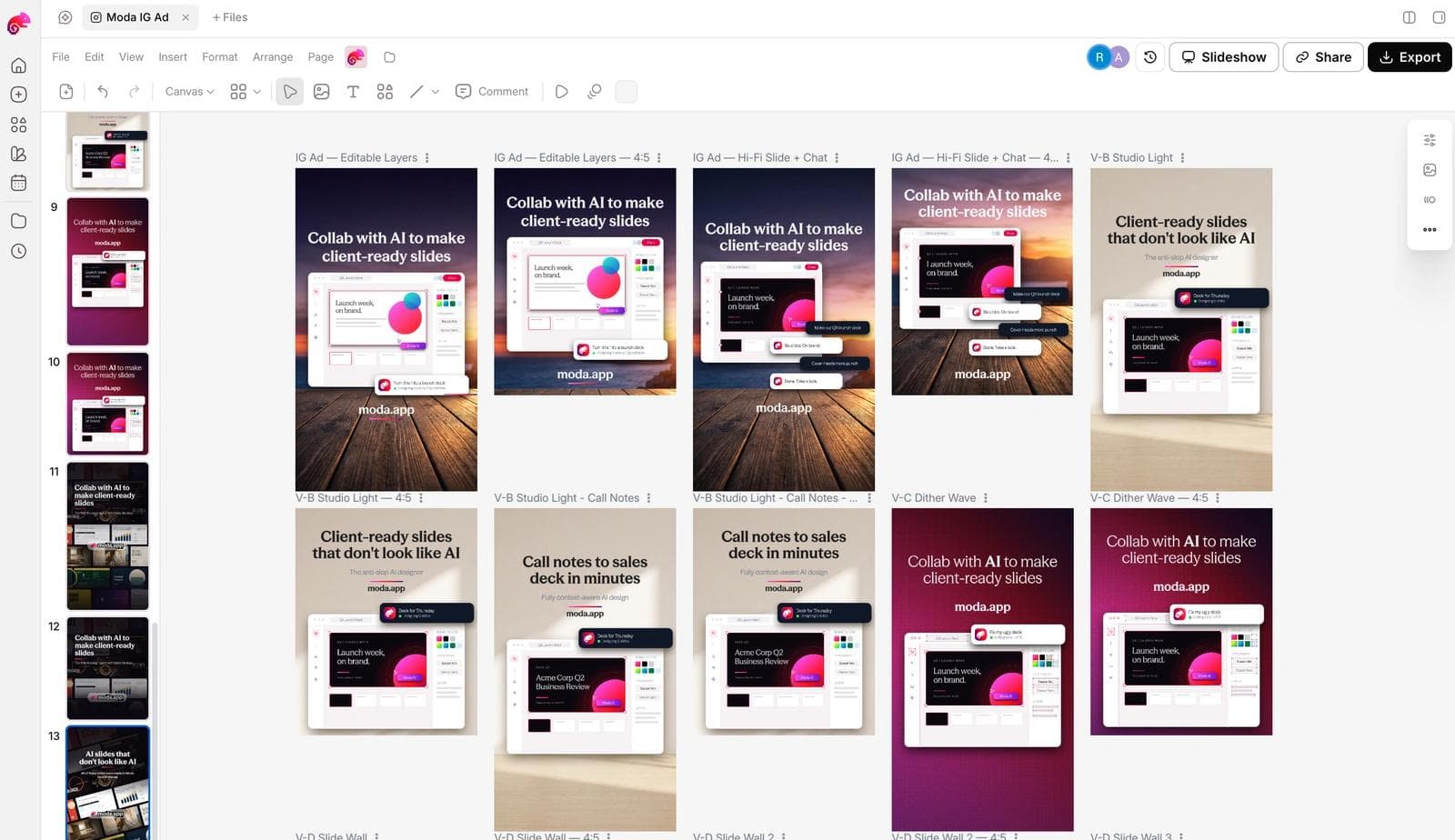
Two limits. Moda does not run or measure ads, so the test still happens in Ads Manager or Campaign Manager, and the stop rule is yours. And a variant built from a reference ad is a structure, not a license: the photography, people, and claims in someone else's ad stay with them.
A one-page test plan
| Field | Fill in | Example |
|---|---|---|
| Control | The ad running now, by ID | Meta ad 1234, running since June 3 |
| Variable | One of hook, hierarchy, proof, offer, CTA, format | Hook |
| Hypothesis | A sentence you can be wrong about | A question hook gets a lower cost per click than the claim hook |
| Variants | Three to five, each named by its change | q, number, confession, objection |
| Held constant | Everything else, listed | Image, proof line, offer, button, placements, audience |
| Mechanism | The platform tool | Meta A/B test, Ads Manager toolbar, "Make a copy of this ad" |
| Audience | One audience not used elsewhere during the test | Lookalike 1 percent, US |
| Budget | Equal per variant | $40 a day per variant |
| Duration | Platform minimum or more | 7 days (Meta), 14 days (LinkedIn) |
| Read on | Date and result count | September 12, or 300 clicks per variant |
| Metric | One | Cost per link click |
| Winner rule | What promotes a winner | Lowest cost per click at 90 percent confidence, or keep the control |
| Loser rule | What happens to the rest | Switch off; keep files for the next round |
| Next test | The variable after this one | Proof, on the winning hook |
The two rows most plans skip are Held constant and Loser rule, and they are the ones that make the next test possible.
Common mistakes
- Changing two things. A new image and a new headline in one variant. The winner teaches you nothing you can reuse.
- Reading the platform's ranking as a test. Six ads in one ad set on default delivery; the leader after two days got the budget and the rest never got a fair run. Faddom's three copies at 10k to 20k, under 1k, and under 1k impressions are what that looks like.
- Stopping at three days. Fourteen of forty ads in the June CRM cohort did. Meta's floor is seven days, LinkedIn's is fourteen.
- Testing the button before the hook. The button has the smallest range and needs a settled ad above it.
- Copies as coverage. Ten identical ads across ten ad sets, as Based Supplies runs, spreads one creative; it does not test it.
- Treating the survivor as the design that works. A lone long-running ad is often the last member of a set whose losers left no trace. Look for a sibling or a versions flag before copying its structure.
- Refreshing with a recolor. Meta's fatigue remedy asks for an image "materially different" from the original. A new background is not.
Frequently asked questions
What is creative testing?
Creative testing is running two or more versions of an ad that differ in one variable, with the same audience, budget, and dates, long enough to see which earns its spend. The controlled form is an A/B test in Meta Ads Manager or LinkedIn Campaign Manager; the cheaper screening forms are Meta's in-campaign creative test and LinkedIn's ad rotation.
How many ad variants should I test at once?
Meta's in-campaign creative test takes 2 to 7 copies; LinkedIn recommends four or five variations in one ad set. A practical default for a static ad is one control and three to five variants that each change one variable, with equal budgets.
How long should a creative test run?
Meta recommends at least 7 days for an A/B test and caps it at 30; LinkedIn requires 14 days, recommends 21, and caps at 90. In the LinkedIn June 2026 cohorts we opened, 14 of 40 CRM ads were switched off within three days, which is too early to read.
What is the difference between A/B testing and dynamic creative?
An A/B test splits the audience and compares versions on cost per result with a confidence level. Dynamic creative combines the assets you upload into variations and reports in aggregate; Meta's own page says it is not a substitute for split testing. Use A/B to learn, dynamic creative to deliver.
What is ad fatigue, and how do I know it has started?
Ad fatigue, which Meta calls creative fatigue, is a rise in cost per result because the audience has seen the same creative too many times. Ads Manager shows Creative limited when cost per result is above your past ads and Creative fatigue when it is at least double. The remedy is a materially different image or video, a larger audience, or a fresh test with the winner as control.
Can I tell from the ad library whether an advertiser is testing?
Partly. On Meta, "This ad has multiple versions" means the advertiser lets Meta serve variants, and several ads from one advertiser with the same copy and different headlines are a visible test. On LinkedIn, a start cohort with several near-identical ads from one company, most switched off within two weeks, is a screening round. Neither library shows which version won.

Real editable visuals. Real canvas. Full control.
Fly through design work