Competitor Ads: How to Find Winning Ads Without Copying Your Competitors (2026)
How to find competitor ads in the Meta, LinkedIn, TikTok, and Google ad libraries, why adjacent categories beat direct rivals, what each library can tell you, and how to rebuild references on-brand.
 Anvisha Pai, Co-founder & CEO, Moda
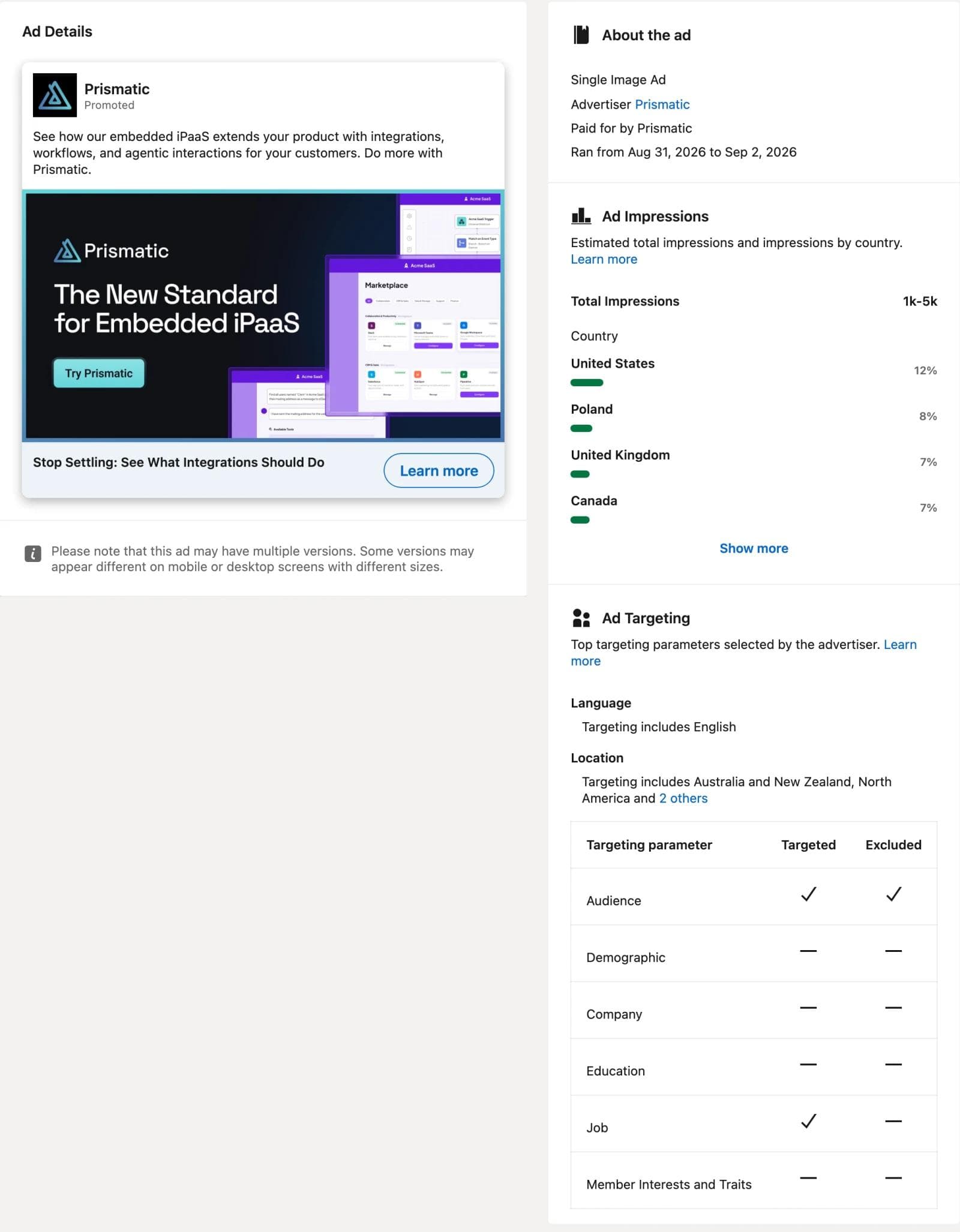
Competitor ads are public. Every ad running on Facebook, Instagram, LinkedIn, TikTok, Google Search, and YouTube sits in a free library that needs no account: the Meta Ad Library, the LinkedIn Ad Library, the TikTok Creative Center, and the Google Ads Transparency Center. You can see any rival's creative, copy, and start date in a minute. The spy-tool industry exists to make that faster, and most guides to competitor ads are a tour of those tools.
Here is the argument this guide makes instead. Search your direct competitors once, to learn the market. Then spend most of your time on adjacent categories: companies that sell a comparable purchase to the same buyer, with a different product. Their ads solve the problem yours must solve, a crowded feed and a skeptical buyer, and their structures transfer to your brand without putting your creative next to a rival's in the same feed. We measured this across all four libraries on September 2, 2026, and the numbers below are what the method looks like in practice: how concentrated a keyword search really is, which signals each library gives you, and which adjacent categories failed the test.
What "adjacent" means, and the test that decides it
The instinct is to search competitors by name. Do it once. A competitor search tells you the claims your market makes, the offers it runs, and how many ads each rival keeps live, and that context is worth an hour. It stops being useful fast, for two reasons. Copying a direct competitor's layout puts your ad beside theirs, which helps the brand people already know. And competitor searches surface the same handful of ads everyone in your category has already seen.
An adjacent category passes a three-part test:
- Same buyer. The person who buys your product is the person these ads are aimed at. Skincare, cosmetics, and haircare share a buyer. A CRM and a payroll platform share a buyer, the operations or sales leader who signs for both.
- Comparable purchase. Similar price, similar consideration, similar proof. A forty-dollar serum and a forty-dollar foundation are comparable. A serum and a snack cake are not, even if a keyword search puts them side by side.
- Different product. The ad cannot be mistaken for yours. That is what makes the structure safe to borrow: the layout, hierarchy, offer format, and proof type move; the claim, the photography, and any regulated language stay with the advertiser.
Three searches from our captures failed the test, and each failed on a different part of it:
- Supplements, searched from skincare (Meta Ad Library, US, active image ads, 118 cards from 65 advertisers, September 2, 2026). The results were long-copy illness narratives from persona pages almost exclusively: 108 of 118 cards carried more than 900 characters of primary text and 79 used a Learn more button. That is a copy format, not a layout, and it comes with claims a skincare brand cannot make. Same buyer, but not a comparable purchase, and the Meta Ad Library guide says so rather than forcing a fifth example.
- A snack cake in the skincare search (Meta Ad Library, Instagram filter, US, 77 cards, same day). Hostess, Library ID 1810062497069826, running since August 1, 2026, was a well-made vertical ad whose joke was "a snack as reviving as a 7-step skincare routine". The keyword matched; the buyer's job did not. The same search returned five cards from TikTok's own app-install ads, plus Schick and Amazon Beauty.
- Cash-advance ads in "budgeting app" (Meta Ad Library, Instagram filter, US, 71 cards from 32 advertisers, same day). Roughly a third of the results, 24 by a text match for advance and loan language, were "need cash now" ads from lending apps, several running the same creative under different page names. Comparable purchase, arguably the same buyer, but the same ad bought many times over is not a pattern, which is the concentration problem below.
The categories that passed: cosmetics and haircare for a skincare brand; coffee, fitness apps, and budgeting apps for each other (all sell a better daily routine to the same phone); payroll, sales intelligence, and proposal software for a CRM; eyewear and mattresses for any direct-to-consumer brand that sells one hero product.
The four ad libraries, side by side
Each library is the subject of its own guide in this series. This table is the part that matters for choosing which one to open first, verified on September 2, 2026 and quoted from those guides.
| Meta Ad Library | LinkedIn Ad Library | TikTok Creative Center | Google Ads Transparency Center | |
|---|---|---|---|---|
| Keyword search | Yes, matches ad text; exact phrase in quotes | Yes, matches ad text | Search bar plus industry and objective filters | No. Advertiser name or website only |
| Advertiser search | Yes, by page name | Yes, company and separately the payer | Brand name when the advertiser supplied it | Yes, verified advertiser or domain |
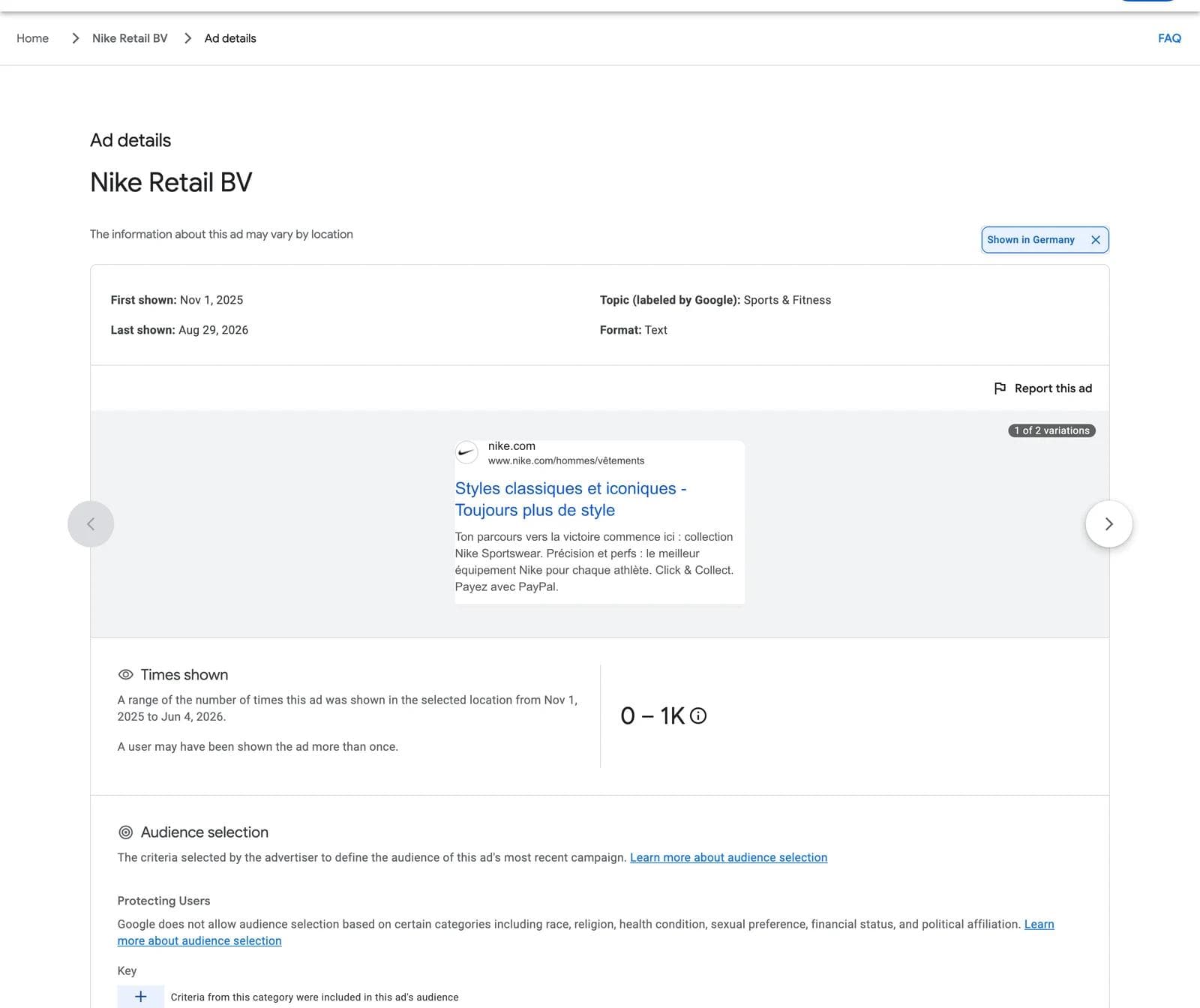
| Dates | Start date on every active ad | Ran from and to, only for ads whose targeting includes the EU | None | Last shown for every ad; First shown only with an EEA region selected |
| Impressions | Hidden for commercial ads (a sort by impressions exists) | Band such as 1k to 5k, and a country split, EU-targeted ads only | Likes, comments, shares; CTR as a percentile of the industry; budget as Low, Medium, High | Times shown range, EEA region only, published after a 90-day delay |
| Targeting | EU-delivered ads only | EU-targeted ads only, by category | None | Audience selection by category, EEA region only |
| Retention | US commercial ads vanish when inactive; EU and UK one year; political seven years | One year after the last impression, ads since June 2023 | Authorized ads for 7, 30, or 180 days | One year from last display; election ads seven years |
| What unlocks the extra data | Nothing, for a US commercial ad | Searching an EU country: the disclosure is attached to the ad, not the searcher | TikTok's own metrics, shown for every authorized ad; the 180-day period, not the default 30 | Selecting an EEA region such as Germany, again per ad |
| Sorting | Most recent, or impressions high to low | Newest to oldest, or oldest to newest | For You, Reach, CTR, 2s and 6s view rates, CVR, Likes | None on commercial listings; order is unstated |
Which to open for what:
- Consumer categories, static and video, keyword search: Meta. It is the largest, the only one where a US search returns dates, and the one with a versions flag.
- B2B: LinkedIn, searched from Germany, France, Ireland, or the Netherlands once you have seen the field from your own country. The LinkedIn Ad Library guide covers the start-cohort method that makes its dates readable.
- Short video and the only public performance numbers: TikTok, on the 180-day period. The TikTok Creative Center guide explains why the default view is not the best ads.
- Search, display, and YouTube for a named advertiser: Google, with the region switched to an EEA country for run lengths. The Google Ads Transparency Center guide covers the workarounds for a library with no keyword search.
The concentration problem, measured
A keyword search returns cards, not advertisers, and one advertiser can hold a large share of the first screen by running many near-identical ads. Every "pattern" you think you see in a search has to survive a dedupe by advertiser first. We counted, for every keyword capture in this series, how many cards the top advertiser and the top three held.
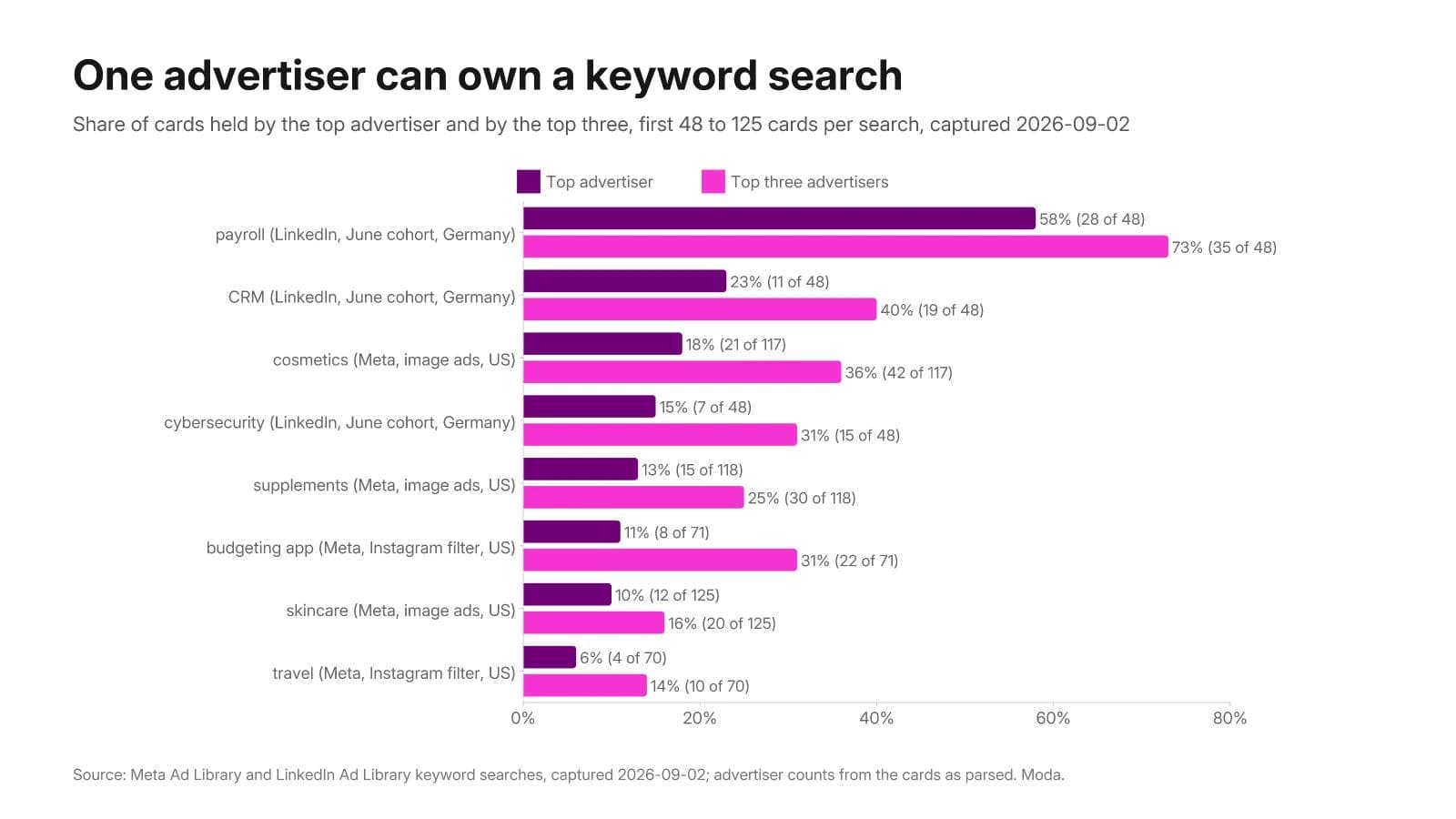
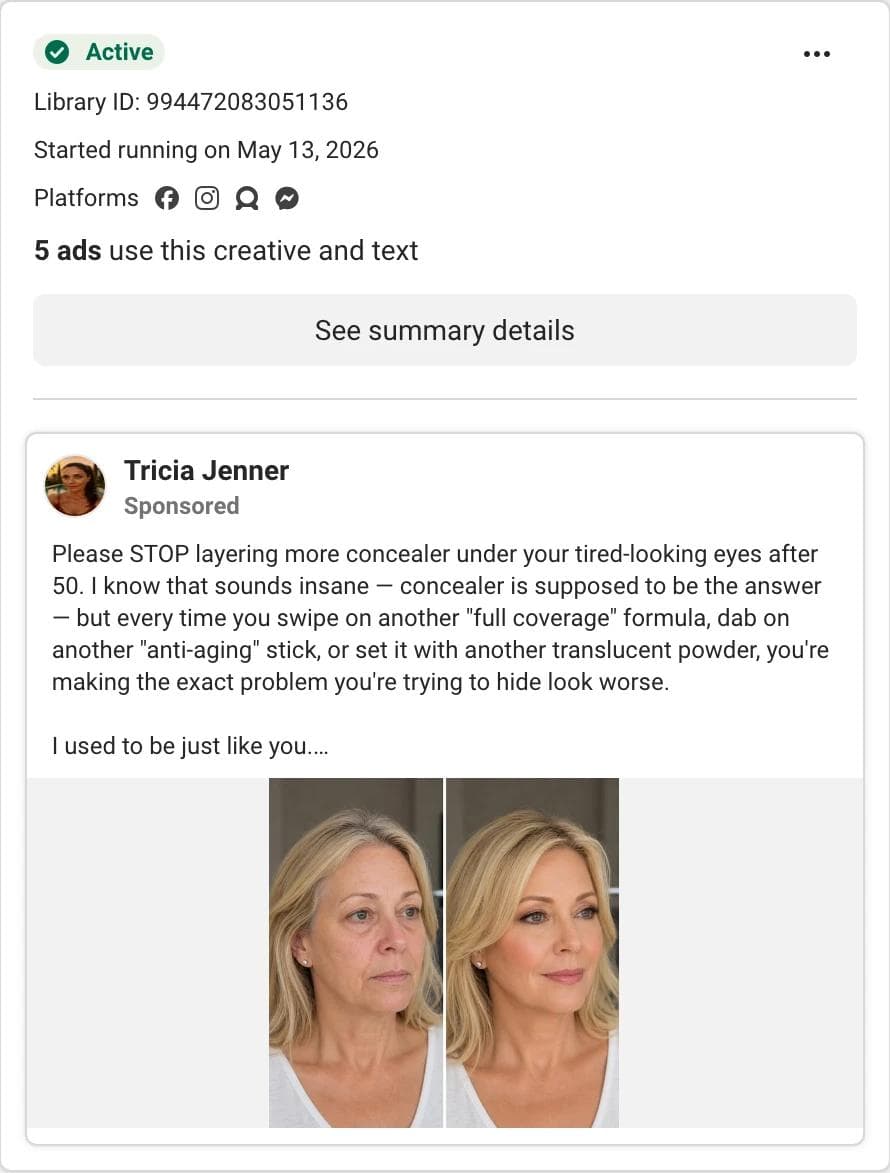
The spread is wide. In the LinkedIn payroll cohort (48 cards, June 2026 start dates, seen from Germany), Papaya Global held 28 cards and the top three advertisers held 35, so a reader who skimmed the results would be looking at one company's ad test and calling it the category. In the Meta cosmetics search (117 active image ads, US), a persona page called Tricia Jenner held 21 cards, and with two more pages the top three held 42. The skincare search was the flattest: 125 cards from 87 advertisers, with the top advertiser at 12 and the top three at 20. The Instagram-filtered travel search was flatter still, 70 cards from 53 advertisers, the top one holding 4.
The same count, drawn as cards against distinct advertisers, is the dedupe rule in one picture.
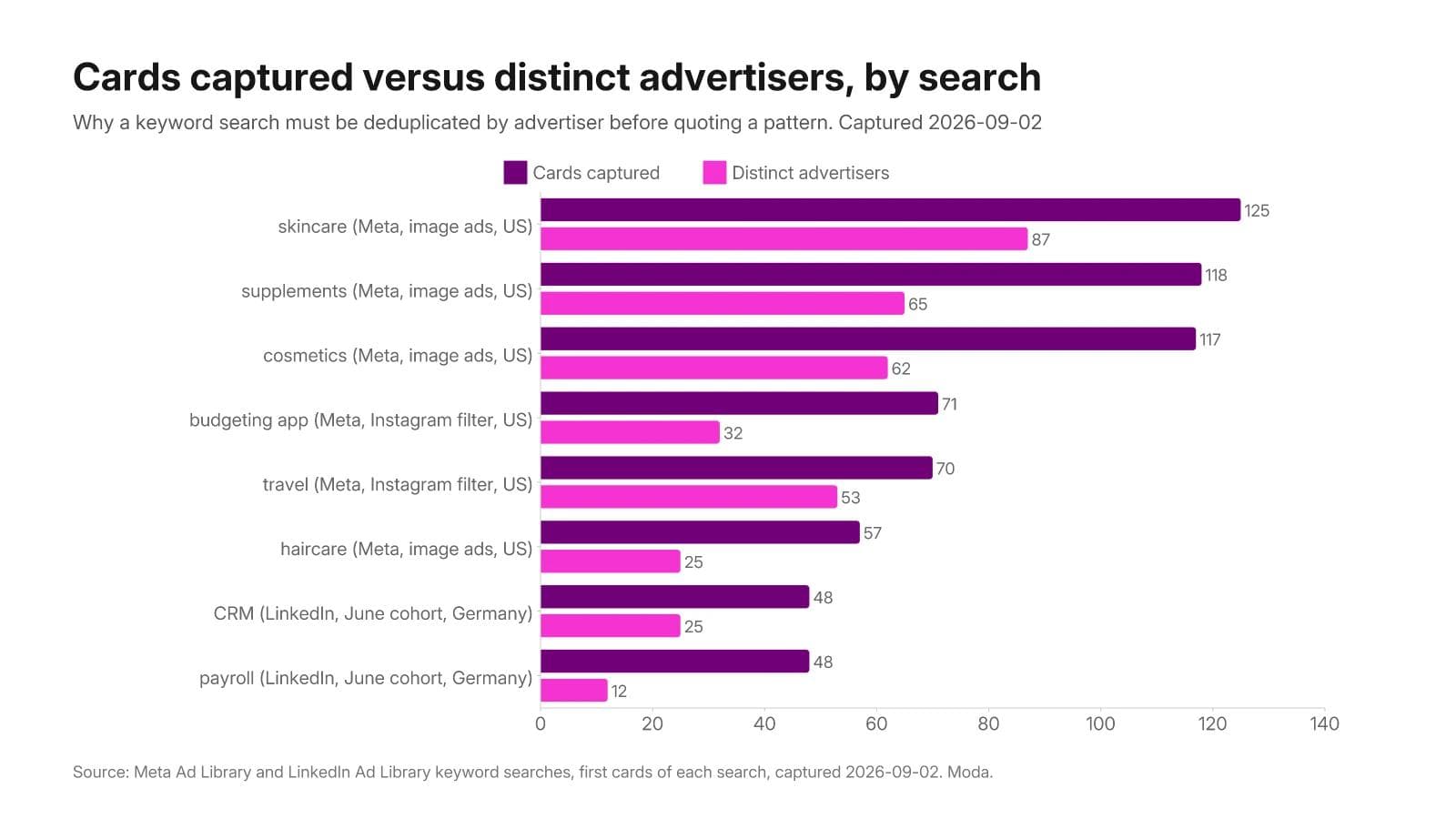
Two libraries could not be counted this way. On Google, search is by advertiser, so concentration is a property of the search, not a finding; the interesting number there is that a domain search aggregates every account pointing at the site. On hubspot.com with Germany selected, the first screen held 16 distinct advertiser accounts and only 1 of the 12 image ads we opened was HubSpot's own; with the United States selected, HubSpot held 24 of the 40 cards. On TikTok, brand name was blank on 36 of the 60 ads in the 180-day beauty sample, nearly all creator posts run as Spark Ads, so the top advertiser cannot be identified from the dashboard at all.
Three rules follow:
- Dedupe by advertiser before quoting any share. "Half the ads use a before-and-after" means nothing until you know it was three pages.
- Take one ad per advertiser into the reference set, two at most when the second makes a different decision.
- Treat a page with many near-identical ads as a copy operation, not a brand. The pages that dominate Meta keyword searches in beauty and supplements are persona accounts running advertorials; their claims are the reason they need so many pages.
The four signals, and what each can and cannot say
None of the libraries shows spend, clicks, or results for a commercial ad. Each gives you a proxy, and each proxy fails in a specific way.
Longevity (Meta, and LinkedIn and Google under the EU condition). An advertiser does not keep paying for an ad that loses money, so an old ad has, on average, earned its budget. The correction the data forces is that the oldest ads in a keyword search are mostly not product ads. In the Meta skincare sample of 125, the median ad had run 87 days and 62 had run more than 90, but the twelve past a year included a salon page-like ad at 1,021 days, "Visit Instagram profile" ads near 900 days, and a newsletter sign-up. On LinkedIn the June CRM cohort (40 opened, seen from Germany) had a median run of 8 days, 14 ads switched off within three days, and 6 still running ten weeks later, every one of them a Thought Leader ad although those were 15 of the 40. Across eight Google advertisers opened with Germany selected, 52 of 55 image ads got a first-shown date: median 60 days, 20 over 90, 6 over a year. Longevity is evidence that an ad is affordable for that advertiser at that budget. Compare it within an advertiser's set, never across a keyword.
Versions (Meta only). "This ad has multiple versions" or "N ads use this creative and text" means someone is testing or scaling that creative. In the skincare sample 17 of 125 carried the flag; in the Instagram-filtered budgeting app search 39 of 71 did, which reads as an aggressive testing cadence from a few advertisers rather than a settled set of winners. LinkedIn says every ad may have versions and lists none; Google shows up to five variations in a carousel, which is the closest equivalent.
Impressions bands (LinkedIn and Google, EU only). A band is a budget and audience-size signal. In the LinkedIn CRM cohort 12 of 40 ads were under 1k impressions and 10 were at 10k to 20k; a cybersecurity ad sat at 500k to 1M, which is an enterprise vendor's always-on campaign, not a creative worth copying because it is big. On Google the range appears only for ads first shown more than 90 days ago, so a new ad shows nothing. Read the targeting before you read the band.
TikTok's metrics. The Creative Center is the only library with performance numbers, and they need translation. "Top 28% CTR" is a percentile against TikTok's industry group, not a rate. Likes are the organic count on the post. Budget is three tiers. And the pool is self-selected: the dashboard's own footnote says ads are limited to those advertisers authorized. On the day we measured, the default view (US, all industries, last 30 days, For You sort, first 60 ads) was 43 Low budget, 18 with ten likes or fewer, and 22 in the bottom fifth of their industry for CTR, from a feed reporting 178 authorized ads. The same dashboard on Beauty & Personal Care over 180 days returned 50 High budget, 39 with more than 10,000 likes, and 43 in the top fifth, from 400. Same sort, one filter changed.
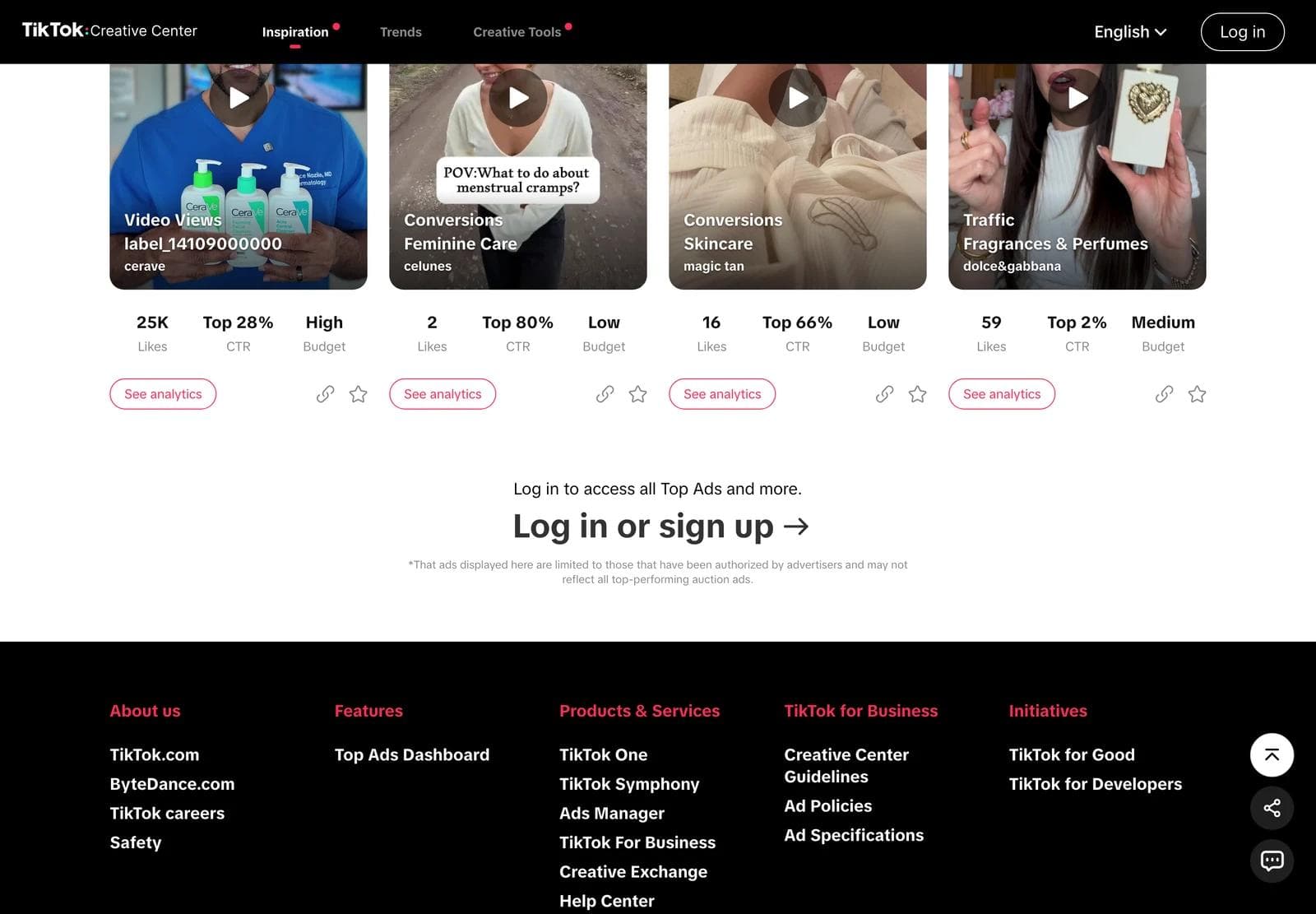
Everything above is observable. "Converts", "winner", and "top performer" are not, in any of the four libraries, and the guides that say a 30-day run means an ad is profitable are stating a hypothesis as a fact.
A worked example: one serum, two adjacent searches
Take a skincare brand with a vitamin C serum. The competitor search is "skincare" on Meta, active image ads, US, and it is worth an hour: 125 cards, 87 advertisers, a median of 87 days running, and a look at what the category claims. Then the adjacent searches.
Cosmetics passes all three parts of the test: same buyer, a comparable price, a product that cannot be mistaken for a serum. Two ads from that search, with their records as captured on September 2, 2026:
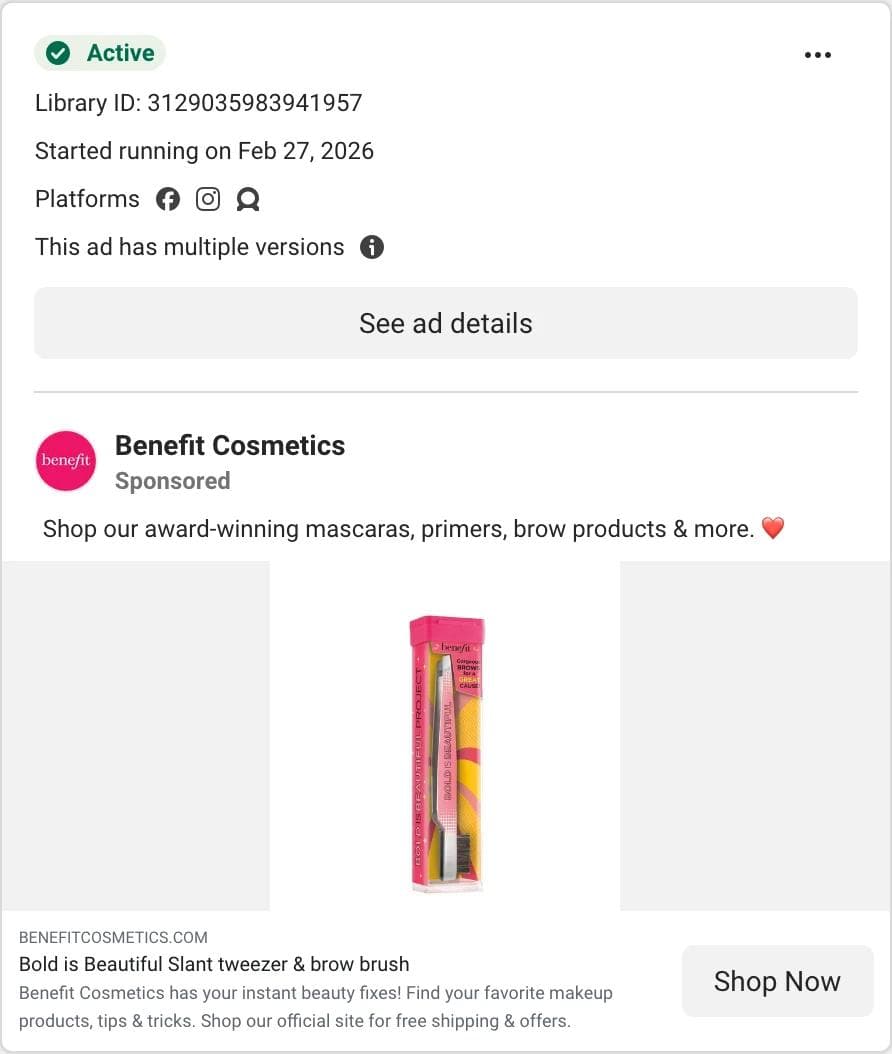
Benefit puts one product on a plain field with no text in the image, the product name as the headline, and the proof in the first words of the primary text: "Award-winning". What transfers to the serum: the whole layout, and the decision to carry the claim in the copy so the creative stays reusable across products. What does not: the award.
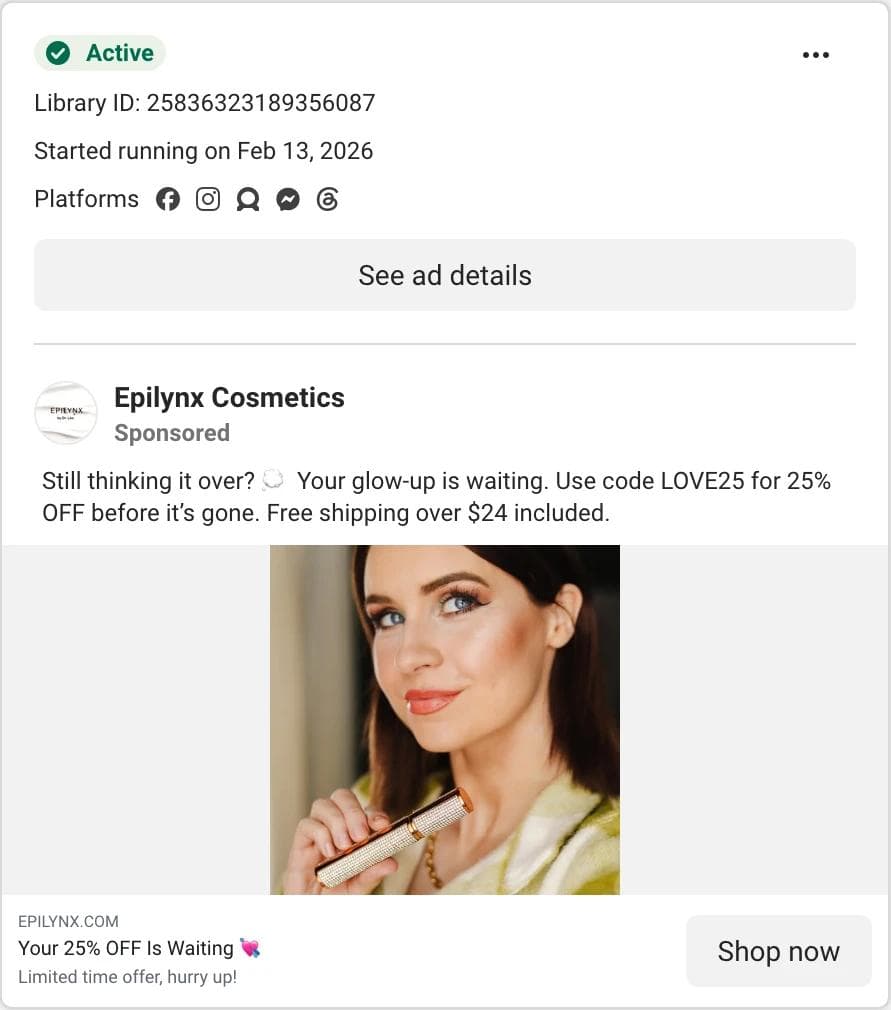
Epilynx opens the primary text with "Still thinking it over?", which is retargeting language, then gives a code, a shipping threshold, and a person holding the product. What transfers: the offer structure, code plus threshold plus urgency line, and the person-in-frame decision. What does not: the model and the photograph.
Coffee passes on a different logic: the buyer is the same person on the same phone, the purchase is a daily routine at a comparable price, and nothing about a coffee ad can be confused with skincare. From the Instagram-filtered coffee search (78 cards from 45 advertisers, median 94 days running):
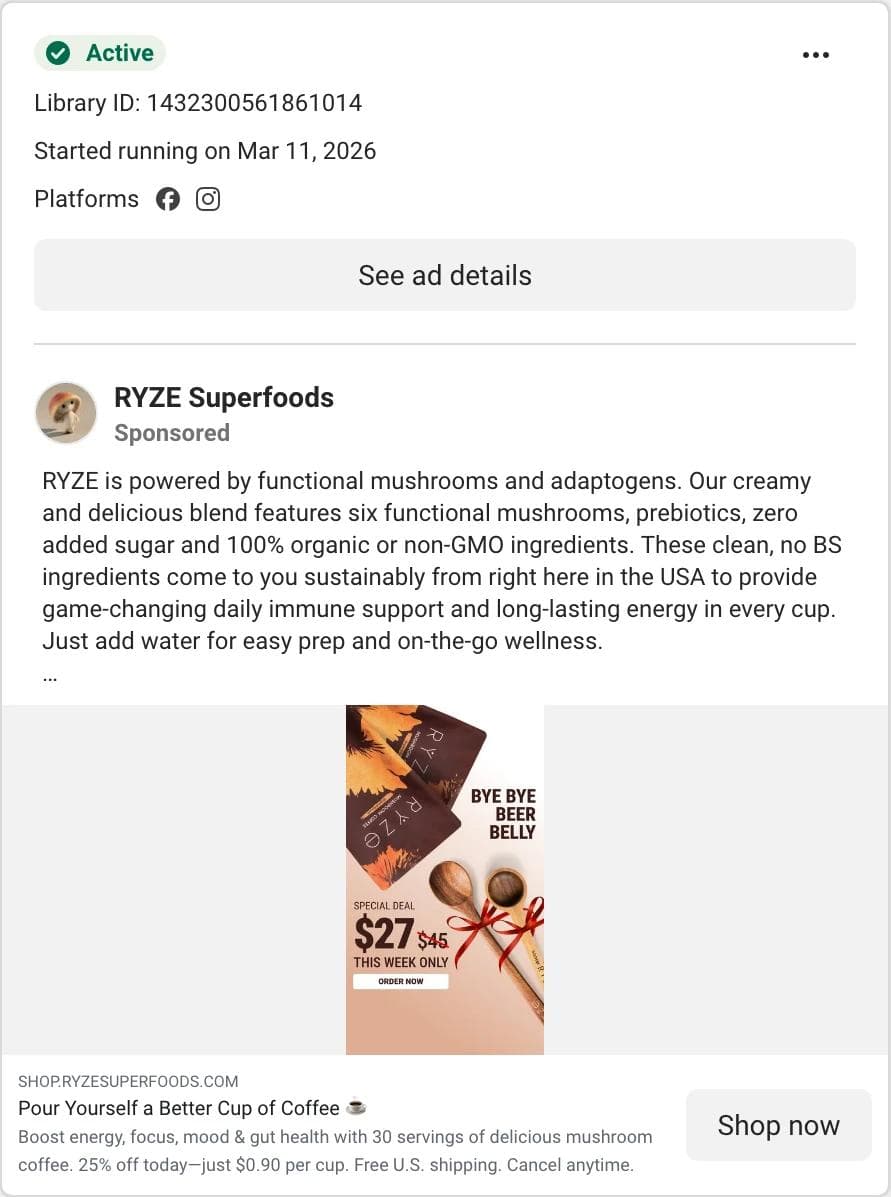
RYZE's price block, new price large, old price struck, an urgency line, a button-shaped element, sits in the middle third of a vertical frame where nothing from Instagram's interface covers it. What transfers: the price block and its placement, which is the most copied structure in direct-response Stories. What does not: "this week only" if it is not true for you, and the body claim in the corner. One caution from the dedupe rule: RYZE held 12 of the 78 coffee cards, so take one.
What failed. Supplements, for the reasons above. And a check on the dedupe rule inside the passing searches: the three longest-running product ads in skincare all came from one brand, Botanique Paris, started the same day and still live at 507 days, which is one advertiser's tested set rather than three data points.
The same walk works in B2B. A CRM brand's adjacent search on LinkedIn is payroll, and the survivor there is a stat-first layout.
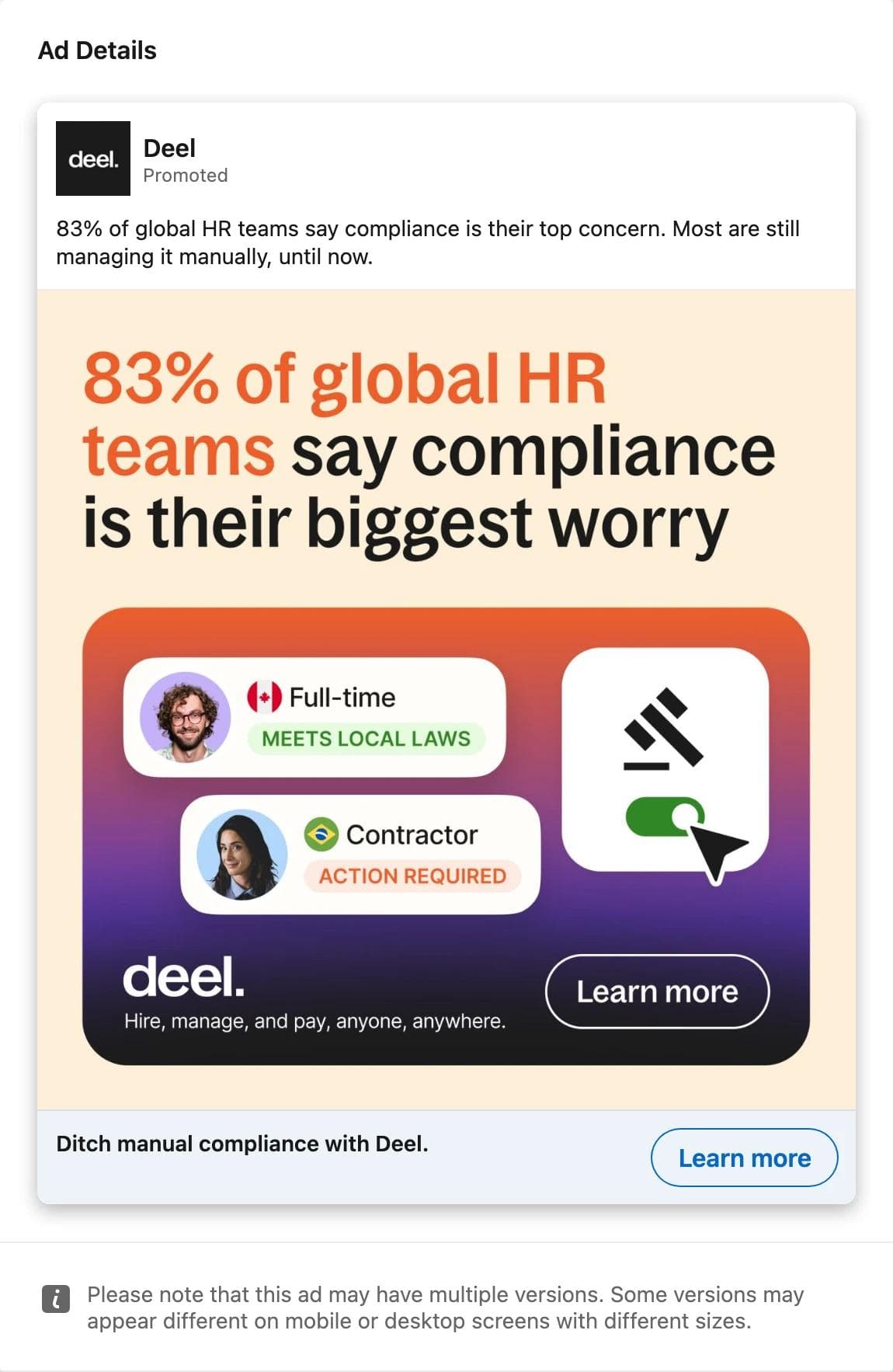
A number as the biggest thing in the frame, the product reduced to one illustrated state, the benefit in plain words under the image. Deel ran it alongside a carousel and two sibling single images with the same compliance message, and all were still live after ten weeks. What transfers to a CRM: the hierarchy and the discipline of one number. What does not: the 83 percent, which has to be your own stat with your own source. The static ads guide takes this anatomy further, with longevity by layout across 120 crops.
Build the reference set
A reference set is six to ten saved ads with a note on why each is there, at least a third of them from adjacent categories and no more than two from any advertiser. None of the libraries can save anything, so the set lives in a document or folder you keep. For each ad record:
- The ID and the advertiser. Meta's Library ID, LinkedIn's ad number, TikTok's permalink ID, or Google's advertiser and creative IDs, so you can find it again after it changes or disappears.
- The library, the country you searched, and the date. The same search returns different cards a day later, and the EU condition changes what a detail page shows.
- The signals the library gave you. Start date and versions on Meta; run dates, band, and country split on LinkedIn; CTR percentile and highlight frames on TikTok; last shown, first shown, and variations on Google.
- What the eye lands on first, in one phrase: product on a plain field, face with a caption, stat as headline, price block, receipt, badge wall.
- What the ad asks the reader to believe, and where the proof for it lives: image, headline, primary text, or a third party's frame.
- What you would keep and what you would change for your brand. This field is what makes a gallery a swipe file.
Save the creative from the detail page and name the file with the ID. For video, save the first frame and one from a second or two in; on TikTok, the seconds the detail page names as highlight frames.
The creative belongs to the advertiser. Saving it to study is ordinary competitive research. Reusing its photography, its people, its footage, or its copy in your own ad is not. Adapt the structure, then supply your own product, people, and claims.
Turn references into on-brand ads in Moda
What you saved is a set of structures: a layout, a hierarchy, and an argument. Rebuilding one with your own brand kit, product photography, and claims is a design task, and it is one an AI design agent handles well when you give it references instead of adjectives.
In Moda, attach two to four saved ad images to a message, name the brand kit to apply, and describe what stays and what changes. For the serum, using the cosmetics and coffee references above:
Use these three ads as layout references. Make four static Instagram feed ads (1080 x 1350) for our vitamin C serum using the Glowlab brand kit. First two: the product centered on a plain brand-color field, no text in the image, product name as the headline, one proof line in the primary text. Third: a person holding the product with an offer in the copy (code, free-shipping threshold, one urgency line). Fourth: a 1080 x 1920 version with a price block in the middle third of the frame. Replace all photography with our product shots, write new headlines, and do not reuse any reference copy or claims.The agent builds the ads on an editable canvas, so the result is not a flat export. Headlines, product images, badges, and price blocks stay as separate objects you can move, restyle, or swap, and the same layout can be pushed to a 1080 x 1080 square, a 1200 x 627 LinkedIn image, or a 300 x 250 display unit without rebuilding it.
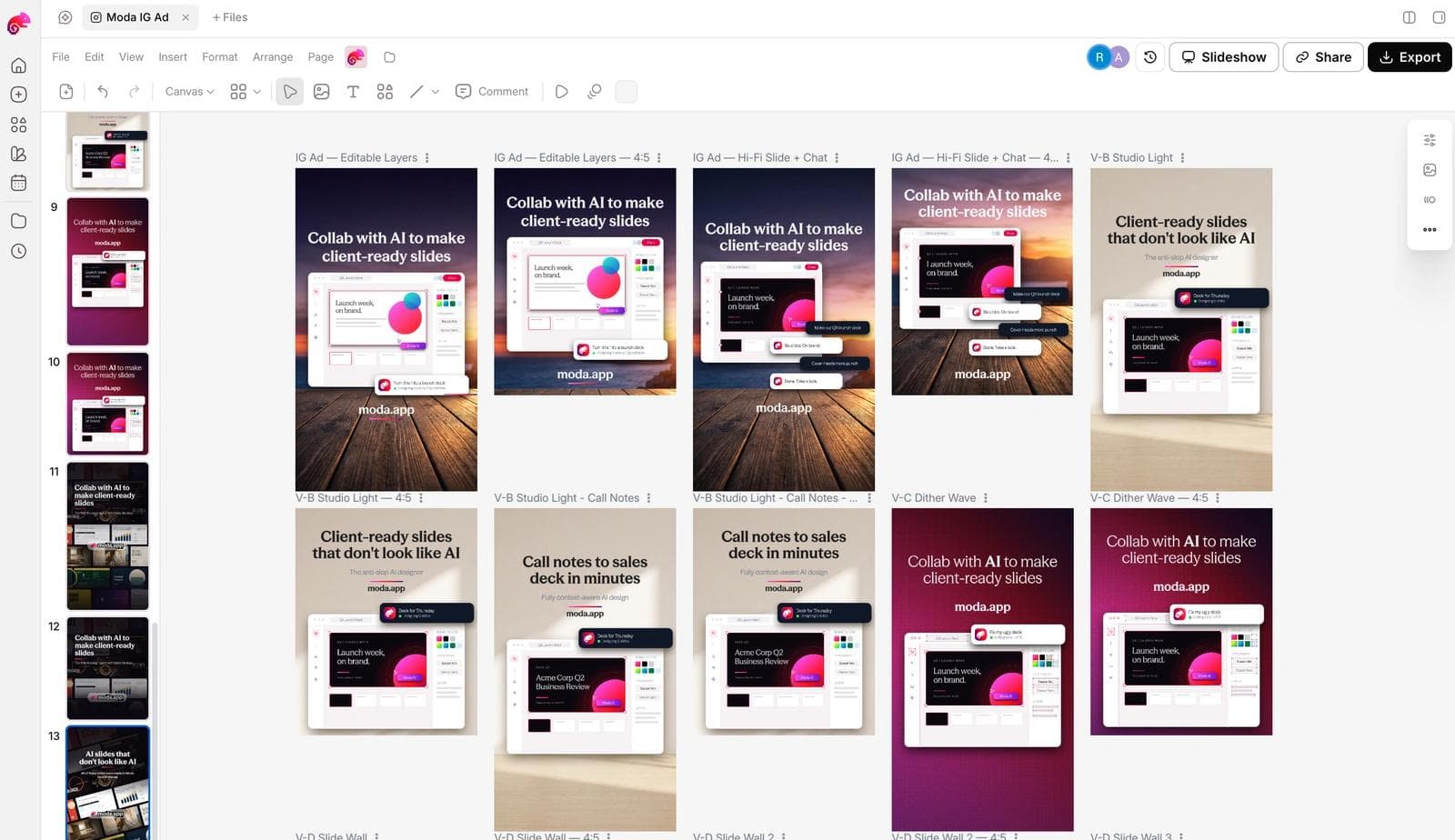
Two limits, stated plainly. Moda does not find the ads, monitor advertisers, or run and measure campaigns; the libraries are the research and Ads Manager is the test. And a reference is a structure, not a license: tell the agent to replace the photography, the people, and the claims, then check that the claims it wrote are ones you can support. If the brand side is not set up, how AI design tools build a brand kit from your website covers what gets extracted and what to correct. For one placement worked end to end, the Instagram Stories ads examples post walks twelve live ads through the same record.
Frequently asked questions
How do I see my competitors' ads for free?
Open the library for the platform: the Meta Ad Library for Facebook and Instagram, the LinkedIn Ad Library, the TikTok Creative Center, or the Google Ads Transparency Center. Search the competitor's name (or website, on Google), pick the country, and every active ad appears with its creative and copy. None of the four needs an account.
What is the best ad spy tool?
For most teams, the free libraries. Paid tools add history, cross-platform search, and saved collections, and estimate spend; the estimates are estimates. None of them measures anything the libraries hide, because Meta, LinkedIn, TikTok, and Google do not publish spend or results for commercial ads. Decide whether you need the archive and the workflow before paying for the data.
Can I tell which competitor ads are working?
Not from a library. The proxies are longevity (Meta, and LinkedIn and Google for EU-shown ads), the versions flag (Meta), impressions bands (LinkedIn and Google, EU only), and TikTok's likes and CTR percentile for authorized ads. Each is a hypothesis about budget or attention, not a result. Compare within one advertiser's set and test the structure with your own product.
Why search adjacent categories instead of competitors?
A competitor search returns the ads everyone in your category has already seen, and copying one puts your creative beside theirs. An adjacent category, same buyer and comparable purchase but a different product, gives you structures that solve the same feed problem and cannot be mistaken for a rival's. Search competitors once for context, then spend the time next door.
Which ad library shows impressions or spend?
None shows spend for commercial ads. LinkedIn shows an estimated impressions band and a country split for ads whose targeting includes the EU. Google shows a times-shown range for ads shown in the EEA, after a 90-day delay. TikTok shows likes, comments, shares, a CTR percentile, and a budget tier for ads advertisers authorized. Meta shows nothing, though it lets you sort by impressions.
Is it legal to use competitor ads as references?
Viewing public ads is ordinary competitive research; the platforms publish the libraries to be searched. Reusing an advertiser's photography, model, footage, copy, or claims in your own ad is not, and a claim you cannot support is a problem whether or not you copied it. Borrow the structure and supply your own assets and proof.

Real editable visuals. Real canvas. Full control.
Fly through design work