Canva Alternatives: Judging Tools on What Survives an Edit
By Moda · Last updated
Teams leave Canva for three reasons: brand control that depends on discipline, output that resists structural change, and exports that arrive as pictures. Moda is an object canvas, so a generated design stays addressable afterwards. Figma and Adobe remain better where the asset is the product.
Comparisons of Canva alternatives tend to line up template counts, seat prices and export formats. Those are real, and they are also the dimensions every vendor already optimises for. The dimension that decides how a tool feels in week three is what happens the second time a file is opened.
The frictions a bigger template library does not fix
Three reasons recur: brand consistency that depends on every person checking their own work, layouts that resist structural change once generated, and exports that open elsewhere as flattened pictures. Template volume solves none of them, which is why a larger library rarely ends the search.
The trigger is rarely one bad design. It is the accumulation: a deck that drifted from the brand, a headline that could not change without rebuilding the frame around it, a file a colleague could not edit. Each is survivable alone, and together they read as friction with no obvious cause.
| The friction | The usual answer | What addresses it |
|---|---|---|
| Brand drifts across a long deck | A brand kit that stores assets | A brand applied at generation, then enforced on later edits |
| A layout cannot be restructured | More templates to choose from | Objects that can be moved without reflowing neighbours |
| Exports open as pictures | A higher-resolution export | Native objects in the exported file, checked element by element |
| Non-designers produce off-brand work | Training and review | Constraints the tool applies rather than a person remembering |
The dimension most comparisons miss
Nearly every comparison scores generation quality, which is the first ten seconds of the work. The rest is revision, and revision depends on whether the output is a picture or a set of addressable objects. That distinction is invisible in a screenshot and decisive in practice.
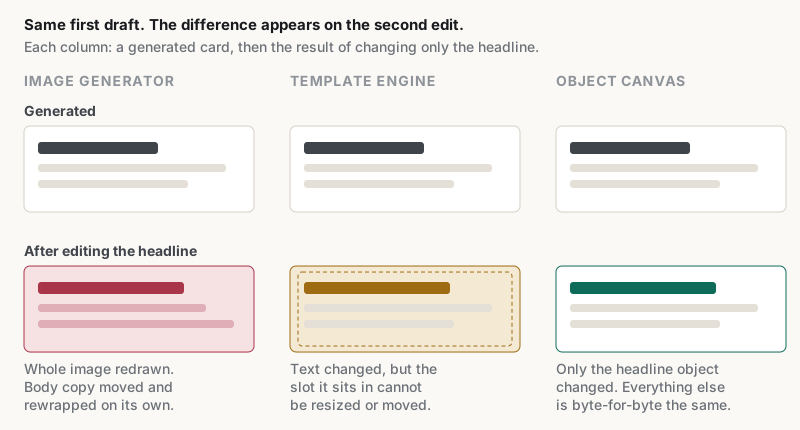
An image generator produces pixels. A template engine produces fixed slots. An object canvas produces named text, shapes and charts that keep their relationships. All three can produce the same first draft, so the difference only appears when something has to change.
So the question is not whether a tool uses AI. It is what the AI hands over. Regenerating a whole design to change one sentence is categorically different from editing the sentence, even when both are described as AI-powered design.
How to test it before committing
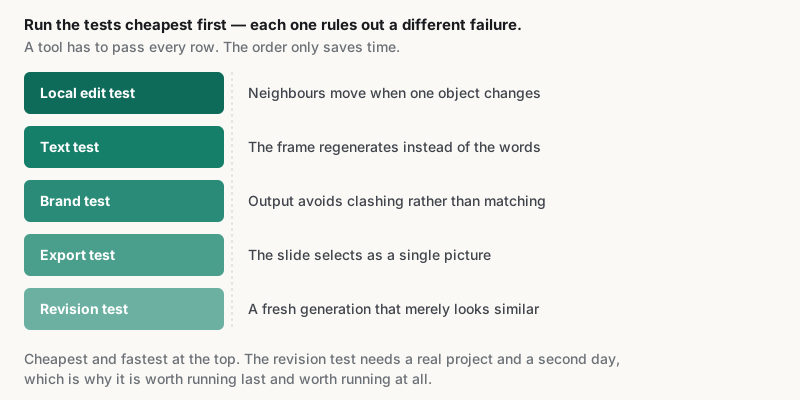
Editability is checkable in an afternoon rather than argued about. Five tests separate an editable output from a customizable one, and each names the near-miss that reads as a pass. Run them on a real brand and a real document rather than a demo file.
The tests are published in full at /resources/ai-design-agent, with the action, the pass condition and the failure that looks like success for each: the local edit test, the text test, the brand test, the export test and the revision test. Run them in that order, because the first is cheapest and eliminates the most candidates.
Run the export test against a published specification rather than an impression. Moda states element by element what leaves as a native PowerPoint object and what becomes a picture at /resources/editable-pptx-export, including where its own export flattens. A vendor who cannot produce an equivalent list is asking to be taken on trust.
Which tool fits which job
The honest answer varies by what is being produced. Canva remains strong for one-off social assets from a template. The cases below are where teams tend to outgrow it, and the middle column is the signal to look for rather than a complaint about any tool.
| The job | Signal to look for | What to shortlist |
|---|---|---|
| Non-designers producing on-brand assets | Brand compliance depends on someone checking every asset by hand | Enforced brand rules, not stored templates |
| Editing what the AI produced | Small corrections mean regenerating the artwork | Object-based output rather than a flattened image |
| Keeping a long deck consistent | Page four has drifted from page one | A shared system applied across pages |
| Handing a deck to PowerPoint | The export opens as pictures of slides | Native objects, and text that stays text |
| Specialist design work | The asset is the brand, not a carrier for it | Figma or Adobe, and a designer |
Where Moda is not the answer
An object canvas is the wrong tool when the artwork itself is the deliverable. Illustration, typography design and pixel-level retouching belong in Figma, Illustrator or Photoshop. Moda also flattens some elements on export, which is why that specification is published rather than summarised.
The clearest limit is the export test applied to Moda itself. Charts drawn as live shapes are rasterised on purpose, and several styling effects turn an element into a picture. Those cases are listed at /resources/editable-pptx-export rather than waved at, because a specification a reader can check beats a claim of completeness.
The second limit is judgement. A tool that applies a brand consistently is not a substitute for deciding what the brand should be, and a generated deck still needs someone who knows which argument the slides are making.
What to do with a shortlist
For teams whose bottleneck is producing on-brand work without a designer in the loop, an object canvas answers the problem Canva leaves open. For specialist design work, Canva is not the tool being replaced and neither is Moda. The deciding test is what happens on the second edit.
Coverbase built a presentation the night before an onsite pilot and corrected slides during the session itself, described at https://moda.app/case-studies/coverbase. That is the revision test in a real setting rather than a benchmark: the value was not the first draft, it was that the draft could be changed while it was being presented.
The recommendation is procedural rather than partisan: take one real brand, one real document, and run the five tests on every tool shortlisted. A comparison built from a vendor's own feature list will always favour the vendor who wrote it.
Related guides
Key takeaways
- Template count and seat price are the dimensions every vendor optimises for; revision behaviour is the one that decides the work.
- An image generator, a template engine and an object canvas can produce the same first draft and behave completely differently on the second edit.
- Editability is testable in an afternoon: run the local edit, text, brand, export and revision tests on a real brand.
- A vendor that cannot state element by element what survives an export is asking to be trusted rather than checked.
- Where the artwork itself is the deliverable, Figma and Adobe remain the right answer and neither Canva nor Moda replaces them.
Frequently asked questions
What is the best Canva alternative?
It depends on the job. For non-designers producing on-brand assets that need editing afterwards, an object canvas fits. For illustration and pixel-level work, Figma or Adobe. A single ranked answer usually reflects the vendor who wrote the comparison rather than the work.
Why do teams leave Canva?
Rarely because of a single design. The pattern is brand drift across long documents, layouts that resist structural change once generated, and exports that open elsewhere as flattened pictures. More templates does not address any of the three, which is why the search continues.
How can editability be tested before buying?
Run five tests on a real brand and a real document: change one object, edit a headline in place, apply a brand kit across formats, export and click into the file, then return the next day and request one targeted change. Each has a documented pass condition.
Does an AI design tool replace a designer?
Not where the artwork is the deliverable. It changes who produces routine on-brand collateral, which is most of what a marketing team ships. Deciding what the brand should be, and what argument a deck makes, remains work a tool does not do.
Moda publishes this page and builds one of the tools it discusses. The evaluation method is stated so it can be run against Moda and against every alternative, including the cases where Moda's own export flattens an element.