Salmon palettes and pairings
HEX
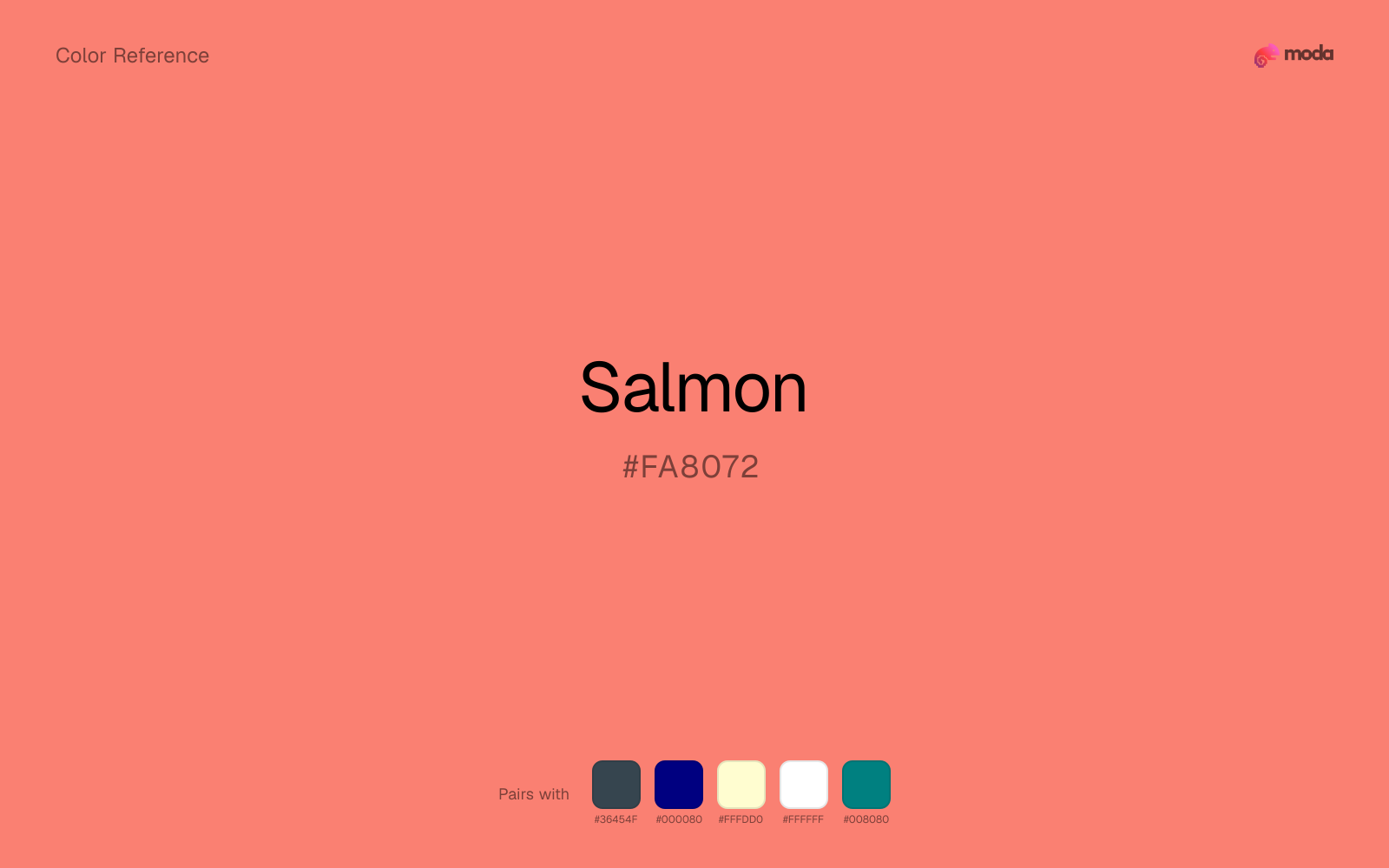
#FA8072
RGB
250, 128, 114
HSL
6°, 93%, 71%
HSV
6°, 54%, 98%
A rosy orange that sits closer to pink than most citrus hues, giving a warm flush rather than a citrus glare. #FA8072 works well when you want orange's heat tempered by something floral or flesh-toned. It reads as a classic "salmon" swatch in digital palettes.
Best for
Product launches, promotional banners, and e-commerce storefronts.
Accessibility
Check contrast before using salmon for text-heavy layouts, especially on low-contrast backgrounds.
How does salmon compare to nearby colors?
What is the difference between salmon and tangerine?
Salmon (#FA8072) and Tangerine (#FF9966) may look neighboring at first glance, yet their surface character diverges once they sit next to whites, charcoals, and other real layout neutrals. Salmon and Tangerine are close enough to substitute for each other, but they do not create the same supporting cast once typography, photography, and neutrals are added. Choose salmon when the surrounding system aligns better with beauty, lifestyle, and soft campaign backgrounds, and move to tangerine when the stronger contextual fit is food, promotion, and social-first graphics.
What color is salmon?
The name comes from salmon flesh, whose color is influenced by diet. In fashion and interiors, salmon has had recurring moments as a bridge between coral, rose, and orange families.
What is the hex code for salmon?
| Format | Value |
|---|---|
| HEX | #FA8072 |
| RGB | rgb(250, 128, 114) |
| HSL | hsl(6°, 93%, 71%) |
| HSV / HSB | hsv(6°, 54%, 98%) |
| CMYK (approx.) | cmyk(0%, 49%, 54%, 2%) |
Convert Salmon to other color formats
Open the color converter with Salmon (#FA8072) prefilled to copy RGB, HSL, HSV, CMYK, or OKLCH values.
Convert Salmon in the color converter →What does salmon mean in design?
Salmon tends to read as lively but softer than pure orange — sometimes social, sometimes romantic, depending on pairing. Compared with tangerine, salmon is usually pink-forward; compared with terracotta, it is lighter, less earthy, and less brick-red.
How do I use salmon in code?
| CSS (hex) | color: #FA8072; |
| CSS (rgb) | color: rgb(250, 128, 114); |
| CSS (hsl) | color: hsl(6, 93%, 71%); |
| RGB % | rgb(98%, 50%, 45%) |
| Tailwind | text-[#FA8072] |
| SwiftUI | Color(red: 0.980, green: 0.502, blue: 0.447) |
| UIKit | UIColor(red: 0.980, green: 0.502, blue: 0.447, alpha: 1.0) |
| Android | Color.rgb(250, 128, 114) |
| Compose | Color(0xFFFA8072) |
| Web Safe | #FF9966 |
Is salmon accessible?
| Combination | Ratio | AA | AA lg | AAA | AAA lg | UI |
|---|---|---|---|---|---|---|
| AaWhite text on this color | 2.5:1 | ✗ | ✗ | ✗ | ✗ | ✗ |
| AaBlack text on this color | 8.4:1 | ✓ | ✓ | ✓ | ✓ | ✓ |
| AaThis color as text on white | 2.5:1 | ✗ | ✗ | ✗ | ✗ | ✗ |
| AaThis color as text on black | 8.4:1 | ✓ | ✓ | ✓ | ✓ | ✓ |
WCAG 2.1: AA normal ≥ 4.5:1, AA large text ≥ 3:1, AAA normal ≥ 7:1, AAA large ≥ 4.5:1, UI components ≥ 3:1.
How does salmon look with color blindness?
Simulated appearance for common types of color vision deficiency. Actual perception varies by individual.
What colors go with salmon
Charcoal lets salmon stay light and atmospheric while still giving the layout a readable dark value for text and hierarchy.
Because salmon already carries warmth, navy blue gives the pair a steadier backbone and keeps it closer to beauty and lifestyle work than to one-note seasonal color.
Cream lets salmon stay expressive without turning the whole composition stark; the result feels closer to editorial or packaging work than to raw UI default.
What colors clash with salmon
With salmon, Neon Green pushes the work toward novelty or screen-effect territory faster than most brand or editorial systems can tolerate.
With salmon, magenta introduces a second emotional story instead of reinforcing the first one, so the palette can feel internally split.
How should I use salmon in design?
- •Use salmon for buttons, badges, and chart accents where it can stand out. Test text contrast with WCAG tools before using it for body copy on light backgrounds.
- •Salmon leans warm, so cool counterparts like navy, teal, or slate create the cleanest contrast. For a softer, tonal look, stay within neighboring warm hues and let value differences do the work.
- •Salmon's high saturation makes it most effective in small doses — buttons, chart highlights, notification badges, and social media accents.
What are good salmon palettes?
Morning palette
Product launches, promotional banners, and e-commerce storefronts.
Sunlit warmth
Startup branding, pitch materials, and product landing pages.
Design with salmon in Moda
Create a presentation or document using salmon as your accent color. Moda's AI applies your color palette automatically.
Create a design with salmon →What are the shades and tints of salmon?
Shades (darker)
Tints (lighter)
Tones (desaturated)
Hue variations
What are the color harmonies for salmon?
Harmonies are calculated from the base swatch. When a harmony matches a named color page, it links there; otherwise it appears here as a computed reference swatch.
Similar colors
Tangerine
Tangerine sits close to salmon on the wheel, but it carries more pigment pressure, which makes it better for faster emphasis and brighter accent work than for broader coverage and quieter supporting roles.
Coral
Coral sits close to salmon on the wheel, but it carries more pigment pressure, which makes it better for faster emphasis and brighter accent work than for broader coverage and quieter supporting roles.
Terracotta
Terracotta stays very close to salmon in hue, but it lands darker, which makes it better for headlines, anchors, and darker sections than for lighter surfaces and more open applications.
Mango
Mango is almost the same hue as salmon; the real difference is value, with mango feeling more grounded and anchor-ready.
Coral Red
Coral Red is almost the same hue as salmon; the real difference is value, with coral red feeling more grounded and anchor-ready.
Frequently asked questions
What is the hex code for salmon?
The hex code for salmon is #FA8072. In RGB, that's 250 red, 128 green, and 114 blue. The approximate CMYK equivalent is 0% cyan, 49% magenta, 54% yellow, and 2% key (black).
Is salmon a warm or cool color?
Salmon sits on the warm side of the palette, so it pairs easily with other warm tones and becomes more energetic when you place it against cooler blues or blue-grays.
Should salmon lead the palette or stay in supporting roles?
Salmon has enough chroma to take the lead, but it usually performs best when the surrounding system stays quieter. Treat it as the voice of emphasis, not the answer to every layout need.
Where does salmon work best in a layout?
Salmon is better on broad surfaces than in tiny details, so treat it as a background or support color and let darker accents carry the sharp hierarchy.
Is salmon accessible?
Salmon works better with dark text than white text. Black text reaches 8.4:1 contrast on the swatch, which makes the color more usable as a background or highlight surface than as a dark panel.
More orange colors
Keep exploring color resources
All color pages
Browse the full library of color references, pairings, and palettes.
Orange colors
Compare salmon with other orange tones.
Brown colors
Explore nearby color families to build stronger palettes and contrasts.
Neutral colors
Explore nearby color families to build stronger palettes and contrasts.
Red colors
Explore nearby color families to build stronger palettes and contrasts.
Last updated April 6, 2026
Color values are computed from the listed hex code using standard conversion formulas. RGB, HSL, and HSV are exact screen-ready conversions. CMYK is an approximate on-screen reference, not a press-ready print specification. Pairings, palettes, and use-case guidance are heuristic recommendations derived from color relationships, contrast behavior, and common presentation, document, and UI patterns.