Using Dark Green in design
HEX
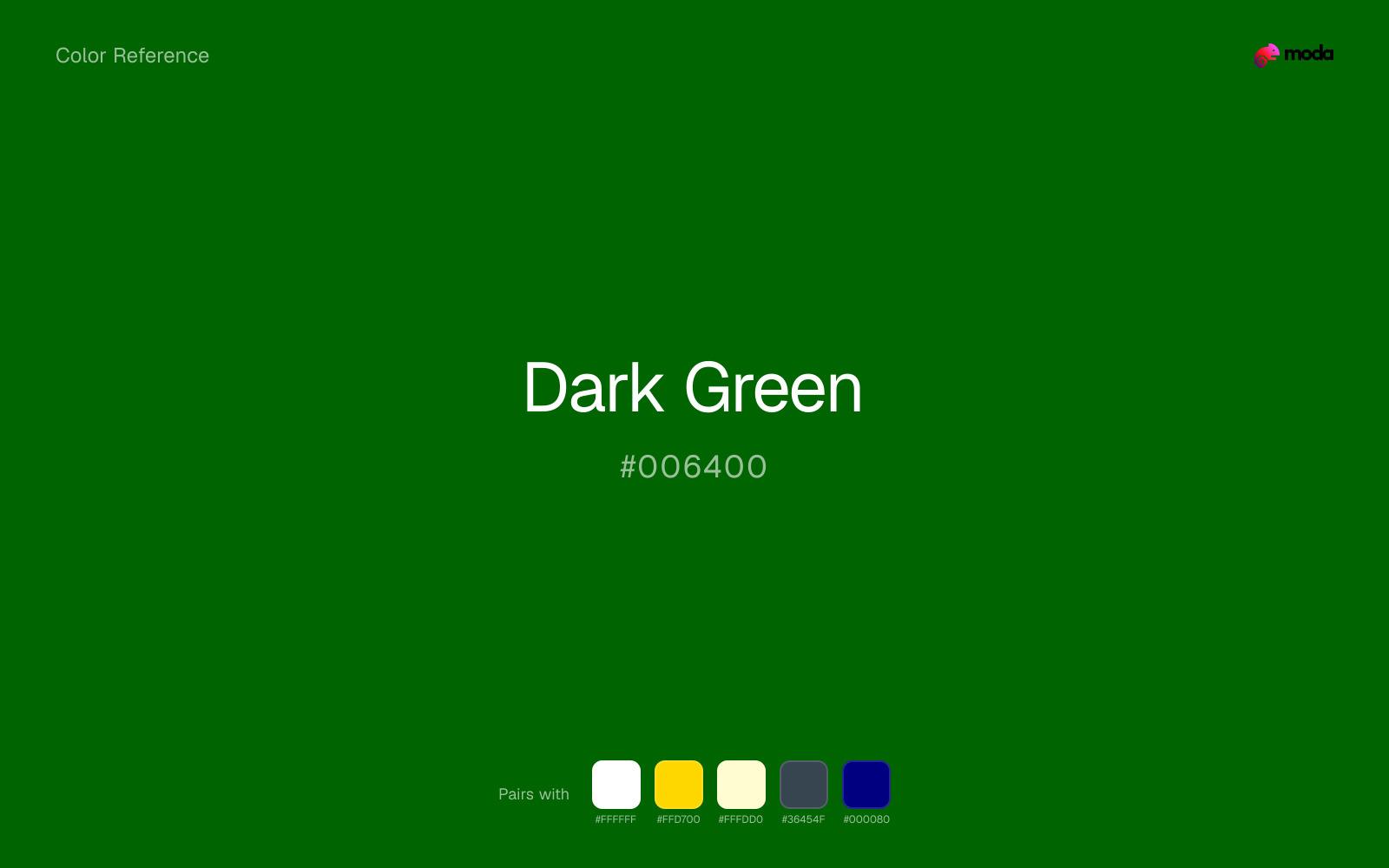
#006400
RGB
0, 100, 0
HSL
120°, 100%, 20%
HSV
120°, 100%, 39%
Dark green pushes light out of the room the way deep shade does under a canopy — rich, quiet, and a little serious. #006400 is dark enough to behave like a near-neutral anchor while still unmistakably green. It pairs naturally with cream, brass, and parchment.
Best for
Financial services branding and client-facing digital experiences.
Compare with
Accessibility
White text on dark green passes AAA at 7.44:1, so it is safe for dark backgrounds and section headers.
How does dark green compare to nearby colors?
What is the difference between dark green and forest green?
Dark Green (#006400) looks cleaner and more charged than Forest Green (#228B22) when the two are shown together. Dark Green is the one that can carry a full dark section without blinking; Forest Green is more often the accent or companion swatch. Reach for dark green when the palette can tolerate a louder note; stay with forest green when the work calls for longer-running color.
What color is dark green?
"Dark green" appears in interior paint lines, institutional branding, and outdoor gear as a default deep foliage tone. It is also one of the HTML/CSS named colors.
What is the hex code for dark green?
| Format | Value |
|---|---|
| HEX | #006400 |
| RGB | rgb(0, 100, 0) |
| HSL | hsl(120°, 100%, 20%) |
| HSV / HSB | hsv(120°, 100%, 39%) |
| CMYK (approx.) | cmyk(100%, 0%, 100%, 61%) |
Convert Dark Green to other color formats
Open the color converter with Dark Green (#006400) prefilled to copy RGB, HSL, HSV, CMYK, or OKLCH values.
Convert Dark Green in the color converter →What does dark green mean in design?
Dark green is often associated with tradition, endurance, and understated luxury. Compared with hunter green it can feel slightly cleaner and less gray; versus pine or teal it tends to read as more purely forest and less aquatic.
How do I use dark green in code?
| CSS (hex) | color: #006400; |
| CSS (rgb) | color: rgb(0, 100, 0); |
| CSS (hsl) | color: hsl(120, 100%, 20%); |
| RGB % | rgb(0%, 39%, 0%) |
| Tailwind | text-[#006400] |
| SwiftUI | Color(red: 0.000, green: 0.392, blue: 0.000) |
| UIKit | UIColor(red: 0.000, green: 0.392, blue: 0.000, alpha: 1.0) |
| Android | Color.rgb(0, 100, 0) |
| Compose | Color(0xFF006400) |
| Web Safe | #006600 |
Is dark green accessible?
| Combination | Ratio | AA | AA lg | AAA | AAA lg | UI |
|---|---|---|---|---|---|---|
| AaWhite text on this color | 7.44:1 | ✓ | ✓ | ✓ | ✓ | ✓ |
| AaBlack text on this color | 2.82:1 | ✗ | ✗ | ✗ | ✗ | ✗ |
| AaThis color as text on white | 7.44:1 | ✓ | ✓ | ✓ | ✓ | ✓ |
| AaThis color as text on black | 2.82:1 | ✗ | ✗ | ✗ | ✗ | ✗ |
WCAG 2.1: AA normal ≥ 4.5:1, AA large text ≥ 3:1, AAA normal ≥ 7:1, AAA large ≥ 4.5:1, UI components ≥ 3:1.
How does dark green look with color blindness?
Simulated appearance for common types of color vision deficiency. Actual perception varies by individual.
What colors go with dark green
White is the easiest way to keep dark green usable in covers, dashboards, and dark sections because the contrast still holds at presentation distance.
With a cooler color like dark green, gold adds richness and turns the system toward premium packaging, hospitality, or ceremonial branding.
Cream takes the hard digital edge off dark green and makes the color feel more printed, paper-backed, and approachable.
What colors clash with dark green
Neon Green changes the meaning of dark green too abruptly, replacing the source color's finance, outdoors, and institutional systems cues with something much louder and less stable.
Magenta remaps dark green too aggressively, dragging it away from finance, outdoors, and institutional systems and into a brighter, more performative palette.
With dark green, orange creates a warm-cool collision that announces itself before it earns a compositional reason to exist.
Pastel Pink can undercut dark green's authority by turning the combination more decorative than decisive.
How should I use dark green in design?
- •Dark Green works well as a dark background with light text, or as a bold accent for headlines and callout bars in presentations and branded materials.
- •Pair dark green with warm accents (gold, rust, amber) when you need more energy, or stay in cool territory (navy, silver, sage) for a composed, professional look.
- •Dark greens tones like dark green tend to feel serious and anchoring — useful when the design brief calls for weight and restraint.
What are good dark green palettes?
Ink and gold
Financial services branding and client-facing digital experiences.
Neutral ground
Personal branding, portfolio websites, and resume designs.
Design with dark green in Moda
Create a presentation or document using dark green as your accent color. Moda's AI applies your color palette automatically.
Create a design with dark green →What are the shades and tints of dark green?
Shades (darker)
Tints (lighter)
Tones (desaturated)
Hue variations
What are the color harmonies for dark green?
Harmonies are calculated from the base swatch. When a harmony matches a named color page, it links there; otherwise it appears here as a computed reference swatch.
Similar colors
Green
Green lives in the same neighborhood as dark green, but the finish shift is enough to make one feel better for finance, outdoors, and institutional systems and the other for a different visual context.
Forest Green
Forest Green stays in the same color family as dark green, but the change in value moves it into different layout jobs, especially once backgrounds, charts, or section dividers enter the system.
Hunter Green
Hunter Green is almost the same hue as dark green; the real difference is value, with hunter green feeling more open and surface-friendly.
Avocado
Avocado keeps some overlap with dark green, but the shift in finish and association is enough to make one feel better suited to this particular layout than the other.
Lime Green
Lime Green tracks close to dark green in hue, but the value shift changes where each one earns its place: lime green is easier to use for backgrounds, tints, and softer supporting areas, while dark green holds onto accents, stronger hierarchy, and firmer structure.
Frequently asked questions
What is the hex code for dark green?
The hex code for dark green is #006400. In RGB, that's 0 red, 100 green, and 0 blue. The approximate CMYK equivalent is 100% cyan, 0% magenta, 100% yellow, and 61% key (black).
Is dark green a warm or cool color?
Dark Green reads as cool. It settles naturally beside blues, greens, silver, and charcoal, and feels more animated when paired with warm accents like gold, coral, or rust.
Can dark green work as a dark background color?
Dark Green can work well as a dark background or cover color because it still carries enough identity to feel intentional rather than default black. The main requirement is pairing it with a light, high-contrast text color.
How should I use dark green in a design?
Dark Green works well as a dark background with light text, or as a bold accent for headlines, callout bars, and key visuals. It adds weight and authority without the starkness of pure black.
Can I use dark green for text or backgrounds?
Dark Green is strong enough for white text at 7.44:1 contrast, so it can handle dark panels, tags, and section headers without much trouble. As text on white, though, it is usually better reserved for larger headings or short accents than for long paragraphs.
More green colors
Keep exploring color resources
All color pages
Browse the full library of color references, pairings, and palettes.
Green colors
Compare dark green with other green tones.
Blue colors
Explore nearby color families to build stronger palettes and contrasts.
Brown colors
Explore nearby color families to build stronger palettes and contrasts.
Neutral colors
Explore nearby color families to build stronger palettes and contrasts.
Last updated April 6, 2026
Color values are computed from the listed hex code using standard conversion formulas. RGB, HSL, and HSV are exact screen-ready conversions. CMYK is an approximate on-screen reference, not a press-ready print specification. Pairings, palettes, and use-case guidance are heuristic recommendations derived from color relationships, contrast behavior, and common presentation, document, and UI patterns.