Brick Red meaning and palette guide
HEX
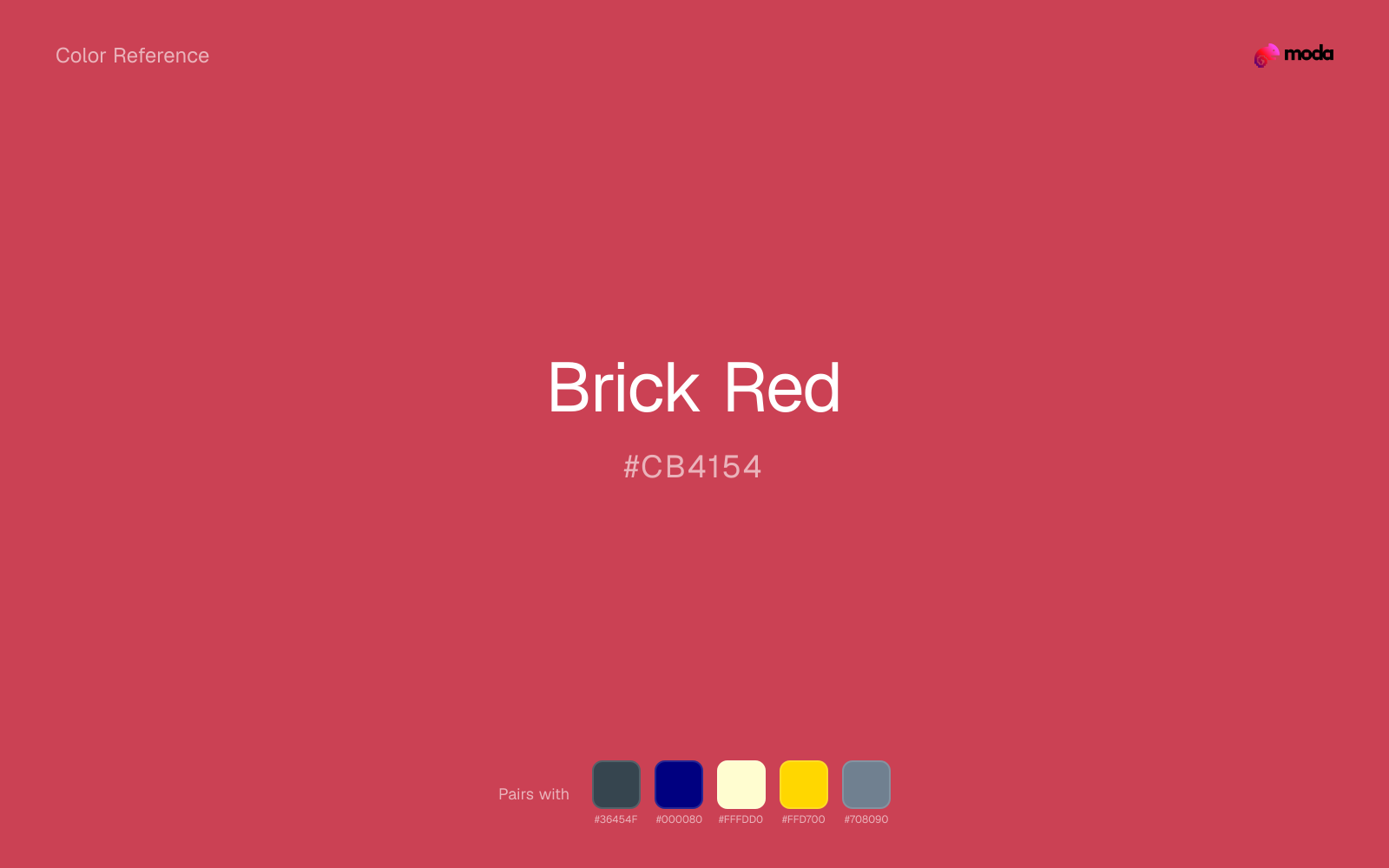
#CB4154
RGB
203, 65, 84
HSL
352°, 57%, 53%
HSV
352°, 68%, 80%
Brick red is dusted down with warmth and gray, like clay after firing rather than wet paint. #CB4154 holds up in rustic palettes, editorial earth tones, and heritage branding where a clean primary red would feel too synthetic. It is especially useful when you need red presence that still feels tactile and weathered.
Best for
Mobile app interfaces, onboarding screens, and light-mode UI themes.
Accessibility
Brick Red text on white passes AA at 4.75:1, which makes it usable for headings and short labels.
How does brick red compare to nearby colors?
What is the difference between brick red and cherry?
Brick Red (#CB4154) and Cherry (#DE3163) may look neighboring at first glance, yet their surface character diverges once they sit next to whites, charcoals, and other real layout neutrals. Brick Red and Cherry can fill many of the same slots, but one steers the palette toward ripe and polished and the other toward poster-bright. Choose brick red when the surrounding system aligns better with brand accents and editorial emphasis, and move to cherry when the stronger contextual fit is retail, sports, and high-urgency graphics.
What color is brick red?
The name describes the characteristic color of fired brick, a material tied to architecture worldwide. The term is common in paint lines and design language for "warm, muted red."
What is the hex code for brick red?
| Format | Value |
|---|---|
| HEX | #CB4154 |
| RGB | rgb(203, 65, 84) |
| HSL | hsl(352°, 57%, 53%) |
| HSV / HSB | hsv(352°, 68%, 80%) |
| CMYK (approx.) | cmyk(0%, 68%, 59%, 20%) |
Convert Brick Red to other color formats
Open the color converter with Brick Red (#CB4154) prefilled to copy RGB, HSL, HSV, CMYK, or OKLCH values.
Convert Brick Red in the color converter →What does brick red mean in design?
Brick red is often associated with stability, craft, and neighborhood-scale familiarity. It tends to read calmer and more nostalgic than vermillion or scarlet, and less purple than wine. That restraint can communicate trustworthiness in branding contexts.
How do I use brick red in code?
| CSS (hex) | color: #CB4154; |
| CSS (rgb) | color: rgb(203, 65, 84); |
| CSS (hsl) | color: hsl(352, 57%, 53%); |
| RGB % | rgb(80%, 25%, 33%) |
| Tailwind | text-[#CB4154] |
| SwiftUI | Color(red: 0.796, green: 0.255, blue: 0.329) |
| UIKit | UIColor(red: 0.796, green: 0.255, blue: 0.329, alpha: 1.0) |
| Android | Color.rgb(203, 65, 84) |
| Compose | Color(0xFFCB4154) |
| Web Safe | #CC3366 |
Is brick red accessible?
| Combination | Ratio | AA | AA lg | AAA | AAA lg | UI |
|---|---|---|---|---|---|---|
| AaWhite text on this color | 4.75:1 | ✓ | ✓ | ✗ | ✓ | ✓ |
| AaBlack text on this color | 4.42:1 | ✗ | ✓ | ✗ | ✗ | ✓ |
| AaThis color as text on white | 4.75:1 | ✓ | ✓ | ✗ | ✓ | ✓ |
| AaThis color as text on black | 4.42:1 | ✗ | ✓ | ✗ | ✗ | ✓ |
WCAG 2.1: AA normal ≥ 4.5:1, AA large text ≥ 3:1, AAA normal ≥ 7:1, AAA large ≥ 4.5:1, UI components ≥ 3:1.
How does brick red look with color blindness?
Simulated appearance for common types of color vision deficiency. Actual perception varies by individual.
What colors go with brick red
Charcoal gives brick red a modern dark partner that feels softer and more material than default black.
Navy blue steadies brick red by adding a sober dark value, which is why the pair can work beyond alerts and sports-style emphasis.
Cream gives brick red a quieter backdrop and preserves a more natural editorial feel than a colder off-white would.
Gold works with brick red when you want the system to feel richer and more intentional, not just higher-contrast.
Slate Gray acts more like structure than spectacle beside brick red, which is often exactly what a stronger source color needs.
What colors clash with brick red
Neon Green changes the meaning of brick red too abruptly, replacing the source color's brand accents and editorial emphasis cues with something much louder and less stable.
Magenta pushes brick red toward a nightclub or cosmetic register that is hard to square with calmer editorial or product work.
With brick red, cyan introduces a colder display-driven cast that strips away some of the source color's tactile character.
Pastel Pink can undercut brick red's authority by turning the combination more decorative than decisive.
How should I use brick red in design?
- •Try brick red for section backgrounds, card fills, or brand-secondary roles where you want color without overpowering the content.
- •Pair brick red with cool accents (navy, sage, steel blue) for sharp contrast, or keep it with other warm tones (cream, gold, tan) for a cohesive, editorial feel.
- •Brick Red works in sales materials, alert UI, and anywhere that calls for confident energy — balance it with neutral space so the emphasis stays focused.
What are good brick red palettes?
Daylight
Mobile app interfaces, onboarding screens, and light-mode UI themes.
Design with brick red in Moda
Create a presentation or document using brick red as your accent color. Moda's AI applies your color palette automatically.
Create a design with brick red →What are the shades and tints of brick red?
Shades (darker)
Tints (lighter)
Tones (desaturated)
Hue variations
What are the color harmonies for brick red?
Harmonies are calculated from the base swatch. When a harmony matches a named color page, it links there; otherwise it appears here as a computed reference swatch.
Similar colors
Indian Red
Indian Red sits close to brick red in hue, but its red-hot cast changes the mood of the palette even when the contrast shift is small.
Cherry
Cherry sits close to brick red on the wheel, but it carries more pigment pressure, which makes it better for faster emphasis and brighter accent work than for broader coverage and quieter supporting roles.
Cardinal
Cardinal is almost the same hue as brick red; the real difference is value, with cardinal feeling more grounded and anchor-ready.
Vermillion
Vermillion sits close to brick red on the wheel, but it carries more pigment pressure, which makes it better for faster emphasis and brighter accent work than for broader coverage and quieter supporting roles.
Fire Engine Red
Fire Engine Red stays very close to brick red in hue, but it lands darker, which makes it better for headlines, anchors, and darker sections than for lighter surfaces and more open applications.
Frequently asked questions
What is the hex code for brick red?
The hex code for brick red is #CB4154. In RGB, that's 203 red, 65 green, and 84 blue. The approximate CMYK equivalent is 0% cyan, 68% magenta, 59% yellow, and 20% key (black).
Is brick red a warm or cool color?
Brick Red sits on the warm side of the palette, so it pairs easily with other warm tones and becomes more energetic when you place it against cooler blues or blue-grays.
Is brick red better for accents, structure, or surfaces?
Brick Red sits in the usable middle: strong enough to anchor a section or call attention to a key moment, but calm enough to support a broader system when the surrounding values are well managed.
Where does brick red work best in a layout?
Brick Red sits in the middle of the spectrum in a useful way: strong enough for emphasis, but controlled enough to support a broader brand or presentation system when the contrast is handled well.
Is brick red accessible?
Brick Red can work as text on white at 4.75:1 contrast, but it is usually safest in headings, labels, and accent moments rather than long body copy.
More red colors
Keep exploring color resources
All color pages
Browse the full library of color references, pairings, and palettes.
Red colors
Compare brick red with other red tones.
Brown colors
Explore nearby color families to build stronger palettes and contrasts.
Neutral colors
Explore nearby color families to build stronger palettes and contrasts.
Orange colors
Explore nearby color families to build stronger palettes and contrasts.
Last updated April 6, 2026
Color values are computed from the listed hex code using standard conversion formulas. RGB, HSL, and HSV are exact screen-ready conversions. CMYK is an approximate on-screen reference, not a press-ready print specification. Pairings, palettes, and use-case guidance are heuristic recommendations derived from color relationships, contrast behavior, and common presentation, document, and UI patterns.