Fire Engine Red meaning and palette guide
HEX
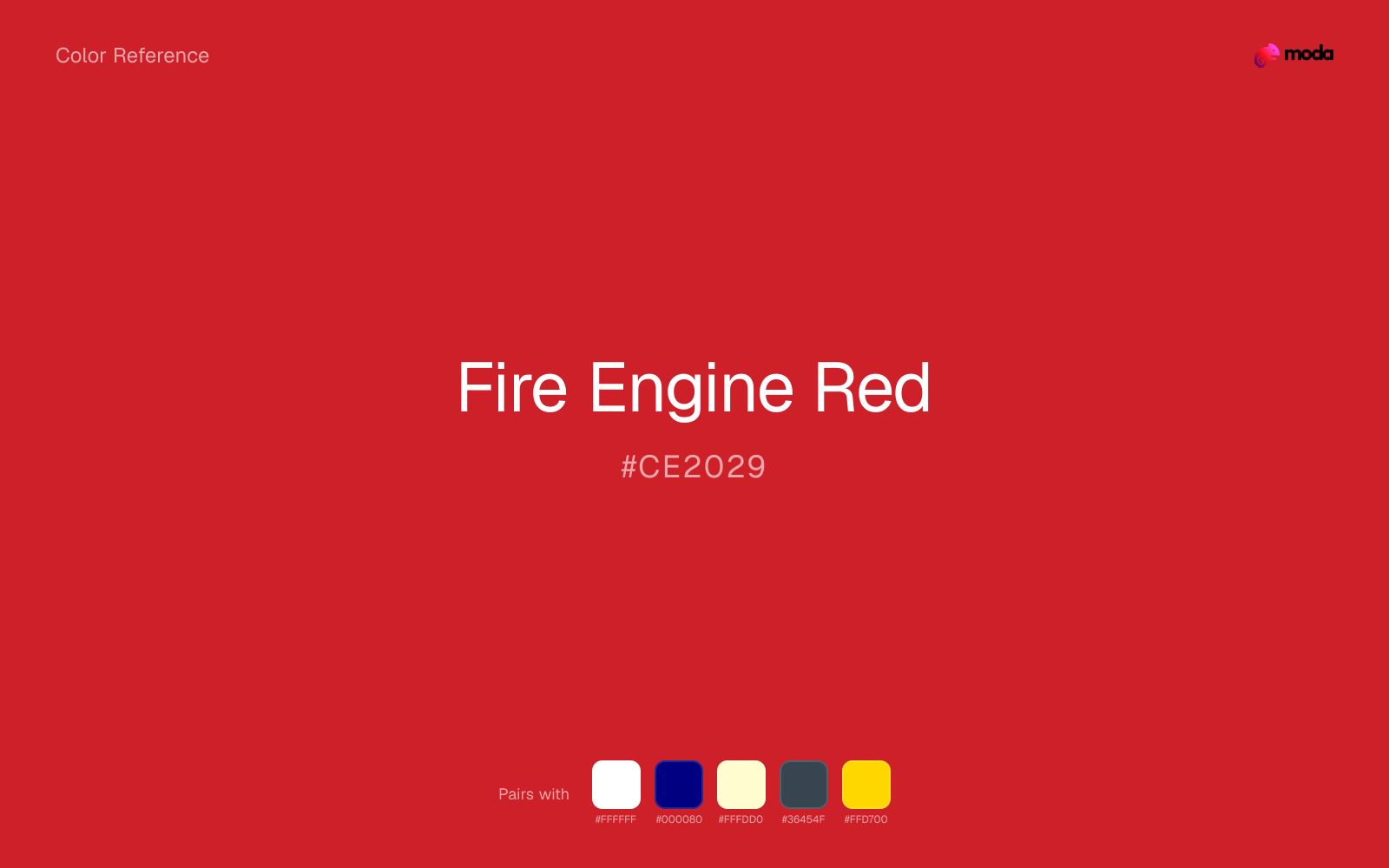
#CE2029
RGB
206, 32, 41
HSL
357°, 73%, 47%
HSV
357°, 84%, 81%
Fire engine red is the red people learn to spot quickly — clean, high-chroma, and built for distance. #CE2029 is a practical safety and equipment color in many public-safety contexts, and it translates well to stickers, helmets, and hardware branding that need instant recognition.
Best for
Corporate branding, executive reports, and enterprise-level web design.
Compare with
Accessibility
Fire Engine Red text on white passes AA at 5.44:1, which makes it usable for headings and short labels.
How does fire engine red compare to nearby colors?
What is the difference between fire engine red and brick red?
Fire Engine Red (#CE2029) and Brick Red (#CB4154) are close enough that the split is more about finish than headline contrast: Fire Engine Red feels more poster-bright, while Brick Red reads more ripe and polished. The practical difference is not raw contrast so much as project fit: Fire Engine Red reads more naturally in retail, sports, and high-urgency graphics, while Brick Red fits more easily into brand accents and editorial emphasis. Begin with fire engine red when the family needs its current undertone and surface character; keep brick red for the nearby alternative that shifts the mood without leaving the same hue neighborhood.
What color is fire engine red?
Fire apparatus in many countries use highly visible reds for conspicuity. The phrase "fire engine red" is common in consumer language for that classic emergency-vehicle hue.
What is the hex code for fire engine red?
| Format | Value |
|---|---|
| HEX | #CE2029 |
| RGB | rgb(206, 32, 41) |
| HSL | hsl(357°, 73%, 47%) |
| HSV / HSB | hsv(357°, 84%, 81%) |
| CMYK (approx.) | cmyk(0%, 84%, 80%, 19%) |
Convert Fire Engine Red to other color formats
Open the color converter with Fire Engine Red (#CE2029) prefilled to copy RGB, HSL, HSV, CMYK, or OKLCH values.
Convert Fire Engine Red in the color converter →What does fire engine red mean in design?
This red is often associated with rescue, danger, and stop-now attention — useful when clarity matters more than subtlety. It tends to read more standardized and authoritative than cherry or ruby fashion reds, and less orange than scarlet.
How do I use fire engine red in code?
| CSS (hex) | color: #CE2029; |
| CSS (rgb) | color: rgb(206, 32, 41); |
| CSS (hsl) | color: hsl(357, 73%, 47%); |
| RGB % | rgb(81%, 13%, 16%) |
| Tailwind | text-[#CE2029] |
| SwiftUI | Color(red: 0.808, green: 0.125, blue: 0.161) |
| UIKit | UIColor(red: 0.808, green: 0.125, blue: 0.161, alpha: 1.0) |
| Android | Color.rgb(206, 32, 41) |
| Compose | Color(0xFFCE2029) |
| Web Safe | #CC3333 |
Is fire engine red accessible?
| Combination | Ratio | AA | AA lg | AAA | AAA lg | UI |
|---|---|---|---|---|---|---|
| AaWhite text on this color | 5.44:1 | ✓ | ✓ | ✗ | ✓ | ✓ |
| AaBlack text on this color | 3.86:1 | ✗ | ✓ | ✗ | ✗ | ✓ |
| AaThis color as text on white | 5.44:1 | ✓ | ✓ | ✗ | ✓ | ✓ |
| AaThis color as text on black | 3.86:1 | ✗ | ✓ | ✗ | ✗ | ✓ |
WCAG 2.1: AA normal ≥ 4.5:1, AA large text ≥ 3:1, AAA normal ≥ 7:1, AAA large ≥ 4.5:1, UI components ≥ 3:1.
How does fire engine red look with color blindness?
Simulated appearance for common types of color vision deficiency. Actual perception varies by individual.
What colors go with fire engine red
With a bright color like fire engine red, white acts like clean paper around the swatch and prevents the palette from feeling packed too tightly.
Beside fire engine red, navy blue supplies structure that keeps the palette from drifting into event-poster or promotional red territory.
With a vivid fire engine red, cream is gentler than white, so the palette keeps warmth and avoids looking overlit.
What colors clash with fire engine red
Neon Green competes with fire engine red so aggressively that the palette never really settles into a clear primary-secondary relationship.
Magenta remaps fire engine red too aggressively, dragging it away from retail, sports, and high-urgency graphics and into a brighter, more performative palette.
Cyan can make fire engine red feel more software-default than designed, especially when the rest of the palette is trying to hold onto material nuance.
Pastel Pink can undercut fire engine red's authority by turning the combination more decorative than decisive.
How should I use fire engine red in design?
- •Fire Engine Red has the saturation to lead a brand palette — strong enough for buttons, headers, and packaging without drifting into pastel or dark territory.
- •Pair fire engine red with cool accents (navy, sage, steel blue) for sharp contrast, or keep it with other warm tones (cream, gold, tan) for a cohesive, editorial feel.
- •Fire Engine Red works in sales materials, alert UI, and anywhere that calls for confident energy — balance it with neutral space so the emphasis stays focused.
What are good fire engine red palettes?
Noir refinement
Corporate branding, executive reports, and enterprise-level web design.
Design with fire engine red in Moda
Create a presentation or document using fire engine red as your accent color. Moda's AI applies your color palette automatically.
Create a design with fire engine red →What are the shades and tints of fire engine red?
Shades (darker)
Tints (lighter)
Tones (desaturated)
Hue variations
What are the color harmonies for fire engine red?
Harmonies are calculated from the base swatch. When a harmony matches a named color page, it links there; otherwise it appears here as a computed reference swatch.
Similar colors
Cardinal
Cardinal is near enough to fire engine red to swap into the same palette, yet the undertone shift still decides whether the family reads warmer or cooler overall.
Crimson
Crimson is nearly adjacent to fire engine red in hue; what separates them is intensity, with crimson reading cleaner and more assertive.
Vermillion
Vermillion is almost the same hue as fire engine red; the real difference is value, with vermillion feeling more open and surface-friendly.
Brick Red
Brick Red stays very close to fire engine red in hue, but it lands lighter, which makes it better for backgrounds, tints, and softer supporting areas than for accents, stronger hierarchy, and firmer structure.
Red
Red is nearly adjacent to fire engine red in hue; what separates them is intensity, with red reading cleaner and more assertive.
Frequently asked questions
What is the hex code for fire engine red?
The hex code for fire engine red is #CE2029. In RGB, that's 206 red, 32 green, and 41 blue. The approximate CMYK equivalent is 0% cyan, 84% magenta, 80% yellow, and 19% key (black).
Is fire engine red a warm or cool color?
Fire Engine Red reads as warm. It feels most natural with creams, golds, rusts, and other warm accents, while cooler partners like navy or teal create sharper contrast.
Is fire engine red better as an accent or a full-palette color?
Fire Engine Red is usually best when it leads in short bursts rather than covering everything. It can headline a palette, but most layouts work better when the color handles accents, highlights, or one main hero role instead of every surface.
How should I use fire engine red in a design?
Fire Engine Red is versatile enough for headlines, accent bars, buttons, charts, or section backgrounds depending on the contrast around it. It works as either a primary or supporting color in decks, documents, and brand systems.
Can I use fire engine red for text or backgrounds?
Fire Engine Red can work as text on white at 5.44:1 contrast, but it is usually safest in headings, labels, and accent moments rather than long body copy.
More red colors
Keep exploring color resources
All color pages
Browse the full library of color references, pairings, and palettes.
Red colors
Compare fire engine red with other red tones.
Brown colors
Explore nearby color families to build stronger palettes and contrasts.
Neutral colors
Explore nearby color families to build stronger palettes and contrasts.
Orange colors
Explore nearby color families to build stronger palettes and contrasts.
Last updated April 6, 2026
Color values are computed from the listed hex code using standard conversion formulas. RGB, HSL, and HSV are exact screen-ready conversions. CMYK is an approximate on-screen reference, not a press-ready print specification. Pairings, palettes, and use-case guidance are heuristic recommendations derived from color relationships, contrast behavior, and common presentation, document, and UI patterns.