Champagne Gold color guide
HEX
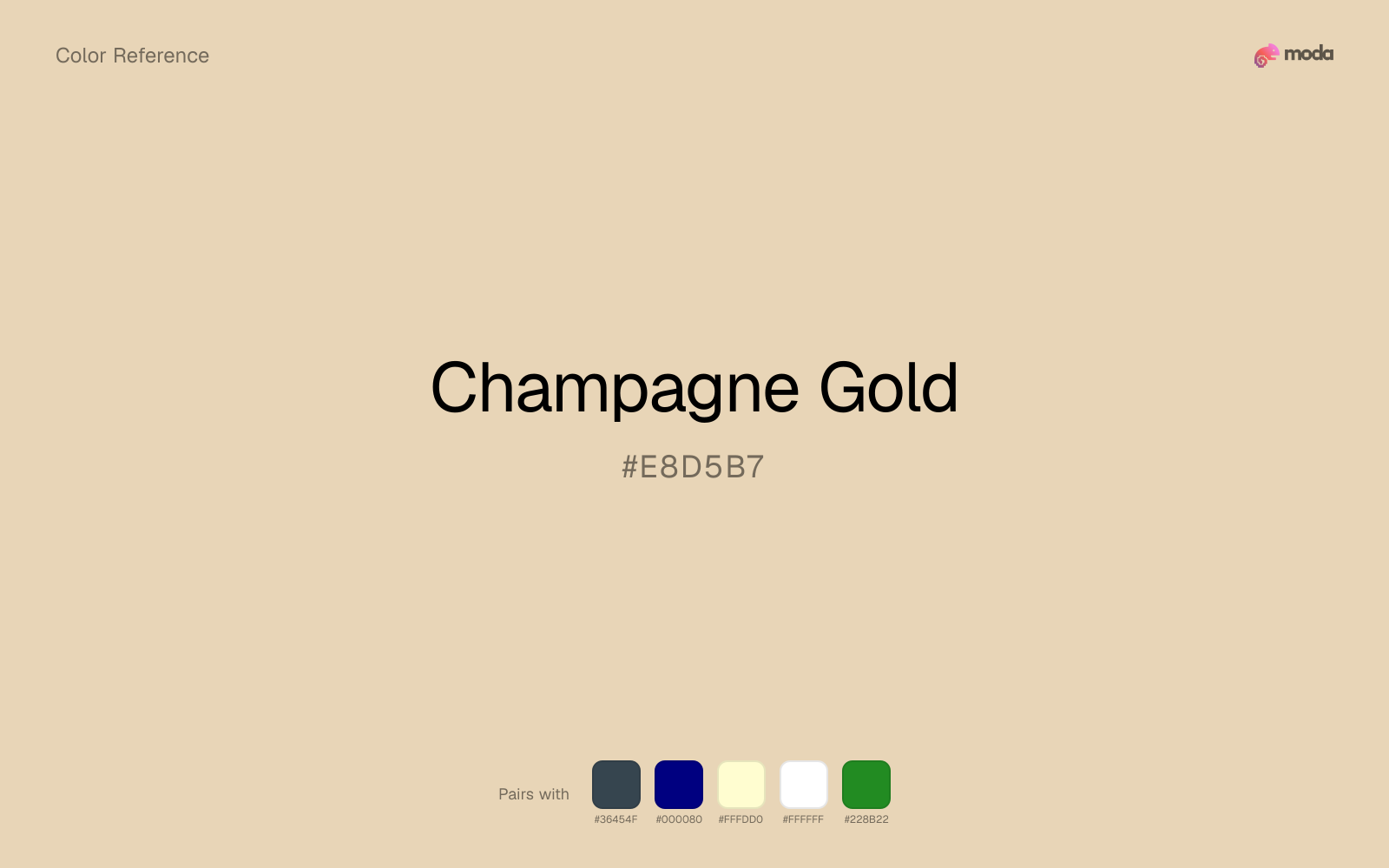
#E8D5B7
RGB
232, 213, 183
HSL
37°, 52%, 81%
HSV
37°, 21%, 91%
Bubbles and silk linings — gold diluted by ivory light. #D4C5A9 glimmers politely, never shouting across a room. In packaging and weddings, it reads as refined festivity rather than vault-door wealth.
Best for
Marketing websites, social media graphics, and campaign landing pages.
Compare with
Accessibility
Check contrast before using champagne gold for text-heavy layouts, especially on low-contrast backgrounds.
How does champagne gold compare to nearby colors?
What is the difference between champagne gold and champagne?
Champagne Gold (#E8D5B7) feels more softened on screen, while Champagne (#F7E7CE) pushes the family in the opposite direction. Champagne Gold makes the palette feel denser and more anchored, while Champagne keeps more daylight in the composition. Choose champagne gold when the surrounding system aligns better with premium packaging and celebratory branding, and move to champagne when the stronger contextual fit is inviting editorial surfaces.
What color is champagne gold?
"Champagne gold" is a frequent descriptor in cosmetics, jewelry plating, consumer electronics finishes, and event design.
What is the hex code for champagne gold?
| Format | Value |
|---|---|
| HEX | #E8D5B7 |
| RGB | rgb(232, 213, 183) |
| HSL | hsl(37°, 52%, 81%) |
| HSV / HSB | hsv(37°, 21%, 91%) |
| CMYK (approx.) | cmyk(0%, 8%, 21%, 9%) |
Convert Champagne Gold to other color formats
Open the color converter with Champagne Gold (#E8D5B7) prefilled to copy RGB, HSL, HSV, CMYK, or OKLCH values.
Convert Champagne Gold in the color converter →What does champagne gold mean in design?
Champagne gold is often associated with understated celebration, romance, and quiet affluence. It reads as paler and more beige-rose than gold metallic, and warmer than platinum or silver metallic.
How do I use champagne gold in code?
| CSS (hex) | color: #E8D5B7; |
| CSS (rgb) | color: rgb(232, 213, 183); |
| CSS (hsl) | color: hsl(37, 52%, 81%); |
| RGB % | rgb(91%, 84%, 72%) |
| Tailwind | text-[#E8D5B7] |
| SwiftUI | Color(red: 0.910, green: 0.835, blue: 0.718) |
| UIKit | UIColor(red: 0.910, green: 0.835, blue: 0.718, alpha: 1.0) |
| Android | Color.rgb(232, 213, 183) |
| Compose | Color(0xFFE8D5B7) |
| Web Safe | #FFCCCC |
Is champagne gold accessible?
| Combination | Ratio | AA | AA lg | AAA | AAA lg | UI |
|---|---|---|---|---|---|---|
| AaWhite text on this color | 1.44:1 | ✗ | ✗ | ✗ | ✗ | ✗ |
| AaBlack text on this color | 14.63:1 | ✓ | ✓ | ✓ | ✓ | ✓ |
| AaThis color as text on white | 1.44:1 | ✗ | ✗ | ✗ | ✗ | ✗ |
| AaThis color as text on black | 14.63:1 | ✓ | ✓ | ✓ | ✓ | ✓ |
WCAG 2.1: AA normal ≥ 4.5:1, AA large text ≥ 3:1, AAA normal ≥ 7:1, AAA large ≥ 4.5:1, UI components ≥ 3:1.
How does champagne gold look with color blindness?
Simulated appearance for common types of color vision deficiency. Actual perception varies by individual.
What colors go with champagne gold
Charcoal gives champagne gold the dark frame it is missing, so pale surfaces do not drift into a washed-out page.
Navy blue reins in champagne gold without deadening it, which is useful when you want warmth to stay present but not dominate every part of the page.
Cream gives champagne gold a quieter backdrop and preserves a more natural editorial feel than a colder off-white would.
Pairing champagne gold with white keeps the layout open and lets the color's orange-warm cast stay easy to read.
Forest Green sits far enough away from champagne gold in lightness that the pair reads cleanly at presentation distance instead of collapsing into one band.
What colors clash with champagne gold
Neon Green competes with champagne gold so aggressively that the palette never really settles into a clear primary-secondary relationship.
With champagne gold, magenta introduces a second emotional story instead of reinforcing the first one, so the palette can feel internally split.
With champagne gold, cyan introduces a colder display-driven cast that strips away some of the source color's tactile character.
Light Gray sits too close to champagne gold in value, so the palette can wash out before it ever establishes a clear hierarchy.
How should I use champagne gold in design?
- •Use champagne gold for soft backgrounds and supporting surfaces rather than foreground text — it creates a gentle atmosphere while keeping the layout open and readable.
- •Pair champagne gold with cool accents (navy, sage, steel blue) for sharp contrast, or keep it with other warm tones (cream, gold, tan) for a cohesive, editorial feel.
- •Light tones like champagne gold work best for card backgrounds, section tints, and gentle emphasis — they add color without competing with the content.
What are good champagne gold palettes?
Daylight
Marketing websites, social media graphics, and campaign landing pages.
Warm hearth
Brand guidelines, design systems, and visual identity documents.
Design with champagne gold in Moda
Create a presentation or document using champagne gold as your accent color. Moda's AI applies your color palette automatically.
Create a design with champagne gold →What are the shades and tints of champagne gold?
Shades (darker)
Tints (lighter)
Tones (desaturated)
Hue variations
What are the color harmonies for champagne gold?
Harmonies are calculated from the base swatch. When a harmony matches a named color page, it links there; otherwise it appears here as a computed reference swatch.
Similar colors
Champagne
Champagne is almost the same hue as champagne gold; the real difference is value, with champagne feeling more open and surface-friendly.
Caramel
Caramel sits close to champagne gold on the wheel, but it carries more pigment pressure, which makes it better for faster emphasis and brighter accent work than for broader coverage and quieter supporting roles.
Platinum
Platinum is almost the same hue as champagne gold; the real difference is value, with platinum feeling more open and surface-friendly.
Tan
Tan tracks close to champagne gold in hue, but the value shift changes where each one earns its place: tan is easier to use for headlines, anchors, and darker sections, while champagne gold holds onto lighter surfaces and more open applications.
Khaki
Khaki is close enough to champagne gold to keep the palette cohesive, yet the lighter-darker shift still decides whether the family behaves more like atmosphere or more like structure.
Frequently asked questions
What is the hex code for champagne gold?
The hex code for champagne gold is #E8D5B7. In RGB, that's 232 red, 213 green, and 183 blue. The approximate CMYK equivalent is 0% cyan, 8% magenta, 21% yellow, and 9% key (black).
Is champagne gold a warm or cool color?
Champagne Gold sits on the warm side of the palette, so it pairs easily with other warm tones and becomes more energetic when you place it against cooler blues or blue-grays.
Is champagne gold better for accents, structure, or surfaces?
Champagne Gold sits in the usable middle: strong enough to anchor a section or call attention to a key moment, but calm enough to support a broader system when the surrounding values are well managed.
Where does champagne gold work best in a layout?
Champagne Gold is very light, so it works best as a background, card fill, or table tint in slides, documents, and landing pages. Pair it with dark text such as charcoal or navy for readability.
Is champagne gold accessible?
Champagne Gold works better with dark text than white text. Black text reaches 14.63:1 contrast on the swatch, which makes the color more usable as a background or highlight surface than as a dark panel.
More metallic colors
See all metallic colors →Keep exploring color resources
All color pages
Browse the full library of color references, pairings, and palettes.
Metallic colors
Compare champagne gold with other metallic tones.
Brown colors
Explore nearby color families to build stronger palettes and contrasts.
Neutral colors
Explore nearby color families to build stronger palettes and contrasts.
Orange colors
Explore nearby color families to build stronger palettes and contrasts.
Last updated April 6, 2026
Color values are computed from the listed hex code using standard conversion formulas. RGB, HSL, and HSV are exact screen-ready conversions. CMYK is an approximate on-screen reference, not a press-ready print specification. Pairings, palettes, and use-case guidance are heuristic recommendations derived from color relationships, contrast behavior, and common presentation, document, and UI patterns.