Deep Purple contrast and palette guide
HEX
#36013F
RGB
54, 1, 63
HSL
291°, 97%, 13%
HSV
291°, 98%, 25%
This is purple pressed toward black — velvet curtain, unlit theater, ink still wet. #301934 loses detail into silhouette, so it works best with careful contrast for text and icons. It can feel more mysterious than dark blue because the red undertone warms the void.
Best for
Financial services branding and client-facing digital experiences.
Compare with
Accessibility
White text on deep purple passes AAA at 17.03:1, so it is safe for dark backgrounds and section headers.
How does deep purple compare to nearby colors?
What is the difference between deep purple and indigo?
Deep Purple (#36013F) and Indigo (#4B0082) may look neighboring at first glance, yet their surface character diverges once they sit next to whites, charcoals, and other real layout neutrals. Deep Purple is the one that can carry a full dark section without blinking; Indigo is more often the accent or companion swatch. Reach for deep purple when metals, paper tones, or photography around it need a warmer partner; use indigo when the surrounding system reads better cooler.
What color is deep purple?
Appears in luxury packaging, gothic fashion, cinema marketing, and high-contrast dark modes when designers want warmth in near-black.
What is the hex code for deep purple?
| Format | Value |
|---|---|
| HEX | #36013F |
| RGB | rgb(54, 1, 63) |
| HSL | hsl(291°, 97%, 13%) |
| HSV / HSB | hsv(291°, 98%, 25%) |
| CMYK (approx.) | cmyk(14%, 98%, 0%, 75%) |
Convert Deep Purple to other color formats
Open the color converter with Deep Purple (#36013F) prefilled to copy RGB, HSL, HSV, CMYK, or OKLCH values.
Convert Deep Purple in the color converter →What does deep purple mean in design?
Deep purple is often associated with secrecy, grandeur, and emotional intensity. Next to eggplant, deep purple tends to read cooler and more nocturnal; next to grape, it feels recessed and solemn.
How do I use deep purple in code?
| CSS (hex) | color: #36013F; |
| CSS (rgb) | color: rgb(54, 1, 63); |
| CSS (hsl) | color: hsl(291, 97%, 13%); |
| RGB % | rgb(21%, 0%, 25%) |
| Tailwind | text-[#36013F] |
| SwiftUI | Color(red: 0.212, green: 0.004, blue: 0.247) |
| UIKit | UIColor(red: 0.212, green: 0.004, blue: 0.247, alpha: 1.0) |
| Android | Color.rgb(54, 1, 63) |
| Compose | Color(0xFF36013F) |
| Web Safe | #330033 |
Is deep purple accessible?
| Combination | Ratio | AA | AA lg | AAA | AAA lg | UI |
|---|---|---|---|---|---|---|
| AaWhite text on this color | 17.03:1 | ✓ | ✓ | ✓ | ✓ | ✓ |
| AaBlack text on this color | 1.23:1 | ✗ | ✗ | ✗ | ✗ | ✗ |
| AaThis color as text on white | 17.03:1 | ✓ | ✓ | ✓ | ✓ | ✓ |
| AaThis color as text on black | 1.23:1 | ✗ | ✗ | ✗ | ✗ | ✗ |
WCAG 2.1: AA normal ≥ 4.5:1, AA large text ≥ 3:1, AAA normal ≥ 7:1, AAA large ≥ 4.5:1, UI components ≥ 3:1.
How does deep purple look with color blindness?
Simulated appearance for common types of color vision deficiency. Actual perception varies by individual.
What colors go with deep purple
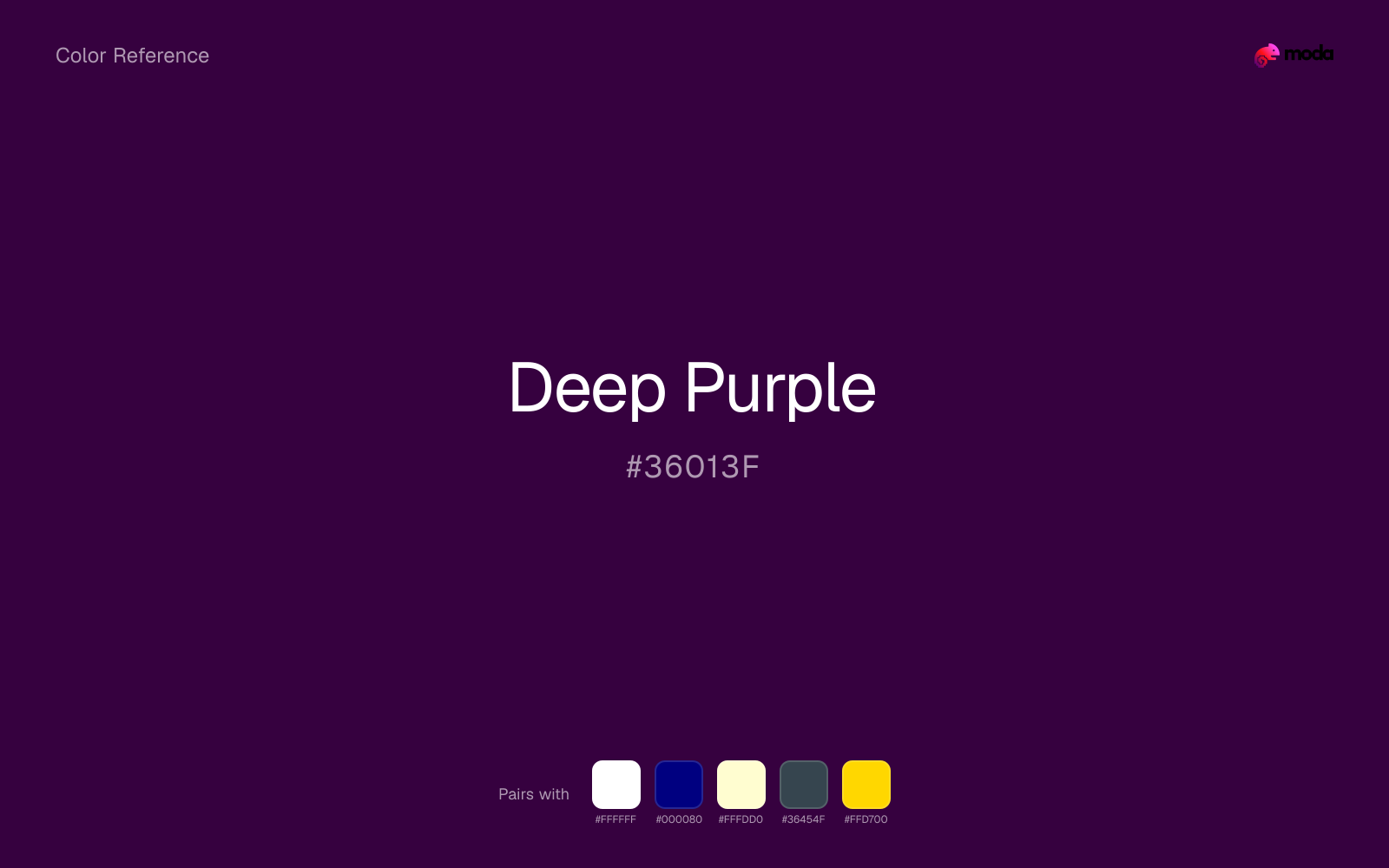
White gives deep purple the clean edge contrast it needs, so dark panels, labels, and type stay readable instead of sinking into the color.
Because deep purple already carries warmth, navy blue gives the pair a steadier backbone and keeps it closer to premium editorial work than to one-note seasonal color.
With a vivid deep purple, cream is gentler than white, so the palette keeps warmth and avoids looking overlit.
What colors clash with deep purple
With deep purple, Neon Green pulls the palette toward LED signage and away from the inked velvet quality that makes the source color usable.
Magenta remaps deep purple too aggressively, dragging it away from luxury, culture, and dramatic editorial systems and into a brighter, more performative palette.
Cyan redirects deep purple toward a more technical, backlit interpretation, which is risky when the goal is warmth, polish, or print-minded editorial work.
Pastel Pink can undercut deep purple's authority by turning the combination more decorative than decisive.
How should I use deep purple in design?
- •Use deep purple for dark slide backgrounds, hero sections, and premium packaging where you want depth with more character than plain black.
- •Pair deep purple with cool accents (navy, sage, steel blue) for sharp contrast, or keep it with other warm tones (cream, gold, tan) for a cohesive, editorial feel.
- •Deep Purple's depth makes it effective for premium packaging, dark-mode interfaces, and editorial layouts that need gravitas without defaulting to black.
What are good deep purple palettes?
Dark precision
Financial services branding and client-facing digital experiences.
Bare essentials
Brand guidelines, design systems, and visual identity documents.
Design with deep purple in Moda
Create a presentation or document using deep purple as your accent color. Moda's AI applies your color palette automatically.
Create a design with deep purple →What are the shades and tints of deep purple?
Shades (darker)
Tints (lighter)
Tones (desaturated)
Hue variations
What are the color harmonies for deep purple?
Harmonies are calculated from the base swatch. When a harmony matches a named color page, it links there; otherwise it appears here as a computed reference swatch.
Similar colors
Indigo
Indigo is close enough to deep purple to keep the palette cohesive, yet the lighter-darker shift still decides whether the family behaves more like atmosphere or more like structure.
Purple
Purple is close enough to deep purple to keep the palette cohesive, yet the lighter-darker shift still decides whether the family behaves more like atmosphere or more like structure.
Midnight Blue
Midnight Blue turns the same general family toward a different energy level, which matters if the palette should feel punchier, dustier, more cosmetic, or more editorial.
Navy Blue
Navy Blue keeps some overlap with deep purple, but the shift in finish and association is enough to make one feel better suited to this particular layout than the other.
Oxblood
Oxblood is a nearby alternative to deep purple when the palette needs a different undertone or material cue more than a dramatic contrast change.
Frequently asked questions
What is the hex code for deep purple?
The hex code for deep purple is #36013F. In RGB, that's 54 red, 1 green, and 63 blue. The approximate CMYK equivalent is 14% cyan, 98% magenta, 0% yellow, and 75% key (black).
Is deep purple a warm or cool color?
Deep Purple leans warm without feeling fully heat-driven, so you can push it warmer with cream, tan, or gold or balance it with cooler blues and slates.
Is deep purple strong enough for dark panels and covers?
Deep Purple is dark enough to anchor sections, hero blocks, and darker editorial surfaces. It is usually more convincing in that role than in tiny accent-only applications.
Where does deep purple work best in a layout?
Deep Purple is very dark, so it works best for cover slides, hero sections, dark-mode interfaces, and data-heavy dashboards where you want more character than plain black. Use white or cream text for readability.
Is deep purple accessible?
Deep Purple is strong enough for white text at 17.03:1 contrast, so it can handle dark panels, tags, and section headers without much trouble. As text on white, though, it is usually better reserved for larger headings or short accents than for long paragraphs.
More purple colors
Keep exploring color resources
All color pages
Browse the full library of color references, pairings, and palettes.
Purple colors
Compare deep purple with other purple tones.
Blue colors
Explore nearby color families to build stronger palettes and contrasts.
Neutral colors
Explore nearby color families to build stronger palettes and contrasts.
Pink colors
Explore nearby color families to build stronger palettes and contrasts.
Last updated April 6, 2026
Color values are computed from the listed hex code using standard conversion formulas. RGB, HSL, and HSV are exact screen-ready conversions. CMYK is an approximate on-screen reference, not a press-ready print specification. Pairings, palettes, and use-case guidance are heuristic recommendations derived from color relationships, contrast behavior, and common presentation, document, and UI patterns.